
Complete wheelsets to EN 13260:2025, AAR M-101 or TB/T, assembled to drawing
Two wheels, one axle, and no fastener between them - the interference fit carries the whole load
Wheel diameter follows axle load, not the catalogue, and both are fixed by the vehicle drawing
ER7 to ER9 wheels and EA1N to EA4T axles on the European route, AAR Class and Grade on the American
The press curve is the only record of the joint, and it cannot be reconstructed after delivery
Assembly carried out at partner works, with certificate scope stated before the quote
840 to 1250 mm, 12 to 35 tonne axle load, standard and broad gauge
Twelve buyer questions answered
A wheelset is the only part of a rail vehicle where a single component carries the whole vehicle mass, transmits traction and braking, and steers the vehicle through curve and switch. Nothing else on the underframe does all three. That is why the drawing matters more than the part number, and why a set that measures right but was pressed wrong will pass goods-in and fail six months later on the track.
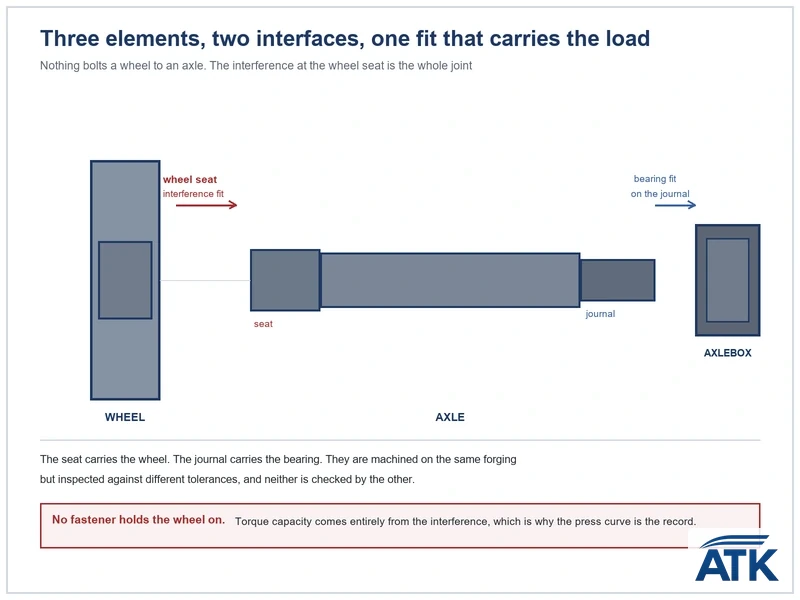
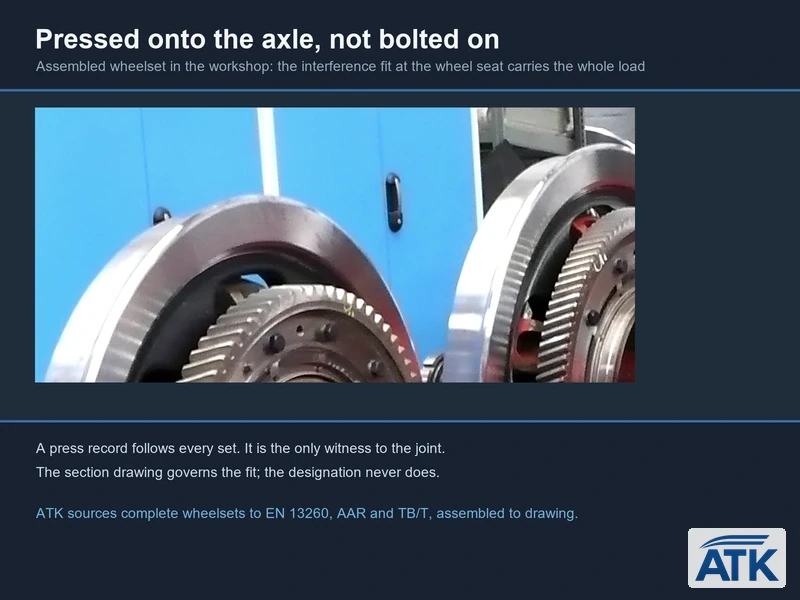
Two wheels, one axle, pressed or shrunk onto the wheel seats at a controlled interference, with the tread profile cut to the same datum. Add axleboxes or bearing journals and the assembly is complete. The finished unit is not a kit of parts and cannot be treated as one, because the fit between wheel and axle is what carries the load. There is no fastener holding a wheel on. Only friction from the interference fit.
That single fact shapes everything downstream. A wheelset is treated as one traceable item through its whole service life, from the press record at assembly to the last reprofiling before scrap. It is scrapped as an item too. A wheel beyond its wear limit takes the whole set out of service even if the axle is sound, and an axle with a fatigue indication condemns wheels that have thousands of kilometres left in them.
In Europe the assembly is governed by EN 13260, in North America by the AAR manuals, in China by the TB/T series. All three treat the wheelset as a product with its own qualification route, separate from the wheels and the axles that go into it. That separation is the part buyers miss. A mill certificate for the wheel and a mill certificate for the axle do not add up to a conforming wheelset, because neither covers what happened in the press shop.
A wheelset assembly has three physical elements and a set of interfaces where tolerances from different standards meet. Most of the failures that arrive at a buyer's inspection desk start at those interfaces, not inside the elements themselves.
Monoblock wheel. One piece of rolled or forged steel, no tyre, no retaining ring. The tread and flange are machined from the same body that carries the hub bore. Two profiles matter: the tread profile itself, and the hub bore that receives the axle seat. Tyred wheels still exist on older locomotives and on some industrial stock, and they are a different product with a different inspection regime.
Axle. Forged and heat treated, with two wheel seats, two bearing journals, and — where the vehicle needs them — seats for brake discs or a traction gear. Solid axles are the norm for freight wagons. Hollow axles are bored from a solid forging and give a useful weight saving, at the cost of a fatigue case that has to be analysed separately.
Axleboxes or bearings. Fitted after assembly or supplied loose, depending on the scope. This is where a wheelset order and a bearing order overlap, and where scope has to be written down before either is quoted. Wheelset bearings are a separate specification with their own tolerance class and clearance, and a wheelset drawing that names a bearing type is not the same document as a bearing drawing.
Interface | What meets what | Why it fails at goods-in |
Wheel seat | Axle seat diameter against hub bore | Interference calculated on nominal diameters, not on measured ones |
Bearing journal | Journal diameter and shoulder fillet against bearing bore | Fillet radius from a different drawing revision |
Back-to-back | Wheel spacing across the axle | Set by press position, not by the machining of either part |
Tread datum | Profile cut relative to the axle centreline | Reprofiling after assembly without re-datuming |
The wheel seat is the interface that decides whether the assembly holds. Interference is stated as a proportion of the seat diameter, so a small change in measured seat diameter moves the fit into a different band. A seat turned to the top of its tolerance and a bore machined to the bottom of its tolerance can both be individually acceptable and still produce an interference outside the permitted range.
Type selection starts from the vehicle, not from the catalogue. Four inputs fix almost everything that follows.
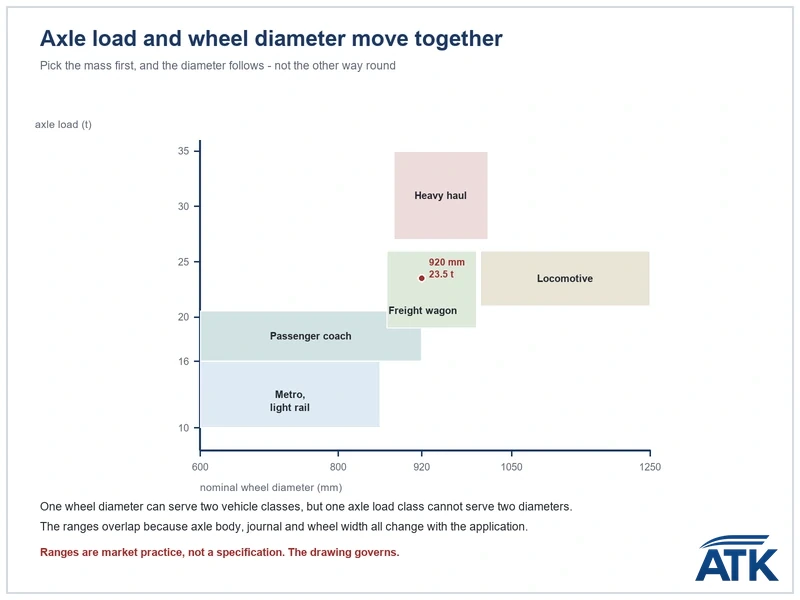
Axle load and speed set the wheel diameter and the strength class of the axle. A 25 t axle on a 920 mm wheel and a 25 t axle on an 840 mm wheel are different assemblies with different axle bodies, even though both carry the same mass.
Track gauge sets the back-to-back dimension and the wheel width. Standard gauge wheels cannot be moved onto a 1,520 mm axle by adjusting the press position, because the axle body length changes with it.
Bearing arrangement decides whether the journals are outboard of the wheels, inboard, or eliminated entirely in favour of a compact unit. Inboard-bearing wheelsets are common on metros and low-floor vehicles, and the interface drawing for one is not interchangeable with an outboard design.
Driven or trailing decides whether the axle carries a gear seat and whether the wheels need a different hub. A powered wheelset from a locomotive is a different product from a trailing wheelset of the same diameter, and mixing the two in one enquiry is a common source of wrong quotes.
Vehicle | Typical wheel diameter | Typical axle load | Usual standard |
Freight wagon, standard gauge | 920 mm new, 840 mm worn limit | 20–25 t | EN 13260 or AAR |
Freight wagon, heavy haul | 915–1,016 mm | 30–35 t | AAR |
Passenger coach | 860–920 mm | 16–20 t | EN 13260 |
Locomotive | 1,050–1,250 mm | 22–25 t | EN 13260 or AAR |
Metro and light rail | 600–860 mm | 12–16 t | EN 13260, project spec |
Industrial and mine | 400–600 mm | 5–20 t | Project drawing |
Those diameters are ranges seen across the market, not a specification. The number that binds is the one on the drawing and in the standard edition the drawing cites. A vehicle type approved at 920 mm cannot be supplied at 860 mm without a design change, even if the axle load would allow it.
Six dimensions decide whether two wheelsets are interchangeable. They come from three different sources and are frequently quoted from the wrong one.
Dimension | What it controls | Where it is fixed |
Nominal wheel diameter | Tread speed, brake thermal capacity, clearance under the frame | Vehicle design, then standard |
Worn wheel diameter | When the set must be replaced rather than reprofiled | Standard or operator rule |
Back-to-back spacing | Guidance through switch and crossing | Gauge standard |
Wheel seat diameter | Interference, and therefore torque capacity | Axle drawing |
Journal diameter and length | Bearing fit and axial location | Bearing and axle drawings together |
Overall axle length | Fits between the bogie side frames | Bogie drawing |
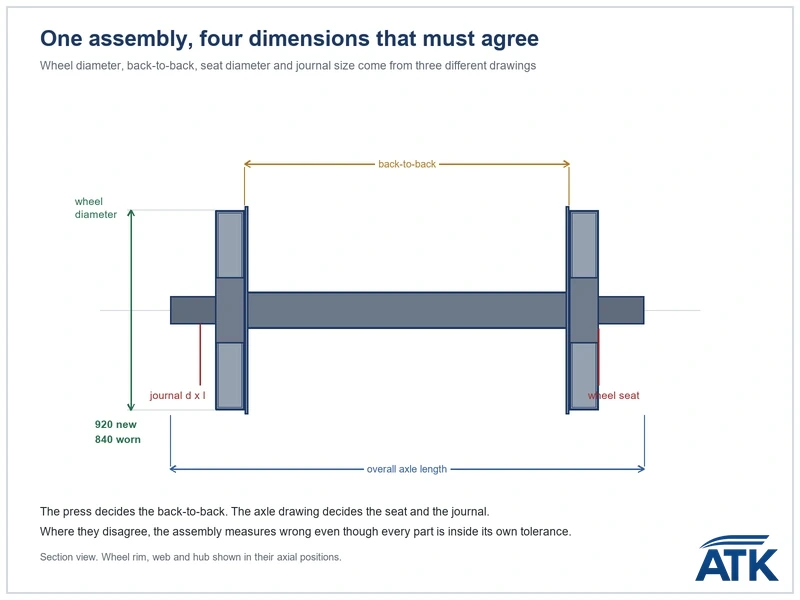
For a standard-gauge 920 mm freight wheelset built to EN 13260, a typical configuration runs as follows. Wheel diameter is 920 mm new, with a worn limit at 840 mm, and rim width is around 135 mm. The wheel seat is approximately 200 mm nominal, and back-to-back spacing is set at 1,360 mm inside a 1 mm band. The journal measures 130 mm by 191 mm, the axle body around 173 mm, and the overall length sits near 2,180 mm. Assembled mass lands close to one tonne.
Those figures describe a well-known combination, nothing more. They are catalogue values and they are not a substitute for the drawing. Where the drawing and this paragraph disagree, the drawing governs, and where the drawing is silent, the standard edition governs.
The tolerance on back-to-back spacing deserves a note of its own. It is a pressed-in dimension, set by where the wheel stops on the seat, not by the machining of either component. A set that measures 1,361 mm on one side and 1,359 mm on the other can pass a diameter check and still be out of the band, because the band is on the finished assembly.
Wheels and axles are different steels doing different jobs, and the grade families are not interchangeable across standards even where the numbers look similar.
Standard | Wheel grades | Axle grades | Condition |
EN 13262 | ER6, ER7, ER8, ERS8, ER9 | — | Rolled or forged, heat treated per grade |
EN 13261 | — | EA1N, EA1T, EA4T | Normalised, quenched and tempered, higher-alloy Q&T |
AAR M-107 / M-208 | Class L, A, B, C, D | — | Class B and C most common on freight |
AAR M-101 | — | Grade F, G, H | F normalised, G and H quenched and tempered |
TB/T series | Rolled solid wheel grades per vehicle type | Locomotive and vehicle axle grades per type | Per product standard and drawing |
ER7 is the workhorse for freight wheels in Europe and appears on a large share of standard-gauge wagons. ER8 and ER9 are used where tread hardness needs to be higher, typically higher-speed passenger work. ERS8 is the newer variant developed for resistance to rolling contact fatigue, and it sits alongside ER8 rather than replacing it. On the American side the AAR series runs from Class L through D. Class L carries a lower carbon content for high-speed service with severe braking; Class B and C dominate freight work, with D reserved for low-speed, high-load duty. On the axle side, EA1N covers most trailing axles; EA4T is chosen for higher strength and for driven axles where the section is more heavily loaded.
Two facts about these grades are worth carrying into an enquiry. First, the grade letter does not describe hardness. It describes a chemistry and heat-treatment route, with hardness following from it. Second, the grade is only half the requirement. Cleanliness, forging reduction ratio, and the position of test samples are specified separately, and a certificate that gives chemistry alone has not answered the question.
Vacuum degassing is not optional in the European axle grades. It is part of what EA1N, EA1T and EA4T mean, and it is one of the reasons an axle is not simply a bar of medium-carbon steel turned to shape.
The three families agree on physics and disagree on paperwork. That difference is where most cross-market problems begin.
Europe | North America | China | |
Wheelset standard | EN 13260 | AAR Manual, Section G | TB/T 1718 series |
Wheel standard | EN 13262 | AAR M-107 / M-208 | Vehicle-type wheel standard |
Axle standard | EN 13261 | AAR M-101 | TB/T 1027 series, vehicle-type standards |
Profile | EN 13715 | AAR contour | TB profile per vehicle type |
Quality system | EN 13260 Annex D qualification | AAR M-1003 | Manufacturer licence and product certification |
Who approves | Notified body for EC verification | AAR, by service item | Product certification against TB/T |
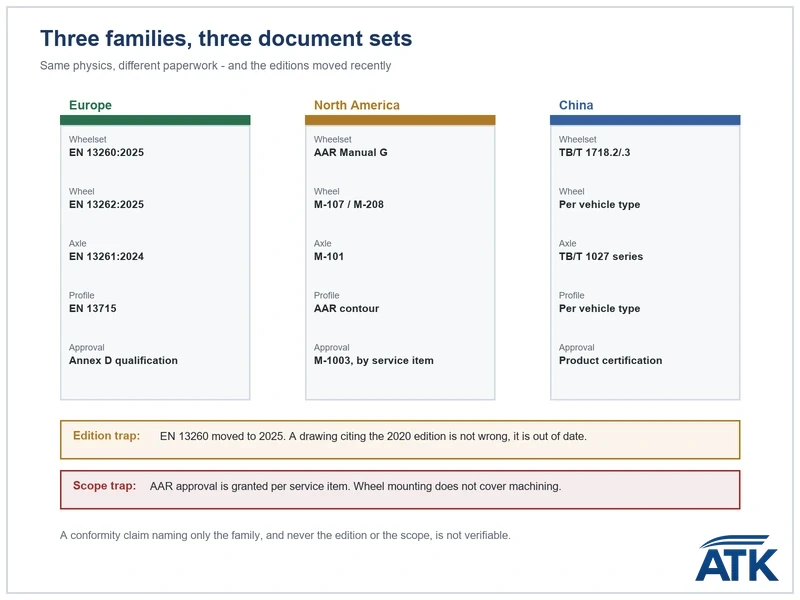
The edition trap. EN 13260 was revised in 2025, superseding the 2020 edition, and the new text points at EN 13261:2024 for axles and EN 13262:2025 for wheels. A drawing that cites EN 13260:2020 and a supplier working to the 2025 edition are not in conflict on the physics, but they are on the document set. The 2025 revision tightened wording on dynamic imbalance and fatigue testing, clarified the qualification conditions in the annex, and refined what counts as an permitted rework after assembly. A specification written two years ago will not mention any of that.
The practical rule: name the edition on the enquiry, and accept that the answer may be "that edition is withdrawn, here is what changed". A supplier who says nothing about the edition has not read the drawing carefully.
The AAR approval trap. AAR approval is granted by service item, not to a company in general. A works approved for wheel mounting is approved for wheel mounting, with its own scope reference. An approval covering a machining operation does not cover assembly. When a supplier says "AAR approved", the question that resolves it is which service item, and the certificate answers it in one line.
Two methods, one record, and no way to inspect the result after the fact. That last point is what makes this section the one to read before approving a supplier.
Press fitting. The wheel is pushed onto the seat with a hydraulic press while force and displacement are logged continuously. Interference is specified as a proportion of the nominal seat diameter, with an added allowance, and the press curve is the evidence that the fit landed inside the band.
Shrink fitting. The wheel is heated, slipped onto the seat, and allowed to contract. Heating is capped — the limit is there to avoid changing the heat treatment of the wheel — and interference is specified slightly wider than for press fitting. No press curve exists, so the evidence is temperature and dimensional records instead.
Parameter | Press fitting | Shrink fitting |
Interference, as a function of seat diameter D | 0.0010 D to 0.0015 D plus an allowance | 0.0009 D to 0.0015 D |
Wheel heating | Not applicable | Capped, typically 250 °C or below |
Assembly record | Force–displacement curve, one point per millimetre | Temperature and dimension records |
Force measurement accuracy | Around ±10 kN | Not applicable |
Acceptance window on final force | Roughly 0.85 to 1.45 times the nominal force | Not applicable |
The curve is not a formality. It is the only witness to the fit, and reading it is a skill in itself.
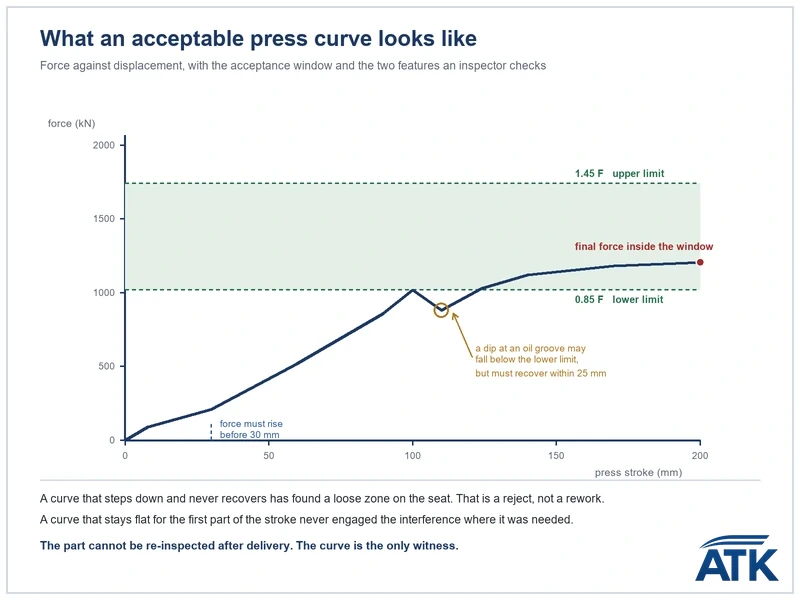
Three features of an acceptable curve are worth knowing, because they are what an inspector looks for.
The force has to start rising before the wheel has travelled far onto the seat. A curve that stays flat for the first part of the stroke means the interference is not engaging where it should, and the fit will not hold torque.
The force has to keep rising through the stroke rather than step down and recover. A dip is permitted at an oil groove, where lubricant relieves pressure briefly, but the force has to return to its previous maximum within a short distance. A curve that never recovers has found a loose zone on the seat.
The final force has to land inside the window for that seat diameter. Too low means insufficient interference; too high means the seat is over-size or the bore under-size, and the wheel may already be yielding at the hub.
After assembly the set has to survive an axial proof load applied for a fixed hold time without any relative movement between wheel and axle. That test is a check on the whole joint, and it catches the case where the curve looked acceptable but the interference was distributed badly along the seat.
A buyer cannot verify any of this from the delivered part. The evidence is the curve, and the curve has to travel with the wheelset. Ask for it by serial number, not as a batch summary.
Inspection on a wheelset falls into three layers, and certificates often cover only the easiest one.
Layer | What is checked | Evidence |
Material | Chemistry, mechanical properties, cleanliness, grain structure | Mill certificate plus test report per heat |
Component | Ultrasonic and magnetic particle testing of axle and wheel, hardness, dimensions | NDT reports with operator certification level |
Assembly | Press curve, back-to-back, run-out, imbalance, electrical resistance, proof load | Per-piece record, serialised |
The assembly layer is the one that separates a real wheelset supplier from a parts trader. Its content is fixed by the wheelset standard rather than left to the supplier, and it is applied to every unit rather than sampled.
For a European order, the per-piece checks include the press curve, the key dimensions of the finished assembly, and — for shrink-fitted sets — a check on the residual grip. Optional additions such as extra dimensional control or ultrasonic inspection are agreed in the technical specification. There is also a defined list of permitted rework: correcting geometry by machining, balancing, dismantling and refitting, and metal spraying. Anything outside that list means the set does not ship.
Dynamic balance and run-out are worth separating, because they fail for different reasons. Imbalance comes from mass distribution and is corrected by balancing. Run-out comes from geometry and is not corrected by balancing at all. A wheelset can be perfectly balanced and still have an eccentric tread.
Bearing mounting is a separate operation with its own approval, and it is often bundled into a wheelset order without being named. Where bearings are fitted by the works rather than supplied loose, the bearing press is a different machine from the wheel press, the press records are separate, and the running-in check after mounting is a third step. A wheelset bearing running-in test bench exists for exactly this case. A bearing that was pressed correctly can still run hot. Temperature and vibration at low speed are the last chance to catch it before the vehicle does.
Electrical resistance across the two treads is measured on every set intended for track circuits. A set that fails it will not be rejected by the vehicle — it will simply fail to shunt, and the signalling will read the section as clear when it is occupied. It is the one acceptance criterion on a wheelset whose failure mode is invisible to the operator and dangerous to everyone else.
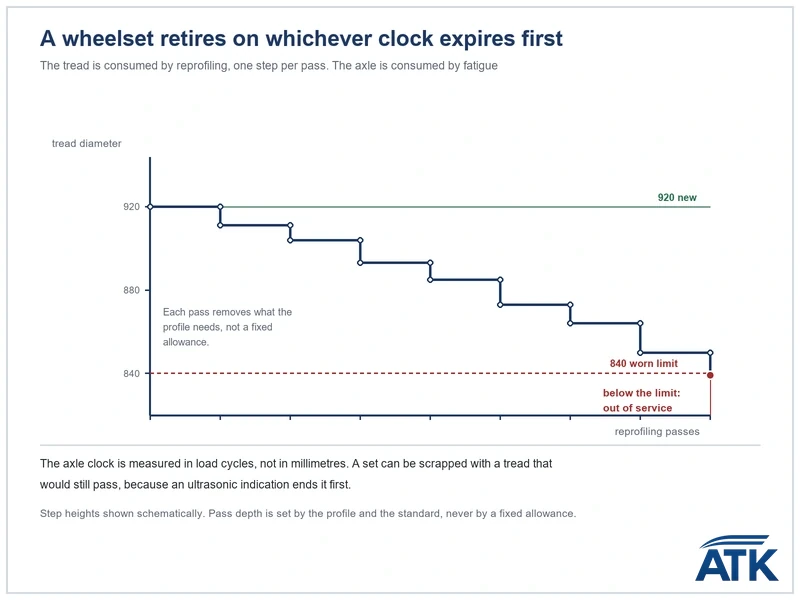
A wheelset in service is consumed from the tread inward. Reprofiling removes metal from the tread to restore the profile; each pass shortens the remaining life. The set retires when the tread cannot be cut again inside the wear limit, or when an axle defect ends it earlier. Those two clocks run independently, and whichever expires first governs.
Three maintenance actions are worth separating, because buyers routinely confuse them in a specification.
Reprofiling. The tread and flange are re-cut to the required profile in a lathe, with the wheelset either removed from the vehicle or turned in place. Wheelset lathes are built for the first case, working from a mounted datum on the axle centres. Choosing between the two machine families is its own decision, covered under underfloor wheel lathe types.
Wheel replacement. When the tread is beyond recovery, the wheels come off and new ones go on. The axle is re-inspected and, if it measures inside the permitted re-machining envelope, the old seats are cleaned up and the assembly sequence repeats with new press records. This is where a "reconditioned" set is created, and where documentation most often goes wrong.
Re-gauging. Moving a wheelset to a different track gauge is not a press-position change. The axle body length, the back-to-back dimension, and sometimes the wheel width all change, and the resulting assembly is a new design that needs its own drawing approval.
One maintenance rule is not negotiable in any of the three standards: the set is reprofiled and inspected as an assembly, not as two wheels and a shaft that happen to be together. Balance, run-out and electrical resistance are properties of the assembled item, and none of them survives being treated part by part.
Freight wagons. The largest volume by far, and the least forgiving on cost. Standard-gauge 920 mm sets dominate, with heavy-haul operators moving to larger diameters and higher axle loads. Duty is dominated by high mileage at moderate speed, so tread wear and reprofiling intervals drive the maintenance cost.
Passenger coaches. Smaller diameter, higher speed, and a much tighter requirement on run-out and balance because the wheelset sits under the floor of a occupied vehicle. Noise and ride quality enter the specification in a way they never do on freight.
Locomotives. Driven wheelsets with a gear seat, larger diameter, and the highest torque through the joint. The wheel seat on a driven axle carries a load case that a trailing axle never sees, which is why the two are not interchangeable even at the same diameter.
Metro and light rail. Small wheels, tight curve capability, and a high share of inboard-bearing or compact designs. Where the tunnel floor limits the wheel diameter, the whole bogie is designed around the wheelset rather than the other way round.
Industrial and mining. Narrow gauge, small diameters, and loads that fall outside every mainline standard. These orders are drawing-driven, and the standard is whatever the site's engineering department wrote.
The same three words are used loosely across the market, and the difference between them is documentation rather than appearance.
New | Reconditioned | Rebuilt or converted | |
Wheels | New, with mill certificates | Usually new; sometimes re-profiled originals | New or re-used, per drawing |
Axle | New forging | Original, re-inspected and possibly re-machined | Original or new, modified |
Assembly records | New press curve per serial | New press curve after reassembly | New press curve, new drawing number |
Traceability | Heat numbers from the mill | Original heat numbers plus new wheel heats | Mixed, needs a clear statement |
Typical use | New build, fleet expansion | Fleet overhaul, budget-constrained replacement | Gauge change, life extension |
The failure mode here is not a bad part. It is an old certificate attached to a reassembled set. When an axle is re-used, its original material certificate stays valid for the steel, but the assembly record has to be new, because the wheels are new and the press curve belongs to this assembly only. A supplier who sends the axle's original documentation alongside a new wheel invoice has not created a reconditioned wheelset. It has created an undocumented one.
If a set is reconditioned, the offer should say so in the description, not in a footnote. Buyers who discover the difference at goods-in have a legitimate complaint even when the parts are sound.
Wheelsets are supplied in three commercial shapes, and the difference between them is not cost. It is who carries the qualification.
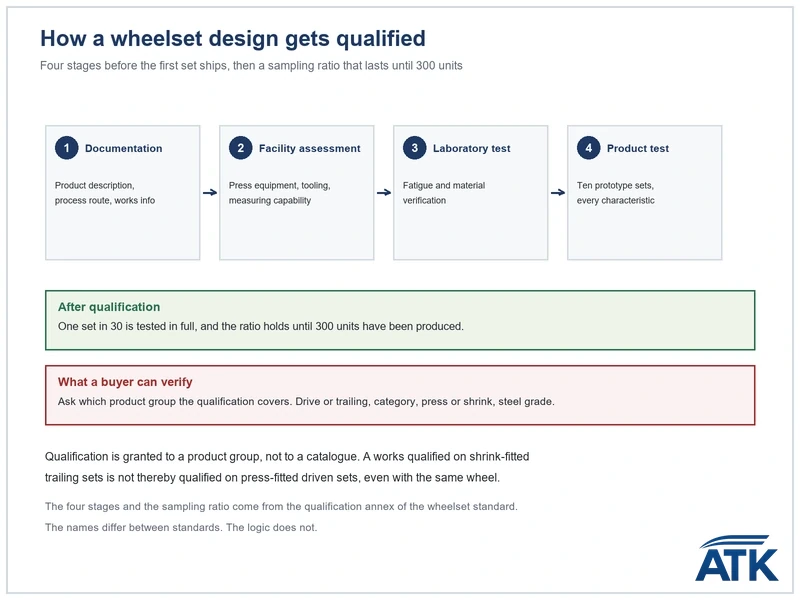
The first is a catalogue assembly at a standard size, ordered against a named standard and edition. The second is a standard assembly modified to a drawing — a different back-to-back, a non-standard journal, a different profile. The third is a bespoke set for a vehicle that was never type-approved against any of the three families, where the drawing is the only specification that exists.
What makes the difference between these three workable is not the supplier's catalogue depth. It is whether the qualification behind the works can be produced when a customer's auditor asks for it, and whether the assembly record survives the shipment.
ATK supplies wheelsets as a sourced and coordinated item, not as a manufacturing claim. The assembly is carried out at works we supply from, to the drawing and the standard edition named on the order, and the documents that come with the set are the works' documents. That distinction is worth being explicit about, because it changes what a buyer should ask for.
What a buyer should ask for | Why it matters |
The certificate scope, not just the certificate | A quality-system certificate states which service items are covered. Wheel mounting is one item; machining is another. |
The exact standard edition | EN 13260 moved to the 2025 edition. Older specifications cite 2020. |
Per-piece assembly records, serialised | The press curve cannot be reconstructed after delivery. |
NDT reports with operator level | An unsigned report with no operator grade proves nothing. |
Who performs the assembly, and where | A trader who cannot name the assembly works cannot answer an audit question either. |
The works we supply from hold the certifications that the destination market requires, and those certificates are provided with the offer so the scope can be checked against the order before anything is pressed. What we do not do is present a works' approval as our own. A buyer comparing suppliers should assume that a supplier claiming a certification it does not hold will also be vague about the press curve.
Customisation follows the same logic. A wheelset can be built to a customer's drawing on diameter, back-to-back, journal, profile, material grade, and marking; the limits are set by the standard edition the drawing cites and by what the works is approved to do.
Where a customer works to a national or company standard outside these three families, that standard and its drawing replace the European or American reference entirely. The assembly still needs a qualified works, but the acceptance criteria, the record format and the marking all come from the customer's own specification rather than from EN 13260 or the AAR manual. This is the normal route for mining, port and industrial operators whose fleets were never type-approved against a mainline standard, and for operators with an in-house specification that is stricter than the published one. Beyond that point the honest answer is that the design needs to change, and a supplier who agrees to everything without asking about the qualification scope has not understood the question.
Lead time on a bespoke set is dominated by two things that are not machining: the wheels and axles have to be scheduled against the grade and diameter, and the assembly has to wait for the qualification documents. Where a customer needs a set urgently, the fastest route is usually a standard configuration already inside the works' approved scope, not a new drawing.
Two wheels pressed or shrunk onto one axle, with the tread profile cut to a common datum. It is treated as a single traceable item through its service life.
Yes in everyday use. In procurement the assembled item is the wheelset; the wheel and the axle are separate purchases with separate certificates.
EN 13260 in Europe, the AAR manuals in North America, the TB/T 1718 series in China. All three treat assembly as its own product requirement.
The revision tightened dynamic imbalance and fatigue test wording, clarified qualification conditions, and refined permitted rework after assembly. It supersedes the 2020 edition.
By interference fit only. There is no fastener. Press fitting logs a force–displacement curve; shrink fitting relies on controlled heating and dimensional records.
Roughly 0.1 to 0.15 per cent of the seat diameter for press fitting, slightly less for shrink fitting. The drawing and standard edition set the exact band.
Yes, within what the works is approved to assemble and what the standard allows. Non-standard diameters need a drawing rather than a catalogue reference.
Material certificates, NDT reports, dimensional records, the press curve by serial number, and the works' certification scope for the destination market.
New assemblies unless a reconditioned set is requested in writing. The two are different products with different documentation.
Roughly 12 to 35 tonnes depending on diameter, gauge and standard. Above that the design is bespoke and driven by the drawing.
The wheelset and the bearing arrangement can be quoted together or separately. Scope has to be agreed before the offer, not after.
Gauge, axle load, wheel diameter, standard and edition, journal size, and the drawing. Six items resolve most of the ambiguity.
Send the gauge, the axle load, the wheel diameter, the standard and edition, the journal dimensions and the assembly drawing. If the drawing is not final yet, send the vehicle type and the duty cycle — the rest follows from the standard that vehicle was approved against.

Where the destination market requires certification, say so at enquiry rather than at inspection. The scope can then be checked against the order before the wheels are scheduled, which is the only point at which a mismatch is still cheap to fix.
Contact us with the drawing and the six parameters. A first technical response, including which standard edition applies and what the assembly records will contain, usually comes back within one working day.
We have recommended some of our Related products to you. I hope you will be interested.
 English
 Русский