
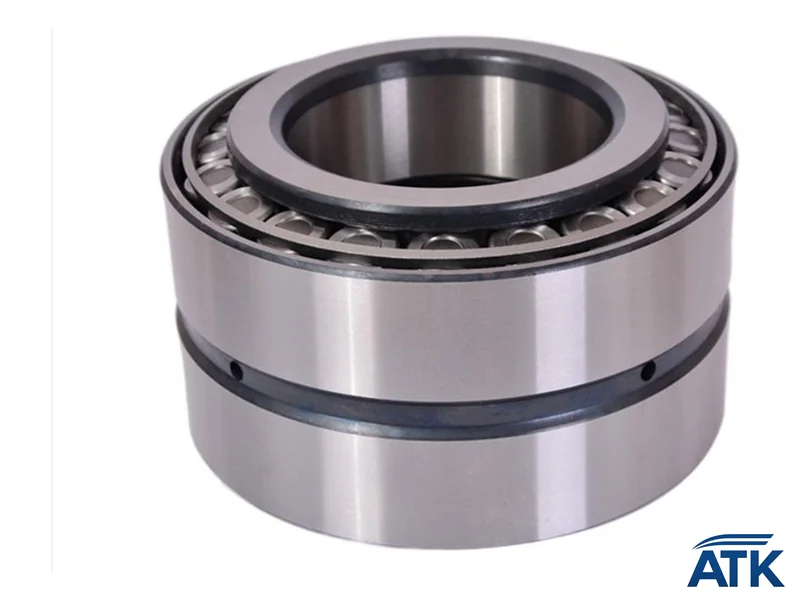
Railway axlebox bearings and wheelset bearing units for freight, passenger, metro and locomotive stock
TBU, CTBU and cylindrical roller units, sealed and pre-lubricated
Metric 130 x 230 x 150 and 150 x 250 x 160 programmes, plus AAR inch Class B to K
EN 12080:2025 / EN 12081 / EN 12082-1 and -2:2025, AAR M-934 / M-1003 / M-959, TB/T 2235-2016
Case-carburised or through-hardened bearing steel, polymer cages
LL labyrinth-lip, garter and non-contact labyrinth seals
Pre-set axial clearance, press-fit mounting, hot-box monitoring
Trial production to your journal, axlebox and adapter drawing
On a loaded freight axle the static load is roughly 22.5 to 25 tonnes, and track irregularities can add impact loads several times that figure. Rail joints, curves and braking all reach the bearing through the same two rings. It sits between the wheelset axle and the bogie frame and has to carry that for hundreds of thousands of kilometres without attention. A failure here is a safety event, not a maintenance inconvenience; that is why the specification, testing and traceability are tighter than for an industrial bearing of the same size.
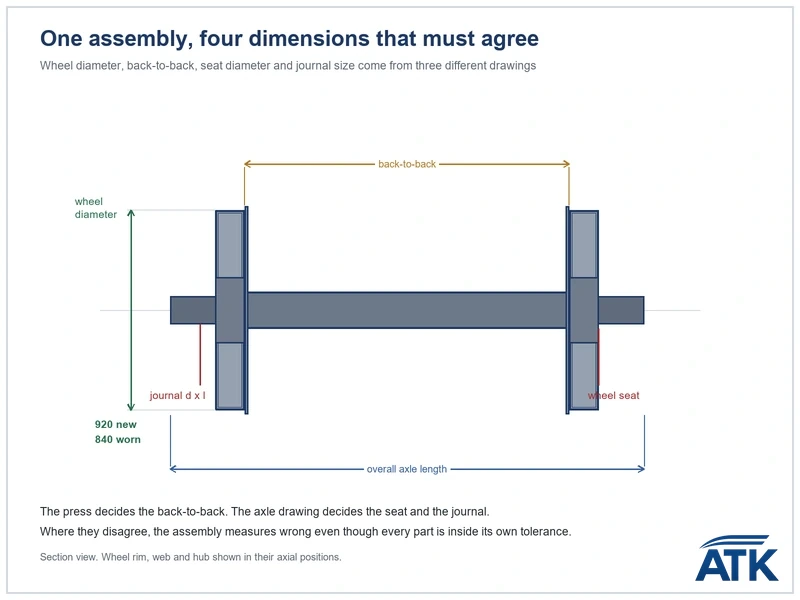
"Railway bearing" is a catch-all in most enquiries, and three different parts hide behind it. The axlebox is the housing joining the wheelset to the bogie. Inside it, the load-carrying part is usually a sealed cartridge unit. The journal is the machined seat on the axle itself. On replacement jobs these three get confused more often than any other detail, so we ask for the axlebox drawing or a photo of the existing assembly before quoting. The assembly that journal belongs to is covered under railway wheelsets.
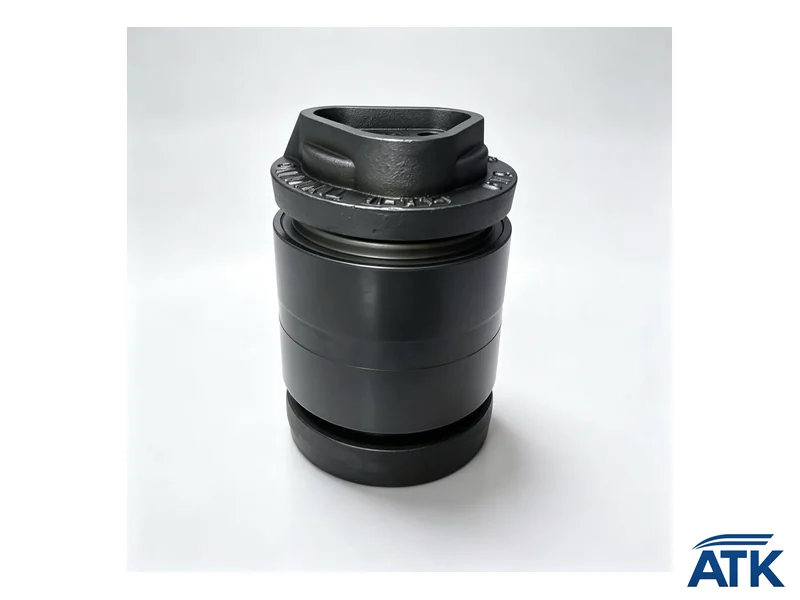
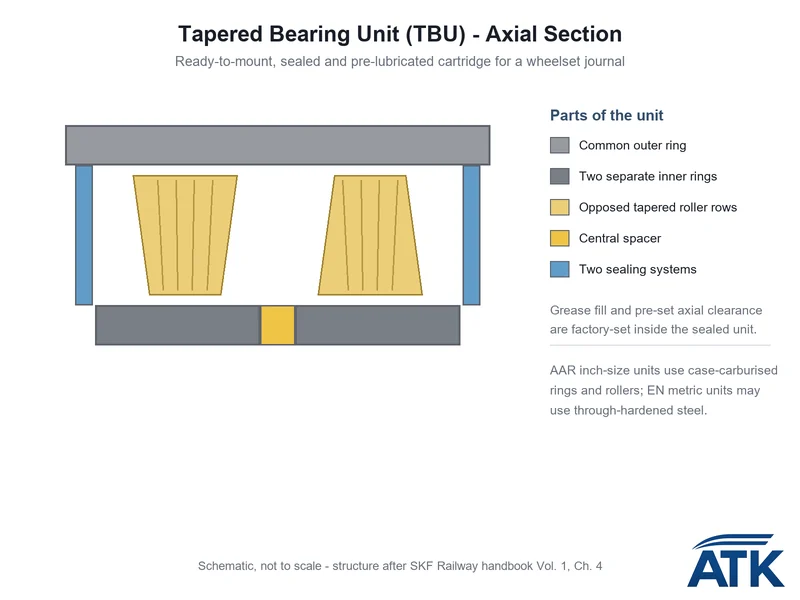
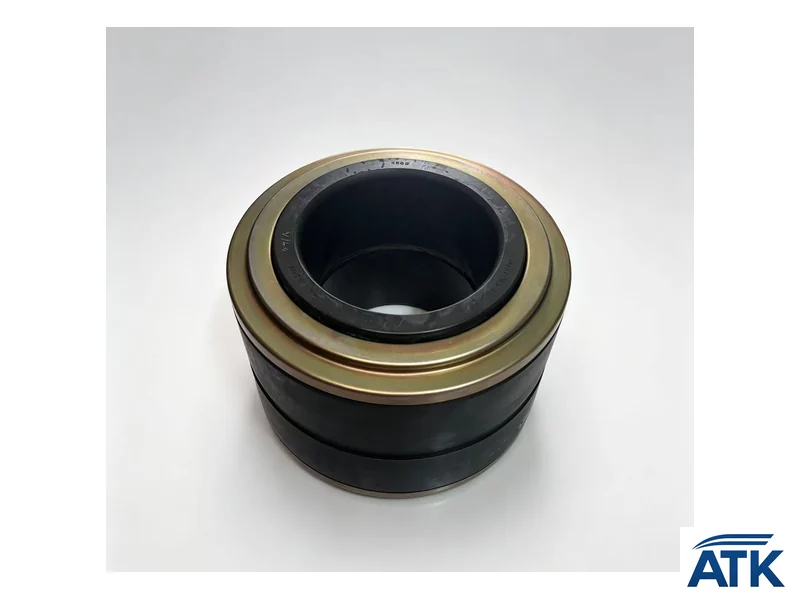
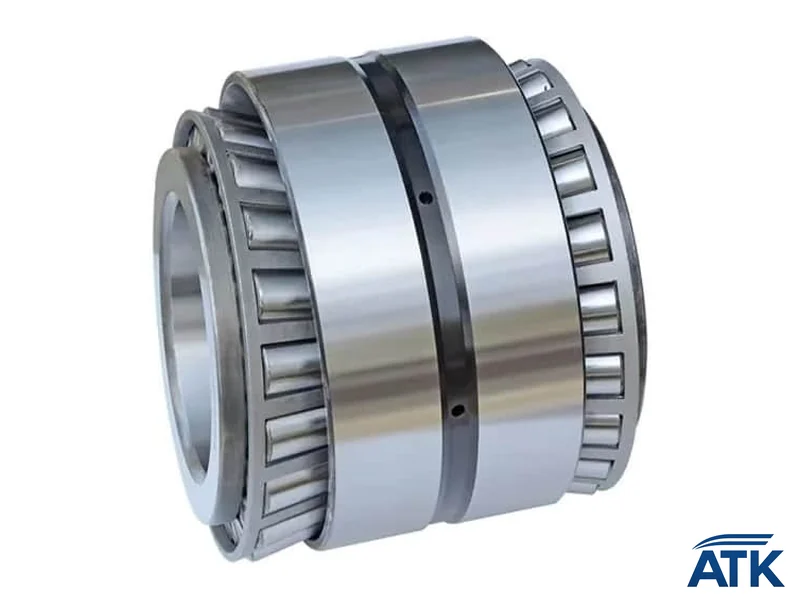
What arrives for a modern axlebox is a complete cartridge, not loose components: two inner rings, one common outer ring, two rows of rollers with cages, a spacer, grease and two seals. Axial clearance is already set. Greasing is done in a clean factory environment, not in the wheelset workshop, and the unit stays closed on site.
A purchase order and a drawing rarely use the same words for this assembly. Most differences are harmless. A few change what gets shipped, so the table maps each enquiry term to the wording that belongs on the order.
Term on the enquiry | What it refers to | How we treat it |
Railway bearing / railroad bearing | The general product family | Primary term |
Axlebox bearing / axle box rolling bearing | Bearing inside the axlebox housing | Primary synonym |
Wheelset bearing / wheel set bearing | Same part, named by the assembly | Primary synonym |
Journal bearing / journal roller bearing | North American wording for the axlebox bearing | Use with care, see note below |
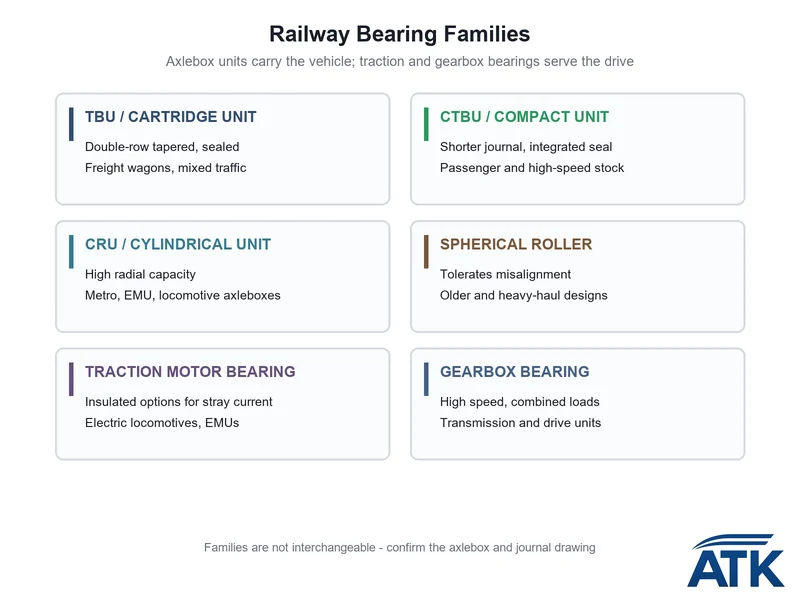
TBU / tapered bearing unit / tapered roller bearing unit | Double-row tapered cartridge, pre-set clearance | Primary product term |
CTBU / compact tapered bearing unit | Shorter-journal version with integrated seals | Product variant |
CRU / cylindrical roller unit | Cylindrical roller cartridge, high radial capacity | Product variant |
Cartridge bearing | EN 12080:2025 term for a sealed, greased unit | Standard term |
Traction motor bearing / gearbox bearing | Bearings in the drive, not the axlebox | Separate product line |
Axlebox assembly / axle box with bearing | Bearing plus housing, grease, seals and end cap | Kit term |
TAROL, AP, AP-2, CTRB | Maker-specific trade names for cartridge units | Long-tail, not our own brand |
353130B, 352226X2-2RZ, NJ3226X1 | Chinese designation codes | Long-tail, quote by drawing |
Two words cause trouble, both of them common in translated enquiries. A journal bearing in railway usage is the rolling bearing at the axle journal; in general engineering it can mean a plain sleeve bearing, a different technology being phased out of freight fleets. A wheel bearing belongs to automotive vocabulary and is too vague to quote against. We write "railway bearing" or "axlebox bearing unit" in titles and put the exact designation on the order.
"TBU" covers two dimensional systems, not one. AAR practice means the inch-size Class B to K series. Metric 130 x 230 and 150 x 250 units are also called TBU, yet nothing between the two families interchanges.
Two opposed rows of tapered rollers share one common outer ring in a TBU, the tapered bearing unit. They take radial load and axial load from both directions, and the unit arrives sealed and pre-lubricated, which is why it dominates freight and mixed traffic. CTBU, the compact version, removes the seal seat and the seal wear ring and puts the seal between the rings instead. The journal can then be 15 to 25 mm shorter. Bending and unsprung mass fall. A CTBU will not, however, fit a journal drawn for an older TBU.
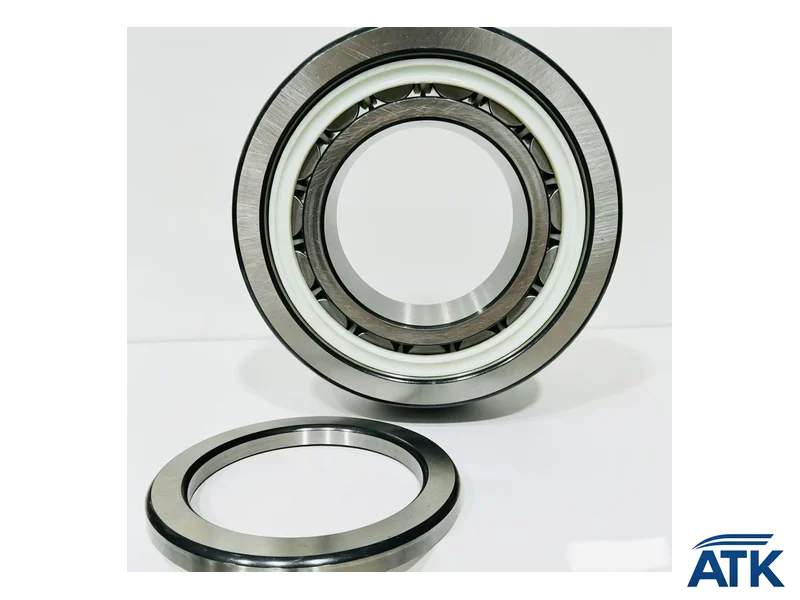
High radial capacity and low friction at speed are the reason a CRU, the cylindrical roller unit, turns up on metro, EMU and locomotive axleboxes. It needs separate axial guidance, so North American freight adapters rarely use one. Spherical roller bearings tolerate misalignment and still appear on heavy-haul and older stock. They run with higher friction.
Outside the axlebox there are two more families. Traction motor bearings see rotor speed, electromagnetic vibration and stray currents, so insulated versions with ceramic or coated rings are used; gearbox bearings take combined loads at high rotational speed. They are often ordered in the same shipment as axlebox units, but the fits and approvals are separate. When an enquiry says "wheelset bearing" or "railroad bearing", it almost always means one of the axlebox families above. The drive bearings are quoted as separate lines.
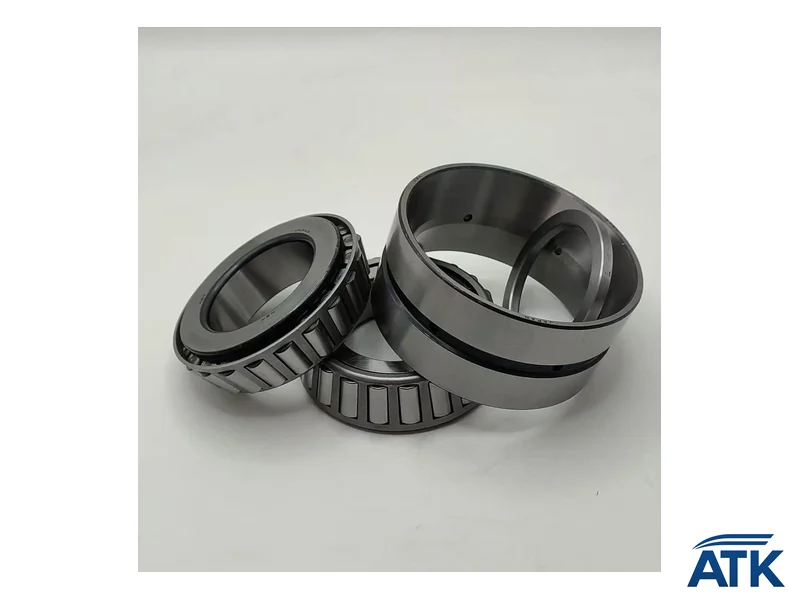
Swapping one ring between two units undoes the clearance setting. A TBU is a matched assembly, not a bag of loose rings:
1. One common outer ring
2. Two separate inner rings, seated on the journal
3. Two tapered roller and polymer cage assemblies, arranged with opposed tapers
4. A central spacer between the inner rings
5. Grease fill, measured and distributed at the factory
6. Two sealing systems, one at each end
7. A pre-defined axial clearance, set before the unit leaves the factory
Depending on the axlebox design, backing rings, lateral spacers, an adapter, end caps and their locking device are added. On a freight car without a full axlebox housing the adapter transfers load into the bogie side frame. It belongs to the fit. Choosing it later is not an option.
Most service-life problems start at the seal, not in the raceway. The classic AAR garter seal rides on a seal wear ring, and AAR standardised both so that components from different makers interchange. LL (labyrinth-lip) seals combine a labyrinth, a lip and a flinger; published rig tests for these seal designs report friction torque up to 75 percent lower than a garter seal arrangement and an operating temperature about 20 degrees lower. Fully enclosed metric axleboxes generally take non-contact labyrinth seals. The housing decides which one applies.
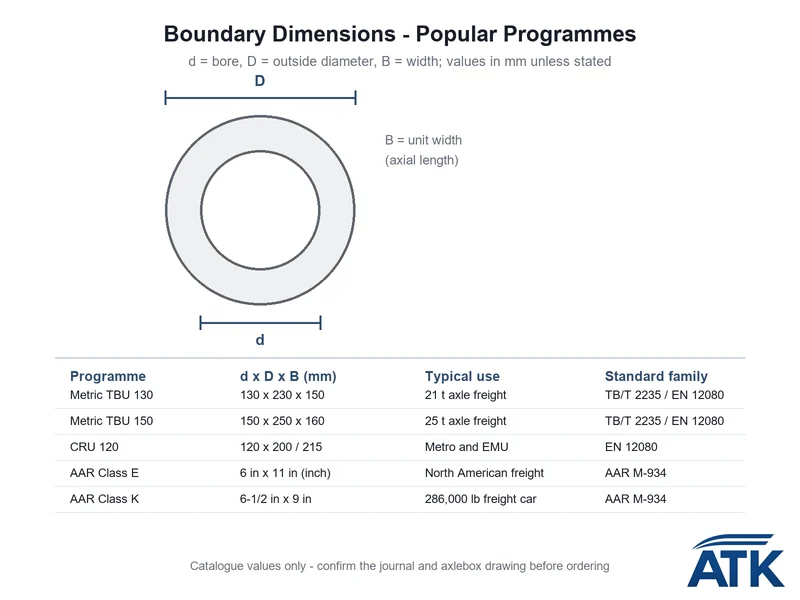
Figures below come from the published standards and maker catalogues for the programmes listed. Which inspection documents apply to a given lot is confirmed when the order is placed.
Programme | d x D x B (mm) | Typical duty | Standard family |
Metric TBU 130 | 130 x 230 x 150 | 21 t axle freight, 120 km/h | TB/T 2235 / EN 12080 |
Metric TBU 150 (353130B) | 150 x 250 x 160, assembly height 180.6 | 25 t axle freight, 120 km/h | TB/T 2235 / EN 12080 |
CRU 120 | 120 x 200 / 120 x 215 | Metro, EMU | EN 12080 |
AAR Class E | 6 in x 11 in (inch series) | North American freight | AAR M-934 |
AAR Class K (CTBU) | 6-1/2 in x 9 in, 165.1 x 228.6 | 286,000 lb freight car | AAR M-934 |
Property | Published value | Where it comes from |
353130B axle load / max axial load | 23.83 t / 9.53 t | Supplier type data |
353130B press-fit force | 68.6 to 235.2 kN; end pressure 313.6 to 352.8 kN | Supplier type data |
353130B axial clearance after mounting | 0.05 to 0.45 mm | Supplier type data |
353130B operating temperature | -45 to +50 deg C, 100% relative humidity | TB/T 2235-2016 |
Overhaul, 353130B | 800,000 km or 8 years, whichever comes first | Supplier type data |
Rated life, 353130B | at least 2,000,000 km | Supplier type data |
Ring surface hardness | 57 to 66 HRC, spread within one bearing <= 4 HRC | EN 12080:2025 |
Metallurgical acceptance | Class 1: 0.5 mm flat-bottom hole ultrasonic reference; Class 2: 1.0 mm | EN 12080:2025 |
Polymer cage material | PA66 or PA6 with roughly 25% glass fibre, no recycled material | EN 12080:2025, Annex D |
Load ratings (C / C0) | Confirm against the drawing and approval basis | Not quoted as a catalogue claim |
Axlebox temperature, high-speed test | loaded zone <= 90 deg C, hot-box target zone <= 70 deg C | EN 12082-1:2025 test principles |
Metric d/D/B figures and inch Class designations belong to different sizing systems. An AAR Class K unit will not replace a 150 x 250 metric unit even where the bore looks close; the approval path is different as well.
Read the data sheet before the headline. Several reseller pages quote "maintenance-free" as a headline while their own data sheet still gives an 800,000 km or 8-year overhaul interval. In maker usage the term normally means no grease top-up between overhauls; it does not mean the bearing is never inspected or never removed. The interval stated in the applicable data sheet is the one that goes on the order.
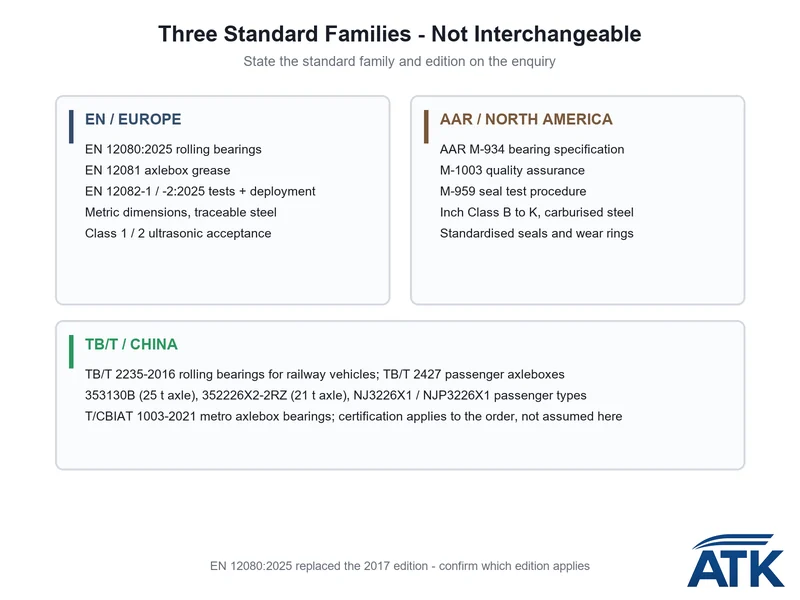
European, North American and Chinese approvals do not transfer from one network to another. Three standard families come up in enquiries, and they are not interchangeable.
EN 12080:2025 covers railway axlebox rolling bearings: steel cleanliness, heat treatment, geometry, tolerances, non-destructive testing and marking. It replaced EN 12080:2017+A1:2022 in December 2025 and moved the conformity and deployment procedures into EN 12082-2:2025. EN 12081 covers axlebox grease; EN 12082-1:2025 the test methods and EN 12082-2:2025 the deployment process. For vehicles above 200 km/h the rig performance test calls for a cumulative 800,000 km; field or line testing is assessed separately under its own criteria. Some project specifications still name the 2017 edition; the edition written on the order decides which documents apply.
AAR M-934 governs North American freight bearings, with M-1003 for the manufacturer's quality assurance system and M-959 for seal testing. AAR standardises the inch Class B through G, GG and K sizes, requires case-carburised rings and rollers, and standardises garter seals and seal wear rings so that parts from different approved makers interchange. An AAR certificate number is traceable, which is why North American buyers ask for it early.
TB/T 2235-2016 covers rolling bearings for Chinese railway vehicles, and TB/T 2427 passenger axlebox assemblies. Designations such as 353130B, 352226X2-2RZ and NJ3226X1 follow a code that encodes bearing type, dimension series and bore: in 352226X2-2RZ, "35" is a double-row tapered bearing with two inner rings and a spacer, and "26" means a 130 mm bore. T/CBIAT 1003-2021 addresses metro vehicle axlebox bearings. Certification requirements belong on the enquiry and are confirmed per order.
A unit that matches the dimension table can still be wrong: the journal may have been machined for a CTBU, or the fleet's hot-box detectors may be set to a different temperature envelope. None of these makes a bearing universal. Journal diameter, axlebox or adapter design, seal arrangement and approval basis have to be read together.
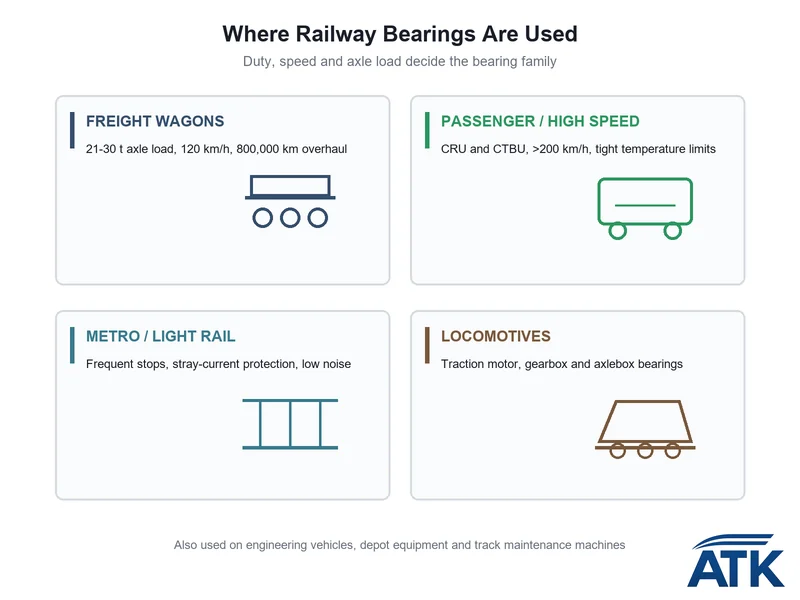
At 21 to 25 t axle load and around 120 km/h, with long distances between inspections, sealed TBU and CTBU units are the practical choice; 30 t axle heavy-haul stock pushes the design further. Freight wagons are the largest group. Above 200 km/h on passenger coaches and high-speed sets, cylindrical roller units and compact tapered units are common, and temperature limits rather than static load become the controlling condition.
Frequent stops, stray currents and noise limits are what change the specification on metro and light rail. Insulated bearings and anti-fretting measures appear here, and the axlebox is often part of a condition-monitoring package with speed and temperature sensors. Locomotives need axlebox bearings plus traction motor and gearbox bearings, sometimes on the same order.
Engineering vehicles, depot shunters and track maintenance machines run the same families at lower speeds, then sit idle for weeks between duties. False brinelling and grease separation show up on stock that stands still, not on stock that runs. That idle time belongs in the enquiry.
Extreme cold, dust or standing water call for a seal and grease combination matched to the route. Wayside hot-box detectors call for a running temperature inside the detector's threshold. State both in the first message; the seal and the grease selection follow from them.
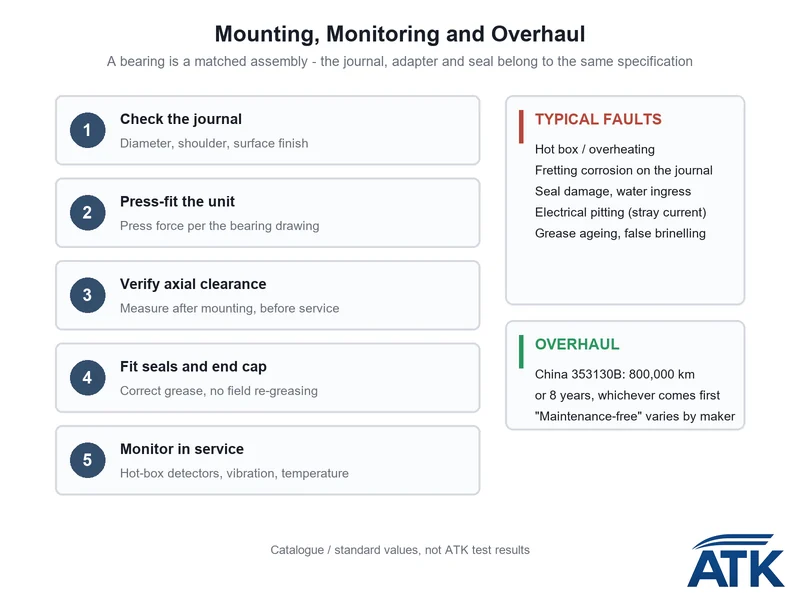
Start with the journal: diameter, shoulder radius, surface finish and any fretting marks. Press the unit on with the force given on the bearing drawing and record the end pressure. A press curve that never reaches the expected value usually means the fit is wrong, not that the bearing is stiff. Measure axial clearance after mounting, before the axlebox is closed. A sealed cartridge is not re-greased in the field, so the specified grease goes in with the seals and end cap.
In service, hot-box detectors read the temperature at the bearing zone, and vibration or acoustic monitoring picks up spalling and cage damage before they become a thermal event. The EN high-speed test principles use a loaded-zone limit of 90 deg C, a hot-box target zone of 70 deg C and a temperature difference between the two bearings of one axle that is kept within a tight band. Each operator sets its own alarm level; the published figures are test thresholds.
Keep the press chart, the clearance reading and the unit serial number with the wheelset record. On fleets that replace bearings at a fixed mileage, that record is what lets a depot recognise a repeat failure on the same axle position. Otherwise every hot box looks like a new incident. A running-in cycle on the assembled wheelset gives that record its first temperature reading, and the LDZM-200 running-in test bench writes it before the wheelset returns to service.
Do not mix rings, rollers or cages from different units, and do not reuse a seal that has been disturbed. Clearance was set with those parts together at the factory. Swapping one of them undoes the setting.
By the time a hot-box detector alarms, several things have usually gone wrong. Water ingress past a damaged seal washes out grease and corrodes the raceways. Fretting corrosion on the journal lets the inner ring creep, which changes the clearance and raises temperature. Stray current through a traction motor bearing produces electrical pitting, while false brinelling appears on stock that has stood still under vibration. Grease ageing and cage wear finish what contamination started.
At overhaul, check the journal, the adapter or housing bore, the seal seat and the end-cap bolts before condemning the bearing. Repeat failures on one axle position usually point to the housing or wheelset rather than a bad batch. Replace the unit as a matched assembly and keep the traceability record with the wheelset.
A rising temperature trend on one axle tells more than a single alarm, and vibration spectra can separate a spalled raceway from a damaged cage before the unit comes off. Depots that keep both records tend to find the housing or wheelset cause earlier. That changes what an overhaul looks like.
The published figure for the Chinese 353130B is 800,000 km or 8 years, whichever comes first, while makers of compact units sometimes quote longer no-top-up intervals. Overhaul intervals vary by design and by operator. Confirm which interval the fleet works to before comparing two data sheets.
A specification needs the bearing type and designation, bore, outside diameter and width, vehicle type and axle load, maximum speed, and whether the unit is for an axlebox, an adapter, a traction motor or a gearbox. Add the standard family and edition the fleet works to (EN 12080:2025, AAR M-934 with its certificate basis, or TB/T 2235-2016), the seal type, and whether insulated or sensor-equipped versions are required.
Quantity, any surface or coating requirement, the mating adapter and end-cap drawing, and the destination port come next. On replacement jobs the journal length decides whether a CTBU will fit; one journal drawing or a photo of the existing axlebox settles more than a paragraph of description. Buyers qualifying a new railroad bearing supplier usually send the approval basis and required manufacturer documentation with the first enquiry, which avoids restarting the quotation after the drawing check. The designation is checked against the drawing first.
Bearing orders follow an overhaul programme, so the commercial terms are settled alongside the drawing. Quantity per designation, whether the units are for a new build or a fleet replacement, and the required delivery window all affect the production slot. Minimum order quantity and lead time are confirmed against the programme and the current production slot; mixed designation orders can normally be consolidated into one shipment.
Packing has one job here: keep the pre-set clearance and the grease fill intact. Protective wrapping, a rigid inner box and a wooden or steel export case are used, with the designation, quantity and lot identification on the outer label. Long sea voyages and humid storage decide the corrosion protection, so the destination port and any inland leg belong at enquiry stage.
Warranty terms, inspection documents and third-party survey are agreed per order rather than assumed from a catalogue. Where the fleet works to a specific acceptance basis, it should arrive with the drawing; what applies is then confirmed before the quotation is finalised.
In most enquiries, yes - both refer to the rolling bearing inside the axlebox. Strictly, the axlebox is the housing and the bearing is the cartridge inside it. An "axlebox assembly" includes the housing, grease, seals and end cap as well.
A TBU is a sealed, pre-lubricated double-row tapered roller unit with pre-set axial clearance, made of two inner rings, one common outer ring, two roller and cage assemblies, a spacer and two seals. A CTBU removes the seal seat and wear ring and integrates the seal between the rings, so the journal is shorter. The two are not drop-in replacements for each other.
No. AAR inch-size and metric units follow different dimension series, different heat-treatment rules and different approval paths. Class K is 6-1/2 in x 9 in (165.1 x 228.6 mm) for a 286,000 lb freight car; the metric 150 x 250 unit belongs to the TB/T / EN family. Confirm the journal and adapter drawing instead of comparing bore numbers.
It depends on the network. European projects normally name EN 12080:2025 with EN 12081 and EN 12082-1/-2:2025; North American freight uses AAR M-934 with M-1003 and M-959; Chinese stock uses TB/T 2235-2016 and the relevant designation. Some specifications still name the 2017 EN edition, so check the edition before the order is placed.
Usually that the sealed unit is not re-greased between overhauls. It does not remove the inspection or overhaul interval. The published 353130B interval is 800,000 km or 8 years, whichever comes first, while some compact-unit makers quote longer no-top-up figures. Ask for the interval in writing.
"35" indicates a double-row tapered bearing with two inner rings and a spacer, "22" the width and diameter series, "26" a 130 mm bore (26 x 5), "X2" a cylindrical outer ring outside diameter, and "-2RZ" two skeleton rubber seals. Suffixes such as A, B, K1 and K2 mark structural or bore variations. Quote against the drawing, not the code alone.
The axlebox decides. AAR inch-size units traditionally use garter seals on a standardised wear ring; LL labyrinth-lip seals reduce friction torque; fully enclosed metric axleboxes often use non-contact labyrinth seals. Send the housing drawing and the operating environment with the enquiry.
Damaged seals and water ingress, grease loss, fretting on the journal, spalling, cage damage or stray-current pitting can all raise temperature. Wayside detectors catch the rise. The root cause usually turns up at overhaul, not in the alarm log.
Yes, as separate lines with their own fits and insulation options. They are often shipped with axlebox units in the same order, but they need their own drawings and approval basis.
Yes. Bearings are often shipped with steel rails, railway track bolts and crane rail clips, or with turnout and fishplate components, in one enquiry and one shipment. Where treads are reprofiled during the same overhaul, ATK also supplies the CY8013D mobile CNC underfloor wheel lathe.A mixed order usually saves more on freight than consolidation costs.
Send the bearing designation, the bore / outside diameter / width, the vehicle type and axle load, the standard family with its edition, the seal requirement and the quantity. Railway bearing units can be developed and trial-produced to a journal and axlebox drawing for EN, AAR or TB/T programmes, with the specification confirmed before the price is fixed. A datasheet, samples or a project price are available - contact us. For a mixed order, ask about our integral cast slide baseplate, insulated fishplates and glued insulated rail joint in the same enquiry.
We have recommended some of our Related products to you. I hope you will be interested.
 English
 Русский