
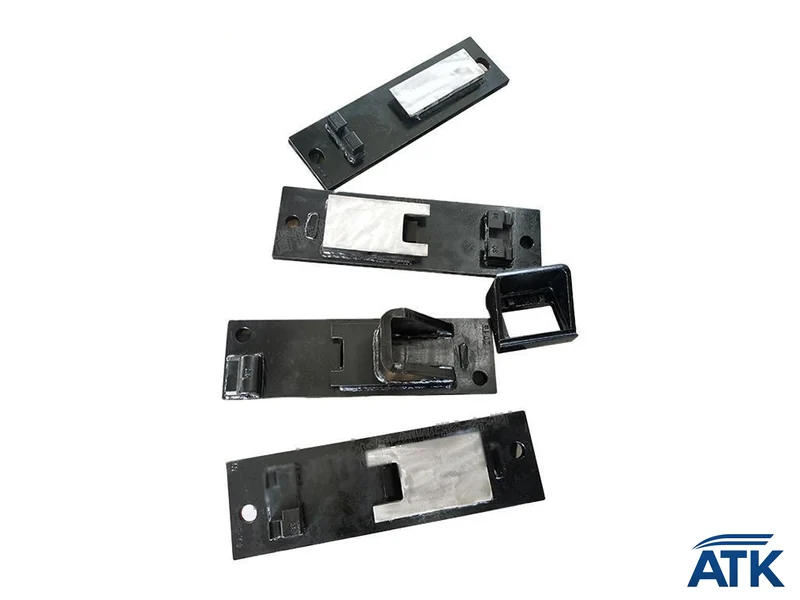
One-piece 20SiMn cast steel slide baseplate - no welds, no weld detachment
Graded composite hardening on the switch rail travel area, retaining lip stays tough
540 MPa tensile, 310 MPa yield, 56 J impact, 510 HBW surface, 96 h salt spray grade 9
Five million fatigue cycles without cracking against a two million cycle acceptance test
Lower oiling frequency, fewer change-outs on metro turnouts
Built to turnout drawing, P60-9# and other switch types
Trial production and drawing review before quoting
A slide baseplate sits under the switch panel of a turnout. It holds the stock rail and gives the foot of the switch rail a flat surface to slide across every time the points move. That sounds like a small job until you count how often it happens. A metro train with 24 wheelsets running at three minute headways for 15 hours a day loads each plate roughly 7,200 times. On a reversing turnout the number can double - one terminal on an urban line was measured at around 650 trains a day, about 15,600 load cycles on the same plate.
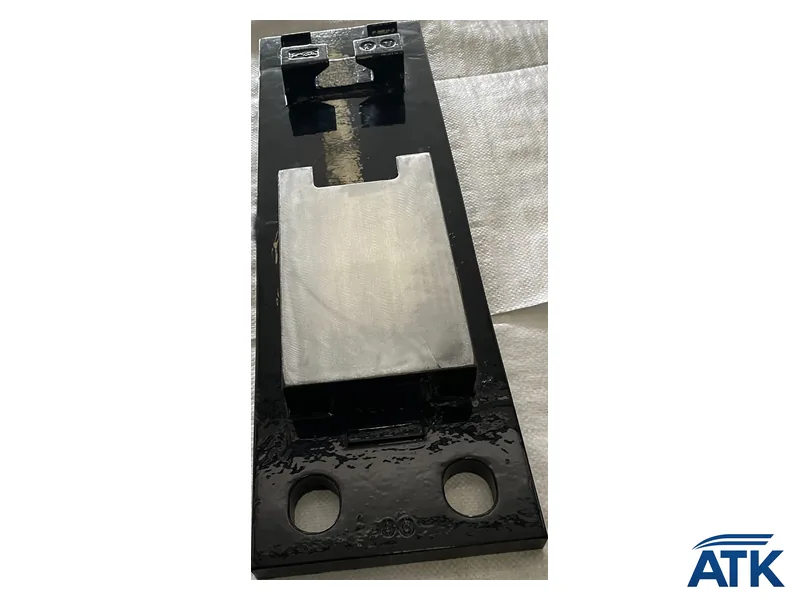
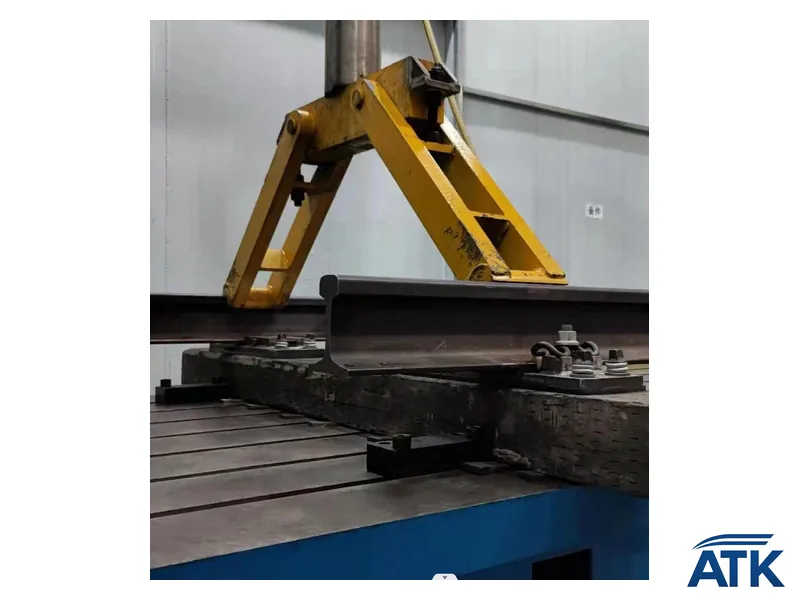
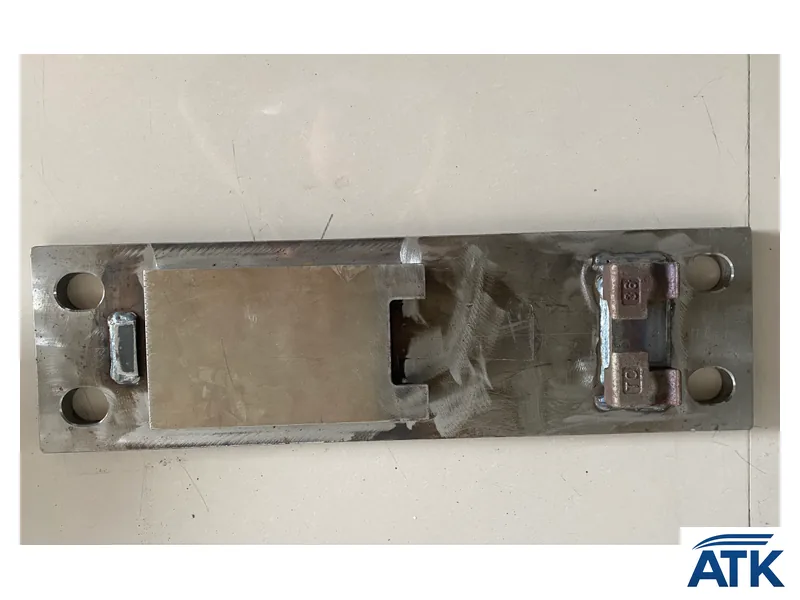
ATK supplies an integral cast slide baseplate for that duty. The base, the sliding table and the retaining lip are cast as one piece in 20SiMn cast steel. Nothing is welded on. The travel area where the switch rail moves is given a graded composite hardening treatment; the lip is left tough. It is a deliberately unglamorous part, but on a slab track turnout it is usually the first component that decides how often the maintenance crew has to close the line.
The conventional plate is a steel baseplate with a slide table and a lip fillet-welded onto it. The inside face of the table cannot be reached by the welding torch, so the joint only has the perimeter to hold it. Under lateral load the stock rail pushes against the lip with a turning moment; the weld spends its life resisting that moment. The relationship is simple enough to sketch on a napkin: the overturning force times its lever arm has to stay below what the weld can hold. Widen the gap between the rail foot and the table edge and the lever arm grows - the same wheel load now demands more from the same weld.
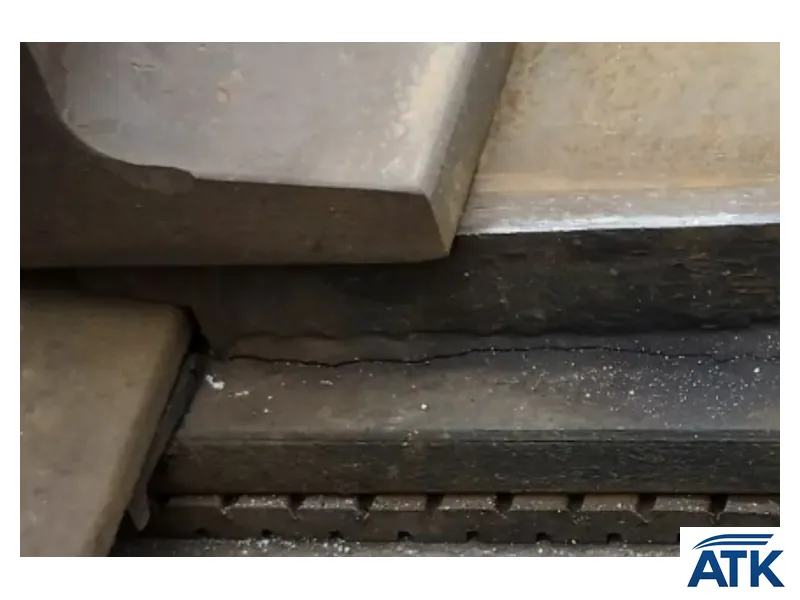
Cracks do not appear all at once. They start at the weld toe, grow a little with each train, and one day the table lifts. The same cycle happens at the baseplate itself. A 12 mm rubber pad under the plate pushes up while the wheel load pushes down, so the top surface alternates between tension and compression. Tighten the anchor bolts past about 120 N·m and you add more tensile stress before a single train arrives. Once the pad ages and loses its elasticity, or shims of mixed thickness create a hard spot, the plate picks up a shear point and cracks in the middle.
Then there is the surface. Ordinary carbon steel table tops run around 148 HBW. Iron filings and ballast dust land on them, the switch rail drags them across, and the scoring left behind can be enough to jam the blade. Rust does the same job more slowly, raising sliding resistance until the point machine starts throwing alarms. A welded plate in hard metro service is often quoted at 0.2 to 0.5 years of life. Most of that time is spent being inspected.
Cast the whole thing and the weld disappears. We use 20SiMn cast steel with a precision casting route, which gives a finer, more even structure than the rough castings that gave integral plates a bad name a decade ago. Internal stress is distributed through a single continuous body rather than concentrated at a joint, and the lip is part of the casting instead of a separate piece waiting to come off.
There is a trade-off worth stating plainly. Casting quality depends on the foundry. Poor gating gives coarse grains, shrinkage porosity and dimensions that drift from plate to plate, and a bad casting is harder to salvage than a bad weld. That is why the process control matters as much as the alloy - and why we would rather discuss the drawing and the inspection record with a buyer than just claim "cast is stronger".
Hardening the entire plate would make the lip brittle, and a brittle lip fails under the same lateral impact that breaks welds. So the hardening is staged: only the zone the switch rail actually travels across is given a composite wear layer. The rest of the casting keeps its toughness. The treated surface reaches roughly 510 HBW against about 148 HBW on a plain carbon steel table, which is the difference between a filing being pushed aside and being pressed in.
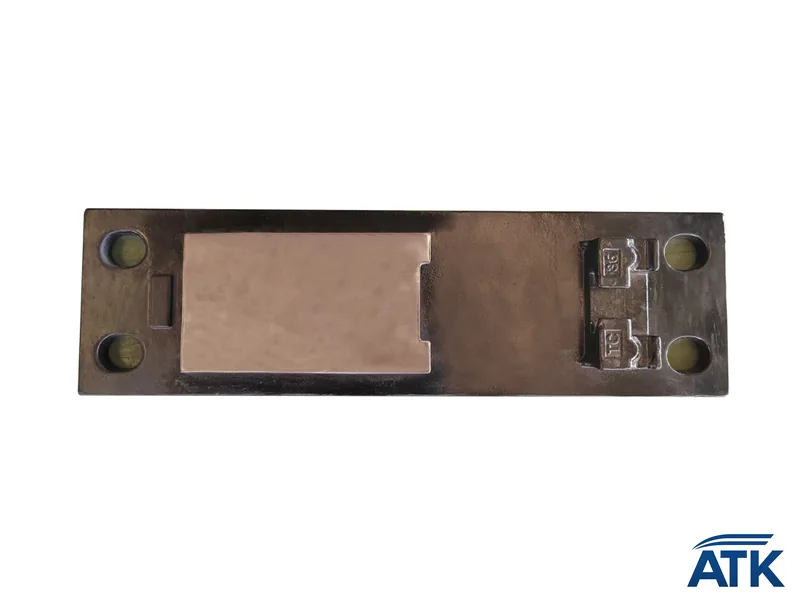
The hardened zone does not rust the way the parent steel does. In a 96 hour salt spray test the treated surface came back at protection grade 9, where an untreated table showed broad corrosion. Less rust and fewer embedded filings mean the plate needs oiling less often - not never, but less. It also means the sliding resistance stays closer to what the point machine was set up for.
The figures below are from the product sample's comparative test record, integral cast plate against a conventional welded plate. They are nominal values from that test programme, not a certificate for a specific batch.
Property | Welded slide plate | Integral cast slide baseplate | Change |
Tensile strength | 375 MPa | 540 MPa | +44% |
Yield strength | 224 MPa | 310 MPa | +38% |
Impact toughness | 28 J | 56 J | +100% |
Sliding surface hardness | 148 HBW | 510 HBW | +245% |
96 h salt spray | widespread rust | protection grade 9 | - |
Two things are worth reading into that table. The tensile and yield numbers tell you the body will take a bigger load before it deforms; the hardness number tells you the surface will keep its finish. Neither one, on its own, predicts how long a plate lasts in a turnout. Fatigue does.
Industry acceptance for a slide plate fatigue test is two million cycles without a crack. The integral cast plate was run to five million cycles and still showed none. Translating that into calendar time depends entirely on traffic: on an ordinary metro frequency the comparison works out at roughly 285 days for a conventional plate against 714 days for the cast one. On a reversing turnout with 650 trains a day those numbers collapse to about 133 and 333 days. Those are arithmetic from a stated headway, not a warranty - a site with bad bearer levels will eat any plate faster.
That is the part buyers sometimes miss. A stronger plate does not fix an uneven slab. If short sleepers sit at different heights and the crew packs shims under the middle of each plate, the load concentrates in one spot and the best casting in the world will still be working against an avoidable bending moment.
There are three ways to solve the sliding problem, and none of them wins on every project.
Route | What it buys you | What it costs you |
Welded slide plate | Lowest unit price, mature process, cheap to replace | Perimeter-only weld, fatigue detachment, regular oiling, surface scoring |
Integral cast slide baseplate | No weld, even stress distribution, hard wear surface, fewer change-outs | Depends on casting quality control; mid-range price |
Roller-assisted slide plate | No oiling, lower switching force, longer point machine life | Higher price; poor installation puts uneven load on rollers and can deform the eccentric shaft and jam the blades |
Roller devices are a legitimate alternative where switching force is the limiting factor - some European suppliers offer continuous height adjustment in the -0.5 to +6.0 mm range to keep the switch rail riding on rollers instead of a plate, and that is the thinking behind a lubrication-free slide baseplate. But they need the installation done right. A cast plate is more forgiving of the trackbed it is given, which is why it tends to be the safer choice on older slab track turnouts where bearer levels are already uneven.
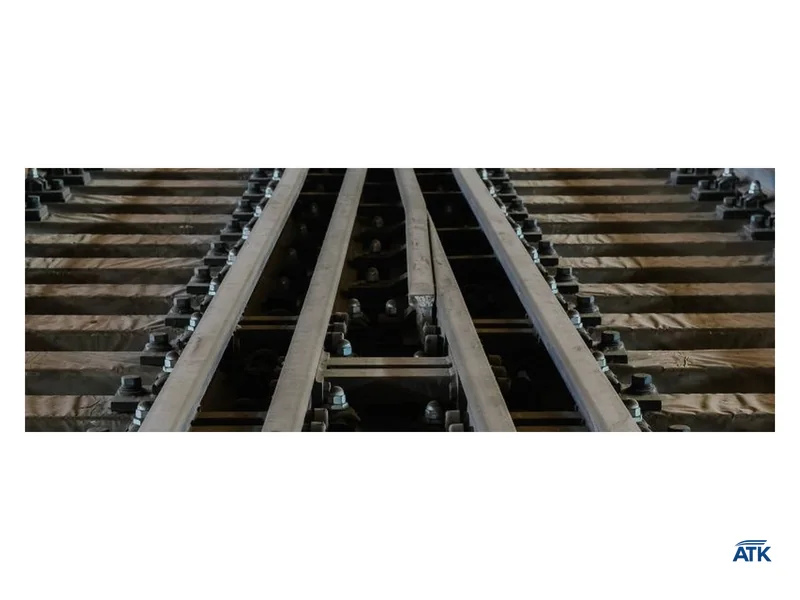
Metro and urban rail turnouts are the main application, particularly small-radius switch panels, reversing tracks and depot throats with slab or ballastless track. Slab track is stiffer than ballasted track, so there is almost no give under the plate beyond the basepad and the rail pad; what would have been absorbed by ballast goes into the steel. Add a tight turnout number and the lateral overturning force climbs again.
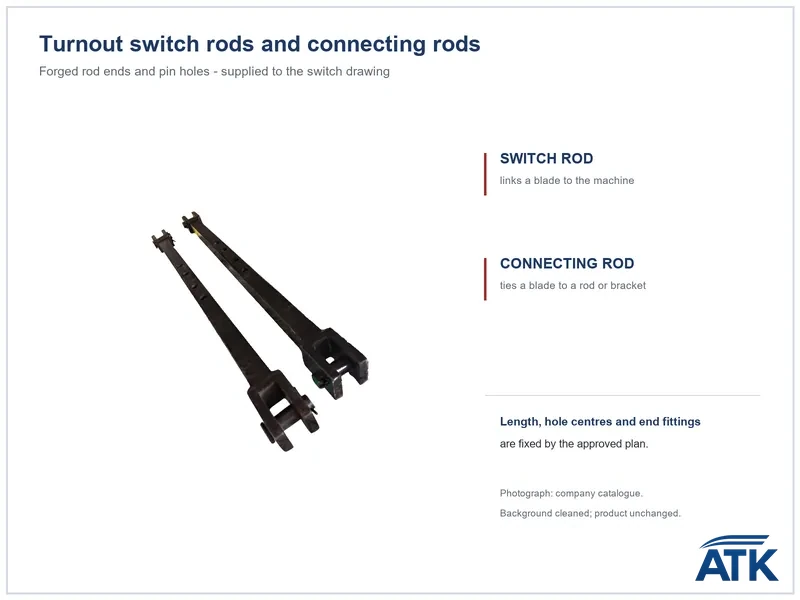
Mainline and heavy-haul turnouts use the same casting where the drawing calls for it, as do industrial and port railways with frequent shunting. ATK also supplies the associated turnout parts - slide baseplates, turnout baseplates, rail supports, gauge blocks and adjustment shims - so a complete turnout system or a mixed enquiry can be handled as one package.It sits in the same hardware family as the rail braces for the lead curve.
Fitting a cast plate is not complicated, but the surrounding details decide how long it lasts. Measure bearer levels before the plate goes down and correct them with proper gradient shims rather than loose packing under the middle. Keep basepad thickness consistent across the panel; a 12 mm pad in one position and a stack of thin shims in the next gives you a shear point. Use gauge adjustment shims to bring the frame dimensions back inside tolerance instead of a round steel bar, and check that the table edge sits close to the stock rail foot so the lever arm stays short.
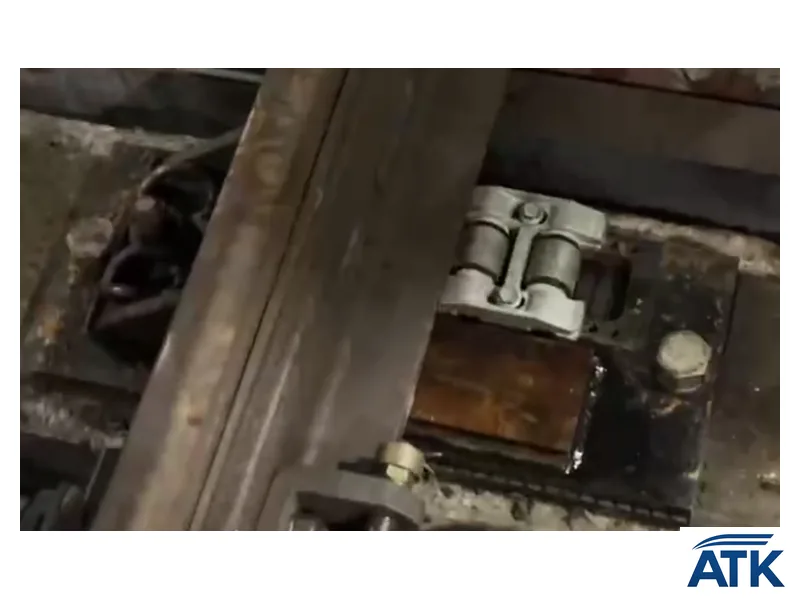
Where the turnout has no outer rail support, adding one changes the load path considerably - the lateral force from the stock rail no longer lands entirely on the lip. A TPEE basepad and a buffer sleeve between the plate hole and the sleeper screw are worth specifying on a stiff slab. After installation, the useful routine is dull: check bolt torque, look for pad extrusion, measure the rail-to-table gap, and wipe the travel surface. A cast plate still needs oiling, just less of it.
Send the turnout drawing number and the switch type. A P60-9# single turnout with 6,450 mm straight switch rails asks for a different plate from a depot turnout with a different rail section and frame dimension. The rail section, the gauge, the switch rail length, the position of each plate along the panel, the fastening type and the basepad specification all belong in the first message. If it is a replacement job, a photo of the failed plate and the measured bearer levels tell us more than a paragraph of description.
A drawing or an old sample is enough to confirm feasibility. We can develop and trial-produce slide baseplates to the turnout standard you work to, and we will confirm the specification before quoting rather than revise the price after the drawing arrives.
Yes, broadly. "Slide baseplate", "slide chair", "slide plate" and "switch plate" are used for the same turnout component in different standards and regions. A standards definition describes it as the part that supports and retains the stock rail and provides the flat surface on which the foot of the switch rail slides. German-influenced suppliers often say "slide chair base plate".
Because the retaining lip takes the lateral impact from the stock rail. Harden it along with the travel area and it loses the toughness that keeps it from fracturing. Graded hardening treats only the switch rail travel zone.
Less than a welded one, not zero. The hardened travel area resists rust and embedded filings, so oiling intervals stretch out, but the sliding contact still needs a maintenance regime. If you want a genuinely oil-free solution, a roller-assisted plate is the route to price - with stricter installation requirements.
The fatigue result comes from the product's assembly fatigue test programme, run to five million cycles without a crack against a two million cycle acceptance threshold. Ask for the test report when you request a quote; we will supply the record that applies to the batch being offered.
Yes. Send the drawing number, rail section, switch type and plate positions. We review feasibility first and confirm the specification before quoting. Trial production is available for non-standard switch panels.
MOQ follows the casting batch and the drawing rather than a fixed price list. Give us the quantity and the delivery window in the first message and we will say what is realistic before anything is quoted. Lead time is set by the casting slot and the inspection date.
Plates are stacked by drawing number with the hardened surface protected, strapped and marked so the receiving store can identify each position without opening every bundle. FOB or CIF, T/T or L/C at sight, with a packing list and dimensional inspection record. Third-party inspection can be arranged where the project specifies it.
Yes. Turnout baseplates, rail supports, gauge blocks, shims, insulated fishplates, steel rails and fasteners & hardware can go into one enquiry and one shipment, which usually saves more on freight than it costs in consolidation. Where the sleepers are timber, [screw spikes for wooden sleepers] can be added to the same list. For the plain baseplates in that list, the railway baseplate page covers the standards, materials and inspection basis.
Uneven bearer levels, inconsistent basepad thickness, over-torqued anchor bolts, a wide gap between the stock rail foot and the table edge, and missing outer rail supports. All of them increase the bending moment or the tensile stress in the plate. Fix those at installation and the casting gets a fair chance. The anti-jump device and limiting stopper sit on this plate and on the rail nearby, controlling the blade once the plate is level.
Send the turnout drawing number, the rail section, the switch type, the quantity and the delivery window. We can develop and trial-produce integral cast slide baseplates to your standard - GB, UIC, AREMA or GOST rail sections - and will confirm the specification before quoting. A datasheet, samples or a project price are available - contact us. For a mixed order, ask about our railway turnout components, steel rails, crane rail fastenings, insulated fishplates, track maintenance tools & equipment and fasteners & hardware in the same enquiry.
We have recommended some of our Related products to you. I hope you will be interested.
 English
 Русский