
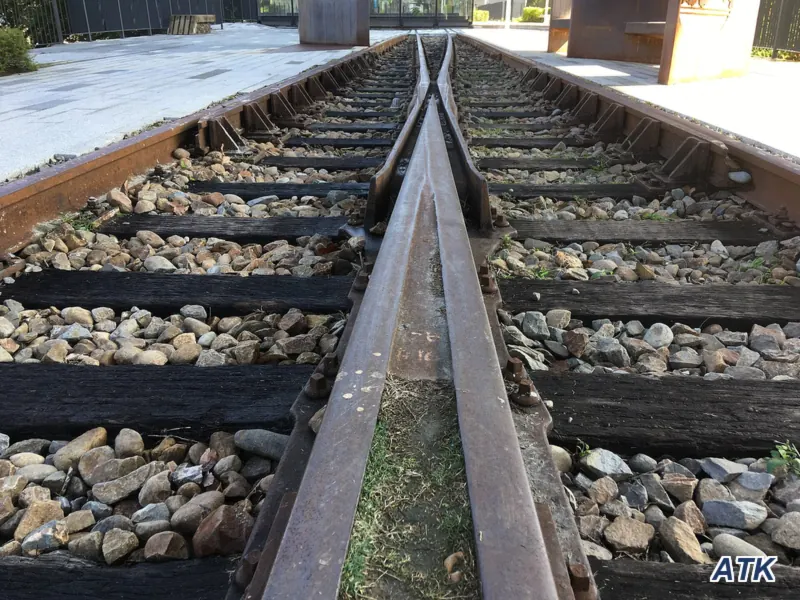
Solid cast austenitic manganese steel to GB/T 5680-2023
Frog numbers No. 7 to No. 20, 50 to 75 kg/m rail
Monobloc, welded-leg and assembled construction
Machined running surface with profile tolerance to drawing
Optional explosion pre-hardening of the transfer area
Radiography and dimensional inspection to EN 15689:2009
Heat number and casting serial for full traceability
Straight, curved, acute and obtuse crossings
Drawing package with joint details and tolerance table
A railway frog is the casting where two rails cross and the wheel has to bridge a gap instead of rolling on continuous rail. It is the one part of a turnout that cannot be made from a length of ordinary rail, and it sets how long the whole assembly lasts. The solid cast manganese type is one piece of austenitic manganese steel, cast to the finished crossing shape and then machined where the wheel actually runs.
Solid cast manganese frogs are used from 50 kg/m to 75 kg/m rail sections and from No. 7 to No. 20 crossings, in straight and curved form. The choice between a monobloc casting, a bolted assembly and a moveable nose follows from the track it goes into, not from a catalogue.
A wheel arriving at a crossing contacts the wing rail first, rolls across the gap in front of the nose, and lands on the vee at the transfer area. For a fraction of a second the whole wheel load passes over a section smaller than the rail head it came from, and it does that at every axle of every train.
The surface has to resist plastic flow, because a frog that deforms loses the profile the wheel is riding on. The body has to absorb impact without cracking, because the load arrives as a blow rather than a smooth roll. And the worn surface has to be re-machinable or weldable, because a frog is a consumable: it comes out when the vertical wear at the 40 mm section reaches the limit for its line class.
Austenitic manganese steel answers all three in an unusual way. In the water-toughened condition it is soft, around 200 HB, and tough enough to take the shock. Under repeated wheel pressure the surface work-hardens to somewhere between 300 and 500 HB, while the core stays austenitic and ductile. The casting hardens itself in service, and the harder it gets the slower it wears.
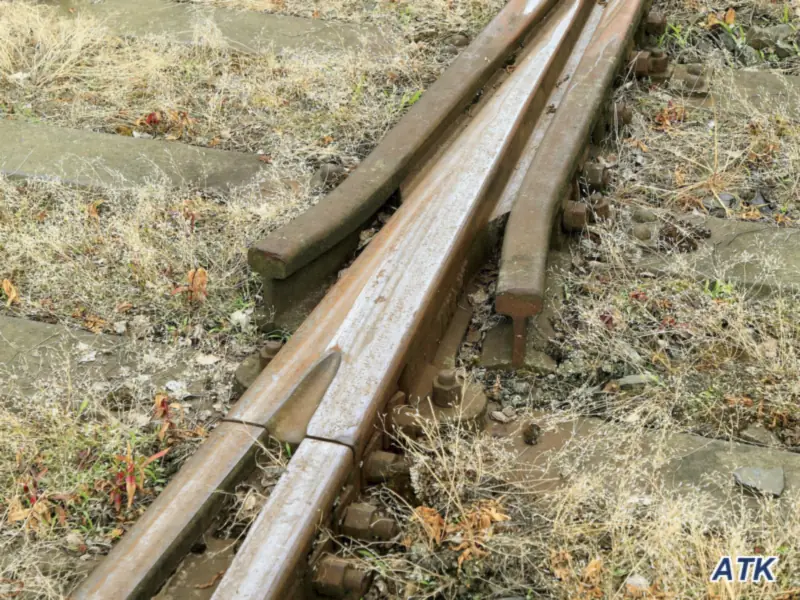
Orders and drawings fail on vocabulary more often than on dimensions. A buyer writes "frog point", a foundry reads "point rail", and the two turn out to be different features.
The terms below follow EN 13232-6, the European standard for fixed common and obtuse crossings. It sets working terminology for the parts, the construction types and the parameters used to describe a crossing, and it is the reference a European infrastructure manager will have in front of them.
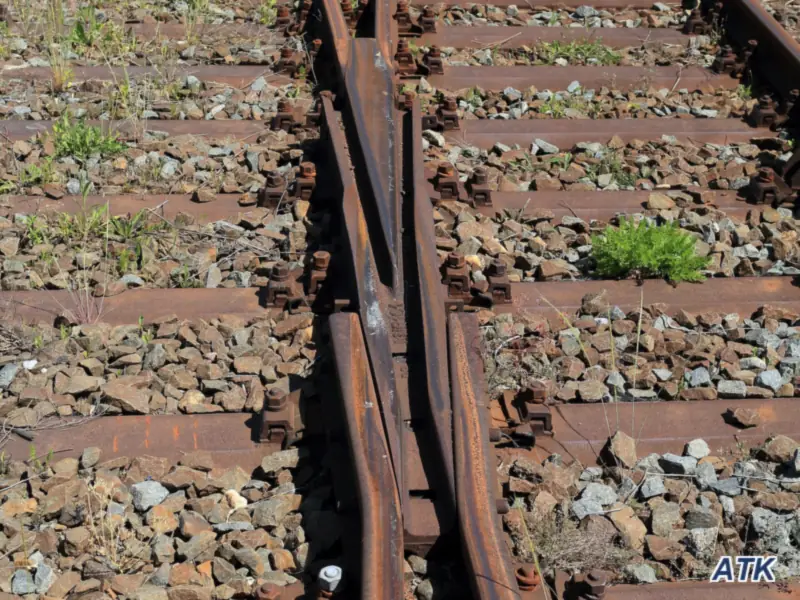
• Vee. The two rails welded or cast into a V, which carry the wheel across the gap. The nose is the tip, where the two running edges meet.
• Point rail and splice rail. In a built-up crossing the vee is made from two rails: the point rail is machined to form the nose, and the splice rail is spliced into it to complete the V. A monobloc casting has a vee but no point rail, which is why the two words are not interchangeable on a drawing.
• Wing rail. The outer part on each side that supports and guides the wheel across the flangeway gap, taking the load before the wheel reaches the nose.
• Throat. The narrowest opening between the two wing rails, ahead of the nose.
• Flangeway. The space between the guiding edge of the wing rail and the running edge of the vee. Its width is a safety dimension, not a clearance to be generous with.
• Transfer area. The area over which the wheel transfers its load from one running surface to another. This is where most surface damage starts.
• Toe and heel. The toe is the end facing the approaching train; the heel is the physical end of the vee at its open end.
• Apron. A plate between two rail sections at the wing front or the vee end.
Construction types divide the same way. A monobloc crossing is cast in one piece, nose and wing rails together. An assembled crossing bolts or welds separate wing rails and point rails to a common base. Welded legs describes a monobloc casting with rail sections welded on at toe and heel so the crossing can be joined to the running line by aluminothermic or flash-butt welding.
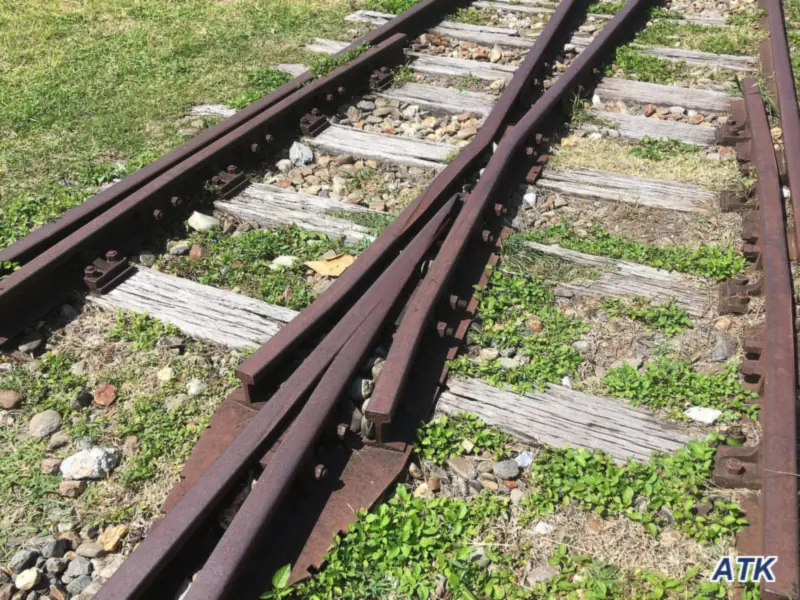
The frog number describes how sharply the diverging route leaves the main line, and it fixes the crossing angle — the frog angle, in older British and American usage. Two formulas are in international use, and they give slightly different angles for the same number.
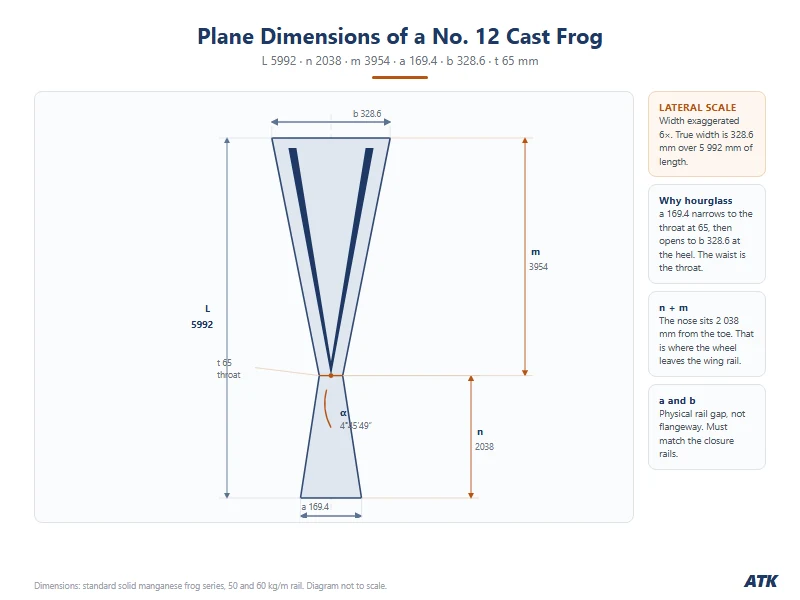
In the Chinese and most European practice, a frog number N corresponds to a crossing angle of arctan(1/N). A No. 7 crossing is therefore 8°07′48″, a No. 9 is 6°20′25″, and a No. 12 is 4°45′49″. Those three figures are the angles printed on standard 50 kg/m and 60 kg/m frog drawings, and they match the formula exactly — which is how you can tell which convention a drawing set is using.
In North American AREMA practice the definition is geometric rather than trigonometric: the number is the distance along the centreline, divided by the spread, so the angle is 2·arctan(1/2N). The same No. 9 becomes 6°21′30″ and the No. 12 becomes 4°46′18″.
The gap is not constant: two and a half minutes at No. 7, falling to seconds at No. 20. That is not a reason to reject a supplier. It is a reason to never convert a number across systems without checking the angle. A No. 12 frog is 5,992 mm long; half a minute of angle moves the heel opening by about a millimetre, which is enough to make a joint fit badly on site. Put the crossing angle on the drawing and let the number follow it.
Two more conventions matter at the interface:
• Where the point is measured. A North American drawing locates the "point of frog" at the half-inch point, the place where the gauge lines of the two point rails are half an inch apart. European drawings use the theoretical intersection of the gauge lines. The two positions are not the same, and a length dimension taken from one is not valid against the other.
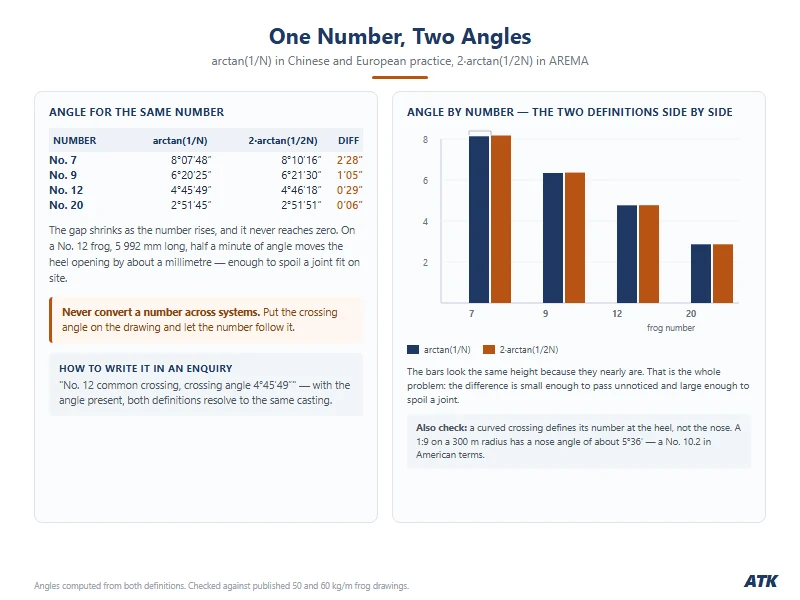
• Which angle the number refers to. EN 13232-6 defines two angles on a crossing: the angle of the crossing heel, taken between the tangents to the two track centrelines at the heel, and the angle of the crossing vee, taken between the running edges at the intersection point. On a straight crossing they are equal. On a curved one they are not, and a 1:9 curved crossing on a 300 m radius carries a vee angle of about 5°36′ — a No. 10.2 in American terms. Buying on the number alone gets you the wrong casting.
[FIG 3]
Dimensions below are for solid cast manganese frogs in the Chinese standard series, in millimetres. The letters are the ones used on the drawings: L overall length, n toe length, m heel length, a toe opening, b heel opening, t throat flangeway, S flangeway at the straight section of the wing rail.
Designation | α | L | n | m | a | b | t | S |
50 kg/m No. 7 | 8°07′48″ | 3441 | 1108 | 2333 | 157.1 | 330.8 | — | 46 |
60 kg/m No. 9 | 6°20′25″ | 4309 | 1538 | 2771 | 170.1 | 306.5 | 65 | 46 |
60 kg/m No. 9, long | 6°20′25″ | 4799 | 1715 | 3084 | 189.7 | 341.1 | 65 | 46 |
60 kg/m No. 12 | 4°45′49″ | 5992 | 2038 | 3954 | 169.4 | 328.6 | 65 | 46 |
50 kg/m No. 7, obtuse | 8°07′48″ | 4296 | 1108 | 2618 / 3188 | 156.7 | 450.9 | 70 | 47 |
Three points about reading that table.
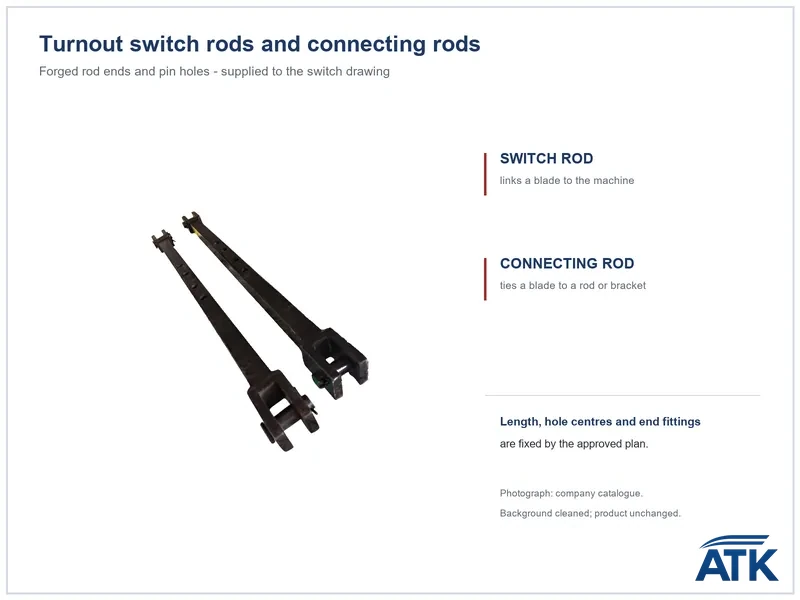
The toe and heel openings are not the same as the flangeway. They are the physical gap between the two rails at each end of the casting, and they must match the closure rails the frog is jointed to. A frog that is dimensionally correct but has the wrong heel opening will need the closure rail cut on site. Those mating rails are the closure rails, ordered to the turnout plan with their length, bend and drilling fixed before manufacture.
Obtuse crossings at the same number are longer than the acute ones, because the two routes diverge in opposite directions and the casting has to cover both. A No. 7 obtuse is 4,296 mm against 3,441 mm for the acute. Its heel length is given twice in the table because the two routes through an obtuse crossing are not symmetrical: 2,618 mm on the shorter side, 3,188 mm on the longer. The angle quoted is the acute angle between the two routes; the obtuse angle at the crossing itself is its supplement.
Longer variants of the same number exist so that a replacement can be fitted without moving the joints. When a frog is changed for the second, third and fourth time on the same site, each replacement is longer than the last and the running rails are cut back to suit. That is a maintenance convention, not a product feature, and it belongs in the order as a separate line: standard length, or standard plus an agreed extension.
The drawing package issued with an order carries the general arrangement, the machining drawing, the joint details at toe and heel, the dimensional and geometrical tolerances, and the reference profile for the transfer area. Tolerances on a finished crossing are covered by EN 13232-6 for European work and by the contract drawing elsewhere. Typical figures on a 60 kg/m casting are a rail head width of 71 mm with a 0 to +1 mm tolerance, and a web thickness of 20 mm ±2 mm. Verticality of the toe and heel faces to the running edge and rail top is 1 mm or less. Ask for the tolerance table with the quotation; a frog quoted without one is being sold on price alone.
The casting material is austenitic manganese steel to GB/T 5680-2023, which is the current Chinese standard for austenitic manganese steel castings and is modified from ISO 13521:2015. The grade used for crossings is ZG120Mn13.
GB/T 5680-2023 Table 2 gives the mechanical properties after water toughening. Yield strength Rp0.2 is at least 370 MPa and tensile strength Rm at least 700 MPa. The impact requirement is a Charpy test on U-notched specimens, designated KU2. The average absorbed energy of three is at least 118 J, and one of the three may fall below that but not below 70 per cent of it. Hardness is not above 300 HB. Carbon sits between 1.05 and 1.35 per cent and manganese between 11 and 14 per cent. The standard also limits non-metallic inclusions and requires a bend test to 150° without complete fracture.
The same grade appears in other systems as ASTM A128 Grade B-2, EN GX120Mn13 and ISO GX120Mn13. These are approximate equivalents, and a purchaser working to one of them should say so on the order rather than assume a substitution is automatic. The chemistry ranges and the test methods differ in detail.
Water toughening is the heat treatment that makes the grade usable. The casting is heated until the carbides that formed during solidification dissolve back into the austenite, then quenched fast enough that they cannot precipitate again. Do it properly and you get a single-phase austenitic structure that is soft, tough and ready to work-harden. Do it badly — too cool, too short a soak, too slow a quench — and carbides form on the grain boundaries, and the casting becomes brittle in exactly the place it needs to be forgiving.
Two hardening routes are applied to the running surface before delivery:
• Explosion hardening. A sheet explosive is laid on the running surface and detonated, sending a shock wave into the steel that multiplies dislocations without changing the shape. Published work on Hadfield steel reports a double pass reaching around 350 HB to a depth of about 16 mm, with a service life gain in the order of 30 per cent. A single pass hardens a shallower layer, and published depths and hardness values for it vary between sources, so it is worth asking which treatment the quotation covers. EN 15689:2009 carries special requirements for pre-hardened crossings, so a pre-hardened frog is a separate specification item, not a free upgrade.
• Casting-penetration or chill hardening. A penetration coating or iron chills placed in the mould refine the grain and raise the hardness of the transfer area during solidification. This is a foundry process rather than a post-treatment, and its result depends entirely on the mould design.
Whether a pre-hardened frog earns its extra cost depends on where it goes. On a busy main line with high axle loads the surface work-hardens quickly on its own and the gain is modest. On a lower-traffic route, where the surface never receives enough load to harden itself, explosion hardening does work that the service condition would not do — and that is the case worth paying for.
A manganese frog is a difficult casting. The section changes from a 71 mm rail head to a 20 mm web within a few hundred millimetres, and the casting is long and thin. The steel has a thermal expansion about 1.5 times that of pure iron and a low thermal conductivity. It wants to crack while it cools, and it wants to shrink away from the dimensions you designed.
The sequence runs: pattern and mould, melting and chemistry control, pouring, shakeout, riser removal, water toughening, shot blasting and grinding, machining of the running surfaces and the joint ends, then inspection.
The process controls that decide the outcome are not the ones a buyer usually asks about.
Phosphorus. Above roughly 0.04 per cent, phosphorus forms a brittle phosphide eutectic network on the grain boundaries, and both toughness and fatigue resistance fall away. A foundry that controls phosphorus is buying selected low-phosphorus ferromanganese; one that does not is saving money on the melt.
Riser and chill design at the toe and heel. The transition about 600 mm from each end is where cross-cracks appear, because the section changes there and the feed path is long. Sectioning a 60 kg/m No. 12 casting that had cracked in service revealed a shrinkage cavity of 20 to 30 mm diameter under the running surface. Insulating risers with a feed path, plus chills on the running surface, are what close that cavity.
Weld repair discipline. Manganese steel cannot be repaired like carbon steel. Every weld pass puts heat into a surface that was carefully quenched, and the heat-affected zone precipitates carbides unless each pass is followed by water quenching. EN 15689:2009 sets limits on weld rectification by the supplier for exactly this reason. Ask what those limits are in the quotation, and ask how many repairs a casting is allowed before it is scrapped.
Machining after heat treatment. The running surfaces and the joint ends are machined after water toughening, because the quench distorts the casting. Machining before the quench means the dimensions you inspect are not the dimensions that ship.
The inspection items below are the ones that catch a bad casting. Each should be named in the purchase order with the acceptance criterion, because a criterion not written down is a criterion not applied.
Item | Method | Criterion basis |
Chemical composition | Spectrometer on a sample from the ladle | GB/T 5680-2023 grade table |
Mechanical properties | Tensile and impact specimens, cast or attached, same heat and same toughening cycle | GB/T 5680-2023 Table 2 |
Internal soundness | Radiography, or ultrasonic testing where the buyer accepts the grain-structure limitation | EN 15689:2009, or contract |
Surface and near-surface defects | Visual, and liquid penetrant on machined faces | EN 15689:2009 |
Dimensions | Calliper, gauge and template against the drawing | EN 13232-6, or contract drawing |
Running surface profile | Profile gauge at the transfer area | Contract, against the reference profile |
Weld repairs | Repair map, count, and post-weld quench record | EN 15689:2009 limits |
Identification | Heat number, casting serial, grade mark on the casting | EN 15689:2009 traceability |
Hardness after pre-hardening | Brinell on the running surface, if ordered pre-hardened | EN 15689:2009 |
Radiography deserves a note. Ultrasonic testing is the usual method for steel castings, but the coarse as-cast grain of manganese steel scatters and attenuates the beam so badly that sizing a defect is unreliable. Radiography reads through the section instead. Liquid penetrant is the practical surface method, and magnetic particle is of little use on a metal that is close to non-magnetic. If a supplier offers only ultrasonic testing on a manganese frog and cannot explain how they size indications in that grain structure, the inspection is a formality.
Traceability is the other item worth insisting on. EN 15689:2009 requires crossings to be identified and traced, which in practice means a heat number and a casting serial that can be linked to the chemical analysis, the heat treatment record and the inspection report. A frog installed on a main line will be there for years and will be inspected repeatedly; without the serial number, its history starts from zero on the day it is laid.
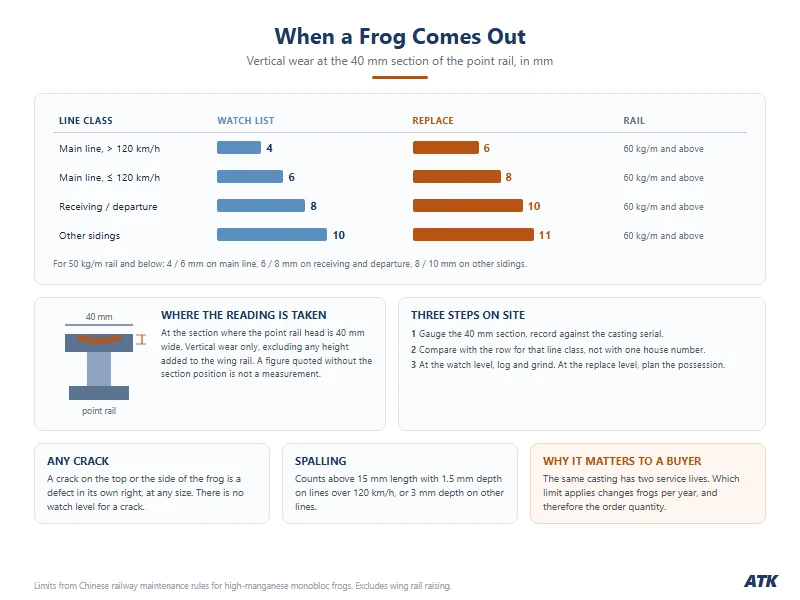
A frog is not replaced when it fails. It is replaced when vertical wear at the 40 mm section of the vee reaches the limit for that line class. The measurement excludes any height added to the wing rail, and it is taken at one defined position — which is why the same worn casting can be within limits on a siding and overdue on a main line.
The Chinese maintenance rules set two thresholds. The lower one marks the frog as damaged and puts it under observation; the upper one requires it to come out. The table covers 60 kg/m rail and above.
Line class | Light damage | Heavy damage |
Main line, permitted speed above 120 km/h | 4 mm | 6 mm |
Main line, permitted speed 120 km/h or below | 6 mm | 8 mm |
Receiving and departure tracks | 8 mm | 10 mm |
Other sidings | 10 mm | 11 mm |
For 50 kg/m rail and below the figures are 4 and 6 mm on main line, 6 and 8 mm on receiving and departure tracks, and 8 and 10 mm on other sidings. On a moveable-nose crossing, the wing rail wear at the sections corresponding to 40 mm and 20 mm vee width is judged against 4 mm and 6 mm.
Any crack on the top or the side of the frog is a defect in its own right, at any size. Spalling or shelling on the vee or wing rail counts when it exceeds 15 mm in length. On lines above 120 km/h the depth threshold is 1.5 mm; on other lines it is 3 mm. Under those thresholds the frog is watched and ground; above them it comes out.
That table is the reason wear belongs in the procurement conversation and not only in the maintenance manual. A buyer specifying frogs for a fleet needs to know which limit will apply where the frog is going. A frog wear limit set by line class changes the number of frogs per year, and therefore the order quantity. A No. 12 frog on a 120 km/h main line and the same frog on a siding are the same casting with two different service lives.
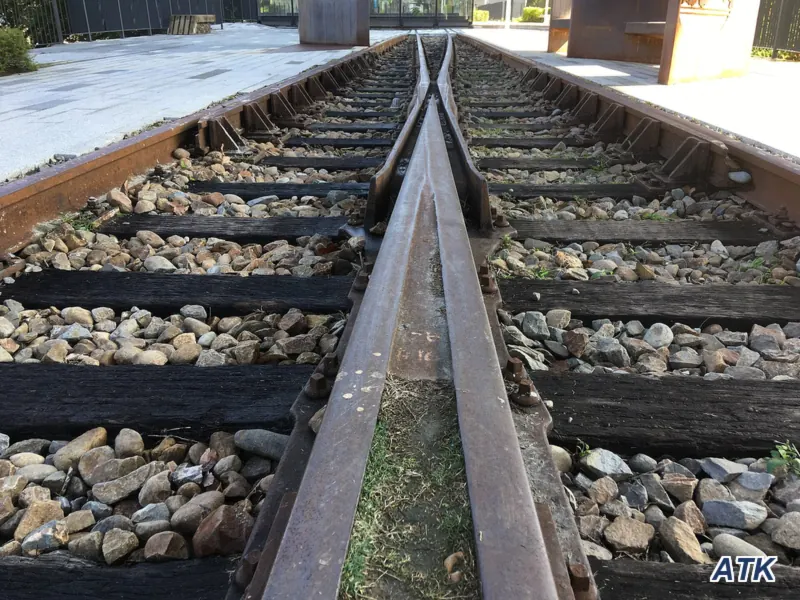
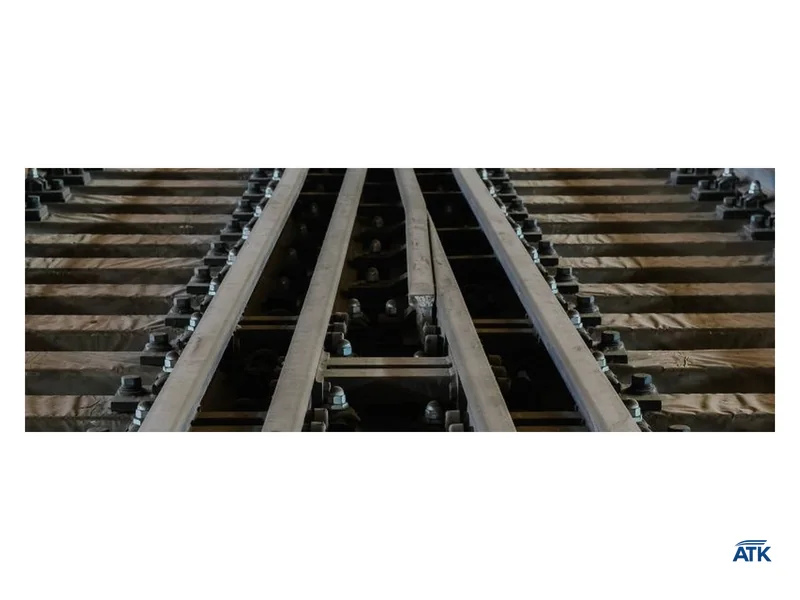
A cast frog arrives as a finished component and is installed between two closure rails, on bearers or sleepers. The joint at each end is made by heel fishplates or by welding where the specification allows. The work itself is not complicated. The sequence is what decides whether the frog lasts.
Check the frog against the drawing on arrival, before it goes anywhere near the track. Overall length, toe and heel openings, flangeway widths, and the position of the joint holes. A frog that has been dropped in transit can be out of flatness without showing a mark, and once it is in the track that is a shim problem forever.
Set the bearing first. The frog sits on a baseplate or directly on bearers, and any void under it means the casting takes the wheel load as a bending moment rather than as compression. Packing is not a substitute for a properly seated bearing surface.
Match the ends. The toe and heel openings have to meet the closure rails with the specified gap and with the running edges aligned. On a curved crossing, check the alignment against the chord specified on the drawing, not by eye.
Fasten in the specified order and to the specified torque. Joint bolts at toe and heel, then the baseplate or bearer fastenings, then a re-check of the flangeway dimensions after everything is tight. Torque values belong in the technical agreement; they differ with bolt grade and with the fastening system, and a generic figure from another railway is worse than no figure.
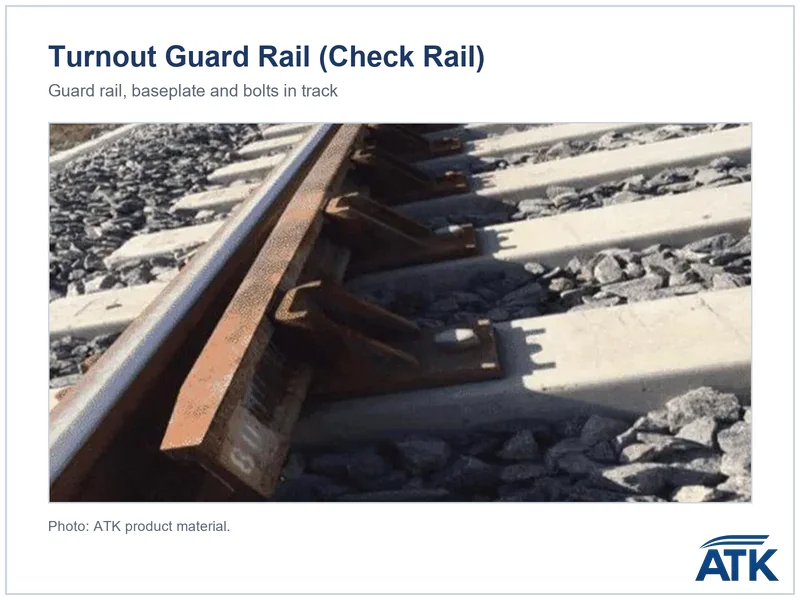
Then walk the crossing with a gauge. Flangeway at the throat and through the transfer area, check gauge and back-to-back clearance at the point where the wheel transfers, and the height of the wing rail relative to the point rail. Record the readings against the serial number of the casting. When the frog comes out years later, that record is the only baseline anyone will have. One of those readings, the check gauge, is set by the turnout guard rail on the opposite side of the track rather than by the casting.
The mistakes that recur on this type of work:
setting the frog before the bearers are consolidated, so the bearing is lost within a month
• mixing up the toe and heel ends on a symmetrical casting
• welding the joint without protecting the machined running surface from spatter
• taking delivery without recording the dimensions as installed
Manganese cast frogs are the default for good reason, but they are not the only answer. Two other constructions exist, and one surface treatment changes how a casting behaves.
Bolted alloy-steel frogs use a hardened alloy steel point rail with standard rail section wing rails, assembled with high-strength bolts. In China these are covered by TB/T 3467-2024, which classifies four construction types and sets the alloy steel point rail at a tensile strength of at least 1,240 MPa with a hardness of 38 to 45 HRC. The advantage over a casting is weldability: the wing rails are ordinary rail steel, so the frog can be joined to a continuously welded line. The disadvantage is more parts and more bolts to inspect.
Moveable-nose crossings eliminate the gap entirely by moving the point rail to close against the wing rail. They are covered by EN 13232-7, not Part 6, and they need a drive, locking and detection system. Use them where the crossing angle is shallow and the speed is high — a fixed nose at a small angle means a long gap and a hard impact.
Explosion-hardened or otherwise pre-hardened castings are not a separate type, but they behave like one in service, and they are worth specifying where the traffic will not harden the surface by itself.
The decision in practice comes down to three questions: can the frog be welded into the line, what is the axle load and annual tonnage, and how long is the possession window for replacement. A welded line with heavy traffic and short possessions points to a bolted alloy frog or a moveable nose. A jointed line, a siding, or a workshop with a stock of castings points to the monobloc casting.
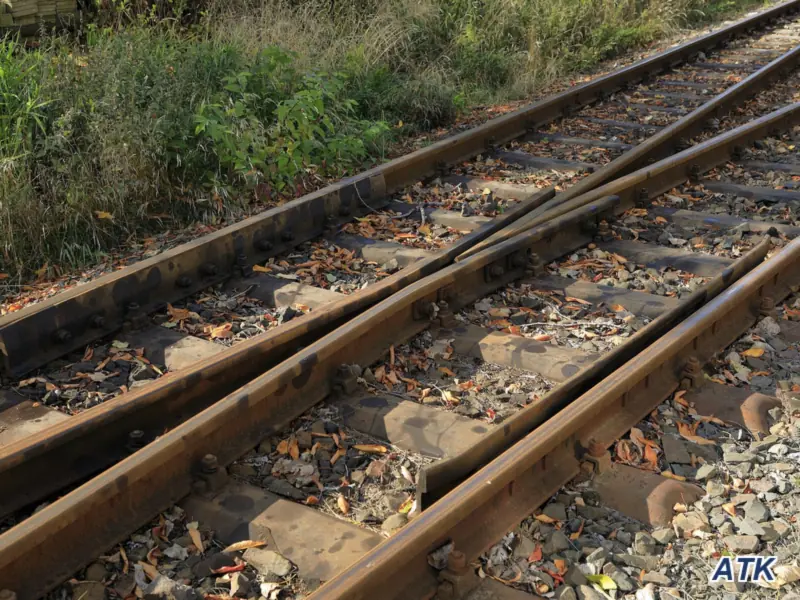
Most of a frog is fixed by the track it goes into. What can be varied is the interface and the surface treatment.
Can be specified.
• Rail section and steel grade of the jointed rails.
• Frog number and crossing angle.
• Straight or curved geometry, and the radius if curved.
• Left or right hand, obtuse or acute.
• Overall length, including any extension for a repeat replacement.
• Pre-hardening by explosion or by casting penetration.
• Machining allowance on the running surface for future re-profiling.
• Joint hole pattern and identification marking.
Fixed by the system. The flangeway widths, the check gauge and the back-to-back clearances follow from the wheel profile. The transfer area profile and the wheel-rail geometry at the throat follow from the network's vehicle envelope. A frog cannot be redesigned to suit a supplier's convenience, and a supplier who offers to change these has not understood the question.
A quotation should answer six questions in writing.
• Which standard the casting is made to, and which edition.
• Which grade, and what the mechanical property acceptance values are.
• Whether the running surface is pre-hardened, and by which method.
• What the weld repair limits are.
• What the dimensional tolerance table is, and how the casting is identified.
• What records travel with it, and what inspection the buyer may witness.
It is the cast or built-up part where two rails cross and the wheel bridges a gap instead of rolling on continuous rail. The words railroad frog and railway frog mean the same thing; common crossing is the term used in European standards and in most specifications. Common, obtuse and diamond describe different geometries of the same family of part.
Weakly, and not reliably. Water-toughened austenitic manganese steel is essentially non-magnetic, which is why magnetic particle inspection does not work on the running surface and why radiography and penetrant are used instead. A magnet that grips a machined face hard is worth asking about, though scale, rust and fittings can all mislead.
Because the drawing gives the hardness after water toughening, in the soft and tough condition. The surface hardens in service under wheel load. Both numbers are correct; they describe different states of the same casting.
Only with welding legs designed for it, and only with a procedure agreed in advance. The manganese casting itself is not readily weldable to carbon rail steel. Where the line is continuously welded, an assembled or bolted frog with rail-steel wing rails is usually the simpler answer.
In millions of gross tonnes, and the figure depends more on the site than on the casting. Curves, poor drainage, and a soft bearer condition all shorten it. Ask a supplier for a figure in MGT with the traffic and site conditions attached; a figure in years is not a lifetime, it is a guess.
It is the position on the vee where the running surface is 40 mm wide, measured across the head. Wear is measured there because it is the section that carries the wheel as it transfers, and because it is the position the maintenance rules use. A wear figure without a section position is not a measurement.
No. The flangeway width is a check dimension tied to the wheel flange and the back-to-back setting. Opening it up to stop contact damage removes the guidance the wheel needs and can allow a flange to strike the nose.
Because the two are using different definitions. The European and Chinese convention takes the angle as arctan(1/N); the North American convention takes 2·arctan(1/2N). Quote the angle on the drawing and the number becomes unambiguous.
Yes, and there is a European standard for it — EN 16725 covers the restoration and repair of manganese crossings. Whether it is worth it depends on the remaining section, the crack history and the cost of a possession. Repair is routine in some networks and not permitted in others; check which applies before planning the work.
The number follows from the diverging speed and the available length in the layout, not from a preference. A shallow crossing gives a smoother ride and a longer assembly. The turnout number selection guide works through the geometry.
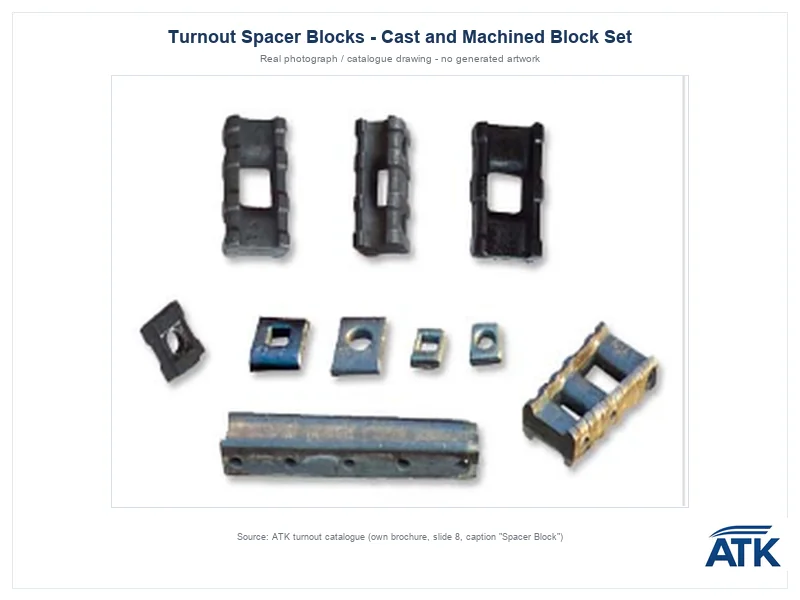
Through a baseplate or directly to bearers, depending on the fastening system, with the same spacer blocks and clips used elsewhere in the turnout. The frog end joints take fishplates or a weld; the body takes the turnout's normal fastening.
Loss of bearing. A frog that is rocking on a void at the transfer area will spall and crack long before its wear limit, and no material choice fixes that. The frog failure modes article works through the crack and spalling patterns and what each one points to.
A quotation depends on these inputs.
• Rail section and steel grade, with the standard for each.
• Frog number and crossing angle, and whether the number follows the European or the American definition.
• Straight or curved, with the radius if curved.
• Acute or obtuse, left or right hand.
• Overall length, and whether an extension is needed for a repeat replacement.
• Joint hole pattern at toe and heel, or a drawing of the closure rail ends.
• Pre-hardened or not, and by which method.
• Inspection scope: radiography, mechanical tests, witness points.
• Identification and record requirements.
• Quantity, and whether the order is a first installation or a replacement programme.
The turnout assembly this frog sits in is described on the railway turnout page, including the switch, the fastenings and the bearer arrangement it has to fit.
We have recommended some of our Related products to you. I hope you will be interested.
 English
 Русский