
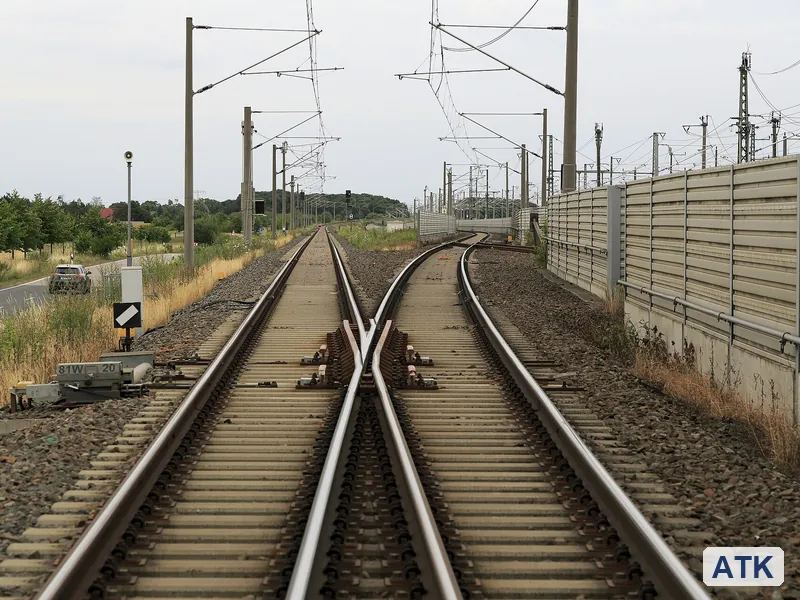
Explains frog failure by unsupported flangeway count instead of wear depth: two, one or none per crossing type, 14 failure modes grouped for inspection, why fatigue outranks wear, service life in MGT, differential settlement over stiffness, and a replacement survey checklist with 10 FAQ.
Frog maintenance usually starts in the wrong place. A fitter looks at the nose, sees the polished dip left by a million wheel passes, and writes a replacement request. The defect that actually ends the service life is often somewhere else — a bolt hole crack in a leg rail, a corner of the casting, a welded stop under the platework. Wear is the visible part of the story and rarely the deciding one.
What separates a frog from plain line is not tonnage. It is the moment a wheel leaves one rail and lands on another. Load amplification, fatigue, settlement and most of the inspection work that follows all trace back to that one geometric fact.
A frog exists because two rails cross, and a wheel has to pass through one of them. The slot cut for the flange is the flangeway, and it is the largest of the running surface interruptions in the frog.
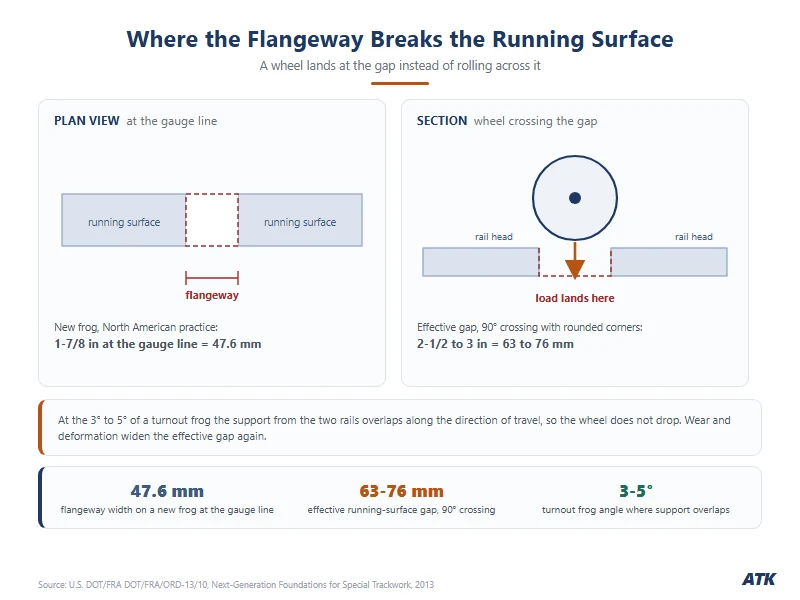
On a new North American frog the flangeway measures 1-7/8 in at the gauge line — about 47.6 mm. With the rounded corners typical of a casting, the effective running-surface gap on a 90-degree crossing is closer to 2-1/2 to 3 in, roughly 63 to 76 mm. The wheel does not roll across that; it lands, transfers load, and bounces.
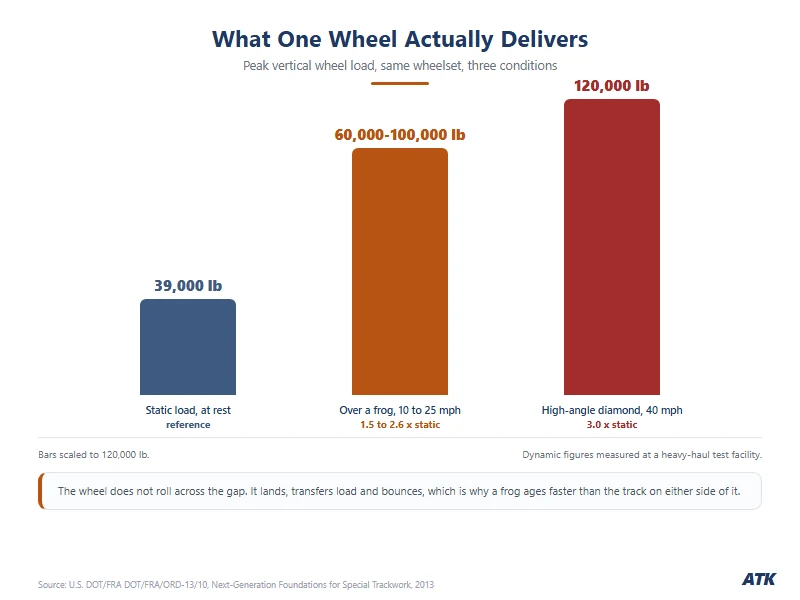
Measured at a heavy-haul test facility, a wheelset with a 39,000 lb static load produced peak dynamic loads of 60,000 to 100,000 lb at 10 to 25 mph. A 315,000 lb car crossing a new high-angle diamond at 40 mph reached 120,000 lb, three times its static wheel load. These figures come from the U.S. DOT/FRA research report DOT/FRA/ORD-13/10, published in 2013, and they explain the maintenance history of a turnout better than annual tonnage does.
Geometry offers one piece of relief. The effective gap narrows as the crossing angle flattens, and at the 3 to 5 degrees typical of turnout frogs the support from the two rails overlaps along the direction of travel. In theory the wheel rolls from one onto the other without dropping. Worn running surfaces enlarge the effective gap again, which is why the same casting can perform well when new and badly when half-worn.
That difference is why experience from a diamond crossing does not transfer to a turnout frog. The two are the same component family with different geometry, and the numbers that describe one will mislead you on the other. A frog is also only one panel of a larger assembly. The boundary of what is being replaced matters as much as the part itself. Settle it before pricing is discussed — see the railway turnout assembly page for how the panel scope is defined.
The flatter angles that carry continuous support belong to higher-numbered turnouts. Which number a project can use is a separate decision: diverging speed, axle load and available length set it, not frog performance. turnout number selection covers that geometry trade-off, and the two decisions should be made in that order.
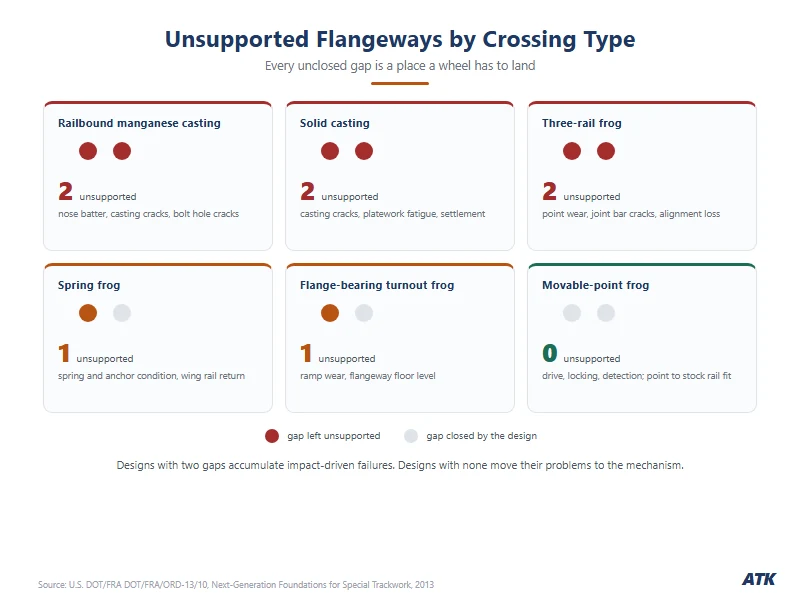
The same FRA study mapped failure modes against a single structural property of each crossing design: how many flangeways are left unsupported by running surface.
Railbound manganese castings, solid castings and three-rail frogs each carry two unsupported flangeways. A spring frog and a flange-bearing turnout frog carry one. A movable-point frog and a flange-bearing diamond carry none.
That count is not a marketing ranking. It tracks the measured dynamic load, because every unsupported gap is a place where a wheel has to land. Designs with two gaps accumulate the impact-driven failure modes; designs with none shift their problems to the mechanism that closes the gap.
Crossing arrangement | Unsupported flangeways | Where it is used | Where maintenance attention goes |
Railbound manganese (RBM) casting | 2 | Conventional mainline, yards, industrial track | Nose and wing rail batter, casting cracks, bolt hole cracks |
Solid casting | 2 | Heavy-haul mainline, high-angle crossings | Casting cracks, platework fatigue, settlement |
Three-rail | 2 | Special layouts and junctions | Point wear, joint bar and track bolt cracking, crosstie and ballast breakdown |
Spring frog | 1 | Heavily used mainline with moderate diverging traffic | Spring and anchor condition, wing rail return, fastener fatigue |
Flange-bearing turnout frog | 1 | Low diverging tonnage off a mainline | Ramp wear, flangeway floor condition |
Movable-point frog | 0 | High-speed and heavy-tonnage mainline, crossovers | Drive, locking and detection faults; point and stock rail fit |
Flange-bearing diamond | 0 | Heavy-haul crossing diamonds | Flangeway floor level, ramp wear |
The count and the design list come from the study. The last column is a maintenance reading rather than a copy of its table. Read it as a forecast and not a specification. A frog with two unsupported flangeways will ask for running-surface work, a frog with none will ask for mechanism work. Budgets and spares lists should follow the same split.
Published heavy-haul practice lists the frog failure modes that appear in revenue service. Fourteen are common enough to plan for.
Running surface height loss comes two ways, through metal flow and through wear. Differential settlement, casting cracking and frog point cracking follow. So do rail bolt hole cracks, joint bar cracking and track bolt failures. Platework cracking, rail fastener and shoulder weld fatigue and plate welded stop failure come next, with crosstie splitting, crosstie to ballast abrasion and loss of alignment underneath.
Fourteen items is too many to hold in your head at trackside. Grouped by what an inspector actually sees, they collapse into four.
Group | What you find | Modes inside the group |
Running surface | A dip, a lip of flowed metal, a battered nose | Height loss by metal flow, height loss by wear |
Casting and point | A crack in the casting body, or in the nose or point | Casting cracking, frog point cracking |
Bolted connections | Cracked holes, loose or broken bolts, cracked bars | Rail bolt hole cracks, joint bar cracking, bolt failure, welded stop failure |
Support and fastening | Cracked platework, tired clips, split ties, dirty ballast, movement | Platework cracking, fastener and shoulder weld fatigue, crosstie splitting, ballast abrasion, loss of alignment, differential settlement |
The grouping is useful because each group has a different owner and a different remedy. Running surface work is grinding and profile restoration. Casting cracks are a replacement decision. Bolted connections are torque, fit and hole condition. Support problems are surfacing, ballast and plate renewal — and they are the group most often misread as "the frog has worn out".
Bolted connections deserve a note of their own. Where a joint stops staying in compression, the bolts begin acting as pins and the rail carries load through the hole rather than through clamped faces. That is why a hole crack appears in a rail that shows no surface distress at all. Bolt grade and tightening practice belong to a separate specification; track bolt grades covers the strength classes and what has to be stated on the order.
The instinct at trackside is to measure depth. Depth is easy to measure, easy to record, and easy to compare year on year. It is also a poor predictor of when a frog will be taken out.
The FRA study states the position directly: wear is not often the root cause of frog failure and removal, and because dynamic loading at these locations is so high, fatigue is the dominant failure mode in heavy-haul service. The mechanisms behind that are visible in the material. Austenitic manganese steel work-hardens under impact, which is why it survives the nose at all, but it also flows. At roughly 20 to 25 percent strain the casting reaches the limit of what that flow can absorb, and cracking follows. Stress raisers are built into the design at bolt holes and corners, accepted because the material is tough enough to tolerate them until it is not.
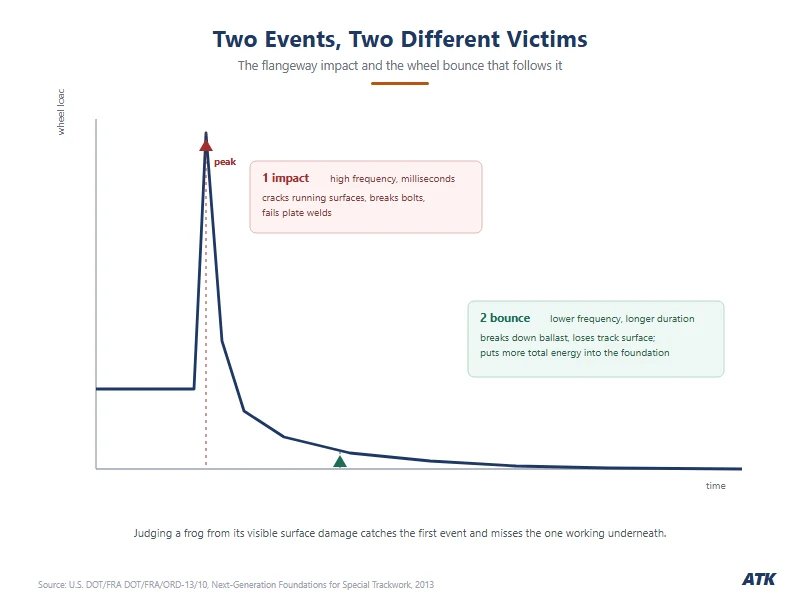
Every pass delivers two events, and they do different damage. The flangeway impact is short and violent — high frequency, over in milliseconds — and researchers attribute running surface cracking, broken bolts and plate weld failures to it. A wheel bounce follows at lower frequency but with more total energy, and that one is tied to ballast breakdown and loss of track surface. On a turnout frog at 3 to 5 degrees the first event is much reduced. That is why the second one deserves the attention. Judging a frog from its visible surface damage catches only the first and misses the one working on the foundation underneath.
Size works against the casting as well. A turnout frog may be 30 to 40 ft long, so track settlement puts bending into a component that is being asked to behave like a beam as well as a running surface. Excessive deflection under load is a separate route to casting cracking.
The practical consequence: a frog with an acceptable wear profile can be closer to failure than one with a deeper dip and no cracks. Record both, and let the crack map and the settlement history carry more weight than the depth reading.
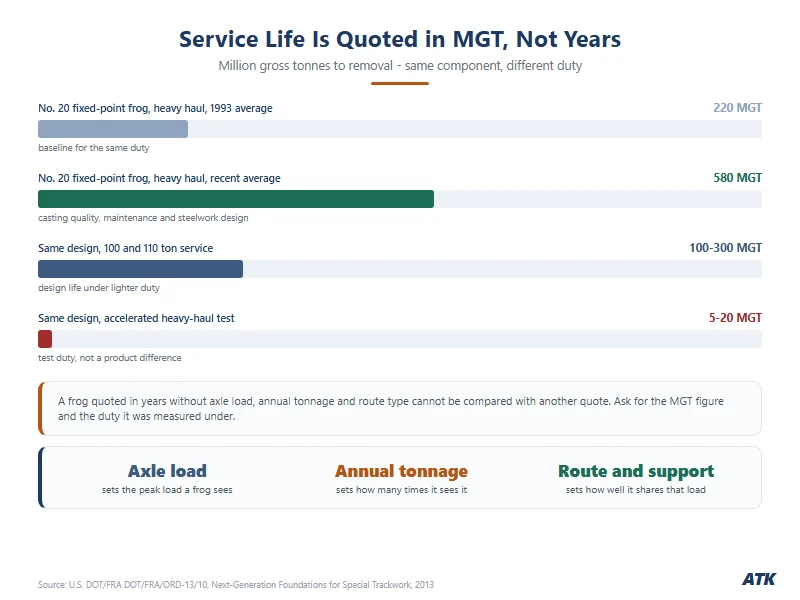
Service life for frogs is quoted in million gross tonnes, not years, and the reason is that tonnage is what the component actually experiences. Two turnouts of the same design on the same network can differ by a factor of thirty depending on axle load, traffic mix and support condition.
Published figures show the spread. A mainline No. 20 fixed-point frog in heavy-haul service averaged about 580 MGT, against 220 MGT for the same duty in 1993, an improvement the report credits to casting quality, maintenance and steelwork design. The Association of American Railroads put the growth in average service life between 1990 and 2005 at 257 percent for turnout frogs and 500 percent for crossing diamond frogs.
At the other end, crossing diamonds tested under heavy-haul conditions at an accelerated facility lasted 5 to 20 MGT, against 100 to 300 MGT for the same designs under 100 and 110 ton service. The difference was the test duty, not the product.
What that means for planning: ask for the MGT figure and the duty it was measured under. Years only become comparable once tonnage per year is known, which is why a lightly loaded metro frog can stay in track for decades while a heavy-haul frog is measured in single-digit years. A supplier who quotes "five years" without axle load, annual tonnage and route type has given you nothing you can compare.
A turnout is stiffer than the track either side of it, and the common explanation for frog damage is that the wheel hits this stiffness step and loads the component. The research does not support that explanation.
Analysis of a track modulus change from 2,000 to 30,000 lb/in/in — a soft approach into an open-deck bridge — put the dynamic load increase at roughly 6 to 8 percent. A separate finite element study of an abrupt stiffness change at 200 mph produced about 8 percent going from soft to stiff and 7 percent the other way. Large stiffness steps do not generate the loads usually attributed to them.
Differential settlement does. Traffic rates on the main and diverging routes differ, the dynamic loading differs with them, and the result is uneven vertical movement around the frog. The geometry defect that follows is what produces the high forces. Settlement correlates with the damage, but the cause is the loss of support, not the change in stiffness.
For maintenance this flips the usual response. Renewing ballast and surfacing the track adjusts the foundation; fitting a stiffer frog into a settling foundation makes the impact worse, because once a crossing is worn, wheel-rail impact rises with foundation stiffness rather than falling. On a new crossing with no differential settlement, optimising foundation stiffness and damping was modelled to cut impact by about 30 percent. On a worn one, the same optimisation moves the wrong way.
The bearing and seating components belong in this discussion too. Platework cracks because it spans a settlement that the frog above it cannot follow. A plate that has lost its seat will keep cracking whatever is bolted to it. integral cast slide baseplates sets out how the seating and slide interfaces are specified for turnout service.
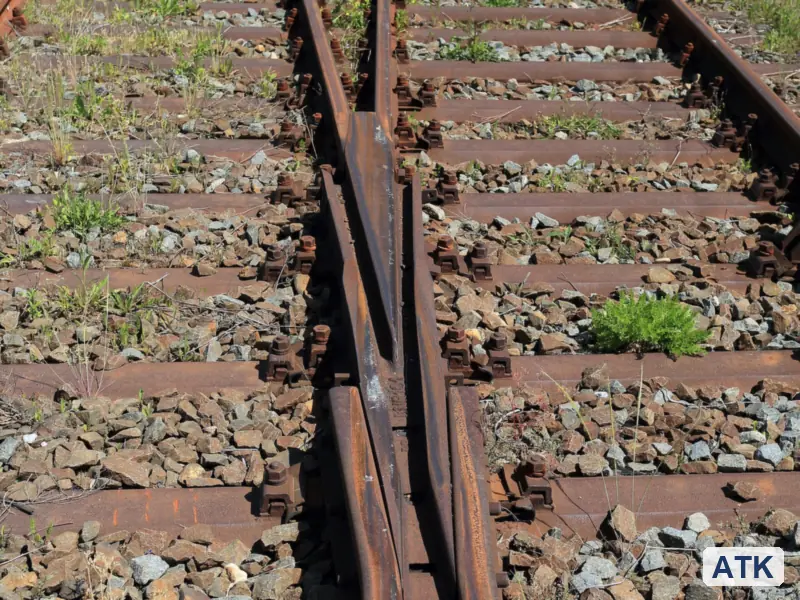
A movable-point frog removes the unsupported flangeway, and with it the impact that drives most of the failure modes on the list. That is a real engineering gain and not a marginal one. It is also not free.
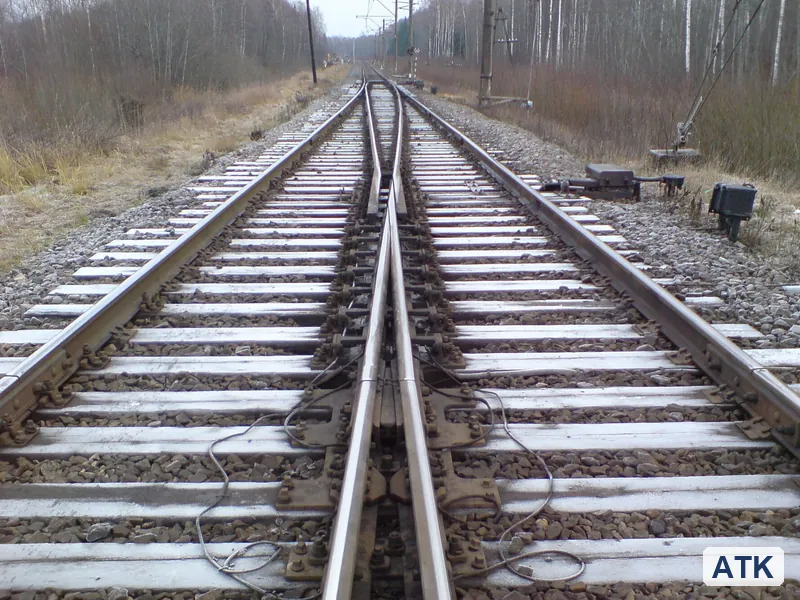
The point has to be driven, locked and detected, which means a switch machine or an equivalent actuator, rodding, a locking arrangement and detection that the signalling system can trust. Drainage and obstruction become operational issues, because ballast or ice under the point stops it closing. The failure profile shifts from running surface to mechanism, as the table earlier shows.
The economics have been analysed, and the threshold is high. Published work suggests traffic in the range of 60 to 100 MGT per year before the initial cost premium of a movable-point frog is justified. Below that, a fixed frog with good support and a maintenance plan is the better buy, even on a mainline.
Two conditions can override the tonnage argument. Where the diverging route carries passenger traffic at speed, the ride quality through a fixed gap becomes a service issue rather than a cost issue. And where the signalling already provides reliable detection and the maintenance organisation can keep the mechanism adjusted, the operational risk of the extra equipment is lower. Neither condition replaces the calculation.
Frogs reward a fixed order of inspection, because the cheap findings explain the expensive ones.
Start with support. Look for a dip or a rise through the frog relative to the approach track, and check whether it is on the main route, the diverging route or both. Uneven settlement explains a large share of the damage found later.
Then check the running surface for the two kinds of height loss: a flowed lip of metal at the nose, which points to impact, and a broad polished dip, which points to wear. Note where each sits.
Move to the bolted connections. Look for fretting dust around joint bars, gaps at clamped faces, bolts that will not hold torque, and cracks running from bolt holes into the web. A joint that has lost compression is on its way to a hole crack.
Check the casting for cracks at the corners, at bolt holes and around the point, and check the point itself for plastic flow and for cracking. Where the frog has a welded stop, look at the weld and the plate beneath it.
Finish with the fastening system: clip condition, shoulder welds, tie or bearer condition under the frog, and ballast condition around it. A tired clip at a frog is a symptom, not a cause — the deflection it sees is larger than its working range was designed for.
Acceptance limits and inspection intervals come from the infrastructure manager's maintenance rules and the approved drawing. They are not transferable between networks, and no generic depth figure substitutes for them. What transfers is the order of inspection and the discipline of recording location, dimension and trend for every finding.
A replacement railroad frog is a survey job before it is a purchasing job, because the new unit has to fit track that already exists. An order that says only "one No. 9 frog" cannot be drawn, priced or checked. What the drawing has to carry — grade, crossing angle, tolerances and inspection items — is set out in the cast manganese frog specification.
The information that has to be settled first:
· Rail section of the connecting track and of the frog, including whether the leg rails differ
· Crossing number, and the notation convention used to state it
· Hand, seen from the facing direction
· Arrangement: fixed or movable-point
· Construction and material standard, such as a high-manganese casting to GB/T 5680-2023, a frog to TB/T 447-2020, an alloy-steel combined frog to TB/T 3467-2024, or a movable-point crossing to EN 13232-7:2023
· Drilling and bolt hole pattern, including the joint bar to be reused
· Support arrangement below: plates, bearers and any height adjustment
· Connection details at both ends
Where the original drawing is missing, the survey has to reproduce it. Record the gauge line offsets along the frog, the position of every bolt hole relative to the nose, overall length, and the height of the running surface against the adjoining rails. Photographs help, but they do not replace dimensions.
State the standard edition, not just the organisation. A drawing that says "manganese steel" without a grade, or "to AREMA" without the plan number, leaves the acceptance criteria open. For projects where the original specification is long gone, describe the duty instead — axle load, annual tonnage, diverging speed — and let the supplier propose a construction, then approve it against the drawing.
Fatigue. Heavy-haul research found wear rarely the root cause of frog removal, with fatigue dominant under high dynamic loading.
Report it in MGT, not years. A No. 20 fixed frog averaged about 580 MGT in heavy-haul service, against 220 MGT in 1993.
The casting work-hardens and also flows. Around 20 to 25 percent strain it reaches its limit, and cracks start at bolt holes and corners.
About 1-7/8 in, or 47.6 mm, at the gauge line. The effective running-surface gap on a 90-degree crossing is wider, roughly 63 to 76 mm.
Sometimes, if an approved procedure covers that material and defect. Manganese steel is sensitive to welding heat and to incompatible repair methods.
They remove the unsupported flangeway, so impact drops sharply. Drive, locking and detection add failure points and maintenance work of their own.
Differential settlement between the main and diverging routes, plus ballast breakdown under repeated impact. Stiffness change alone accounts for little.
Against the infrastructure manager's limits and the trend of recorded defects. No universal depth figure applies across networks.
The approved drawing, or a measured survey: rail section, number, hand, arrangement, material standard, drilling pattern and support details.
A flatter angle gives continuous support in theory. Axle load, support condition and maintenance practice decide more than the number does.
We have recommended some of our Related products to you. I hope you will be interested.
 English
 Русский