
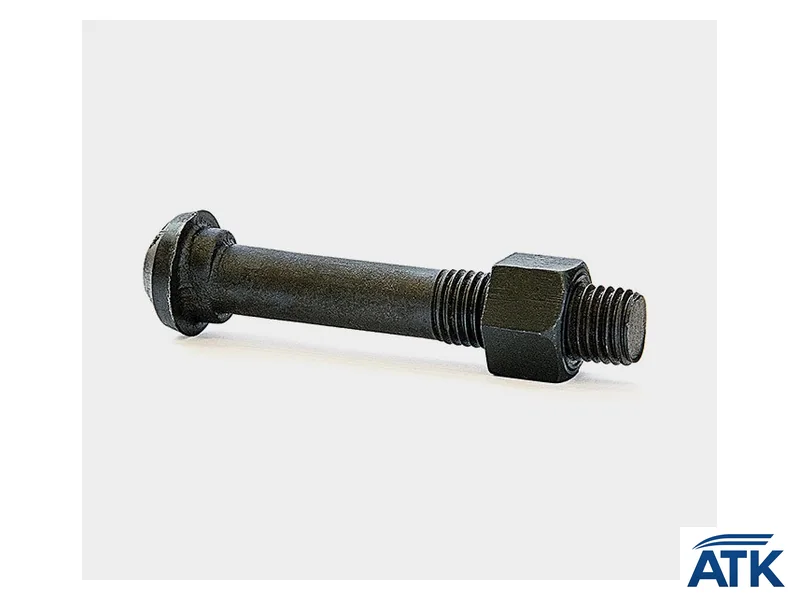
Fish bolts, BHON and diamond neck track bolts for bolted rail joints
T-bolts, clip bolts, anchor bolts and hook bolts for baseplates and clip assemblies
Property classes 4.8 / 8.8 / 10.9 / 12.9 to ISO 898-1 and GB/T 3098.1
8.8S and 10.9S high-strength insulated joint bolts to TB/T 2347-1993
ASTM A183 heat-treated track bolts (A183-03 Grade 2) and AREMA Chapter 4 sections
M22 x 135 / M24 x 150 / M27 x 160 to GOST 11530-76, and imperial 5/8 in to 1-1/4 in
Matched heavy nuts, spring washers and flat washers supplied as a set
Plain, black oxide, zinc plated, HDG, Dacromet and sherardized finishes
Trial production to your rail section, fishplate drilling and drawing
Railway track bolts, fish bolts and joint bar bolts are the fasteners that clamp a fishplate to the rail web at a bolted joint. They are bought as a matched set with nuts, washers and a bar drilled to the rail section. Head and neck profile, property class, length and standard edition decide fit; torque comes from the project specification.
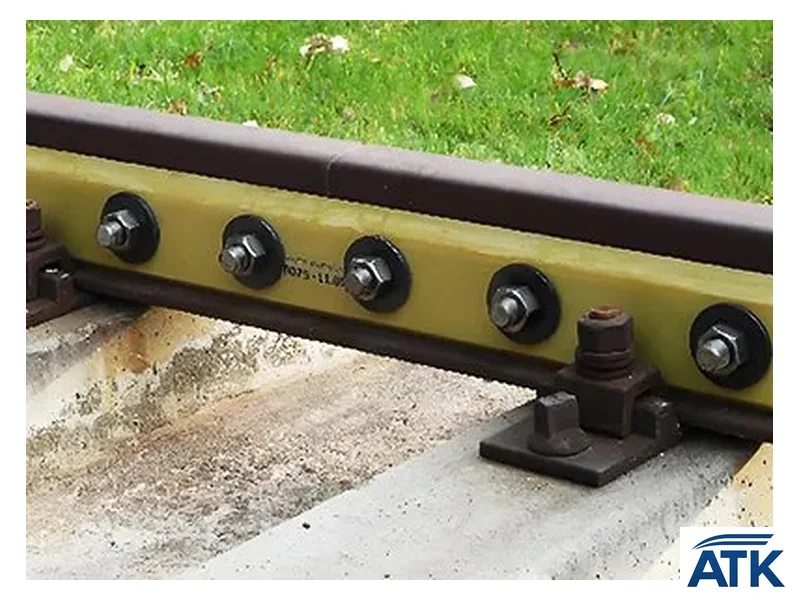
At a bolted joint, four or six track bolts clamp the fishplate to the rail web. Each wheel passage puts an impact load through that joint, so the bolts have to keep the two rail ends in line without losing preload. Continuous welded rail has removed most mainline joints, but bolted ones are still there at insulated joints, switch ends, turnouts, temporary track during construction, and on most industrial and crane runways. The same bolt family, with a different head, also fixes baseplates and clip assemblies to sleepers and steel girders. The bar and drilling side of that assembly is compared in AREMA vs UIC Fish Plates.
What separates a fish bolt from a plain hex bolt is the neck, not the head. A fish bolt has a shaped neck - oval, square or diamond - that drops into the matching elongated hole of the joint bar. That neck stops the bolt turning while the nut is tightened, so a track crew can work with one wrench from one side of the rail. A plain hex bolt in the same hole would spin, and no amount of torque would hold it. The same idea appears in a T-bolt, whose flat head slides into a slot in the baseplate, and in a hook bolt, whose forged hook reaches under the edge of a crane girder flange.
Orders that give only a thread size cause most of the back-and-forth. A track bolt belongs to a matched set - heavy nut, spring washer, flat washer and a joint bar drilled to the same pattern. Get the neck profile or the bolt length wrong and the assembly either will not go together or will lose preload after a few weeks of traffic.
Bolt type | Neck / head | Governing spec | Thread and length | Mating parts |
Fish bolt / joint bar bolt | Oval, diamond or square neck; button head (BHON) in North America | TB/T 2347-1993; AREMA practice; ISO 898-1 for property class | M22 / M24 to TB/T 2347; imperial sizes to the approved joint drawing | Heavy nut, spring washer, flat washer; insulating set where the joint is signalled |
Frog or switch bolt | Heavy hex or cup head | Turnout drawing; rail class where specified | To the turnout or crossing drawing | Heavy nut and washer set matched to the joint bar |
T-bolt / clip bolt | Flat T head for a baseplate slot | 23G525; JB/T 10543-2018 for WJK assemblies | Set by the clip plate and rail section | Nut, spring washer, clip and plate as one assembly |
Hook bolt | Forged hook under the girder flange | Project drawing; no product standard names the hook bolt | Set by the beam flange and clamp plate | Clamp plate, nut and washer; no drilling or welding to the girder |
Anchor bolt | Hex head; cast in or resin bonded | Project drawing and base detail | Set by the concrete or steel base | Baseplate, nut and washer to the approved detail |
Enquiries arrive under several names for the same part. The table maps them to the wording used on drawings and in purchase orders.
Term buyers use | What it means here | How we use it |
Track bolt / railroad track bolt | The standard North American term | Primary term |
Fish bolt / fishbolt / fishplate bolt | The most precise term for a joint-bar bolt | Primary synonym |
Rail joint bolt / joint bar bolt / splice bolt | Same part, phrased around the joint | Primary synonym |
Rail bolt / railway bolt / railroad bolt | Generic catalogue wording | Secondary synonym |
BHON bolt (button head oval neck) | A specific AREMA head profile | Long-tail term |
Diamond neck / square neck / cup head oval neck bolt | Neck-profile variants | Long-tail term |
Frog bolt / switch bolt | Bolts at turnout frogs and switch ends | Long-tail term |
T-bolt / clip bolt / clamp bolt / anchor bolt / hook bolt | Other bolt families in the track | Product variants |
Track bolt and nut set / three-piece joint kit | Bolt + nut + spring washer | Kit term |
Rail bolt and nuts / OTM fasteners | Other Track Material cataloguing | Category term |
Four words cause trouble if used loosely. A screw spike is threaded into a sleeper or a plastic dowel, not through a fishplate. A rail anchor is a creep restraint clipped to the rail foot. A rail clip is an elastic spring component, and a rail clamp can also mean a temporary device that stops a wagon on a stub track. None of these is a track bolt. On a purchase order, "railway track bolt" or "fish bolt" plus the head profile is specific enough to quote against; "bolt" on its own is not.
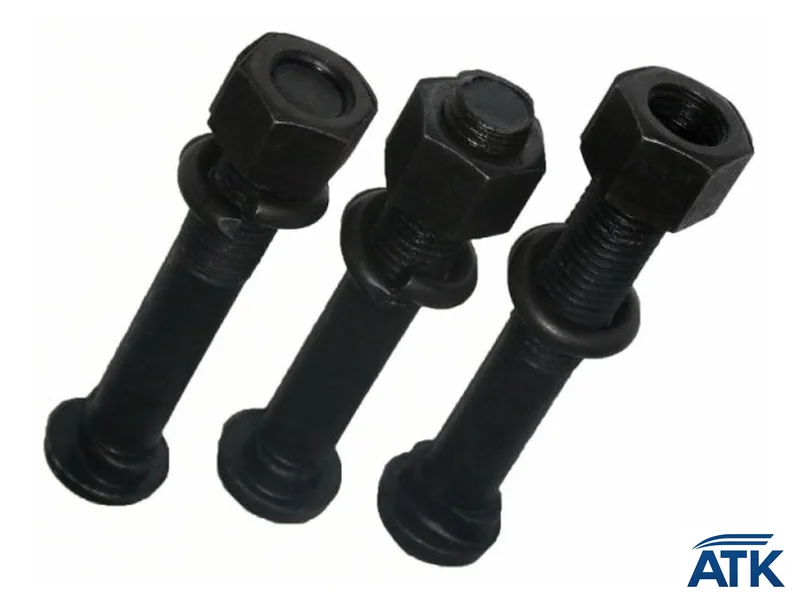
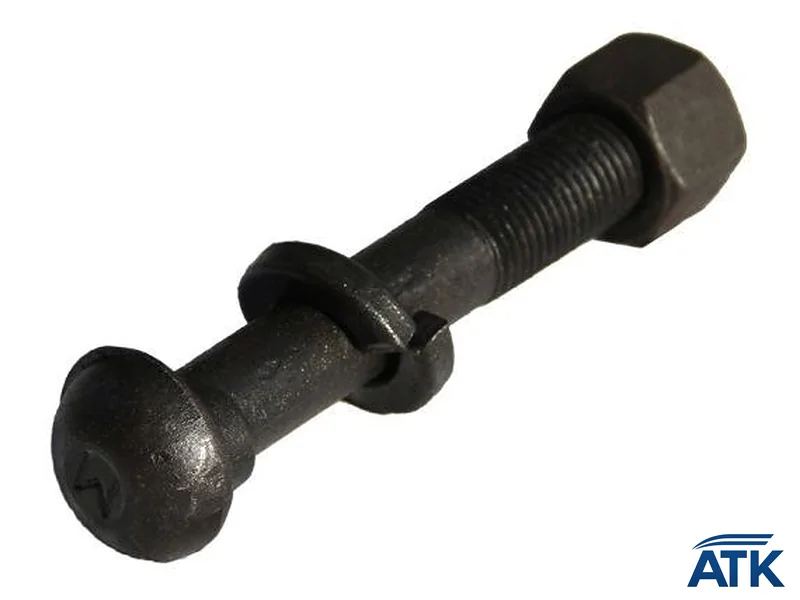
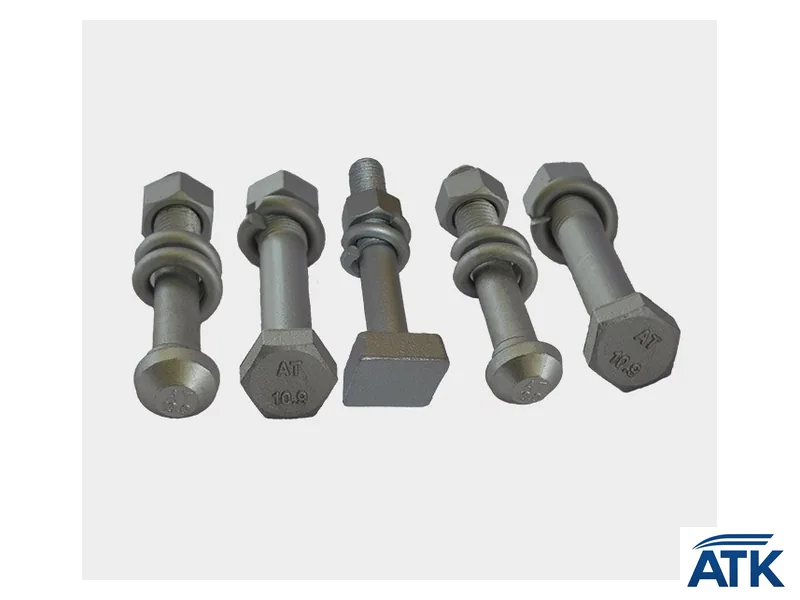
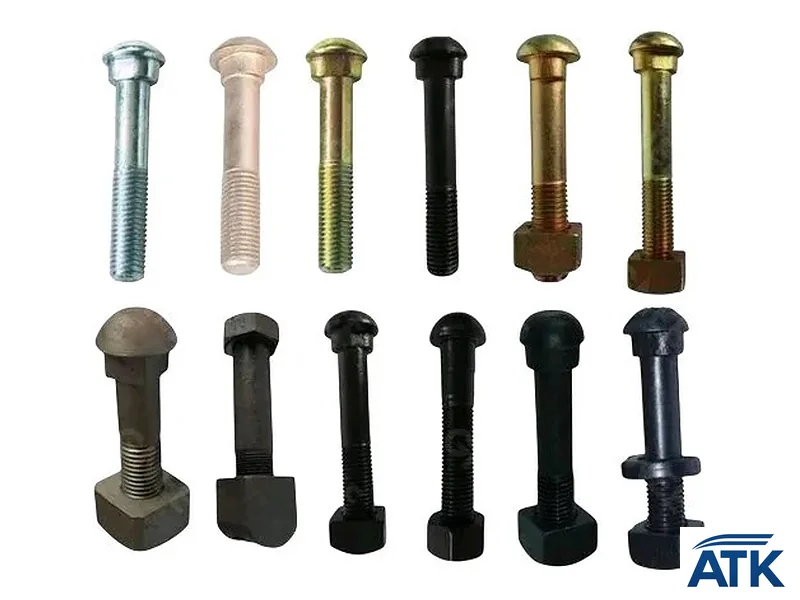
Fish bolts and BHON bolts are the classic joint fasteners. The button head gives a low profile near the wheel flange, and the oval neck locks into the joint bar. Diamond neck bolts use a square or diamond neck for the same anti-rotation job and are common on heavy rail sections. Cup head oval neck bolts and heavy hex head frog bolts appear at turnouts and crossings, where the geometry is tighter and the head has to clear a frog or a switch plate.
T-bolts have a flat T head that slides into a T-slot in a baseplate or switch plate. They are the standard fixing for adjustable fastenings and for the welded bases used with crane rail clips on steel girders. Clip bolts and clamp bolts hold an elastic clip or a clamp assembly down; their installation torque sets the clip toe load, so the thread, length and property class all matter. Anchor bolts fix baseplates and guard rails to concrete sleepers or steel girders, either cast in, resin bonded or through-bolted with a counterplate. Hook bolts and fang bolts are forged with a hooked end that grips the underside of a rail foot or timber sleeper; they survive on older timber track and on some bridge and crane installations.
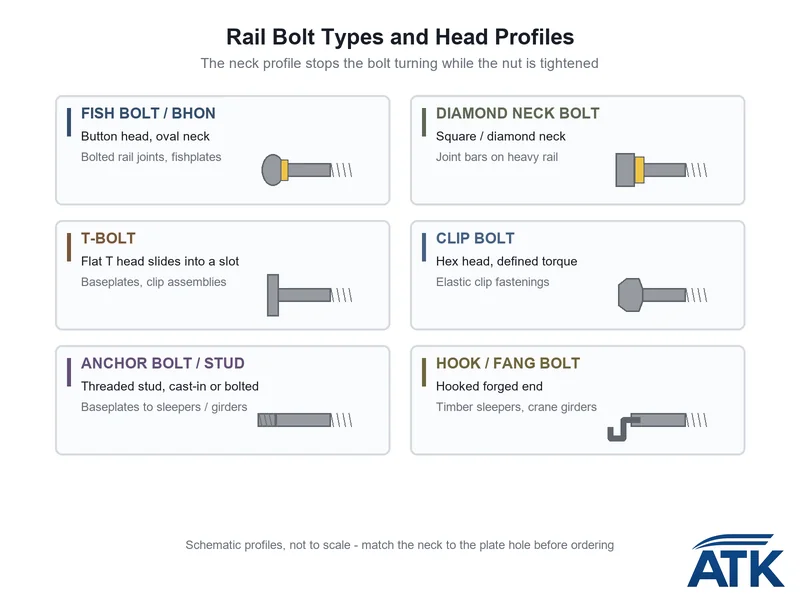
Two M24 bolts with different necks are not interchangeable, even if the thread gauge and length match. State the head and neck profile on the order.
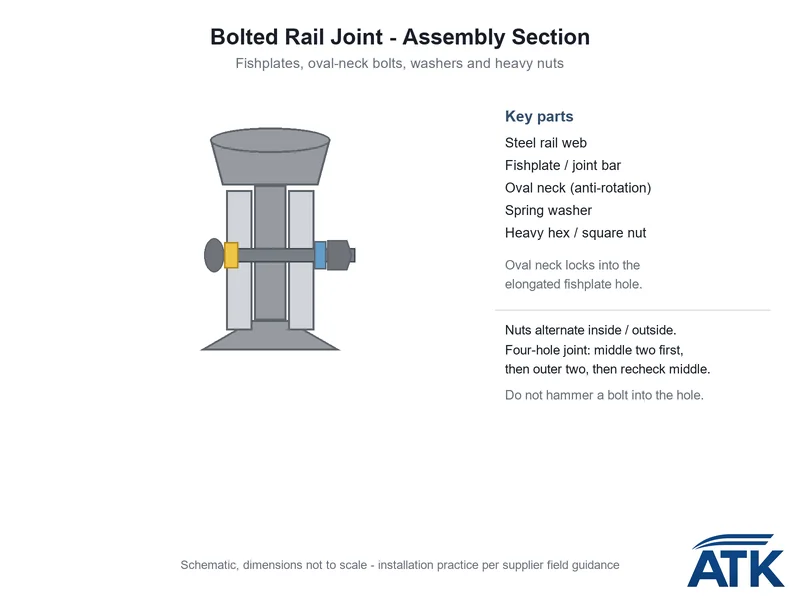
A bolted rail joint is a matched assembly:
1. Two joint bars (fishplates), drilled to the rail section
2. Four or six track bolts with the correct neck profile
3. Heavy square or hex nuts, one per bolt
4. Spring washers to hold preload under vibration
5. Flat washers to spread the nut load
6. Insulating bushes, washers and an end post where the joint is an insulated one
North American suppliers list the bolt, spring washer and heavy nut as a three-piece joint kit. On a signalled line the insulating parts are not optional: the bushes, insulated washers and end post of an insulated joint assembly keep the track circuit intact, and a bare bolt through the joint will short it. Fit the nuts alternately from the inside and outside of the rail so that a derailment does not shear every nut on the same side.
Bolt length is set by the joint bar thickness plus the rail web plus the washer stack. A bolt that is too short does not fully engage the nut; one that is too long fouls the opposite joint bar or leaves so much thread that the crew cannot tell whether the nut is seated.
The figures below are the values published in the standards and supplier catalogues, not measurements from an ATK batch. Which inspection documents apply is settled against the order, not assumed here.
Property / class | ISO 898-1 & GB/T 3098.1 | TB/T 2347-1993 rail joint bolts | ASTM A183 Grade 2 |
Nominal 8.8 / rail 8.8S | 800 MPa nominal tensile, 640 MPa nominal yield | 830 MPa min tensile, 660 MPa min yield, HRC 25-35, elongation >=12% | - |
Nominal 10.9 / rail 10.9S | 1000 MPa nominal tensile, 900 MPa nominal yield | 1040 MPa min tensile, 940 MPa min yield, HRC 34-41, elongation >=9% | - |
Grade 2 carbon steel | - | - | 110,000 psi (760 MPa) min tensile, 80,000 psi (550 MPa) min yield, elongation >=12% |
Recommended material | Medium carbon or alloy steel, quenched and tempered | 8.8S: Q275 (GB 700); 10.9S: 20MnSi (GB 1499) | Heat-treated carbon steel; C >=0.30%, P <=0.05%, S <=0.06% (A183-03 Gr.2 chemistry per catalogue) |
Common supply classes | 4.6, 4.8, 5.6, 6.8, 8.8, 10.9, 12.9 | 8.8S, 10.9S; mating nuts 10H | Grade 2 (A183-03); heavy hex nuts to ASTM A563 Grade B |
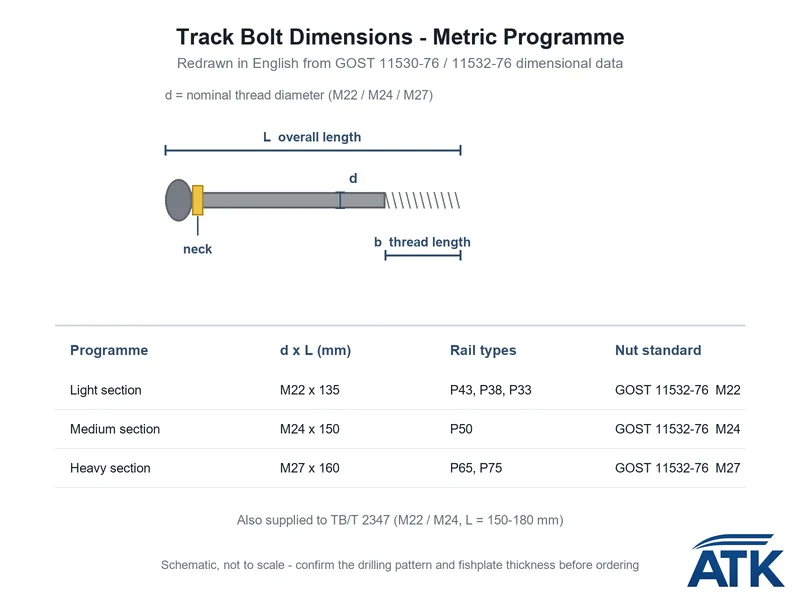
Programme | Bolt size | Rail sections / use | Mating nut |
GOST 11530-76 | M22 x 135 | P43, P38, P33 | GOST 11532-76 M22 |
GOST 11530-76 | M24 x 150 | P50 | GOST 11532-76 M24 |
GOST 11530-76 | M27 x 160 | P65, P75 | GOST 11532-76 M27 |
TB/T 2347-1993 | M22 / M24, L = 150-180 mm | High-strength insulated rail joints | 10H nut |
Common metric range | M14 x 70 to M24 x 170 | Light rail to heavy rail joints | Hex or square nut |
AREMA / imperial | 5/8 in to 1-1/4 in UNC, 3 in to 6-1/2 in long | 115RE, 136RE and similar sections | Heavy square or heavy hex nut |
The 8.8S / 10.9S classes belong to TB/T 2347, a rail-specific standard; an 8.8S bolt is not an ISO 898-1 8.8 bolt under another name. Treat the two columns as separate specifications.
Surface finishes: plain oiled, oxide black, zinc plated, hot-dip galvanised, Dacromet, sherardized, wax or bitumen coating. Hot-dip galvanising is the usual choice for coastal, ballast and mining environments; black oxide suits dry indoor or protected positions.
One grading claim keeps appearing in search results. Some supplier pages advertise "ASTM A183 Grade B" at 150,000 psi or 1,300 MPa, sometimes with cryogenic treatment or blockchain traceability attached. ASTM A183-03 defined Grade 1 (low-carbon, untreated, for industrial and mine track) and Grade 2 (heat-treated, for general track); the current A183-14(2020) simply specifies heat-treated bolts and medium-carbon nuts, with no grade numbering. Grade A / Grade B is not part of either edition. The 110,000 psi minimum tensile figure in our table is the Grade 2 value from a manufacturer catalogue; we quote the grade named in the enquiry and do not carry a higher number over without a matching record.
Five standard families come up in enquiries, and they are not interchangeable.
ISO 898-1 / GB/T 3098.1 define the property-class system - 4.6 through 12.9 - for carbon and alloy steel bolts. The class number encodes nominal tensile and yield strength; 8.8 is 800 MPa and 0.8 x 800 = 640 MPa. Classes 8.8 and above are quenched and tempered.
TB/T 2347-1993 covers 8.8 and 10.9 high-strength insulated joint bolts for rails, in M22 and M24, with specified mechanical properties, 8g thread tolerance, coaxiality of 1.4 mm and surface quality requirements. It is a rail-specific standard, not a general bolt standard.
ASTM A183 / AREMA Chapter 4 govern North American track bolts. A183 covers carbon steel bolts and nuts used with joint bars to connect rails in track; the 03 edition split bolts into Grade 1 and heat-treated Grade 2, while the current 14(2020) edition no longer numbers them. AREMA practice adds the BHON profile, UNC rolled threads, heavy square nuts and spring washers. ASTM A449 is described in manufacturer catalogues as comparable to property class 8.8 - a strength comparison, not a standard equivalence - and ASTM A563 Grade B heavy hex nuts are the usual mating part.
GOST 11530 / 11532 cover the metric joint bolts and their nuts used with P-series rails. The 1976 edition is the one supplier catalogues still quote: M22 x 135, M24 x 150 and M27 x 160. A 2014 revision of GOST 11530 and DSTU GOST 11530:2017 are also in circulation, so the edition belongs on the enquiry; the sizes here are catalogue data, with rail types as those catalogues state them. UIC 864-2 / 864-9, NF F50-008, BS, JIS, DIN and RDSO appear on project specifications for fishplates and joint bolts; we work to whichever the enquiry names.
A bolt can match its own standard and still be wrong for the joint. Read the rail section, the joint bar drilling and the neck profile together. Holes worn oversize in an old fishplate let the neck rock; leave out the insulating bushes on a signalled line and the assembly fails electrically before it fails mechanically.
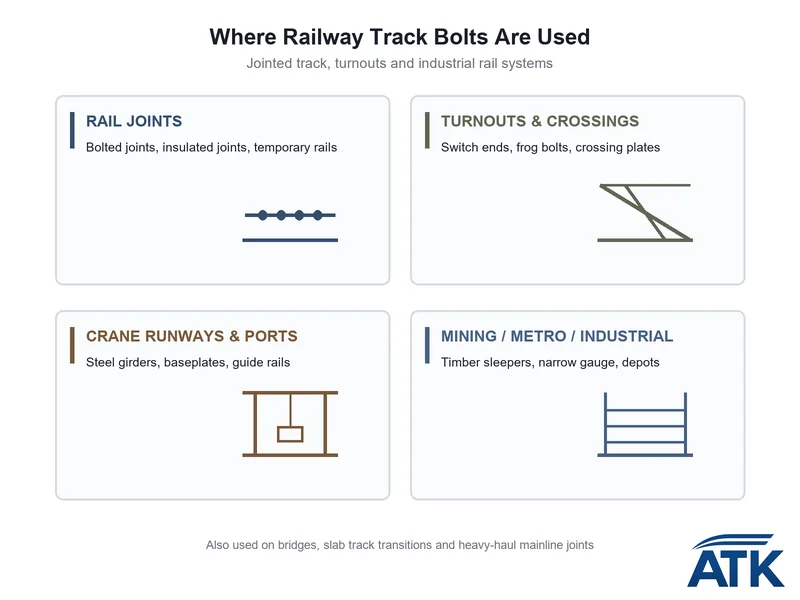
Bolted rail joints remain at insulated joints, at switch and turnout ends, on temporary track during construction, and anywhere a welded string has to be broken for a signal boundary. Turnouts and crossings add frog bolts, switch bolts and crossing-plate bolts, often with a head profile chosen to clear a tight flangeway.
Crane runways and port rail are the second large group. Bolts fix baseplates and clip assemblies to steel girders, and hook bolts or through-bolts secure guide rails on bridges and gantry structures. On those runways the clip, its T-bolt and the welded base are ordered as one assembly. Mining and narrow-gauge track, metro depots, timber-sleeper sidings, industrial yards and heavy-haul mainline joints all use the same families at different sizes and classes. How a hook bolt is sized to the beam and installed without welding or drilling is set out in the crane rail hook bolt and joint bolt guide.
Two site conditions change the specification before anything else is discussed. On a coastal or mining site, coating choice matters more than a marginal strength upgrade. On a signalled line, the bolt has to be part of an insulated assembly - bushes, insulated washers and the correct end post - or the track circuit will fail. Where the joint is factory-bonded instead of assembled on site, the glued insulated rail joint we supply follows the same insulation logic. Say which applies in the first message; it changes the kit, not just the coating
A crane rail joint is a different job from a mainline fishplated joint, even though the fastener looks similar in the box. The runway uses QU or DIN A sections, the joint is often at a 45 degree bevelled splice or an expansion break, and every wheel passage puts an impact load through two rail ends that are not welded together. Crane rail joint bolts are chosen to hold that assembly in line; they are not selected by rail weight alone.
These parts go by several names on purchase orders: crane rail fish bolts, crane rail fishplate bolts, and crane rail joint bolts. They describe the fastener at the joint bar, not the clip bolt or the hook bolt used at the rail-to-girder fixing. The bolts are one part of a matched set. A crane rail fishplate bolt passes through the crane rail fishplate, the rail web and the second plate, with a nut and washers on the far side. The bar is drilled to its own rail section, so the bolt, the bar and the rail end have to come from the same joint drawing. A bar drilled for QU100 and a bolt ordered only as "M27 joint bolt" can still arrive with the wrong neck, the wrong grip length or a shank that bottoms before the nut is seated.
• Two joint bars drilled to the rail section and joint angle
• Four or six bolts with the neck profile the bar holes require
• One heavy nut per bolt, matched to the bolt class and coating
• A flat washer and a spring washer under each nut
• Where the joint is insulated: bushes, insulated washers and an end post, to the assembly drawing
Suppliers publish size tables for crane rails, and they do not agree with each other. One catalogue pairs QU70 and QU80 with M24 bolts and QU100 and QU120 with M27; another lists M22 and M24 for the same QU120 section. None of those tables is a product standard, and a purchase order that fixes a diameter from one of them is guessing at the grip.
What fixes the bolt is the joint itself. Diameter follows the hole in the crane rail fishplate. Length is the sum of bar thickness, rail web, the washer stack and the nut, with enough thread showing to confirm the nut is fully engaged. Thread form and pitch follow the specification named on the drawing. Property class follows the duty: 8.8 covers most joints, 10.9 where the joint takes repeated impact, and 4.8 only in light positions. Rail specific classes such as 8.8S belong to TB/T 2347 and are quoted separately, not swapped for an ISO 898-1 class 8.8.
No diameter, length or torque figure is assigned here. Those values are taken from the approved joint drawing and the technical agreement for the order.
Crane rail fastening bolts are bought as a kit, not as loose shanks. The nut has to match the property class, and on a hot dip galvanised bolt it has to be over-tapped so it fits without scraping the coating off the thread. A spring washer that has flattened is replaced, never reused, and nuts and bolts from different batches are not mixed on one joint.
Coating is a service decision. Hot dip galvanising is usual on coastal, port and outdoor runways, zinc flake or zinc plating in general industrial halls, and plain or black oxide only in dry protected positions. On a coastal installation the coating usually matters more than a small increase in strength class, because a seized nut cannot be re-torqued when the joint needs attention.
There is no torque table that transfers between crane rail joints. The figure depends on diameter, pitch, class, the friction of the coating on the thread and bearing face, and the stiffness of the plates being clamped. Change from oiled to galvanised and the same wrench setting gives a different preload. The value belongs in the project specification, the technical agreement or the installation instruction issued with the assembly, and the applied value is recorded on site rather than assumed.
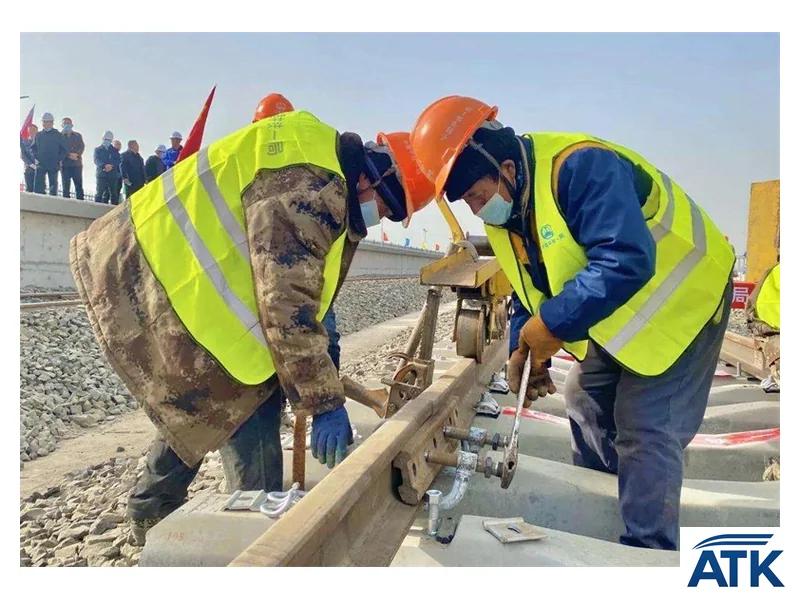
Bring each joint up in stages, starting at the centre holes and moving outwards, with the nuts placed on alternate sides of the rail. After the crane has run on it, measure again: the contact faces settle under load, so a splice that was level on the day of installation may need another quarter turn.
Send the rail section and joint type. Add the crane rail fishplate drawing with its hole pattern, the thread size and how length is measured, and the property class. Then state the nut and washer requirement, the coating, the quantity and whether the joint is insulated. A photograph of the existing joint helps, but the hole pattern and the grip length come from the drawing. Where the joint is a 45 degree bevelled splice, say so at the enquiry stage; it changes the bar, not just the bolt.
For the rail side of the assembly, see the crane rail fishplates page. For the clip and rail-to-girder fixings, see crane rail clips and welded rail clamps; for the hook variant used where the girder cannot be drilled or welded, see the guide to crane rail hook bolts.
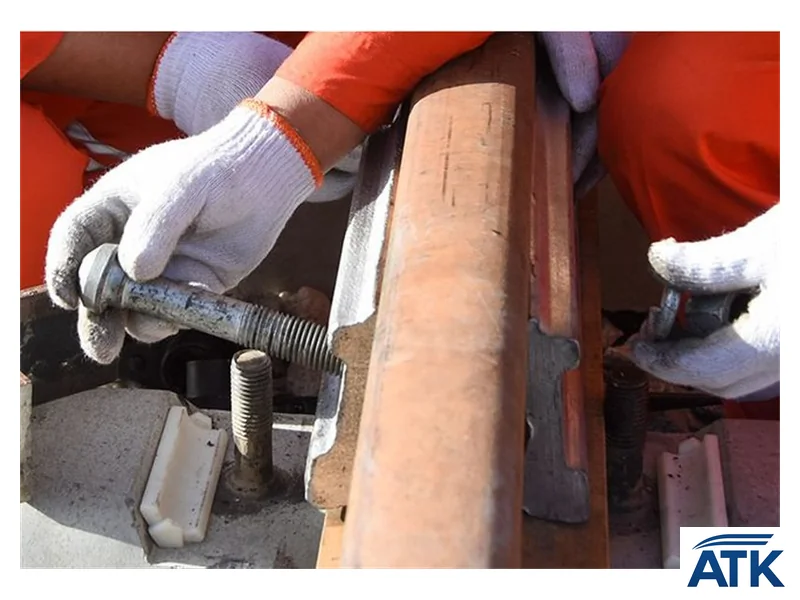
Start by oiling the contact faces between the joint bar, the rail and the bolts. Insert the bolts with nuts alternating inside and outside. On a four-hole joint bar, tighten the two middle bolts first, then the two outer ones, then recheck the middle pair. Use a single wrench of the specified length - field guidance for metric fish bolts calls for a wrench around 55 cm and one person, not an extension pipe and not two people leaning on it. If a bolt will not go through, tap the joint bar to line up the holes; never hammer the bolt itself.
Torque figures published online are not transferable. AREMA practice for a 1 in track bolt is roughly 400-450 ft-lbs (about 540-610 N·m), other North American pages quote 400-650 ft-lbs for BHON assemblies, and the WJK-type clip T-bolt on a crane rail clip is tightened to 150-220 N·m. Those are different bolt diameters, different threads and different assemblies. The torque is fixed once the bolt size, thread, property class and mating plate are confirmed; where the order calls for an installation instruction, that is where the figure belongs.
Do not reuse a spring washer that has flattened, and do not mix nuts and bolts from different batches on one joint. Both are common causes of a joint that passes inspection in the morning and is loose by the end of the shift.
On a scheduled walk, check bolt torque, look for a gap between the joint bar and the rail web, watch for rust bleeding from a bolt hole, and look for elongated or ovalised holes in the fishplate. A bright ring around a nut is a good sign the nut has been moving.
Four causes account for most of what a walking inspection finds. Vibration flattens a spring washer and the nut backs off. Dirty water in the bolt hole corrodes the thread until the nut seizes, so the next adjustment cannot be made at all. An oversize fishplate hole lets the neck rock and the bolt loses its anti-rotation grip. Over-torquing strips the thread or yields the bolt; under-torquing leaves the joint loose enough to pump the fishplate and bruise the rail end. On an insulated joint, a missing bush shows up as a track-circuit fault long before anyone sees anything mechanical.
If one bolt is loose, check the adjacent pair, the joint bar and the rail end before tightening it harder. A single loose bolt is usually a symptom of a joint that has moved, not a defective fastener. Replace bolts, nuts and washers as a matched set.
Six details let us check feasibility before quoting: the bolt type and head/neck profile, the thread size and pitch, the overall length, the property class, the rail section and the joint bar drilling pattern, and whether the joint is insulated.
Then add the standard you work to (ISO 898-1, TB/T 2347, ASTM A183 / AREMA, GOST 11530 or a project specification), the surface finish, the quantity, whether you need the matched nuts and washers, and the destination port. A fishplate drawing or a photo of the existing joint settles the hole pattern faster than any description, especially on replacement jobs. We check the profile and drilling before the price is fixed. For the grade systems, lockbolt meaning and fields that decide a joint bolt quote, see fish bolts and lockbolts ordering.
They are the same part. "Track bolt" is the broader North American term; "fish bolt" or "fishplate bolt" names its job at the joint bar. Both appear on purchase orders, so both are worth recognising.
No. A T-bolt has a flat head that slides into a slot in a baseplate; a fish bolt has an oval or diamond neck that seats in a joint bar hole. They are not interchangeable, and their torque values are different.
Class 8.8 is the usual choice for standard fish bolts and clip bolts; 10.9 where higher clamping force is required; 4.8 for light-duty positions. To ISO 898-1, 8.8 means 800 MPa nominal tensile and 640 MPa nominal yield. Rail-specific TB/T 2347 classes are written 8.8S and 10.9S with slightly different minimum values.
ASTM A183-03 Grade 2 is a heat-treated carbon steel track bolt, quoted in manufacturer catalogues at 110,000 psi (760 MPa) minimum tensile and 80,000 psi (550 MPa) minimum yield. Grade 1 and Grade 2 were the two bolt grades in that edition; the current A183-14(2020) no longer numbers them. "Grade A / Grade B" and 150,000 psi are not part of either edition, so we do not quote them without a test record.
Length equals joint bar thickness plus rail web thickness plus the washer stack and nut. GOST programmes commonly use M22 x 135, M24 x 150 and M27 x 160; TB/T 2347 uses M22 / M24 at 150-180 mm. Confirm against the actual fishplate drawing, not the rail weight alone.
There is no single number. A 1 in AREMA track bolt is roughly 400-450 ft-lbs, while a WJK clip T-bolt is 150-220 N·m. We confirm the torque after the bolt size, thread, class and mating plate are fixed. Never copy a torque value from another assembly's data sheet.
The oval or diamond neck seats in the matching elongated hole of the joint bar and stops the bolt turning while the nut is tightened. Without it the bolt spins, and the joint cannot be brought up to preload with one wrench.
Yes, as a matched set: heavy square or hex nuts, spring washers and flat washers, with insulating bushes and washers where the joint is insulated. Mixing batches on one joint is a common cause of premature loosening.
Hot-dip galvanising for outdoor, coastal and ballast environments; zinc plating or Dacromet for general industrial use; plain or black oxide only for dry, protected positions. On a coastal site the coating usually matters more than a marginal strength upgrade.
Yes. Fishplates, crane rail clips, steel rails, insulated fishplates, turnout components and fasteners & hardware can go into one enquiry and one shipment, which usually saves more on freight than it costs in consolidation.
Send the bolt type and head profile, the rail section, the thread size and length, the property class, the standard you work to and the quantity. We can develop and trial-produce railway track bolts to your drawing - ISO, GB/T, TB/T, AREMA, GOST or UIC sections - and will confirm the specification before the price is fixed. A datasheet or samples are available - contact us. For a mixed order, ask about our steel rails, crane rail clips, insulated fishplates, glued insulated rail joint and fasteners & hardware in the same enquiry.
We have recommended some of our Related products to you. I hope you will be interested.
 English
 Русский