
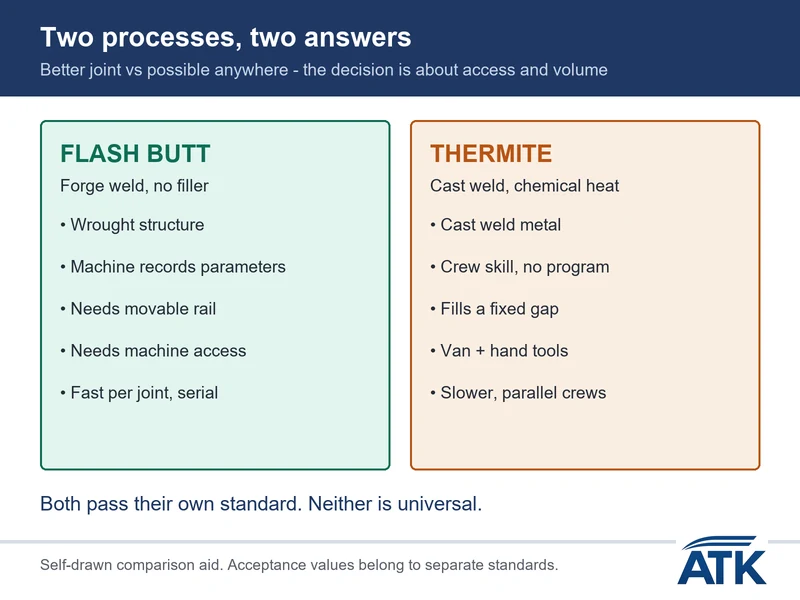
Flash butt makes the better joint; thermite makes a joint almost anywhere - the choice is about access, rail length and joint count
Flash butt needs the rail to move and the machine to reach; thermite fills a fixed gap with hand equipment
The processes follow separate standards: flash butt EN 14587 parts 1-3, thermite EN 14730 parts 1-2
Compare a possession by access and setup, not by seconds of weld time - machines are serial, thermite crews are parallel
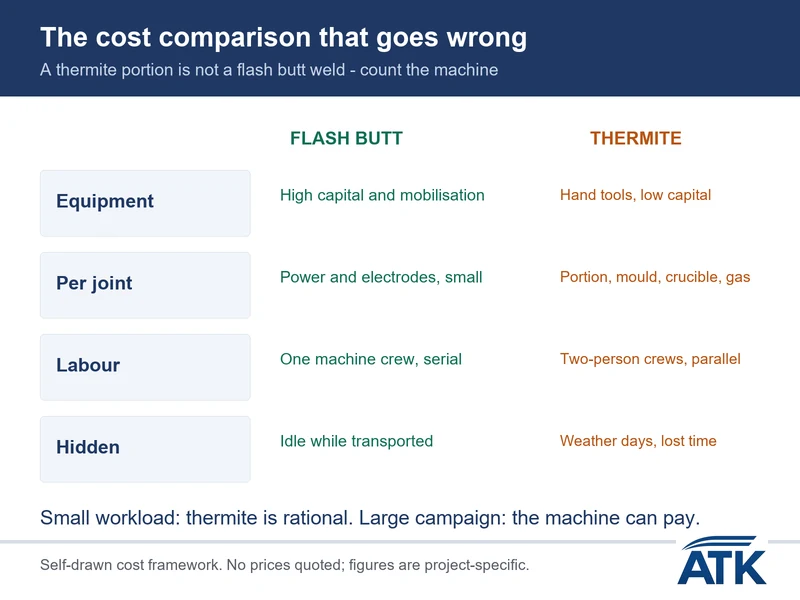
A thermite portion is not a flash butt weld: count the machine, the mobilisation and the idle days
YHG-1200TH is a 9.2 m containerised plant: 50-75 kg/m, 1200 kN upsetting, 13-14 joints/hour with normalising
Buyers usually ask this question as if one process had to win. It does not. Flash butt welding makes the better joint; thermite welding makes a joint almost anywhere. Most real decisions turn on access, rail length and the number of joints in one place — not on which weld is stronger.
Neither process is universal, and both clear the strength requirement in rail welding when carried out to their own standard. What separates them is what each one needs before it can start, what it does to the rail, and how the joint behaves after years of traffic. A flash butt vs thermite comparison that starts and ends with tensile strength will point a project at the wrong process.
The sections below follow that order: what happens at the rail end, what the site allows, what the standards demand, and what the work costs. A mobile plant such as the YHG-1200TH is covered where it belongs — in the jobs that can keep it busy.
Use flash butt welding where the rail can be freed to move, a machine can reach the joint, and enough joints sit in one area to justify bringing the machine in. Plain-line renewal, long welded strings and depot production are its territory. The joint is a forge weld made from the rail steel itself, with no filler metal.
Use thermite welding where the joint is fixed in place — a closure weld, a turnout, a defect cut-out on an occupied line, embedded track, or a short siding with no power and no room for a machine. It is a cast weld made from a chemical reaction in a single-use mould. It needs a skilled crew and almost no equipment.
When both are possible, the flash butt joint usually wins on quality. Often only one is possible. On a handful of scattered joints, the cost of moving a machine decides the matter well before anyone argues about metallurgy.
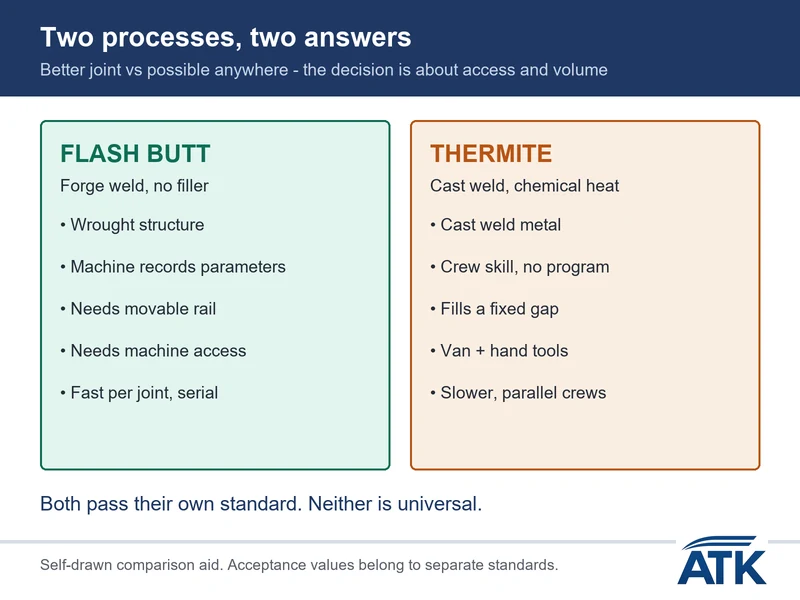
A flash butt weld is a resistance forge weld. The two rail ends are clamped in a machine, brought together under current until the contact faces heat and burn away, then pressed together by hydraulic upset. Any molten metal is squeezed out of the joint rather than left in it. The parameters come from a program, and the machine records what it did.
A thermite weld is a cast fusion weld. A mixture of iron oxide and aluminium is ignited in a crucible above a sand mould wrapped around the two rail ends. The steel produced fills the gap and fuses with the rail. There is no machine program and no recorded parameter trace. Preparation, timing, mould condition and the operator decide the result. A damp mould or a rail face that was not cleaned properly will show up in the joint, not in a log file.
That difference explains most of what follows. A flash butt joint is made from the parent steel and keeps a wrought structure. A thermite joint introduces weld metal from the reaction and solidifies as a casting. Both can be made to pass acceptance testing; they are not metallurgically the same.
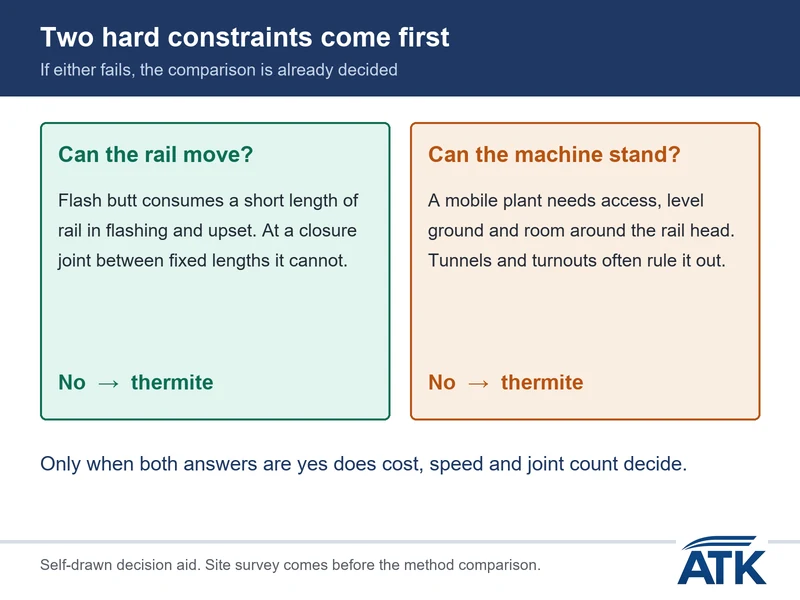
Two questions come before any discussion of quality or price.
Can the rail move? Flash butt needs to draw the rail ends together and consumes a small length of rail in the flash and upset. On a string being assembled in the open, that is fine. At a closure joint between two fixed lengths, in a turnout, or beside a structure that cannot be disturbed, the rail cannot be consumed — and thermite is the process that fills a gap without shortening the rail.
Can the machine reach and stand at the joint? A mobile flash butt plant is a heavy, self-contained installation. It needs access, level standing room and space around the rail head. Tunnels, bridges, embedded track and congested junctions are where this question ends the comparison. A thermite crew carries its equipment to the joint in a van.
If either answer is no, stop comparing. Put the effort into the thermite procedure — dry moulds, clean rail ends, controlled preheat — because that is where this joint will be won or lost.
These processes run under separate standard families. Their acceptance values cannot be swapped. A contractor who treats them as one rulebook will find the difference at audit.
For flash butt welding, the EN 14587 series — Railway applications: flash butt welding of new rails — covers the process. Part 1 is for fixed plants, Part 2 for mobile and on-track machines, and Part 3 for switch and crossing work. Part 2 was revised in 2024 and is the harmonised edition cited in the Official Journal; contracts still naming the 2009 edition should be queried before work starts.
For thermite welding, EN 14730 covers approval of the process in Part 1 and qualification of welders, contractors and acceptance in Part 2. In North America, AREMA Manual Chapter 4 covers both plant and field welding practice, and AWS D15.2 addresses arc welding used for rail repair — a different job from joining two strings.
The differences that matter in a specification include the hardness scale, the permitted heat-affected zone and the retention of records. Flash butt records are typically kept for five years; thermite records for ten — a reflection of how much of a cast joint's history lives in its paperwork. Where a tender names a standard, quote the edition, not just the number.
Inspection also differs. Ultrasonic testing is used on both in the field, and plant flash welds are often checked by magnetic particle inspection. What your project requires belongs in the technical agreement, not in a supplier's generic datasheet.
Comparing the seconds of the weld itself is misleading. A possession is spent getting to the joint, setting up, welding, cooling, grinding and clearing the line, and the two processes distribute that time differently.
A mobile flash butt machine is a serial resource: it does one joint at a time and every joint waits for it. Its advantage is that each joint is quick and repeatable once the machine is standing. Thermite is a parallel resource: several crews can pour several joints at different locations at the same time, each taking longer per joint.
That gives a simple rule of thumb. Twenty joints close together in one stretch of plain line suit one machine. Twenty joints scattered across a junction suit several thermite crews. The same number of welds, a completely different plan.
Network Rail's published comparison puts an aluminothermic weld at a minimum of 90 minutes including grinding, against 30 to 45 minutes for a flash butt or induction weld. Those are network figures, not promises for your site — but they show where the time actually goes. The weld is the small part.
Weather belongs in the estimate too. Wind, rain and rail temperature all bite during a thermite pour and its cool. A rained-off pour does not just cost an hour — it costs the possession. A flash butt plant works within a stated environmental envelope and is less exposed to those variations, but it still needs its access and its setup time.
The common mistake is to compare the price of a thermite portion with the cost of a flash butt weld and conclude that one process is ten times cheaper. That leaves out the machine.
Flash butt carries high capital cost, high mobilisation cost and a need for enough work to keep the machine busy. Its consumables per joint are small. Thermite needs cheap hand equipment, but every joint consumes a portion, a mould, a crucible and preheat gas, and the published rate per weld is several times that of flash butt.
The break-even depends on volume and ownership. For a network with thousands of joints in reach of one machine, mobile flash butt can pay for itself. For a metro depot, a port railway or an industrial siding with tens of joints a year, the capital sits idle; many operators buy mobile flash butt as a service rather than as an asset. In those cases the money is better spent on welder qualification and grinding quality.
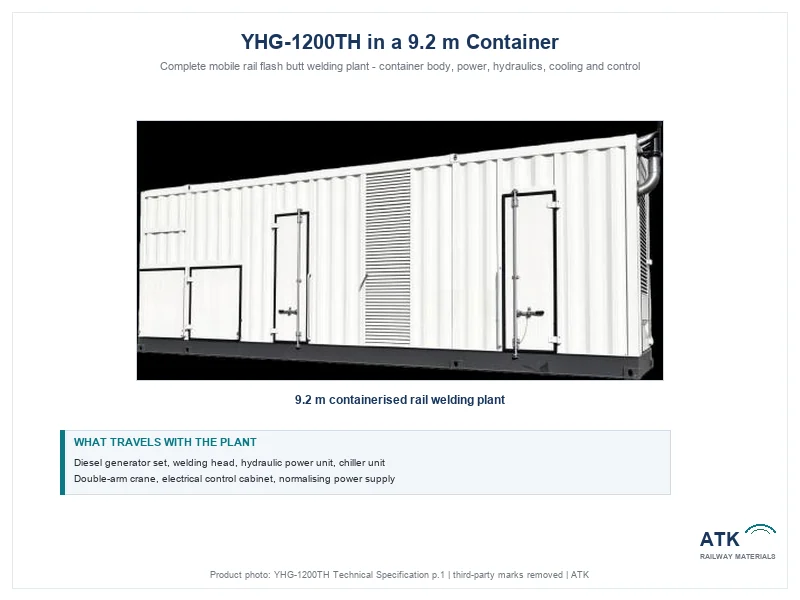
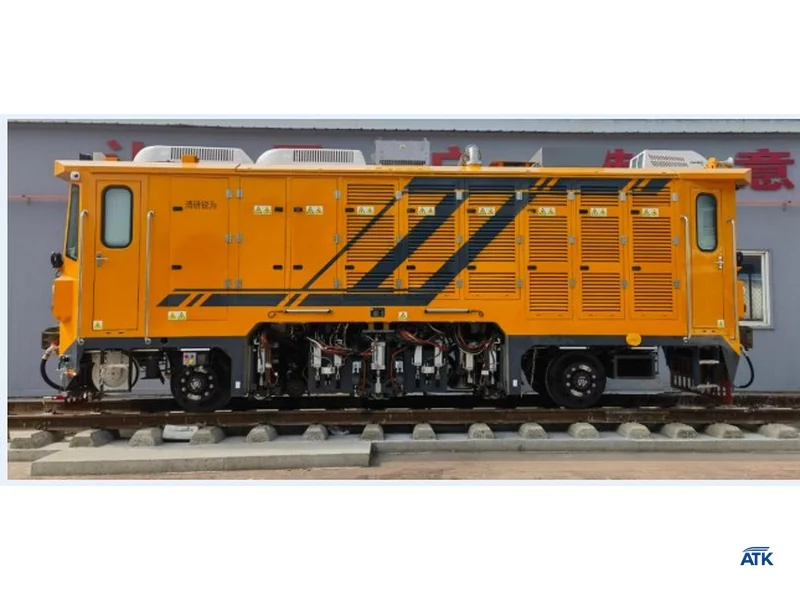
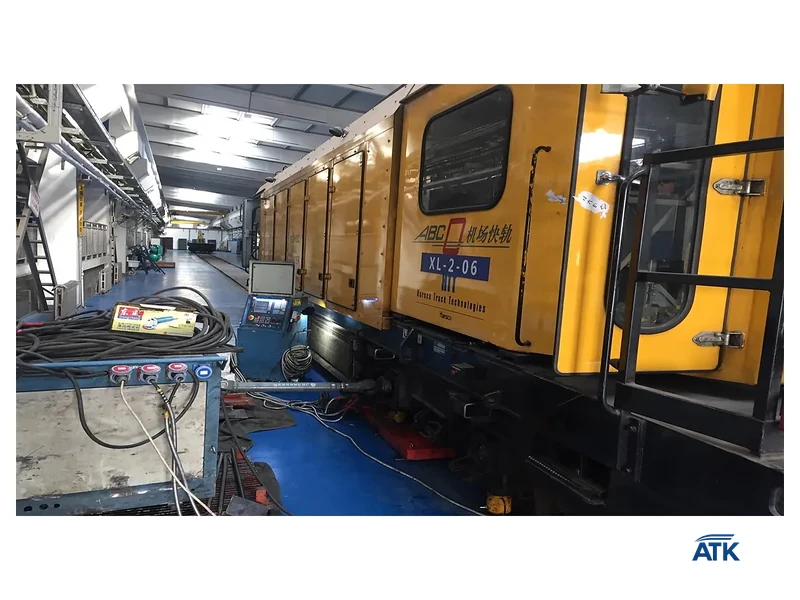
The YHG-1200TH is one example of the mobile plant this comparison keeps referring to. Its published specification places the whole installation — welding head, diesel generator, hydraulic unit, chiller, double-arm crane, control cabinet and induction normalising supply — inside a 9.2 m container. It supports rails from 50 to 75 kg/m across Chinese, European, Russian and American sections, and it carries out continuous and pulsating flash welding.
The numbers that matter in a comparison are these. Maximum upsetting force is 1,200 kN and clamping force 3,000 kN. It can complete 13–14 joints per hour including heat treatment, with induction normalising in the same cycle, and stores at least 100,000 weld records. Its stated envelope runs from −20 °C to 50 °C, up to 4,000 m altitude, on curves down to 180 m radius.
These are the manufacturer's specification values, not acceptance guarantees for a particular project. For the process choice, two things matter here. Normalising and data recording are built in, which covers the proof a buyer needs: a controlled joint and a traceable one. The rest is logistics. A container this size has to reach the site, stand there, and have enough joints waiting — otherwise it earns nothing.
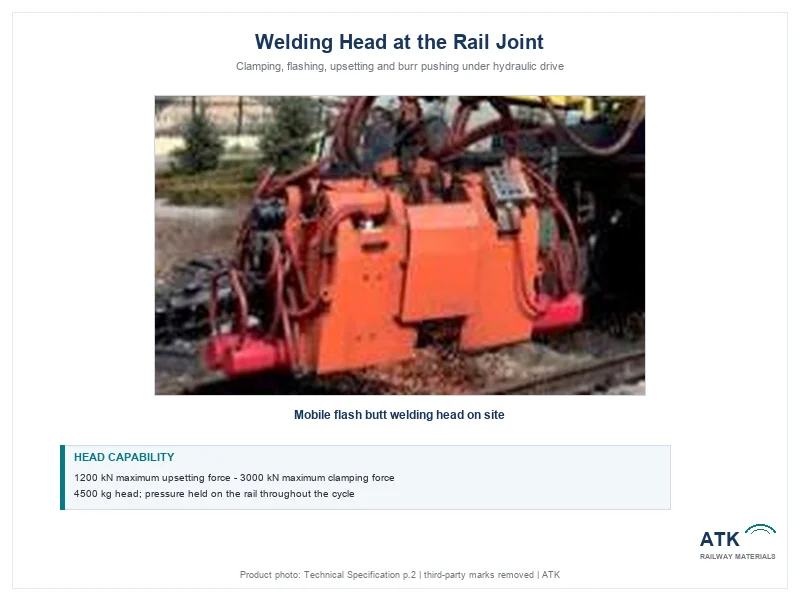
Full specification and enquiry requirements sit on the YHG-1200TH mobile flash butt welder page.
Not every rail joint fits either method. Switch and crossing work often needs welding on austenitic manganese steel, which behaves quite differently from rail steel and is covered by its own practice. Railhead repair — wheel burns, end batter, surface build-up — is an arc welding job under standards such as AWS D15.2, not a joining process at all.
There is also the bolted joint. At insulated joints, turnouts and temporary track, a fishplate assembly remains the specified answer, and neither welding process replaces it. A project that defaults to "weld everything" will meet these exceptions on site.
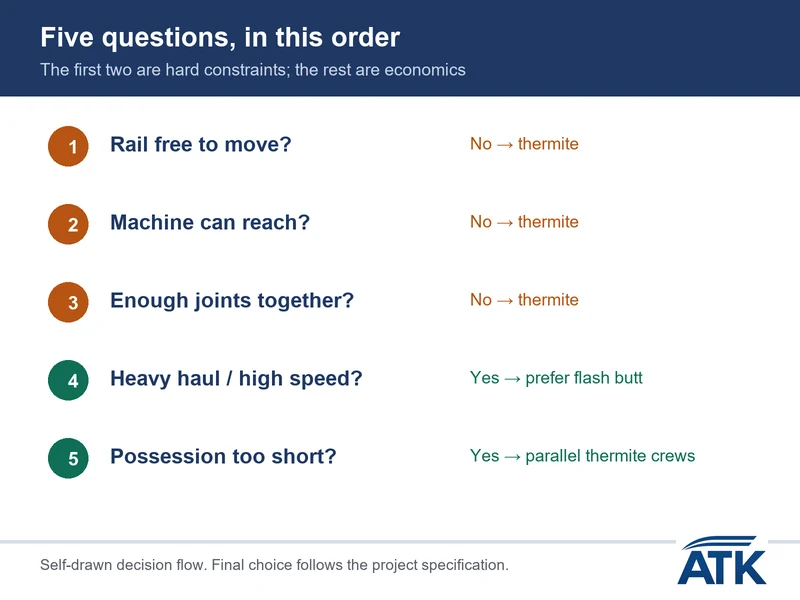
Ask them in this order. The first two are hard constraints. The rest are money.
Question | If yes | If no |
Can this rail be freed and consumed at the joint? | Flash butt is possible | Thermite |
Can a machine reach the joint and stand there? | Flash butt is possible | Thermite |
Are there enough joints together to justify mobilising a machine? | Flash butt | Thermite |
Is the traffic heavy haul or high speed? | Prefer flash butt where possible | Either |
Is the possession too short for a serial machine to clear the list? | Parallel thermite crews | Flash butt |
If the first two answers are yes, the comparison becomes a real one. If either is no, spend the effort on doing the thermite joint correctly rather than on trying to force a machine into a place it cannot work.
Flash butt makes the better joint — a forge weld with no filler metal and a wrought structure. Thermite makes a cast joint that is accepted by the standards when done properly. "Better" for a project usually means the process that fits the site, the possession and the number of joints.
It is used on them for closure welds and repairs where a machine cannot work. Where the choice is open, flash butt is generally preferred for the higher-duty joint, subject to the project specification.
It consumes a small length of rail in flashing and upsetting. At a closure between two fixed lengths there is no rail to consume, so a gap-filling process is required.
It is a cast structure and generally sits below parent rail in toughness and fatigue performance, even though it meets its acceptance standard. That is why it is specified by process and inspection requirements, not by strength claims alone.
Per joint, flash butt is quicker. Across a possession with joints spread over a site, several thermite crews can work in parallel and may finish the list sooner.
Flash butt: EN 14587 parts 1–3. Thermite: EN 14730 parts 1–2. North American practice is in the AREMA Manual. Quote the edition required by the contract.
A containerised unit such as the YHG-1200TH carries its own diesel generator, so it does not rely on a site supply. It does need road or rail access and space to stand.
Usually not. Below a certain annual joint count the capital is hard to justify, and mobile flash butt is commonly bought as a service. Thermite plus good welder training is the rational choice for a small depot or port railway.
Send the rail section and grade, the number and location of joints, whether the rail can be freed to move, access and standing conditions, the possession length, and the standard and edition your project calls for. State whether you are comparing processes for a specification or looking for equipment for a defined workload. If you want the machine figures behind this comparison, say so in the enquiry. For a specific project, use the Contact Us page.
We have recommended some of our Related products to you. I hope you will be interested.
 English
 Русский