
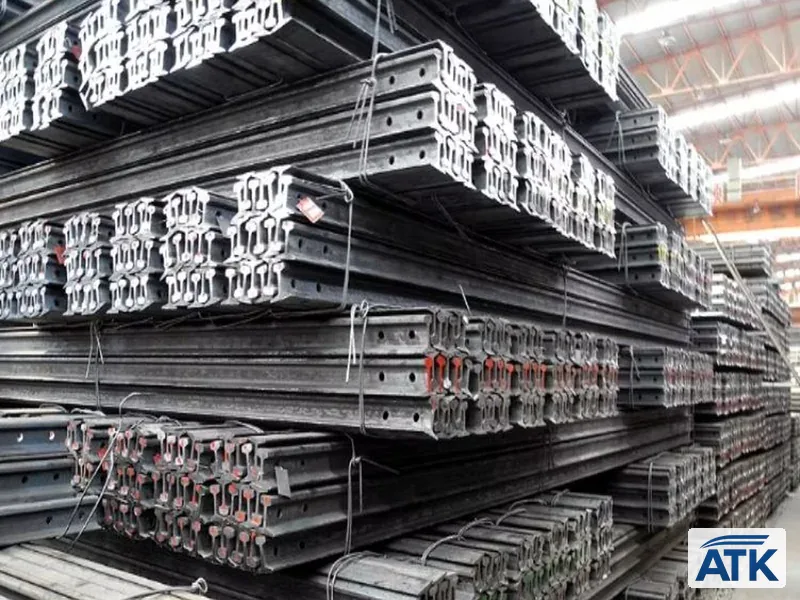
CR104 to CR175 are numbered by pounds per yard, not head width
QU and DIN count millimetres, which is why the same number means two different rails
ASTM A759 clause 1.4 makes the inch-pound figure the standard and the kg/m bracket information only
The series stops at 175 lb/yd, and heavier runways leave the family
CR175 alone carries a 2.4 mm flange tolerance instead of 1.6 mm
The standard sets a chemistry window, not a grade name
Weight per metre cannot choose a substitute, because every interface is set by base width
The standard sets its own seven-point ordering list
Twelve buyer questions answered
A drawing arrives with "104 lb/yd crane rail" written on it. The supplier quotes QU70, because 104 lb/yd converts to 51.6 kg/m and QU70 carries a similar mass per metre. The two figures look close enough to pair. The rail that arrives will not fit the clips already on the beam.
That mistake is common and it is not a units problem. It happens because three crane rail families in daily use number their sections by three different things, and two of those things are millimetres. In the American family the number is a weight per yard, and the section it points to is not the one you would pick by converting.
This is a reading guide for the A759 series: what the numbers mean, where the standard stops, and which substitutions it will not tolerate.
Put a QU section, a DIN A-section and an American CR section side by side and the designations look interchangeable. They are not.
Family | Example | The number means | Consequence |
QU (China, YB/T 5055) | QU100 | Nominal head width, 100 mm | Two QU sections never share a head width |
DIN 536-1 Form A | A100 | Head width, 100 mm | A100 and QU100 are both "100" and are different rails |
ASTM A759 | CR104 | Nominal weight, 104 lb/yd | Not a dimension — and not a standard designation either |
Two of those columns describe head width. The Chinese family is set out section by section under QU crane rail profiles.
One thing about the third column needs stating plainly. A759 does not publish a table of CR sections. It identifies a rail by two things: the nominal weight in pounds per yard, and a complete section drawing supplied by the purchaser. CR104 is the trade name the industry uses for the 104 lb/yd section, and mills list it alongside an MRS number. It is a real and consistent set of profiles. It is not a designation the standard itself defines, which is why the section drawing outranks the code on every enquiry.
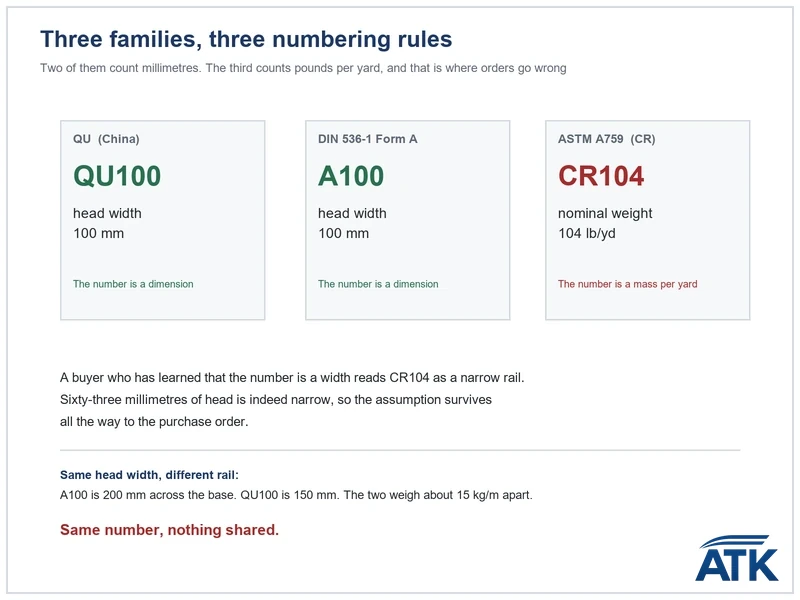
One caution before the table is used. Not every designation beginning with CR comes from A759. Some mill catalogues number crane rail sections by mass in kilograms per metre, which produces a different series with different sections behind it. A drawing marked CR100 from a European catalogue is not an A759 section — there is no CR100 in A759, and this series starts at 104 lb/yd. Ask which catalogue the designation came from before quoting against it. The third describes mass. A buyer who has learned that the number is a width will read CR104 as a narrow rail. Sixty-three millimetres of head is narrow by crane standards, so the assumption survives all the way to the purchase order.
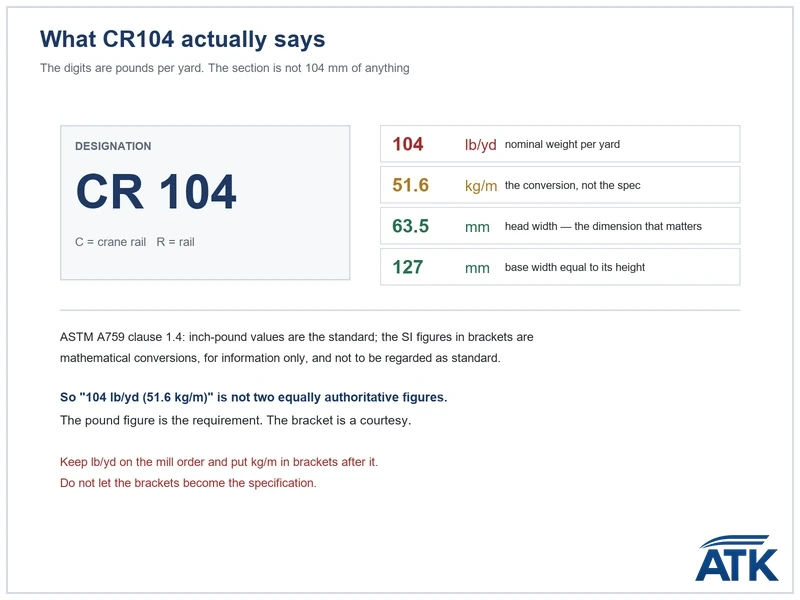
ASTM A759 is written in inch-pound units, and the standard says so in a way that matters commercially. Clause 1.4 states that the inch-pound values are the standard and that the values in parentheses are mathematical conversions to SI, provided for information only and not to be regarded as standard.
That sentence decides arguments. If a contract specifies "104 lb/yd (51.6 kg/m)" the two figures are not equally authoritative. The pound figure is the requirement. The kilogram figure is a courtesy conversion, rounded, and it is not a tolerance.
Where this bites is on a drawing that has been converted to metric for a Chinese or European fabricator. Somebody writes 52 kg/m, the mill rolls a section that weighs 52 kg/m, and the assembly is a few tenths of a kilogram per metre lighter than the American design assumed. On a 12 m length that is a few kilograms, which nobody notices, and a section modulus that is slightly under the drawing, which somebody notices later.
The practical rule: keep the pound-per-yard figure on the enquiry and on the mill order, and put the metric conversion in brackets after it. Do not let the brackets become the specification.
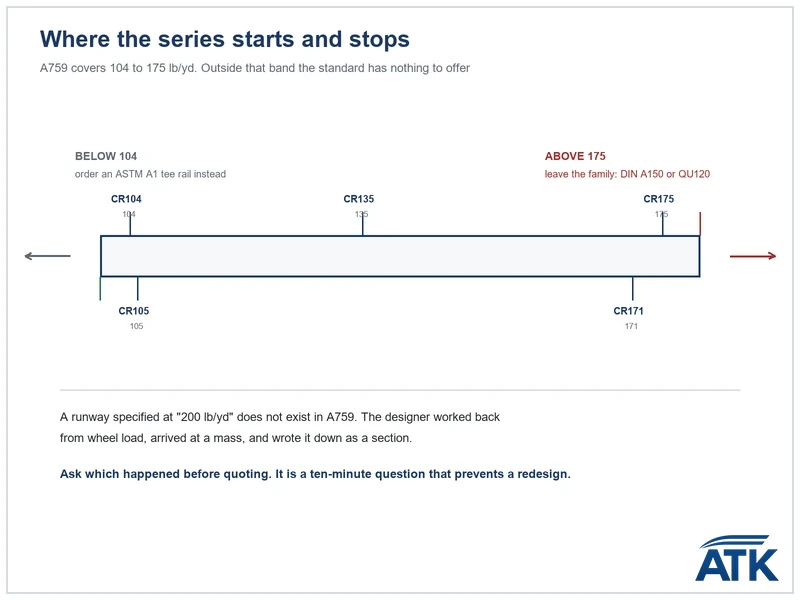
The standard covers carbon steel crane rails of special designs in nominal weights from 104 lb/yd (51.6 kg/m) through 175 lb/yd (86.8 kg/m). Special designs is not filler wording. Clause 1.2 sends anyone wanting a standard tee rail section to ASTM A1 instead. A crane rail under A759 is a purpose-shaped section with a wide base and a thick web, not a railway rail being used on a runway.
Designation | Mill alias | Nominal weight | Head width | Height | Base width | Web |
CR104 | MRS51 | 104 lb/yd (51.6 kg/m) | 63.5 mm | 127 mm | 127 mm | 25.4 mm |
CR105 | MRS52 | 105 lb/yd (52.1 kg/m) | 65.1 mm | 131.8 mm | 131.8 mm | 23.8 mm |
CR135 | MRS67 | 135 lb/yd (67.0 kg/m) | 87.3 mm | 146.0 mm | 131.8 mm | 31.7 mm |
CR171 | MRS85 | 171 lb/yd (84.8 kg/m) | 109.2 mm | 152.4 mm | 152.4 mm | 31.7 mm |
CR175 | MRS87B, TR87 | 175 lb/yd (86.8 kg/m) | 107.9 mm | 152.4 mm | 152.4 mm | 38.1 mm |
Section dimensions are catalogue values for the rolled profiles and are given here to two levels of precision only. Order to a drawing, not to this table.
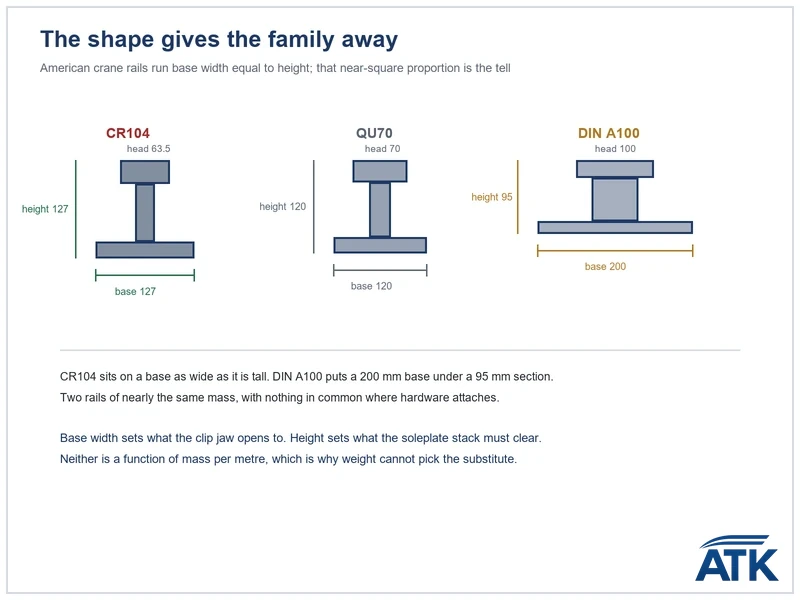
Two things in that table are worth more than the numbers. CR104, CR105, CR171 and CR175 have a base width equal to their height, and CR135 is within 15 mm of it. That near-square proportion is the visual signature of the American crane rail family, and it is why a section that looks "too tall and too narrow" on a drawing is usually the right one.
The second is that CR175 is not simply a heavier CR171. It carries a wider web, 38.1 mm against 31.7 mm, while the head is narrower. Heavier rail in this family is not the same section scaled up.
The range ends at 175 lb/yd and it ends there deliberately. A runway that needs a heavier section has left the American crane rail family, and the options are a DIN A150 or a QU120, both of which bring their own fastening geometry.
This is where a specification written by converting tonnage goes wrong. A 150 t quay crane may well be drawn with "200 lb/yd" on a first pass, because the designer worked back from wheel load and arrived at a mass. There is no such section in A759. The engineer then either drops to CR175, which changes deflection, or leaves the standard, which changes clips, soleplates and joint bars.
Ask which has happened before quoting. It is a ten-minute question that prevents a redesign.
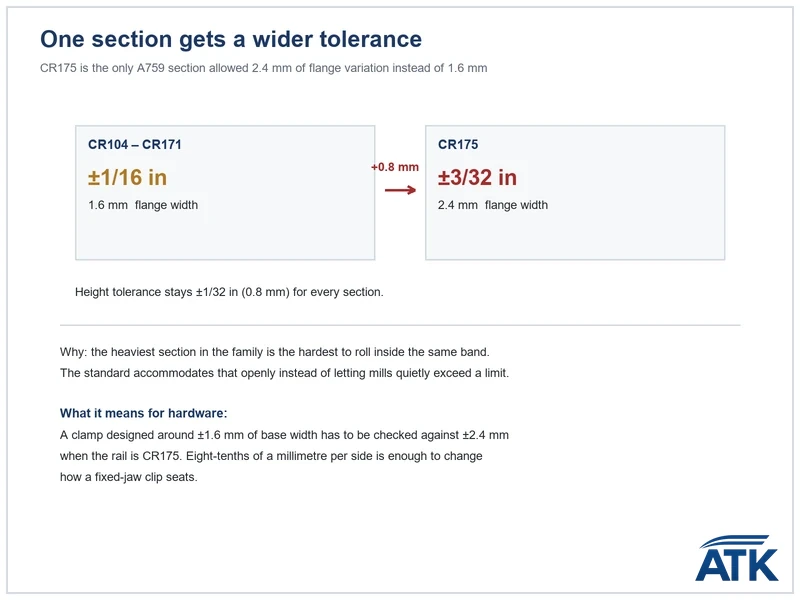
A759 sets a height tolerance of ±1/32 in (0.8 mm) and a flange width tolerance of ±1/16 in (1.6 mm). CR175 is the exception: its flange width tolerance is ±3/32 in (2.4 mm), while the overall base width still has to hold ±3/32 in.
The reason is metallurgical rather than arbitrary. The heaviest section in the family is the hardest to roll to the same tolerance band, and the standard accommodates that openly instead of letting mills quietly exceed a limit nobody can meet.
For a buyer the consequence is specific. A gauge or clip arrangement designed around a ±1.6 mm base width tolerance has to be checked against ±2.4 mm when the rail is CR175. That is 0.8 mm of extra variation per side, and on a clamp with a fixed jaw it is enough to change how the clip seats.
Clause 6.2 allows a variation of 1 per cent from the calculated weight of the section, applied to the entire order rather than to each bar. The designation is a nominal figure, the section drawing is the real one, and the two are not required to agree to the last decimal.
Read a mill certificate against the section drawing, not against the designation. A CR135 whose measured mass works out at 135.9 lb/yd equivalent is not out of tolerance. It sits inside the 1 per cent band the standard allows on the order, and the designation was never a weighing result.
This matters at the enquiry stage because it is the source of a recurring disagreement. A buyer who orders "104 lb/yd" and then weighs a bar and finds it corresponds to 104.9 will query it. A buyer who orders to the section drawing and accepts the 1 per cent order tolerance will not.
CR104 converts to 51.6 kg/m, and the metric section that carries a similar mass per metre is QU70. A spreadsheet will pair them. They are not interchangeable.
Property | CR104 | QU70 | Difference |
Base width | 127 mm | 120 mm | 7 mm |
Height | 127 mm | 120 mm | 7 mm |
Head width | 63.5 mm | 70 mm | 6.5 mm |
Web thickness | 25.4 mm | 28 mm | 2.6 mm |
This table compares geometry only. Theoretical mass per metre for the QU family changed with the current edition of its Chinese standard, and quoting one edition's figure against another is its own trap. The dimensions are what the hardware sees.
Every interface on the rail is set by those four numbers. The clip jaw opens to the base width. The soleplate footprint follows the base. The joint bar is drilled to the web and matches the head and base profile. A 7 mm difference in base width is not a tolerance question, it is a different fastening system.
The same logic blocks the more tempting swap between CR171 and QU100, which sit 4 kg/m apart and are further apart in every dimension that touches hardware.
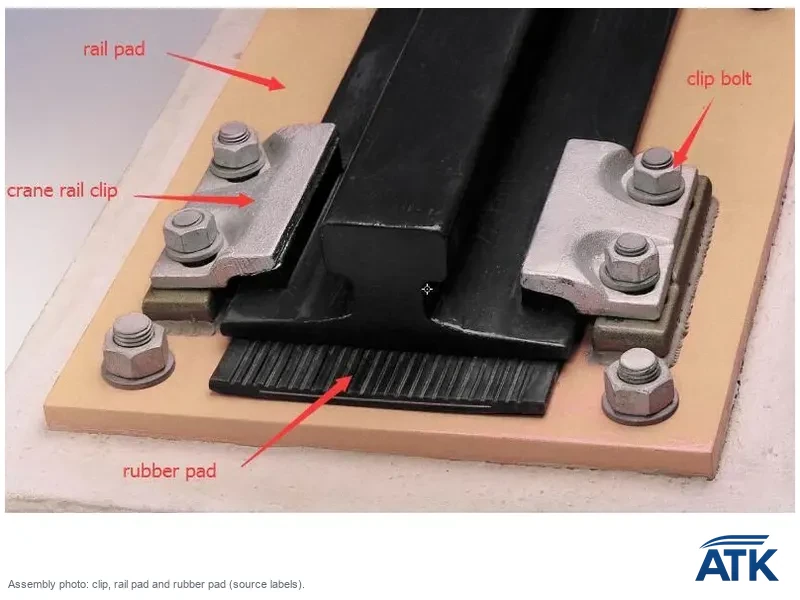
Where a runway genuinely has to change family, the fastening system changes with it. crane rail clips are selected from base width before anything else. A rail substitution that keeps the existing clips is not a substitution. It is a mismatch waiting for the first brake application.
The rail is one component of an assembly that includes the soleplate or support, the pad, the clips and the joint bars. A759 governs the rail section, its manufacture, marking, chemistry and dimensional tolerances. It does not govern any of the parts around it, and it does not tell you which section to choose for a given wheel load.
For the support side of that assembly, crane rail rubber pads and the soleplate family are specified separately. For the joint, crane rail fishplates are matched to the rail section and drilling pattern, not to the rail weight.
There is one more reading trap around the joint. A CR section ordered blank, without drilling, is normal — many runways weld. A CR section ordered drilled needs the hole pattern to match the joint bar, and the joint bar is a separate purchase. Say which you want at enquiry.
Clause 11 fixes the marking, and the marking is the cheapest verification available on delivery.
The manufacturer's name or brand, the month and year of manufacture, and the weight and section designation have to be rolled in raised letters and figures on the web. The heat number, the rail letter, and the ingot number or the strand and bloom designation for continuously cast rail are hot stamped into the web where the joint bars will not cover them.
Two practical consequences. Sections shorter than 25 ft (7.6 m) are exempt from full marking, so a short cut length tells you nothing from the mark. And the rolled designation is the mill's statement of what the section is, which is the first thing to check against the drawing when a delivery is queried.
This is the part most reading guides skip, and it is where A759 does more than set a chemistry window.
Steel may come from a basic-oxygen or an electric furnace, and may be continuously cast or poured into ingots. Both routes are permitted. What the standard then demands is a minimum reduction ratio of 8:1 through rolling, enough to break up segregation, piping and the cast structure. That 8:1 is the reason a crane rail is not simply a railway rail rolled heavier.
Controlled cooling is the second requirement, and it is specified in numbers rather than adjectives:
Step | Requirement |
Charging temperature | Not below 725 °F (386 °C) |
Where temperature is measured | Rail head, at least 12 in (305 mm) from the end |
Time under cover | At least 10 hours |
Rails released when top layer falls to | 300 °F (149 °C) or lower |
Control point for cooling rate | Between outer and adjacent rail, bottom tier, 12–36 in (305–914 mm) from the end |
Rails made from vacuum-degassed steel or from controlled-cooled blooms are exempt — those may be air cooled. Everything else follows the sequence above.
Why a buyer should care: controlled cooling is what keeps hardness uniform along the length and across the section. Skip it or run it short, and the rail arrives inside dimensional tolerance, passes a chemistry check, and still wears unevenly because one end is harder than the other. It is invisible on a certificate unless you ask for the cooling record.
Ask a mill what grade an A759 rail is and the answer may come back as U71Mn, 900A or something proprietary. None of those is an A759 grade, because the standard does not name grades. It sets a chemistry window and lets the mill meet it however it likes.
Element | Requirement (%) |
Carbon | 0.67 – 0.84 |
Manganese | 0.70 – 1.10 |
Phosphorus | 0.04 max |
Sulphur | 0.05 max |
Silicon | 0.10 – 0.50 |
A heat outside those ranges is not an A759 rail, whatever the rolled mark says. A heat inside them is compliant, whatever the mill chooses to call it. That is why a certificate quoting a familiar Chinese or European grade name tells you less than a certificate quoting the chemical analysis.
Where a harder rail is wanted, the route is the optional high-strength requirement, which brings a Brinell range rather than a grade name. The distinction matters at enquiry: write the standard, the chemistry and the supplementary requirement, and let the mill state the grade it achieves.
The standard carries optional supplementary requirements, and they apply only when the purchaser specifies them in the enquiry, order or contract. They are not automatic, and a mill is not obliged to volunteer them.
One caution about the list. Earlier editions carried four supplementary requirements; the current edition carries three. The numbering and the surviving options therefore differ between the edition printed on your drawing and the edition the mill is working to. Do not copy a supplementary requirement reference from a ten-year-old specification without checking it against the current edition.
Separately, the high-strength path is worth knowing even where the option is not called out. It covers heat-treated, head-hardened or alloy rail held to a Brinell range of 321 to 388, measured after the decarburized surface is removed. A runway that assumed high-strength rail but never wrote the requirement on the order will receive standard rail, correctly, and discover it at the wear survey.
The high-strength option is the one most often wanted and most often forgotten. It covers heat-treated, head-hardened or alloy rail within a Brinell hardness range of 321 to 388, measured after the decarburized surface has been removed. A runway that specified high-strength rail but did not write it on the order will receive standard rail, correctly, and find out at the wear survey.
Note the limit that sits outside the standard: some mills offer proprietary head-hardened grades that are not A759 grades at all. Those are mill specifications. If the contract names A759, ask for the Brinell result and the supplementary requirement reference, not the marketing grade name.
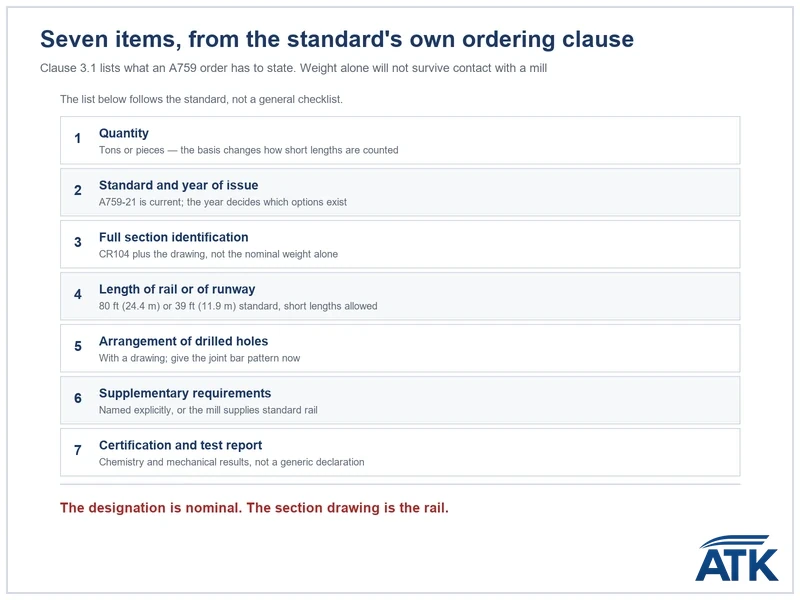
The standard sets out its own ordering information in clause 3.1. Seven items, and following them removes most of the ambiguity this family creates.
Item | Why it matters |
Quantity | Tons or pieces — the basis changes how short lengths are counted |
Standard and year of issue | A759-21 is current; the year decides which supplementary requirements exist |
Full section identification | CR104 plus the drawing, not the nominal weight alone |
Length of rail or of runway | 80 ft (24.4 m) or 39 ft (11.9 m) standard, with short lengths allowed as a proportion |
Arrangement of drilled holes | With a drawing; if the joint bar is a separate purchase, give the pattern now |
Supplementary requirements | Named explicitly, or the mill supplies standard rail |
Certification and test report | Chemistry and mechanical results, not a generic declaration |
Length deserves a note. A759 names 80 ft (24.4 m) or 39 ft (11.9 m) as standard, measured at 60 °F (15.5 °C). Shorter lengths are permitted within a proportion of the order, which is why a mixed delivery of long and short bars is normal and not a part-shipment error.
104 lb/yd nominal weight, in the ASTM A759 crane rail series. The number is a mass per yard, not a dimension.
No. Their masses per metre are close enough to be confused, and they differ by 7 mm in base width and 7 mm in height. Clips and soleplates are not interchangeable.
There is no CR100 in the A759 series. DIN A100 has a 100 mm head, and its mass falls between CR135 and CR171. None of the three substitutes for another.
As a courtesy conversion for readers outside the inch-pound system. Clause 1.4 makes the inch-pound value the standard and the metric value information only.
CR175 at 175 lb/yd (86.8 kg/m). Heavier runways move to DIN A150 or QU120.
Only with separate fastening systems at the transition, and normally with a transition arrangement. The base widths and head profiles do not match.
Brinell 321 to 388 after the decarburized surface is removed, and only when the optional high-strength requirement is ordered.
80 ft (24.4 m) or 39 ft (11.9 m) as standard, with short lengths permitted as a proportion of the order.
Yes, to a stated hole pattern. If the joint bar is a separate purchase, give the pattern at enquiry rather than after delivery.
No. It governs the rail section, how it is made, its chemistry, tolerances and marking. Fastenings are separate specifications.
Read the rolled designation and the heat number on the web, then check chemistry against the mill certificate and dimensions against the section drawing.
Yes. Send the section, the standard year, the length, the drilling pattern and any supplementary requirement, and the offer is built against them. Contact us with the drawing.
The A759 family is one of three that turn up in crane runway enquiries. The European and Japanese families number their sections by head width, which is where most of the confusion starts. DIN 536, JIS and EN 13674 compared covers those three.
We have recommended some of our Related products to you. I hope you will be interested.
 English
 Русский