
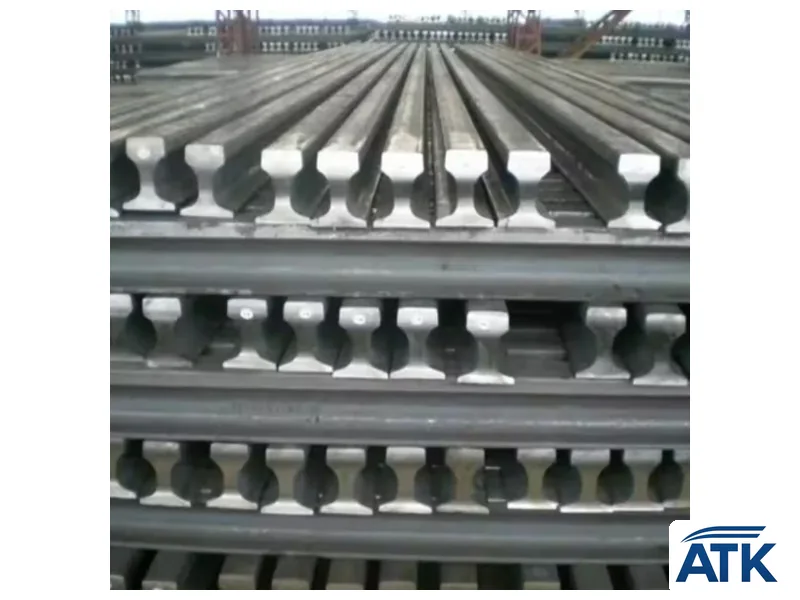
DIN 536-1:1991-09 is the only dedicated crane rail product standard of the three
EN 13674-1:2011+A1:2017 covers Vignole railway rails 46 kg/m and above
JIS E 1101:2001 and JIS E 1103:2021 are railway and light rail standards
CR73 and CR100 are mill catalogue designations, not JIS sections
60E2 is 172 / 150 / 72 / 16.5 mm at 60.03 kg/m under EN 13674-1
A100 and QU100 both have a 100 mm head and different rail seats
Form F belongs to DIN 536-2:1974-12, not to the Form A series
RFQ line: standard number with year, profile, grade, length, drilling and drawing
A search for these three names usually starts with an enquiry that has gone sideways. The specification says "crane rail to DIN 536 / JIS / EN 13674", the mill asks which one, and nobody can say which document actually governs the section on the drawing. The three are not competing versions of the same thing. DIN standard crane rails are governed by DIN 536-1:1991-09, a dedicated crane rail product standard. EN 13674-1 is a railway rail standard whose profiles sometimes appear on light industrial runways. On the JIS side there is no Japanese Industrial Standard dedicated to crane rails at all — the CR sections quoted in catalogues are mill designations, and the JIS numbers printed next to them are frequently wrong. This crane rail standard comparison separates the documents by scope, shows how their section designations are built, and sets out what to write on an RFQ so a quotation comes back for the rail that was meant.
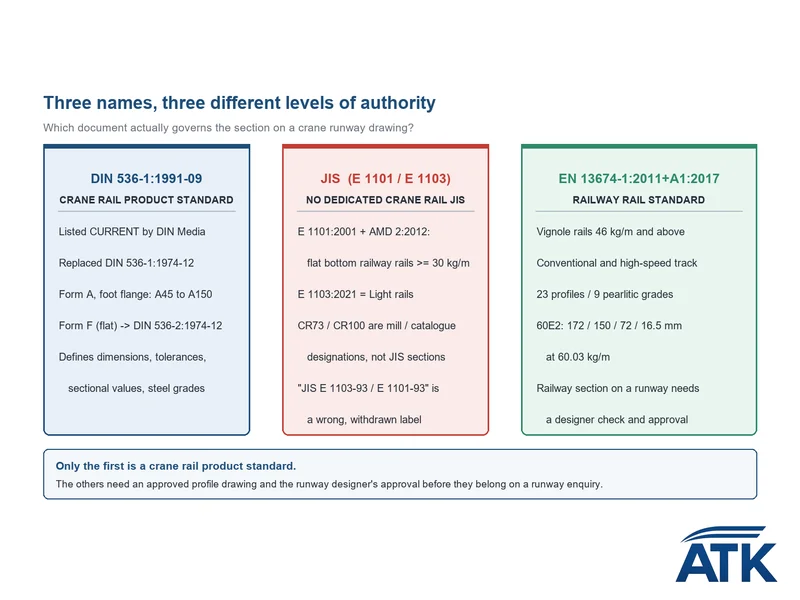
DIN 536-1:1991-09 is listed as CURRENT by DIN Media under the title "Craine rails [sic]; dimensions, sectional properties, steel grades for crane rails with foot flange, form A" — the misspelling is on the publisher's page, not in this guide. It replaced DIN 536-1:1974-12. Its scope is the product: A-series foot-flange crane rail sections, their dimensions, sectional properties, dimensional and shape tolerances, and the steel grades. Its companion DIN 536-2:1974-12 covers Form F, a flat section intended for flangeless wheels, with F 100 and F 120 designations. Form F is not a variant of the A series; it is a different rail for a different wheel arrangement.
EN 13674-1:2011+A1:2017 has a different scope entirely: "Railway applications — Track — Rail — Part 1: Vignole railway rails 46 kg/m and above". The standard text states it applies to conventional and high-speed railway track usage. It specifies 23 rail profiles and nine pearlitic steel grades across a hardness range of 200 HBW to 440 HBW. A 60E2 is one of those 23 profiles. A revision drafted as prEN 13674-1:2023 — 24 profiles and an added grade R335V — was still listed as a draft in the catalogues checked; the 2011+A1:2017 edition remains the current EN publication. Nothing in that scope makes 60E2 a crane rail. It can still turn up on a crane runway, but that is a design decision taken by the runway engineer, not a classification the standard grants.
On the Japanese side the two JIS documents that get quoted are both railway standards. JIS E 1101:2001 (with Amendment 2:2012) is "Flat bottom railway rails and special rails for switches and crossings of non-treated steel", covering ordinary railway rails of 30 kg/m and above. JIS E 1103:2021 is "Light rails"; it replaced the 1993 edition. Neither standard defines a crane rail section. The profiles known as CR73 and CR100 are listed in the ArcelorMittal crane rail catalogue under "ArcelorMittal Specification" — a mill designation, not a JIS designation. Supplier pages that print "JIS E 1103-91 / JIS E 1101-93" above a CR73 table are mixing a withdrawn edition, a wrong year and the wrong standard family. A drawing that says "CR100 to JIS" will be interpreted differently by different mills, which is exactly the sort of ambiguity a quotation should not have to absorb.
That difference in status is the whole point of the comparison. Only one of these three names is a crane rail product standard. The other two are a railway rail standard and a set of catalogue references with railway standard numbers attached to them.
The A-series is a squat, wide-footed family designed for concentrated wheel loads on a steel girder. The letter is followed by a number close to the nominal head width in millimetres: A45, A55, A65, A75, A100, A120 and A150 appear in mill catalogues, alongside variants such as A75S. The published profile data below is taken from the ArcelorMittal crane rail technical manual, which lists these sections against DIN 536 P1:1991.
Designation | Height H (mm) | Foot width B (mm) | Head width C (mm) | Web E (mm) | Mass (kg/m) |
A45 | 55 | 125 | 45 | 24 | 22.10 |
A55 | 65 | 150 | 55 | 31 | 31.80 |
A65 | 75 | 175 | 65 | 38 | 43.10 |
A75 | 85 | 200 | 75 | 45 | 56.20 |
A100 | 95 | 200 | 100 | 60 | 74.30 |
A120 | 105 | 220 | 120 | 72 | 100.00 |
A150 | 150 | 220 | 150 | 80 | 150.30 |
The number is not a load rating and it is not interchangeable with the QU numbering. A100 has a 100 mm head and a 95 mm overall height; QU100 has a 100 mm head and a 150 mm height. Both are called "100", and a foot that fits one will not fit the other's fastening arrangement. Always confirm the section against the standard drawing and the mill data sheet. Tolerances and acceptance belong to the applicable edition of DIN 536-1 and the project specification, not to a secondary catalogue table.
The QU crane rail profiles page sets out the Chinese QU family and the American ASTM A759 family alongside the A-series, if the full set of sections on a single project needs to be read together.
A buyer searching "EN 13674-1 60E2" is usually not looking for a crane rail standard. More often a light industrial runway, a transfer track or an existing installation has been specified with a railway section, and the procurement team has been handed a 60E2 designation to source. That can be legitimate. Railway sections do get used on light runways where wheel reactions are low and the support spacing allows it. The condition is that the responsible designer checks the maximum wheel reaction, wheel tread and flange geometry, section properties, the fastening system and the supporting girder for the actual duty. Nominal mass does not establish suitability.
The 60E2 numbers are worth knowing because they explain the confusion. To EN 13674-1 the 60E2 is 172 mm high, 150 mm at the foot, 72 mm at the head, with a 16.5 mm web and a mass of 60.03 kg/m. The 60E1 (UIC60) in the same standard has the same envelope of 172 / 150 / 72 / 16.5 mm and a mass of 60.21 kg/m; the small difference comes from the head and web contours, not from the nominal dimensions. A QU100 crane rail is 150 mm high, 150 mm at the foot, 100 mm at the head, with a 38 mm web and a theoretical mass of 88.96 kg/m to YB/T 5055-2025 Table 3. The matching 150 mm foot width is what tempts people into a substitution. The head and web geometry, the section properties and the fixing interfaces are not close.
The wider family is covered on the steel rail grades and profiles page, which lists the EN, GB, GOST, AREMA and JIS railway sections in one place.
Reading a designation correctly saves more time than any comparison table. Four naming habits show up in crane and railway enquiries:
- DIN 536-1 Form A: letter A plus nominal head width in millimetres (A100 ≈ 100 mm head). Form F uses the same width logic under DIN 536-2 (F 100, F 120).
- YB/T 5055 QU: QU plus nominal head width in millimetres (QU70, QU80, QU100, QU120).
- EN 13674-1: approximate mass in kg/m plus the letter E plus a sequence number (54E3, 60E1, 60E2). The sequence number distinguishes profiles inside the same mass class; it is not a revision or a grade.
- CR and MRS: mill or catalogue designations. CR73 and CR100 take their numbers from mass in kg/m; MRS sections in the same ArcelorMittal manual are marked "ArcelorMittal Specification". Neither carries a standard number of its own.ASTM A759 crane rail designations are the other CR series: CR104 to CR175, numbered by pounds per yard, and governed by a standard that does carry a number.
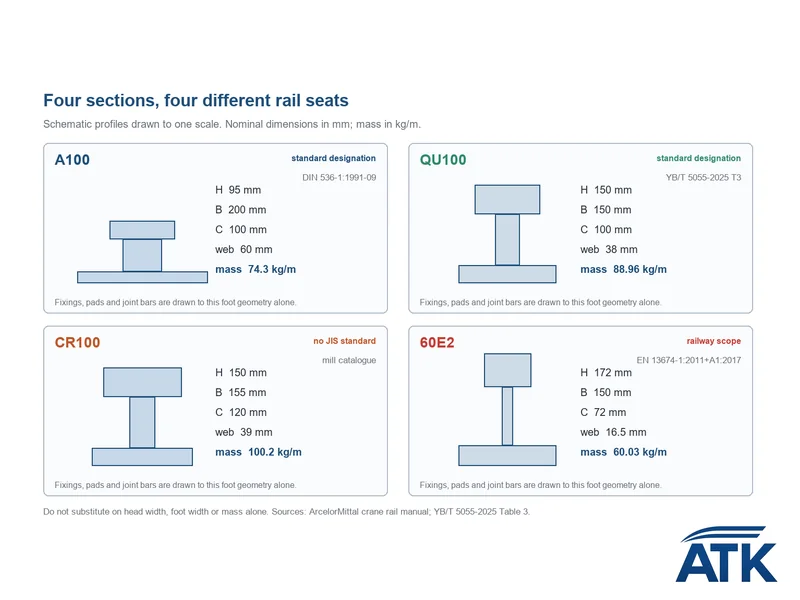
The table below is a reading aid, not an equivalence table. Values for the A-series, CR sections and 60E2 are published mill catalogue values; the QU100 figures are standard values from YB/T 5055-2025 Table 3. Where a column says "catalogue designation", the number on the drawing is not backed by a product standard and the profile has to be fixed by an approved drawing or mill data sheet.
Designation | Governing document | Status of the number | Height (mm) | Foot (mm) | Head (mm) | Web (mm) | Mass (kg/m) |
A100 | DIN 536-1:1991-09 | Standard designation | 95 | 200 | 100 | 60 | 74.30 |
QU100 | YB/T 5055-2025 | Standard designation | 150 | 150 | 100 | 38 | 88.96 |
CR100 | None in JIS | Catalogue designation | 150 | 155 | 120 | 39 | 100.20 |
CR73 | None in JIS | Catalogue designation | 135 | 140 | 100 | 32 | 73.30 |
60E2 | EN 13674-1:2011+A1:2017 | Standard designation, railway scope | 172 | 150 | 72 | 16.5 | 60.03 |
QU100 and 60E2 both carry a 150 mm foot. That is where the similarity stops: head and web geometry, section properties and fixing interfaces all differ. The CR100 and QU100 are both 150 mm high; their head widths differ by 20 mm and their feet by 5 mm. On a real runway that is the difference between a clip that seats and one that has to be machined on site. Catalogue values are useful for a first-pass layout, then the approved drawing decides.
Approximate cross-system matches sometimes get written into early specifications — A100 against QU100, or a railway grade against R260. Those are performance or dimensional approximations, not equivalences. Keep the word approximate in the specification and put the final call with the purchaser and the designer. The chemistry and mechanical side of that question belongs to the U71Mn steel grade guide; this page only deals with which document governs the section.
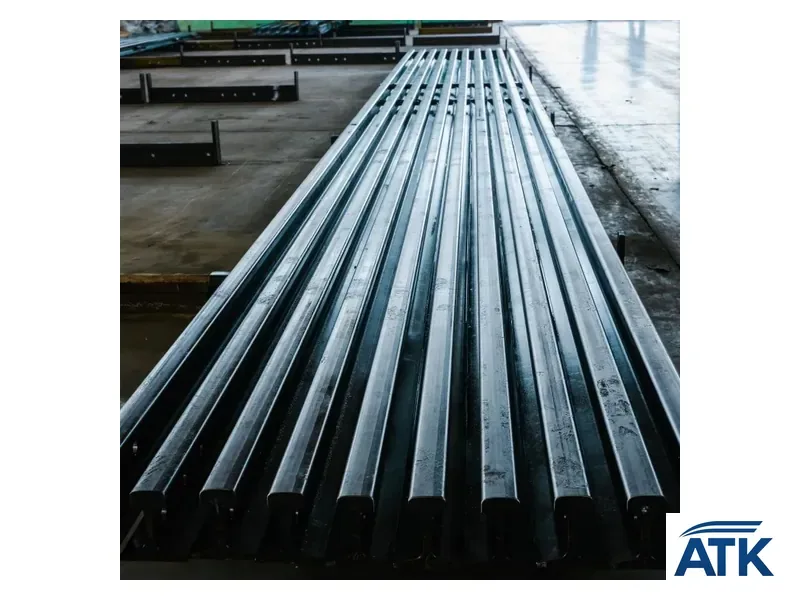
No section in the table above substitutes for another on mass, head width or foot width alone. The reasons are practical rather than theoretical:
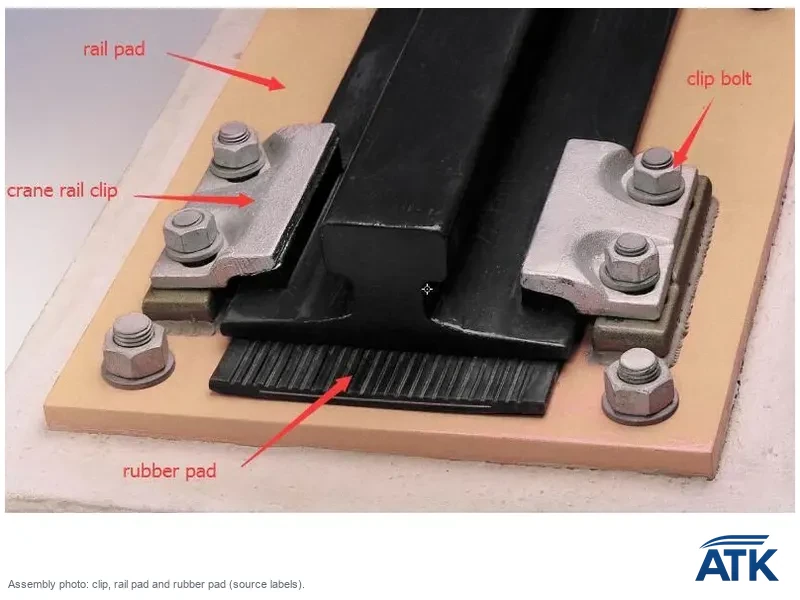
A different profile changes the rail seat. Pads, sole plates, clips, bolts and the girder detail were drawn around one foot geometry. Change the foot and the whole fixing line has to be re-checked. A different head width changes the wheel tread contact and the permitted alignment movement. A different web changes section properties under a concentrated wheel reaction. An existing runway being re-railed usually needs the same section, not a "better" one — it needs a check on head wear and on the condition of the joints.
Inside one standard family the same rule applies. 60E1 and 60E2 share an envelope but are different profiles with different contour details and different masses; the standard lists them separately. Switching between them is a specification change, not a sourcing convenience. Switching editions is another one: DIN 536-1:1974-12 and DIN 536-1:1991-09, or YB/T 5055-2014 and YB/T 5055-2025, do not define identical acceptance bases.
A railway section on a crane runway is the one case that is not automatically excluded. It is permitted as a design outcome after calculation, and it needs the same scrutiny as any other substitution — wheel reactions, tread geometry, section properties, fixing arrangement and support spacing for the actual duty, with purchaser approval recorded. Sourcing a railway section is a separate enquiry from sourcing a crane runway section; both the profile drawing and the governing standard have to be stated. The joint is affected too: the crane rail fishplates used on a QU or A section are drawn to that section's web and hole pattern, and a bar quoted for a railway profile will not fit.
The most expensive line on an RFQ is "crane rail to standard". It names no section, no edition and no acceptance basis, so every mill fills the gaps differently. A workable line carries the standard number with its year, the profile designation, the steel grade, the length and drilling, and the document that governs anything the standard does not cover.
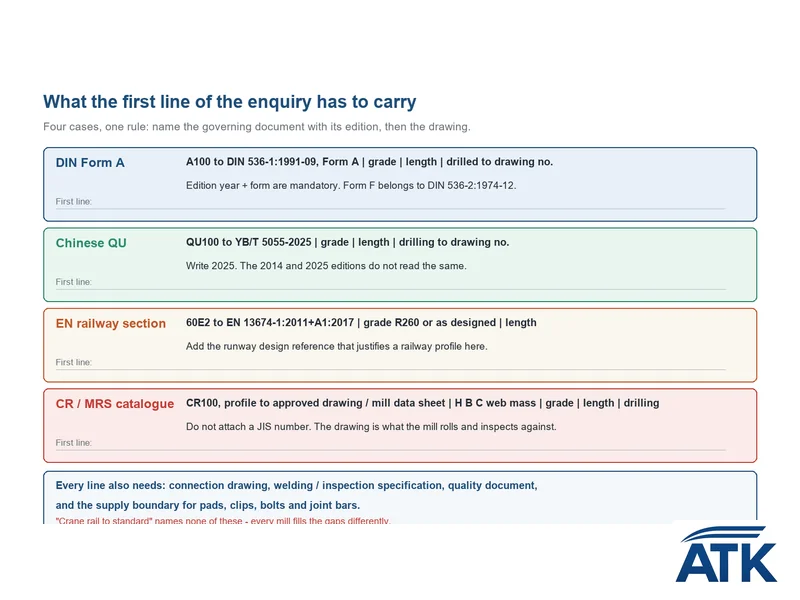
Written out, the four common cases look like this:
- DIN Form A: "Crane rail A100 to DIN 536-1:1991-09, Form A, [grade], [length] m, drilled to drawing [number]. Tolerances and acceptance to DIN 536-1:1991-09 and the project specification."
- Chinese QU: "Crane rail QU100 to YB/T 5055-2025, [grade], [length] m, drilling to drawing [number]." The edition belongs in the line: the 2014 and 2025 documents do not read the same.
- EN railway section: "Rail 60E2 to EN 13674-1:2011+A1:2017, grade R260 [or as designed], [length] m." Add the runway design reference that justifies a railway profile on this track, because the standard itself does not.
- CR or other catalogue section: "Rail CR100, profile to approved drawing [number] / mill data sheet, [dimensions], [grade], [length] m." Do not attach a JIS number. If a buyer insists, attach the drawing anyway; the drawing is what the mill will roll and inspect against.
Add the documents that sit beside the rail standard: the current structural drawing for the rail-to-girder connection, the site welding or inspection specification, and the agreed quality document. A project normally names more than one governing document, and each should appear with its edition or drawing number. Where a specification names a standard, that standard and the technical agreement take precedence over a catalogue. Where it names none, the drawing decides.
Read the designation on the drawing as a claim about a document, then check the claim. If it says DIN, look for the part number and year. If it says EN 13674-1, ask whether a railway section was deliberately designed onto this runway. If it says JIS next to a CR number, ask for the profile drawing before asking for a price. If it says only a weight — "60 kg rail" — it is not a specification yet.
The standards are not in competition, so there is no winner to pick. There is one crane rail product standard, one railway rail standard that may be designed into a light runway, and a group of mill profiles that need a drawing to mean anything. Get the governing document onto the first line of the enquiry and the rest of the package — pads, clips, joint bars, drilling — has something consistent to be quoted against.The same distinction on the joint-bar side is explained in **AREMA vs UIC Fish Plates**.
Yes. DIN Media lists DIN 536-1:1991-09 as CURRENT. It replaced the 1974-12 edition. Write the full number with the year on the enquiry, because the acceptance basis is tied to the edition.
No. DIN 536-1:1991-09 covers Form A with a foot flange. DIN 536-2:1974-12 covers Form F, a flat section for flangeless wheels, with F 100 and F 120 designations. Name the form on the drawing.
No JIS document dedicated to crane rails was identified. JIS E 1101:2001 (Amendment 2:2012) covers flat bottom railway rails of 30 kg/m and above, and JIS E 1103:2021 covers light rails. CR73 and CR100 are catalogue designations; the ArcelorMittal crane rail manual lists them as "ArcelorMittal Specification".
Those labels combine an edition that has been superseded with a standard family that does not cover crane rails. JIS E 1103:1993 was replaced by JIS E 1103:2021, and JIS E 1101:1993 was replaced by JIS E 1101:2001. Treat such a table as a catalogue, and ask for the profile drawing.
No. It is one of the 23 Vignole railway rail profiles in EN 13674-1:2011+A1:2017, a standard whose scope is conventional and high-speed railway track usage. It may be used on a light industrial runway only after the runway designer checks it for the actual duty.
No. A100 is 95 mm high with a 200 mm foot and 74.30 kg/m; QU100 is 150 mm high with a 150 mm foot and 88.96 kg/m. The foot geometry, pads, clips and rail seat are different. Substitution needs a project-specific calculation and purchaser approval.
That figure appears in secondary tables. YB/T 5055-2025 Table 3 gives the theoretical mass of QU100 as 88.96 kg/m. Use the standard table for the specification and reconcile any catalogue value against the approved drawing.
They share a nominal envelope of 172 mm height, 150 mm foot, 72 mm head and a 16.5 mm web, but they are separate profiles with different head and web contours and masses of 60.21 and 60.03 kg/m respectively. Name the exact designation.
The leading number is the approximate linear mass in kg/m. The E and the following number identify the profile within the European Vignole family in EN 13674-1. It is a profile identifier, not a steel grade or a revision.
The grade required by the governing product standard and the project design. Grades are not transferable between systems without approval; a railway grade under EN 13674-1 and a crane rail grade under YB/T 5055 are specified against different documents.
The designation alone does not fix the profile. Include the approved drawing or mill data sheet giving height, head width, foot width, web thickness and mass, together with the grade, length and drilling. The same section can appear with different joint details.
No. Rail product standards govern the rail section and material. Joint bars, bolts, clips, pads and the rail-to-girder connection are set by the approved runway drawing, the project specification and separate documents. State the supply boundary on the enquiry.
We have recommended some of our Related products to you. I hope you will be interested.
 English
 Русский