
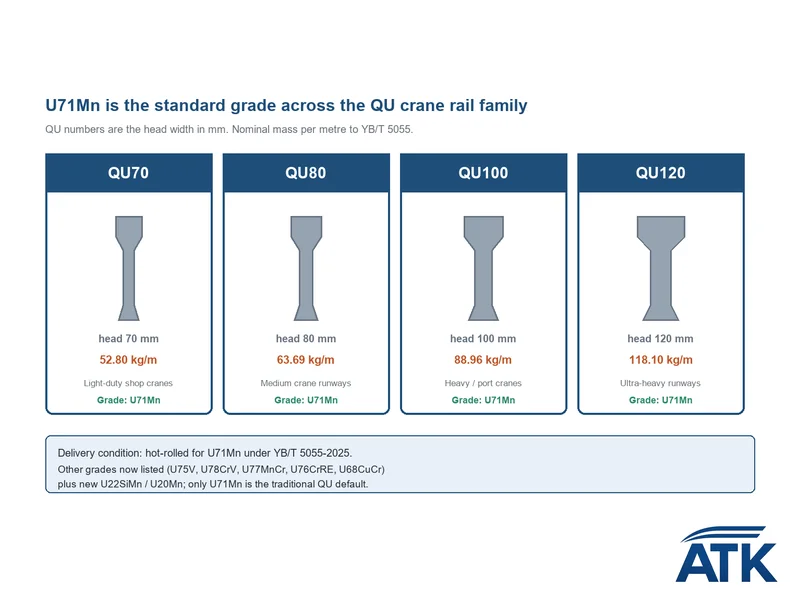
U71Mn steel grade under YB/T 5055-2025, effective 1 March 2026
Carbon 0.65-0.80, manganese cut to 0.70-1.20 from the 2014 edition
Phosphorus at or below 0.030 and sulphur at or below 0.025
Tensile 880 MPa minimum, 9.0 percent elongation to GB/T 228.1
Standard grade across QU70, QU80, QU100 and QU120
Hot-rolled delivery; equivalent to EN R260 only in broad performance
EN, JIS, GOST and ASTM matches are approximate - buyer approval required
What to put on an RFQ: section, standard edition, grade in full
A buyer rarely orders a rail by grade alone. The documents behind those editions are mapped in the crane rail standard systems comparison.The section, the standard edition and the mill certificate travel with the grade on every enquiry. U71Mn is the name that keeps coming back on Chinese crane rail, and it is often quoted loosely — as if the grade were a fixed composition with a fixed equivalent somewhere else. It is not. The composition changed in the current edition of the crane rail standard, and the grades buyers compare it with in Europe, Japan and Russia sit in different standard systems. This guide sets out what the U71Mn steel grade actually is, what the 2025 revision changed, and what an U71Mn rail specification needs to say on a drawing or an RFQ so the material arrives as intended.
U71Mn is a pearlitic carbon-manganese rail steel. The name is a Chinese grade designation: the "71" points to a carbon content near 0.71%, and "Mn" marks manganese as the main alloying element. It is a workhorse grade, not a special one. In the Chinese rail system it appears across heavy mainline rail (TB/T 2344.1) and across the whole QU crane rail family (YB/T 5055), and it has been the traditional default for crane runway sections for decades.
A specification that says only "U71Mn" leaves a gap. The grade name on its own does not tell you which standard edition is being used, and the 2014 and 2025 editions of the crane rail standard give different limits. U71Mn is also a steel grade, not a rail section — the profile, the length and the standard still have to be named. The steel rail grades and profiles overview puts the grade in context with the other rail families if the wider picture is useful.
For crane runways the governing product standard is YB/T 5055, Steel rails for cranes. The current edition is YB/T 5055-2025, published on 19 August 2025 and effective from 1 March 2026. It replaces YB/T 5055-2014 and covers QU70 through QU120 rails for crane bridge and trolley tracks. A few supplier pages still give a February 2026 effective date or quote the 2014 composition under a 2025 heading — treat those as stale. The official record and the standard's own explanatory note both give 1 March 2026.
This is the part that catches people out. The 2025 revision adjusted the chemistry of U71Mn, and the explanatory note says why: the new composition aligns the crane rail grade with the national and railway rail grade systems (GB/T 2585 and TB/T 2344.1), so a single heat can serve more products. Phosphorus and sulphur were tightened at the same time.
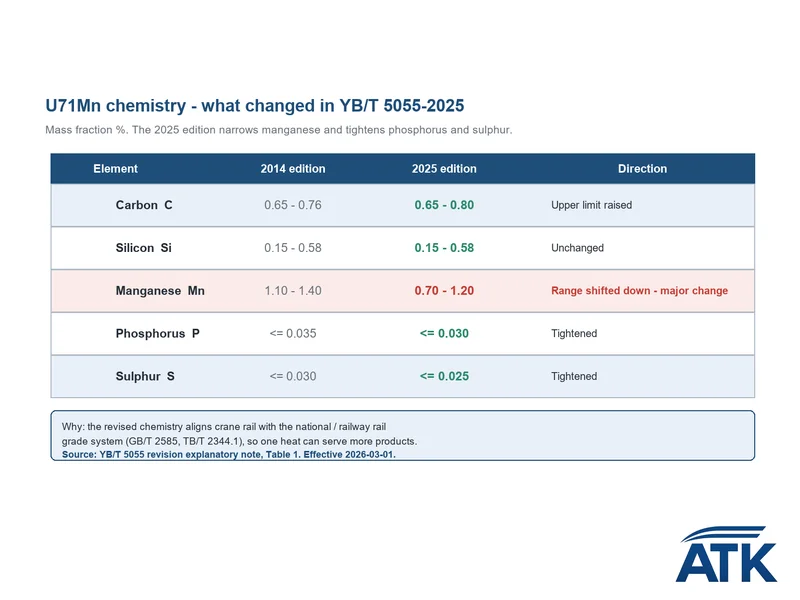
Element | YB/T 5055-2014 | YB/T 5055-2025 | Change |
Carbon, C | 0.65–0.76 | 0.65–0.80 | Upper limit raised |
Silicon, Si | 0.15–0.58 | 0.15–0.58 | Unchanged |
Manganese, Mn | 1.10–1.40 | 0.70–1.20 | Range shifted down — the main change |
Phosphorus, P | ≤ 0.035 | ≤ 0.030 | Tightened |
Sulphur, S | ≤ 0.030 | ≤ 0.025 | Tightened |
The manganese move is the significant one. Under the 2014 edition U71Mn sat at 1.10–1.40% Mn, while the 2025 edition places it at 0.70–1.20%. That is not a typo and it is not a rounding difference — it brings the crane rail grade into the same band as U71Mn in GB/T 2585-2021 and TB/T 2344.1-2020. If a procurement specification was written against the old edition, the chemistry clause now needs to be re-read rather than copied forward.
The same revision added three new grades — U68CuCr, U22SiMn and U20Mn — and introduced oxygen and nitrogen limits for all grades in both liquid steel and the finished rail. U22SiMn and U20Mn are delivered in the tempered condition; U71Mn remains hot-rolled. The tensile properties of the new grades were added, while U71Mn keeps its existing requirement. None of that turns U71Mn into a different product, but it does mean a "YB/T 5055" call-up without an edition date is ambiguous. Name the edition.
Under YB/T 5055-2025 the tensile requirement for U71Mn stays at a minimum tensile strength of 880 MPa and elongation after fracture of at least 9.0%. Tensile testing follows GB/T 228.1, with the specimen taken from the centre of the rail head. Macrostructure is checked by acid etch; white spots and shrinkage cavities are not allowed.
Do not mix figures from different standards. TB/T 2344.1-2020 lists U71Mn at ≥ 880 MPa with ≥ 10% elongation and a head hardness of 260–300 HB, and European R260 carries its own set of limits under EN 13674-1. The values overlap, which is why the grades get compared, but they are requirements of separate documents with separate test regimes. When a buyer asks "what is the strength of U71Mn", the honest answer names the standard first.
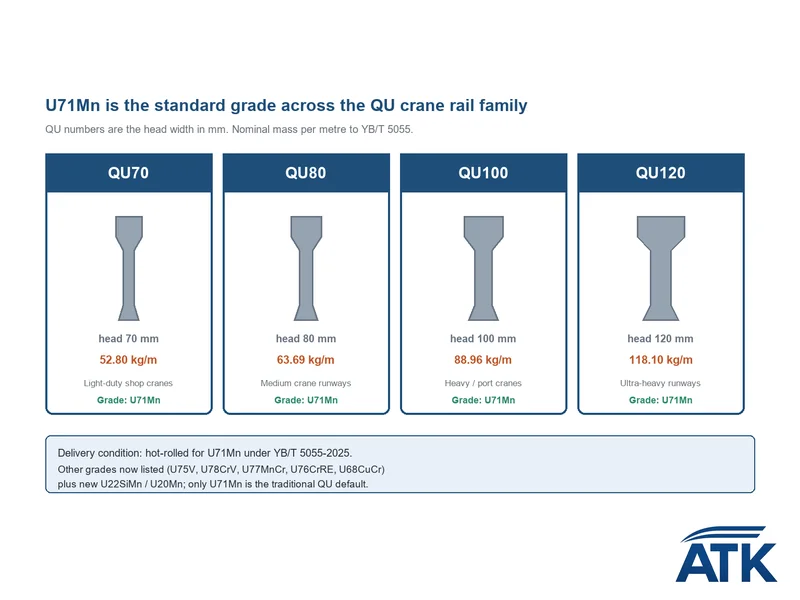
QU numbers refer to the head width in millimetres. The four sections in the crane rail standard, with theoretical mass per metre to the standard's table of nominal masses, are:
Section | Head width | Theoretical mass | Typical duty |
QU70 | 70 mm | 52.80 kg/m | Light workshop and stacker cranes |
QU80 | 80 mm | 63.69 kg/m | Medium crane runways |
QU100 | 100 mm | 88.96 kg/m | Heavy and port cranes |
QU120 | 120 mm | 118.10 kg/m | Ultra-heavy runways |
U71Mn is the traditional grade across all four. Buyers searching for a U71Mn QU120 crane rail for an ultra-heavy runway are usually choosing the section for its head area, not looking for a different steel — heavier wheels and higher cycle counts drive the section rather than the grade. Moving from QU80 to QU100 or QU120 buys wear life, not a new composition. The QU crane rail profiles page carries the full dimensional tables for these sections.
That said, the 2025 edition broadens the grade list. Projects with higher strength or special corrosion demands can now call up U75V, U78CrV, U77MnCr, U76CrRE, U68CuCr, U22SiMn or U20Mn. Those are separate grades with separate chemistry and delivery states. Choosing between them is a different conversation from specifying U71Mn, and belongs on the rail section page rather than here.
U71Mn is supplied in the hot-rolled condition under YB/T 5055-2025. The standard sets out ordering details, dimensions, shape, mass, technical requirements, test methods, inspection rules, packaging, marking and the quality certificate — it is a product standard, not an installation standard. Where a project also needs the connection layout, that sits under the crane girder connection drawings rather than the rail standard.
One practical point on documents: a mill certificate should state the heat number, the grade, the standard edition, the composition and the tensile result for the delivered rail. Ask for it at enquiry stage. A certificate that says only "U71Mn" without an edition is no better than the grade call-up itself.
This is where loose quoting does the most damage. U71Mn has no single, official equivalent in another standard system. What circulates in supplier tables is a set of broad comparisons, and they are not interchangeable.
System | Commonly compared grade | Status |
China, YB/T 5055-2025 | U71Mn | Exact — the grade in this standard |
China, TB/T 2344.1-2020 | U71Mn | Comparable rail grade |
Europe, EN 13674-1 | R260 | Performance broadly comparable |
Japan, JIS E 1101 | 50Mn / 60Mn | Rough match — composition differs |
Russia, GOST 24182 / 51685 | M76 (М76) | Approximate — check the revision |
USA, ASTM A759 | Grade 60 / 90A | Approximate — section-led, not grade-led |
The most defensible comparison is with EN 13674-1 R260. A published comparison of rail standards concludes that the Chinese U71Mn grade and the European R260 grade are broadly equivalent in performance requirements, with head hardness in the 260–300 HB band for both. That is a performance comparison, not a composition match — the chemistry limits differ. It is the reason R260 is the name buyers most often put next to U71Mn, and also the reason an engineer will not accept one as a drop-in substitution without checking.
JIS E 1101, GOST 24182 and ASTM A759 belong to different families again. JIS and ASTM comparisons tend to be section-led: the rail shape and weight drive the selection more than the grade name. GOST M76 uses a different smelt-route designation and a revised composition across editions. Every one of these needs the buyer to confirm chemistry, tensile class and section tolerance before it is accepted as a substitute. If a project is written to EN or JIS, keep the governing standard on the drawing and ask for an explicit written approval for any U71Mn substitution.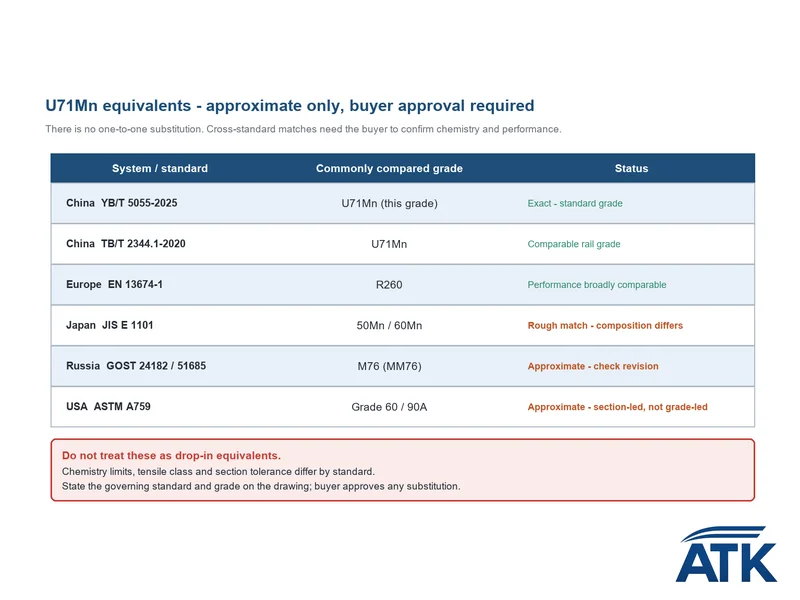
A clean U71Mn enquiry removes most of the back-and-forth. Include these items:
- Section and standard: for example QU100 to YB/T 5055-2025. The edition date matters after the 2025 chemistry change.
- Grade written in full: U71Mn, not "same as R260" or "standard crane rail steel".
- Length and cut condition: standard length or cut to drawing, with the cutting tolerance stated.
- Delivery state: hot-rolled for U71Mn.
- Inspection requirements: state whether a mill certificate, ultrasonic testing or inclusion checks are required. The 2025 edition allows extra inspection by agreement — it is not automatic.
- Joint hardware: fishplates and bolts are bought to the joint drawing and the rail section, not to the grade. If the order includes joints, send the drawing or photographs of the existing assembly. Our crane rail fishplates page explains what the joint side of the order needs.
One more thing worth saying plainly. Grade, section and joint are three separate decisions that often arrive in one email. Getting the grade right does not fix a wrong section, and a correct section does not make an undocumented joint safe. Keep them separate on the RFQ and the reply will be faster and easier to check.
No. They are broadly comparable in performance and head hardness, but the chemistry limits and the governing standard differ. Treat R260 as a comparison, not an equivalent, and get buyer approval before substituting either way.
0.65–0.80%. The upper limit was raised from 0.76% in the 2014 edition.
The 2025 revision aligned crane rail U71Mn with U71Mn in GB/T 2585 and TB/T 2344.1. The range moved from 1.10–1.40% to 0.70–1.20%. The standard's explanatory note gives production alignment as the reason, alongside tighter P and S limits.
Under YB/T 5055-2025, minimum tensile strength is 880 MPa and elongation after fracture is at least 9.0%, tested to GB/T 228.1 on a specimen from the rail head centre.
QU70, QU80, QU100 and QU120 all use U71Mn as the traditional grade. Heavier duty normally changes the section rather than the grade.
Hot-rolled under YB/T 5055-2025. The new U22SiMn and U20Mn grades are the ones delivered tempered.
Not automatically. The grades are only a rough composition match and the sections differ. The buyer needs to confirm chemistry, mechanical class and section tolerance against the governing drawing.
It indicates a carbon content around 0.71%. It is a grade designation, not a rail weight or a section number.
YB/T 5055-2025, effective 1 March 2026, replacing the 2014 edition.
It is good practice and usually required by the project specification. Ask for the heat number, grade, standard edition, composition and tensile result. Extra checks such as ultrasonic testing are by agreement under the 2025 edition.
Name the section, the standard with its edition year, the grade in full, the length and the delivery state. If joints are included, attach the joint drawing.
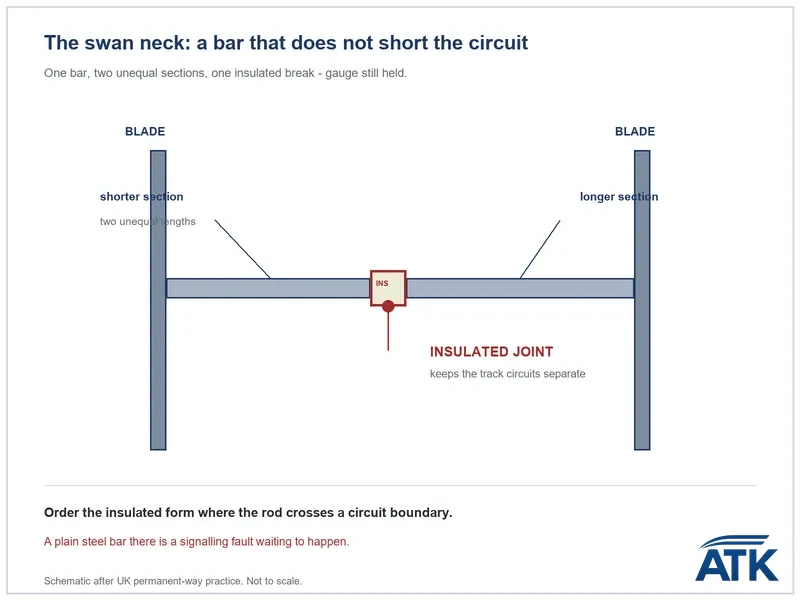
No. Fishplates are selected from the approved joint drawing and the rail section. The grade of the rail does not change the bar profile or the bolt pattern.
Send the section, the standard edition and the duty cycle, and the rail team can confirm the grade call-up and the available sections. If the order includes joints, include the drawing or clear photographs of the installed assembly — that is what lets a supplier match the bar rather than guess from a grade name.
We have recommended some of our Related products to you. I hope you will be interested.
 English
 Русский