
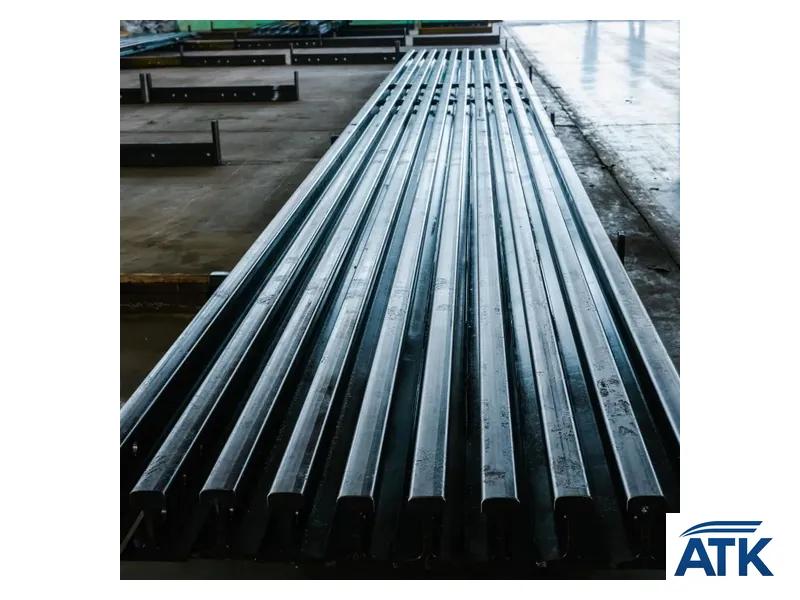
Steel rails to GB/T 2585, EN 13674-1, AREMA, GOST, YB/T 5055 and DIN 536
U71Mn, U75V, R260 and R350HT grades in 12.5 m and 25 m lengths
Cut, drilled and certified to your drawing
Trial production to any standard rail section
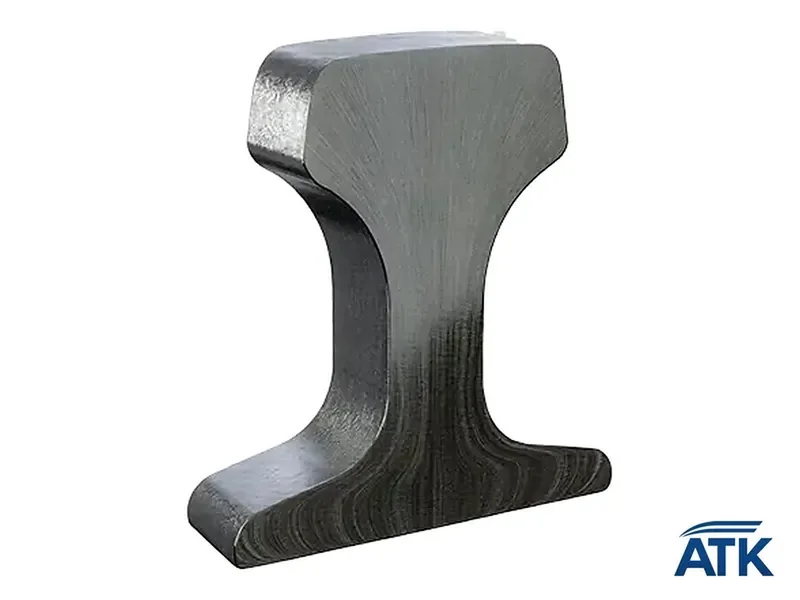
A rail does three jobs at once. It gives the wheel a hard, smooth running surface, carries the bending load between sleepers, and on a signalled line it doubles as the track circuit conductor. For the manganese grade used on QU crane rails, see U71Mn rail specification and equivalents.That is why steel rails are specified by their cross-section rather than by a single dimension: head width, height, foot width and web thickness all have to match the wheel profile, the fastening and the axle load.
ATK supplies steel rails across the full range - heavy mainline sections, crane rails for runways, and light rails for industrial and mining track. There is no universal "standard rail". GB/T 2585, EN 13674-1, AREMA, GOST R 51685, JIS E 1101 and YB/T 5055 each define their own families, and two profiles that look similar in a photograph rarely interchange on an existing track. Send us the section designation or a drawing and we will confirm the equivalent before quoting.
The table below is the set of sections most often asked for on export enquiries. Figures are nominal dimensions defined by the standards, not measurements from one particular mill; the applicable standard and the rolling tolerance govern on a purchase order.
Standard | Section | Height mm | Foot mm | Head mm | Web mm | Mass kg/m | Typical grade |
GB/T 2585 | 50 kg/m | 152 | 132 | 70 | 15.5 | 51.51 | U71Mn |
GB/T 2585 | 60 kg/m | 176 | 150 | 73 | 16.5 | 60.64 | U71Mn / U75V |
GB/T 2585 | 75 kg/m | 192 | 150 | 75 | 20.0 | 74.41 | U75V |
EN 13674-1 | 54E1 (UIC54) | 159 | 140 | 70 | 16.0 | 54.77 | R260 |
EN 13674-1 | 60E1 (UIC60) | 172 | 150 | 72 | 16.5 | 60.21 | R260 / R350HT |
AREMA | 115RE | 168.3 | 139.7 | 69.1 | 15.9 | 56.9 | 260 / 350 |
AREMA | 136RE | 185.7 | 152.4 | 74.6 | 17.5 | 67.4 | 350 |
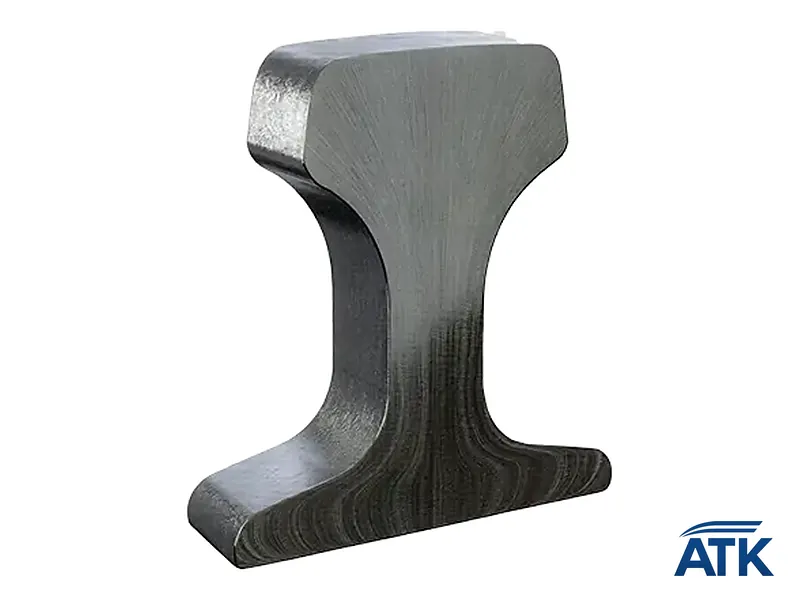
Height is the number that catches people out. GB 60 kg/m stands 176 mm; UIC60 stands 172 mm. Four millimetres is enough to change the pad, the clip and the rail seat, so a "60 kg rail" is not a complete specification on its own. The same applies to the 75 kg/m section, where published mass figures vary between 74.4 and 77.5 kg/m depending on the edition of the standard - always quote the standard year with the section.
Russian-standard rail is its own family. P65 (also written R65) under GOST R 51685 is 180 mm high with a 150 mm foot, a 75 mm head and an 18 mm web, at 64.88 kg/m. The thicker web is deliberate: it gives more margin against web cracking on heavy freight corridors, and the grade is chosen to stay tough at temperatures down to -60 °C. P50 and P75 follow the same system. Standard delivery lengths are 12.5 m and 25 m, with longer strings supplied for continuously welded rail.
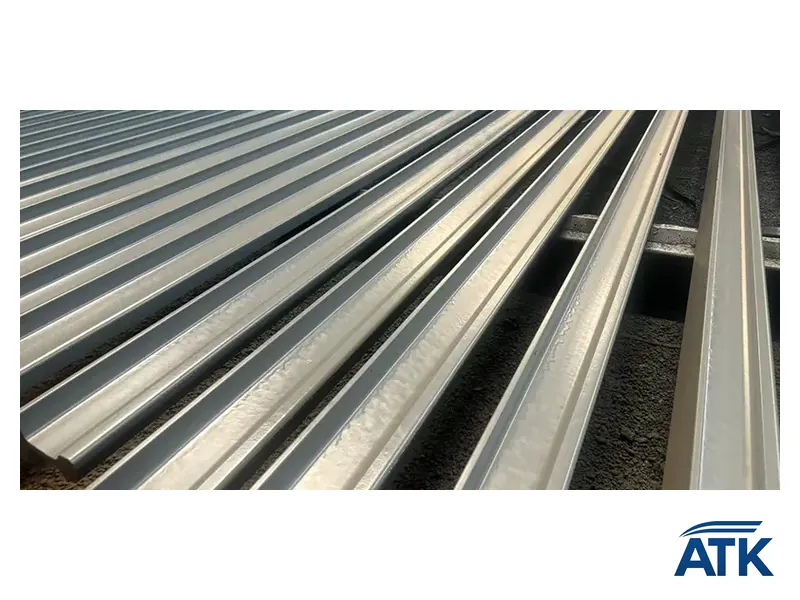
JIS E 1101 covers 50N and 60 kg sections used across Japan and parts of Asia, AS 1085 the Australian 60 kg and 68 kg profiles, and ASTM A1 the ASCE light sections from 25 to 85 lb/yd.The railway JIS standards and the crane rail catalogue sections are separated in the DIN 536 vs JIS vs EN 13674 comparison. If your project names one of these, send the designation rather than a weight. Two rails of the same nominal mass can have different drilling and different fishplate fits.
Crane rail is a different animal. The wheel loads are concentrated, the support is usually a steel girder rather than sleepers, and lateral stability matters more than vertical bending strength.
Standard | Section | Height mm | Foot mm | Head mm | Web mm | Mass kg/m |
YB/T 5055 | QU70 | 120 | 120 | 70 | 28 | 52.80 |
YB/T 5055 | QU80 | 130 | 130 | 80 | 32 | 63.69 |
YB/T 5055 | QU100 | 150 | 150 | 100 | 38 | 88.96 |
YB/T 5055 | QU120 | 170 | 170 | 120 | 44 | 118.10 |
DIN 536 | A65 | 75 | 175 | 65 | 38 | 43.10 |
DIN 536 | A100 | 95 | 200 | 100 | 60 | 74.30 |
DIN 536 | A120 | 105 | 220 | 120 | 72 | 100.00 |
Note the difference in shape. A QU100 and an A100 both have a 100 mm head, but the A100 is 55 mm lower and 50 mm wider at the foot. It is squat, with the mass in the base, which protects the girder flange. The QU100 is taller and narrower. Neither can be swapped onto the other's runway without reworking the clip positions and the rail elevation, and the crane rail fastenings have to be reselected at the same time - a clip sized for an A100 foot will not sit correctly on a QU100.
Light rail to GB/T 11264 runs from 8 to 30 kg/m in Q235B or 55Q, for mine track, factory sidings and yard lines. It is usually supplied bolted rather than welded, and the joint bars are matched to the section.
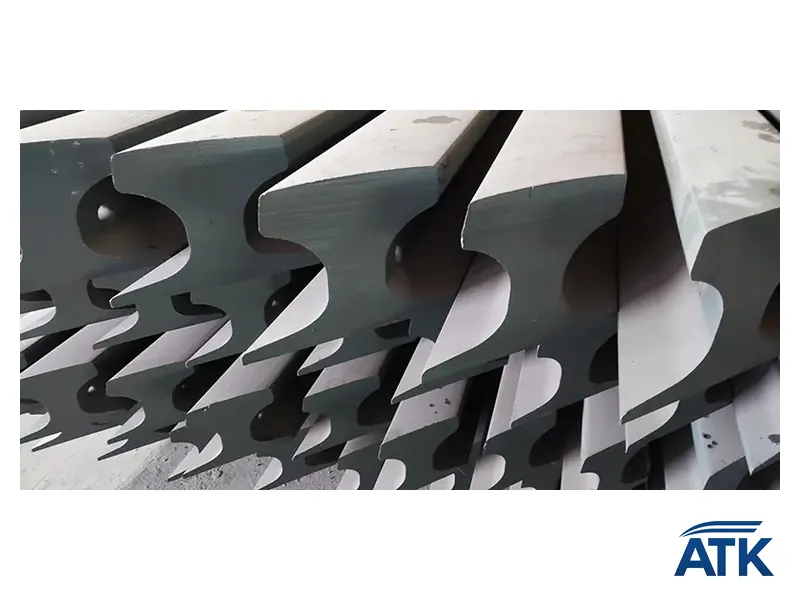
Grade selection is where a rail either lasts or does not. Plain carbon-manganese rail is weldable and forgiving; head-hardened rail resists wear and rolling contact fatigue on curves and heavy-haul lines, but needs a welder who knows the grade.
l U71Mn, GB/T 2585. Tensile strength at least 880 MPa. Work-hardens in service, the general-purpose choice on Chinese mainline.
l U75V, GB/T 2585. Vanadium-microalloyed, at least 980 MPa. Better fatigue resistance for high-speed and heavy-haul.
l R260, EN 13674-1. At least 880 MPa, good weldability, medium-traffic mainline.
l R350HT, EN 13674-1. Head-hardened, at least 1100 MPa. High-speed lines, tight curves and heavy axle loads.
l AREMA 260 / 350 and the 900A / 1100A heat-treated classes for North American sections; 50Mn and U71Mn for QU and DIN A crane rails.
Every rail is marked with the mill, the section, the grade, the heat number and the standard. That marking is what lets a buyer trace a failed rail back to a cast. Mill test certificates to EN 10204 3.1 or 3.2, plus ultrasonic testing and dimensional inspection, are supplied where the project calls for them.
Standard lengths are 12.5 m and 25 m. Long rails for CWR are delivered in much greater lengths and welded on site, so straightness and end squareness matter more than they do on bolted track. Where a joint is bolted, the drilling pattern belongs to the rail section - four or six holes, round or oval, at the pitch set by the profile designation and the fishplate. Drill it to the wrong pattern and no joint bar will fit, including the insulated fishplates used on track-circuited sections; they are machined to the same pitch, not to a universal one.
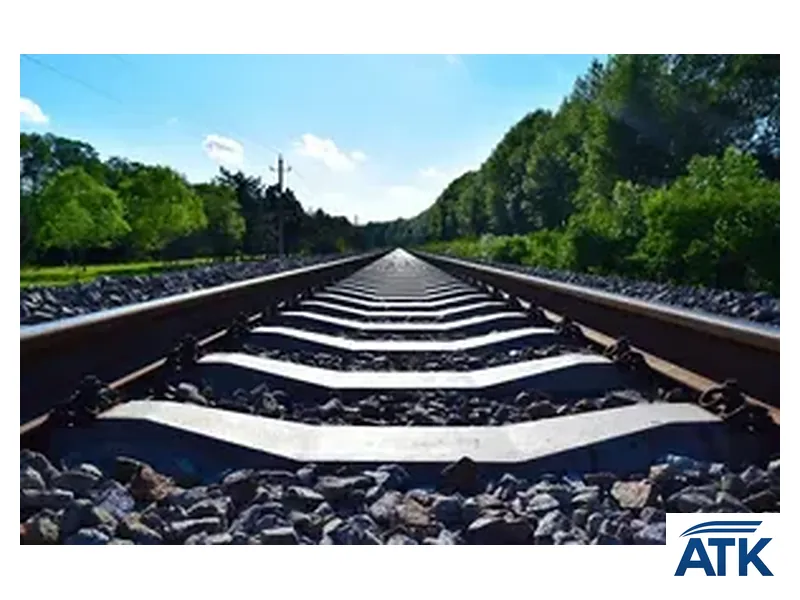
Cutting, drilling, chamfering and end hardening are done to the drawing. End faces for flash-butt or thermite welding are prepared differently from bolted ends. Rail ends also need deburring before a joint is assembled; a burr left at a bolt hole shows up later as a crack. We can develop and trial-produce to any standard rail section, including GB/T 2585, UIC, AREMA and GOST profiles, so a section that is not in the tables above is still worth asking about.
Mainline and high-speed track. Heavy-haul coal and ore corridors, where the grade matters more than the section. Metro, light rail and depot track, often with insulated joints and track circuit sectioning. Ports, steelworks and shipyards, where QU or DIN A crane rails carry gantry and overhead crane wheels. Mine and industrial sidings on light rail. And, regularly, a maintenance crew replacing a single damaged length on a live line - which is usually where an odd profile or an old standard turns up.
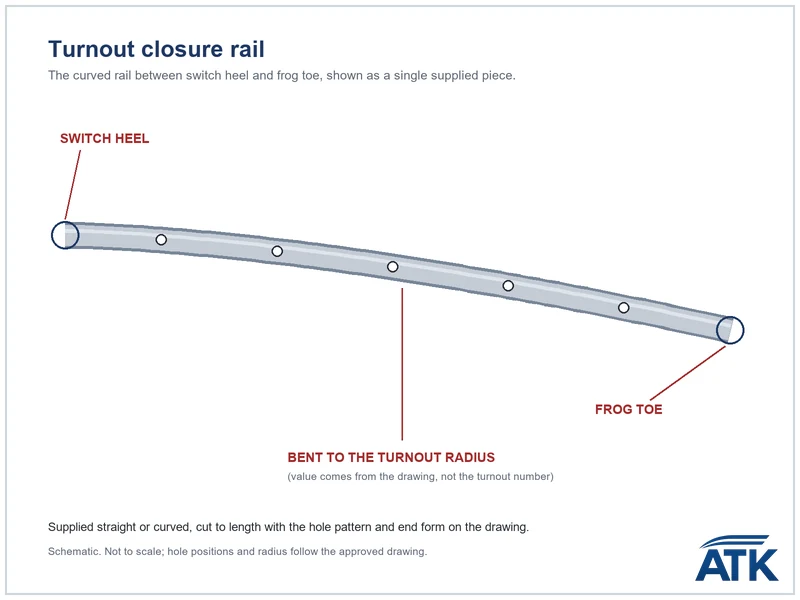
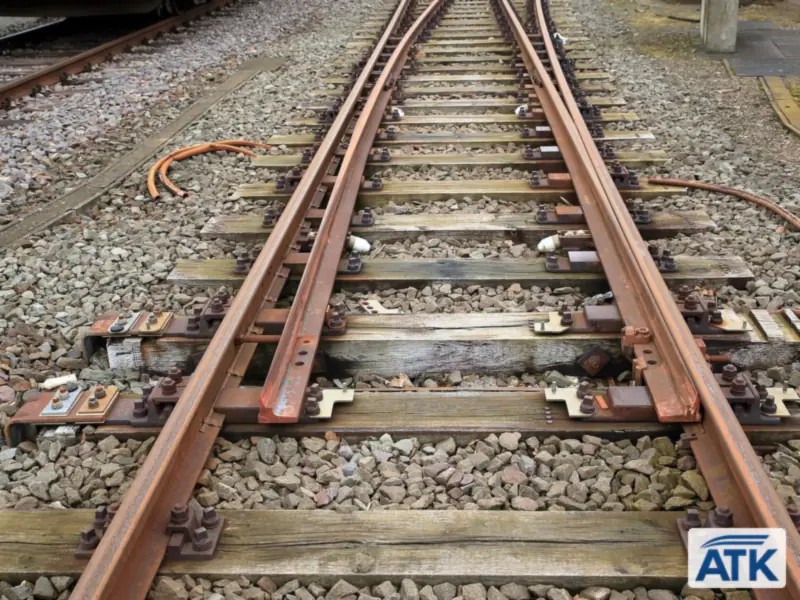
Because the same project nearly always needs crane rail fastenings, railway turnout components, track maintenance tools & equipment and fasteners & hardware alongside the rail, we usually put them on one enquiry rather than four. Insulated fishplates and joint bars for the same sections are supplied as well.
Standard and section first. 60E1 to EN 13674-1 is a specification; 60 kg rail is not.
Grade. U71Mn, U75V, R260, R350HT or the AREMA class, and whether head hardening is required.
Length. 12.5 m, 25 m, or long rails for CWR; state the tolerance and whether random lengths are acceptable.
Ends and drilling. Bolted joint holes, or plain ends prepared for welding. Hole diameter, pitch and count where applicable.
Quantity and tonnage. Sections are quoted by the metre and shipped by weight, so the theoretical mass per metre in the tables above drives the freight calculation.
Inspection. Mill test certificate level, ultrasonic testing, and any third-party inspection the project requires.
Accessories. Fishplates, joint bars, clips, pads and baseplates for the same section - ask for them together, they are matched to the profile.
Send the drawing, or even the section designation off an old rail. We would rather turn down a mismatch early than ship bars that do not fit the fastenings.
Most enquiries start with a section and a tonnage, not a price. Rail is quoted by the metre and invoiced by weight, so the theoretical mass in the tables above is what turns a length into a tonnage - 25 m of 60E1 is about 1.5 t per rail, and that figure is what decides how many rails fit a wagon or a container.
Minimum order quantity follows the rolling programme rather than a fixed price list. Common sections in U71Mn or R260 can usually be worked into an existing schedule. A non-standard drilling pattern, a head-hardened grade or a short run of crane rail is a different conversation. The same request sent to three suppliers often comes back with three different lead times, simply because each one is quoting against a different rolling slot. Give us the tonnage and the delivery window in the first message and we will say what is realistic before anything is quoted.
Bundles are strapped with steel band, tagged by heat number, and loaded with the mill markings facing out so a surveyor can read them without unloading. For export we normally quote FOB or CIF, payment by T/T or L/C at sight; the port of loading, the packing list and the certificate set belong in the quotation, not in a follow-up email. Matching insulated fishplates, clips and pads can be consolidated into one shipment, which is nearly always cheaper than three partial loads. Third-party inspection at the mill is welcome - SGS, BV or your own surveyor - and the bundle stays put until the release note is issued.
Some of the sections above are held in stock; the rest are rolled to order. It is worth asking which is which at enquiry stage, because the answer changes with the rolling programme. If the site has a fixed possession date, that date should be in the first email, not the third.
No. GB 60 kg/m is 176 mm high with a 73 mm head; 60E1 / UIC60 is 172 mm with a 72 mm head. Both weigh about 60 kg/m, but the pads, clips, fishplates and rail seat differ. Name the standard when you enquire.
Yes. P65 to GOST R 51685 is 64.88 kg/m, 180 mm high, with an 18 mm web, normally in 12.5 m or 25 m lengths. P50 and P75 are in the same family. Send the designation and the grade required for the climate.
Both have a 100 mm head. QU100 is 150 mm high with a 150 mm foot and weighs 88.96 kg/m; A100 is 95 mm high with a 200 mm foot and weighs 74.30 kg/m. The A-series sits lower and spreads the load over the girder flange. They cannot be swapped without changing the clip layout and rail level.
It depends on what is failing first. If the site is losing rail head to wear or rolling contact fatigue on a tight curve, head-hardened rail earns its keep - R350HT at 1100 MPa, or U75V at 980 MPa on a GB section. If the problem is weld repairability or a line with frequent turnout work, plain R260 or U71Mn is easier to weld and quite adequate on tangent, medium-traffic track. Curve radius, axle load and tonnage per year all move that decision, so send those three numbers rather than just the standard. A grade specified in isolation is usually a grade that gets changed after the first site meeting.
12.5 m and 25 m as standard, longer CWR strings and custom cut lengths on request. Ends are cut, chamfered and drilled to your drawing.
Yes. Mill, section, grade, heat number and standard are marked on every rail; EN 10204 3.1 or 3.2 certificates on request.
It follows the rolling programme, not a price list. Send the section and tonnage and we will confirm what can be scheduled.
Usually yes. Common heavy, crane and light sections can be bundled together with their matching insulated fishplates and fasteners & hardware, as long as the lengths suit one wagon. Tell us the mix at enquiry stage so the packing list and the mill markings are right the first time.
For export we quote FOB or CIF, payment by T/T or L/C at sight, with the port of loading, the packing list and the certificate set written into the quotation. Lead time is set by the rolling slot and the inspection date; sections held in stock move sooner, while a non-standard drilling pattern, a head-hardened grade or a short run of crane rail has to wait for a mill slot. If the contract calls for third-party inspection, add the surveyor's release to the schedule - the bundle does not leave the mill until that note is issued. A fixed possession date on site should be in the first email, because it is much easier to reserve a rolling slot early than to compress one later.
Send the standard, section designation, grade, length and tonnage, and we can develop and trial-produce to any standard rail section - GB/T 2585, UIC, AREMA or GOST. A datasheet, samples or a project price are available - contact us. Where one project also covers crane rail fastenings, insulated fishplates, railway turnout components, track maintenance tools & equipment and fasteners & hardware, put them on the same enquiry; the packing list is easier to get right when it is written once.
We have recommended some of our Related products to you. I hope you will be interested.
 English
 Русский