
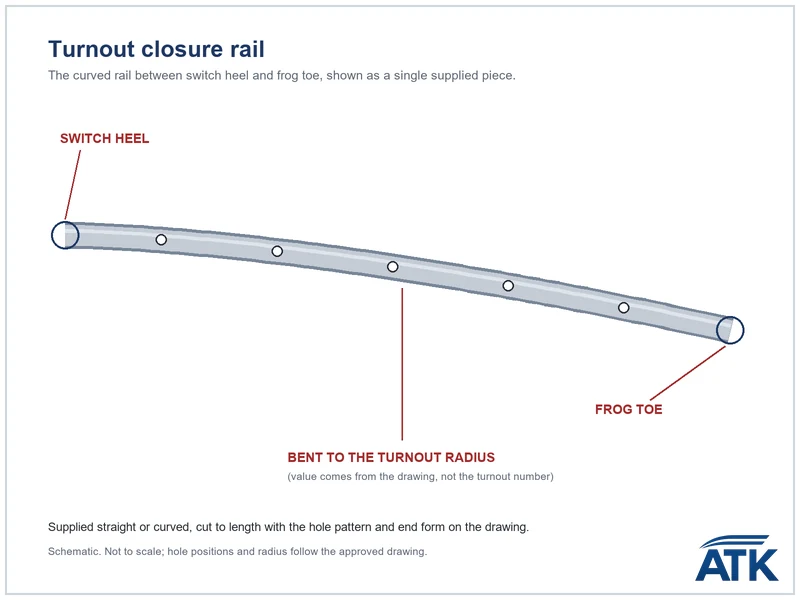
Turnout closure rails: straight and curved
Also specified as lead rails or connecting rails
From switch heel to frog toe
Bent to the turnout drawing radius
Cut lengths with position marking
Hole pattern and end prep to drawing
Gauge widening where the radius requires it
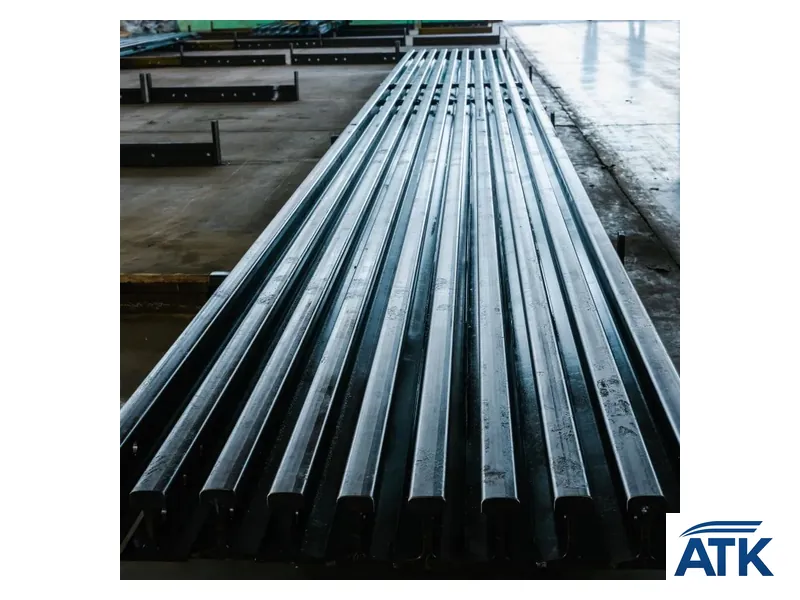
Individual rails, matched pairs or panels
Request a quotation
A turnout is sold as one assembly, but the rail that carries the wheel between the switch and the crossing is ordered separately. It is the closure rail, and on the diverging route it is bent. The radius of that bend decides how fast a train can take the branch, and the wear on it decides when the turnout comes out of service. Buyers use three names for the same part — closure rail, lead rail and connecting rail — so the first thing worth settling is what is being quoted.
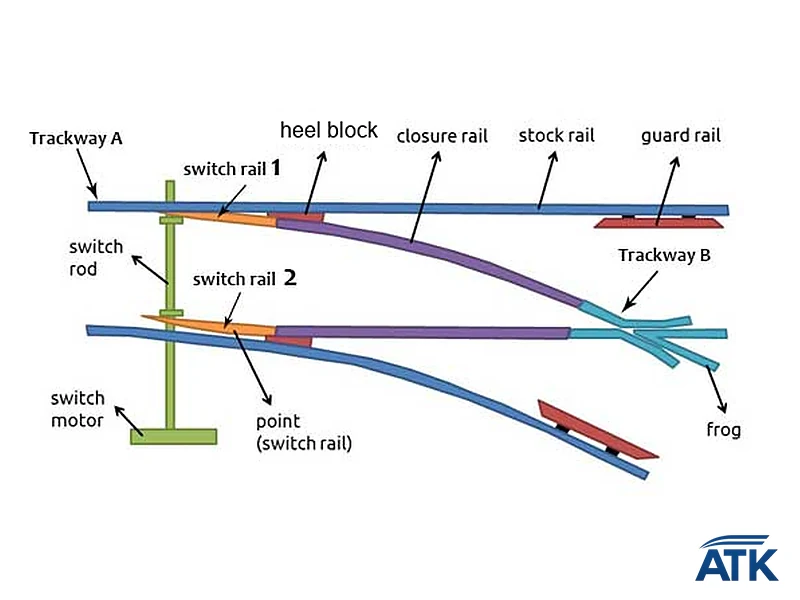
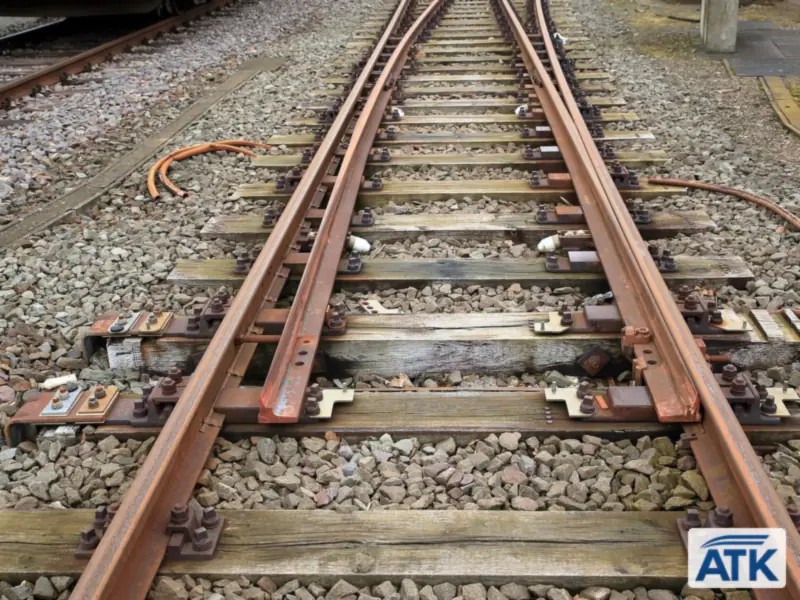
The rails between the switch heel and the frog toe are the closure rails. North American maintenance manuals say it plainly. A technical page reproducing AS 1085.21 defines them more widely as the rails in a turnout that are not part of the switch assembly, the crossing or the check rail unit. Both descriptions point at the same physical stretch.
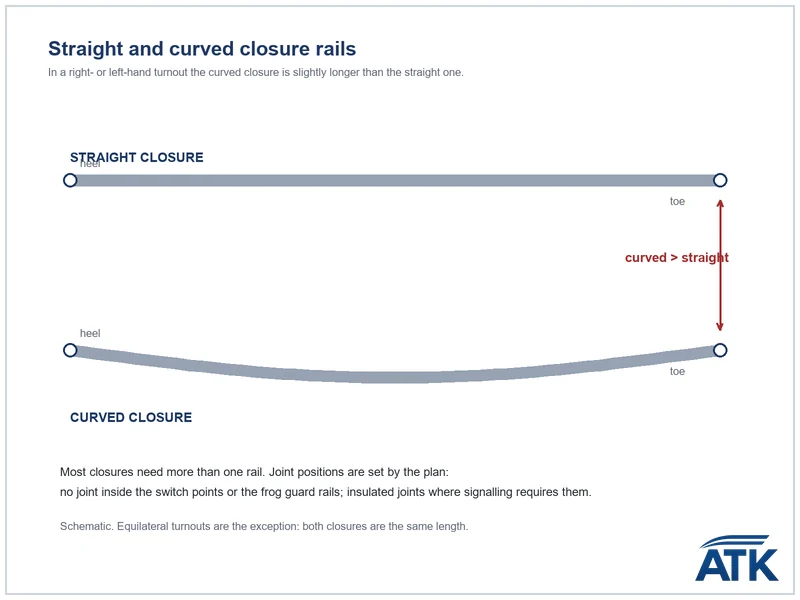
A straight turnout has a straight closure on the through route and a curved one on the diverging route. A right-hand or left-hand turnout makes the curved closure slightly longer than the straight one. An equilateral turnout is the exception: both closures are the same length. Most closures need more than one rail to span the distance, so a drawing will show where each piece starts and ends.
That last point is where orders go wrong. A closure rail is not a length of rail cut to fit. It arrives with a specific radius, a drilled hole pattern, machined ends and, on the curved route, a gauge that has been widened to suit the radius. None of those four things can be worked out from the turnout number alone.
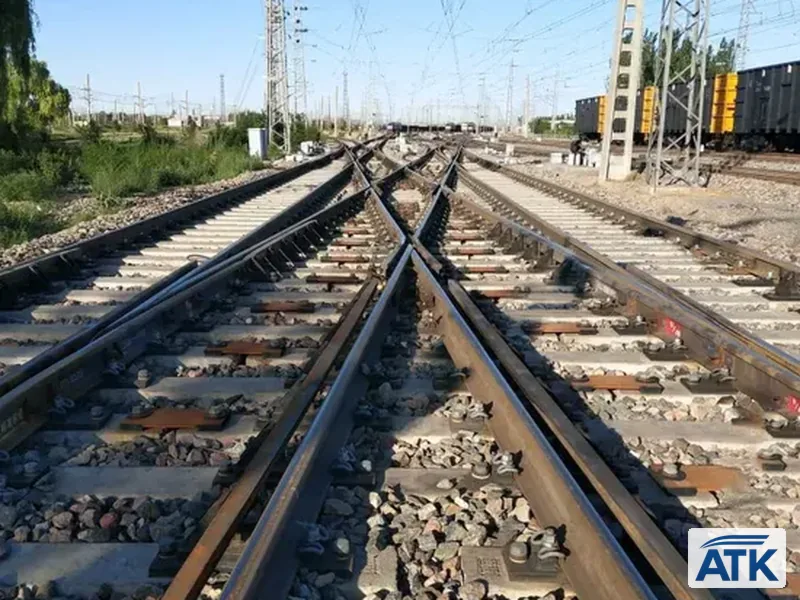
Suppliers are not consistent about which name they print on a quotation, and three terms are in common use:
· Closure rail is the standard term in EN 13232 and in North American trackwork vocabulary. It is the one used in this specification.
· Lead rail is the older North American shop term. The same manuals use it interchangeably with closure rail, including in the phrase "curved lead".
· Connecting rail appears in the same glossaries and in some Asian specifications. In Chinese practice the curved portion is called the guide curve or lead curve, and the rails that form it are the closure rails.
A buyer searching for lead rails and a buyer searching for closure rails are looking for the same part. The difference that matters is not the name but whether the rail is straight or curved, what radius it is bent to, and which end goes to the heel.
Straight closure rail. Runs from the switch heel to the frog toe on the through route. It is straight in plan, but it still needs its own length, drilling and end preparation.
Curved closure rail. Runs on the diverging route and is bent to the radius of the guide curve. The rail is bent before drilling where the shop has a rolling bend machine; drilling after bending keeps the hole positions true to the curved centreline.
Shortened rail. Where a closure is made up of more than one piece, one is cut shorter so that the joints fall at the positions the turnout plan allows. Some networks stock pre-cut lead rails in the common lengths so a field crew is not drilling on the track.
Compromise rail. Used where the closure has to join two different rail sections. It is a short rail with a different profile at each end, and it belongs to the joint rather than to the curve.
Item | Value |
Product | Turnout closure rail, straight or curved |
Also known as | Lead rail, connecting rail |
Rail section | 50, 60 and 75 kg/m Chinese sections; AREMA 115RE and 136RE; EN 49E1, 54E1, 60E1 to drawing |
Curve radius | Set by the turnout number and the project drawing |
Length | Cut to the turnout plan; each piece identified by position |
Closure rail length tolerance | ±5 mm (AS 1085.21:2020, secondary transcription) |
End preparation | Square cut, ground, or prepared for welded or insulated joint |
Hole pattern | Per the turnout drawing; no standard pitch |
Gauge on curved route | Widened per the radius, where the design calls for it |
Supply form | Individual rails, matched pairs, or complete pre-assembled panels |
The tolerance in the table comes from a published transcription of AS 1085.21, not from the standard text itself, so it is given for orientation. Length, drilling and end preparation are confirmed against the drawing before manufacture.
The turnout number fixes the frog angle. It does not, on its own, fix the radius a manufacturer will bend into the closure rail. Published figures for common Chinese turnouts put the guide curve radius at about 180 m for a No. 9 and about 330 m for a No. 12, with later designs using 350 m for the No. 12. A published North American No. 15 layout drawing gives a centreline radius of 564.9 m. These are examples from different design families, not interchangeable values.
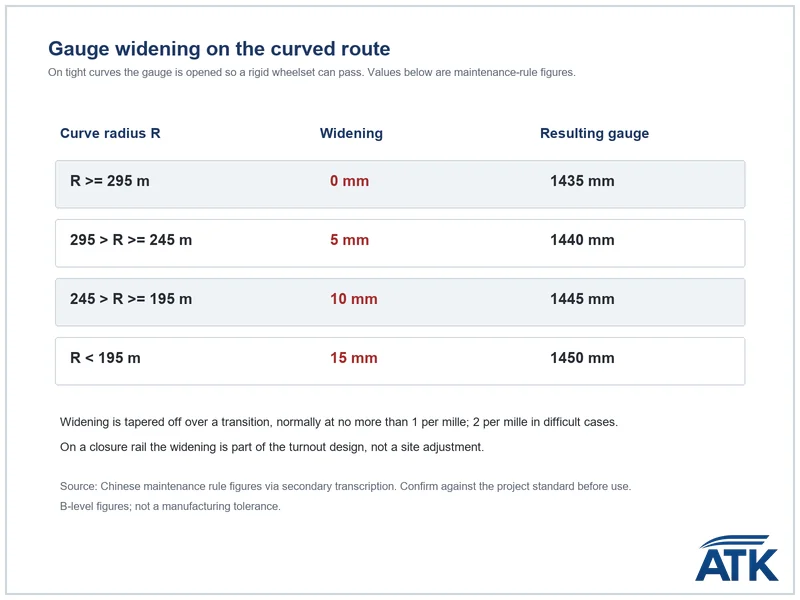
A rigid wheelset needs more room on a tight curve. Where the radius falls below the threshold, the gauge is opened on the curved route. Chinese maintenance figures give the steps as 0 mm at R ≥ 295 m, 5 mm between 295 and 245 m, 10 mm between 245 and 195 m, and 15 mm below 195 m. The widening is tapered off over a transition, normally at no more than 1 per mille and at 2 per mille in difficult cases.
Those numbers are operating-maintenance figures obtained from secondary sources. They belong to the design discussion, not to a product tolerance sheet. On a closure rail the widening is built into the turnout geometry; a fitter does not add it on site.
Published tables for other gauge families make the same point. One AS 1085.21 table covers 1067 mm narrow gauge. It pairs radii of 130, 200, 280, 500 and 1235 m with turnout rates from 1:8.25 to 1:25, and nominal diverging speeds of 25 to 80 km/h. Those figures belong to that gauge and that standard. They are not a cross-reference chart for 1435 mm or 1520 mm track, and a radius taken from them cannot be used to quote a broad-gauge closure rail.
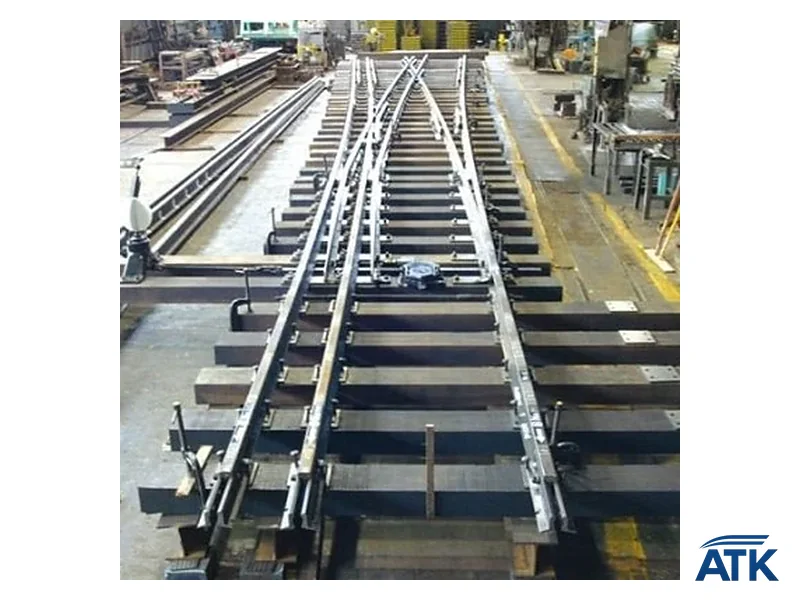
Bending comes first on the curved rail. The rail is set against a form or passed through a rolling bend, then checked against a template before any drilling is done. Drilling a straight rail and bending it afterwards moves the holes off the curved centreline, which shows up later as a joint that will not close.
The ends are prepared for the joint the drawing calls for. On many turnouts the switch area is welded, while the frog toe uses a frozen or glued joint because high-manganese steel cannot be welded to carbon rail with ordinary field procedures. In signalised territory an insulated joint has to sit somewhere in the curved closure when the normal route of traffic is the straight side. That is a layout decision, not a fitting decision, and it changes where the pieces are cut.
MARTA — the Metropolitan Atlanta Rapid Transit Authority — publishes installation guidance that gives the rules most networks follow in some form. Do not put a joint inside the switch points or within the frog guard rails. Stagger joints where the electrical requirements allow, and avoid terminating a stock rail in a heel block joint. Welding is reducing the number of joints in modern turnouts, but it does not remove the insulated ones.
Inspection is on the features that decide whether the rail fits the turnout:
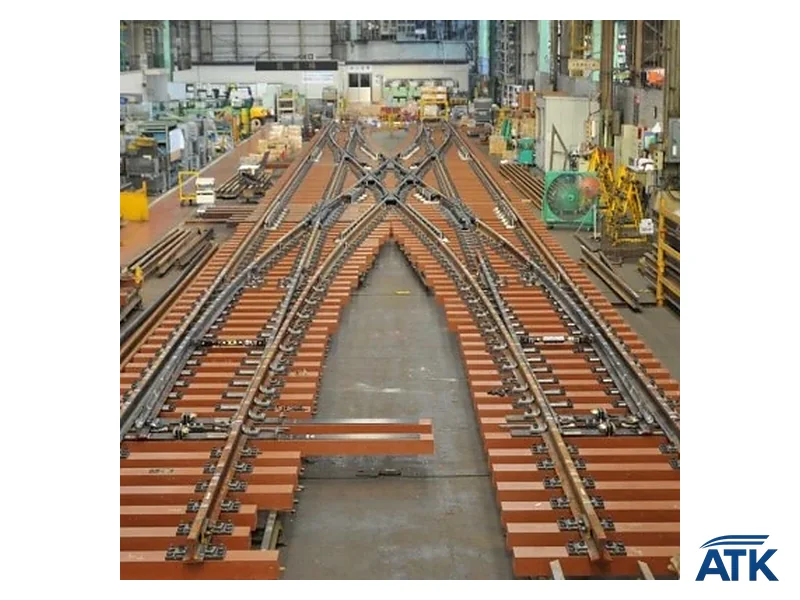
· End-to-end length and the position of every piece in the closure.
· Radius against the template or the drawing, checked before drilling.
· Hole diameter and the chain distances from a datum end.
· End squareness and the surface finish where a welded or glued joint is prepared.
· Straightness of the running surface and the absence of kinks at the bend.
· Marking of hand, position and rail section, so a curved piece cannot be fitted to the straight route.
For a matched pair, the two rails are checked together against the gauge at both ends. A rail that passes a dimensional check but is the wrong hand is a common dispatch error and a costly one to find on site.
The closure rail is seated on the turnout bearers — the longer sleepers used through the switch and crossing — and held at two fixed points: the heel block at the switch end and the frog at the other. Between them, alignment is set from reference offsets given on the turnout plan, measured between the gauge faces of the straight and curved rails at stated distances from the switch point. These offsets are why a closure rail cannot be lined by eye.
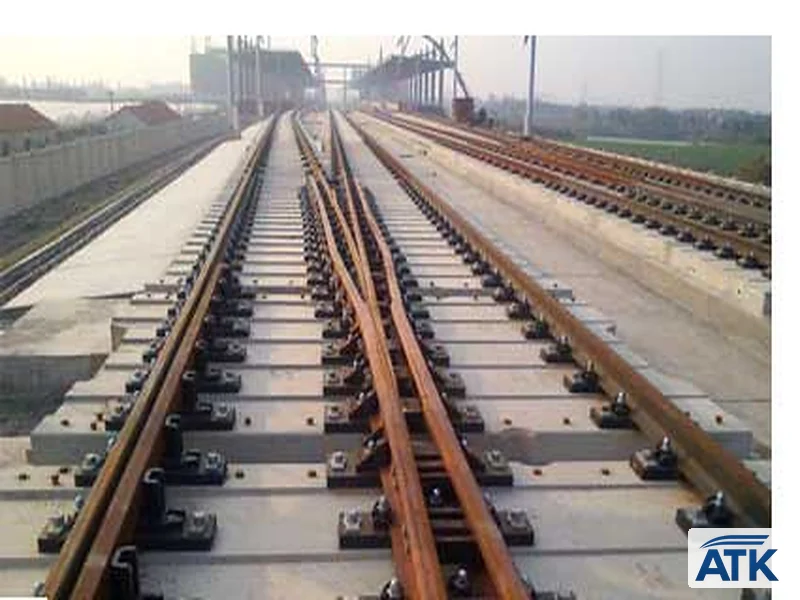
An installation crew that has to force a rail into place should stop. MARTA's guidance is explicit: if the lead rails do not fit, the measured lead distance is wrong, or the frog point and switch points were not located correctly. Driving a rail into position with the joints already tight hides the error and puts a permanent lateral force into the assembly.
After the rails are seated and the joint bars are fitted, the running surface is checked through the transfer area. A small step at the frog toe is felt by every wheel and shows up first as noise, then as wear on the wing rail and the closure end.
The curved closure carries more lateral load than the straight one, so it wears on the gauge face and loses profile earlier. A rail that has worn past its limit is replaced as part of a matched set where the drawing requires paired lengths. Replacing one piece of a multi-rail closure with a rail of a different section or hole pattern changes the joint positions and the lead distance.
Inspection looks at the gauge face, the joint holes, the bent area for signs of a correction bend, and the running surface at the frog end. A rail that has been re-heated or re-bent in the field is not treated as equivalent to a shop-bent rail.
What is made to order: rail section, length and piece count, bend radius, hole pattern, end preparation, insulation details and marking. What is fixed by the turnout design: the hand, the gauge widening, the joint positions and the relationship to the frog. No different radius is substituted to make a rail easier to bend.
For a quotation, send the turnout number and hand, the rail section, the drawing or plan showing the closure pieces, and the required joint type at each end. Where a complete panel is wanted, say so at the enquiry stage — a pre-assembled panel changes the packing and the delivery arrangement.
The rail between the switch heel and the frog toe. On a simple turnout there is a straight one on the through route and a curved one on the diverging route.
Yes. Lead rail is the older shop term and appears throughout North American maintenance manuals. Connecting rail is another synonym used in some specifications.
The diverging route travels further between the same two points. In an equilateral turnout the two routes are symmetrical and the closures are the same length.
No. The number fixes the frog angle. The radius is a separate value on the turnout drawing and differs between design families.
It depends on the radius and the network standard. Chinese maintenance figures step from 0 mm at R ≥ 295 m to 15 mm below 195 m. Use the project standard, not these figures, for manufacture.
It can be done, but drilling after a field bend rarely keeps the holes on the curved centreline. Shop bending with the holes drilled after forming is the reliable route.
Often more than one. The plan shows where each piece falls, and the lengths are set so the joints avoid the switch points and the frog guard rails.
Yes, with the hole pattern and end preparation for the insulated assembly. The joint position comes from the signalling layout.
Yes, including AREMA 115RE and 136RE. Send the turnout plan — the section alone does not define the radius or the drilling.
AS 1085.21:2020 is published at ±5 mm for closure rail length in a secondary transcription. Manufacture follows the project drawing, with the tolerance confirmed before the order.
Send the turnout number and hand, the rail section, the piece position, and either the drawing or the existing rail's length, hole pattern and end form. A clear photo helps when the drawing is not available.
Yes, provided the existing geometry is confirmed first. The rail section, radius, drilling and end joints are checked against the turnout before manufacture; a part number alone is not enough.
Yes. Give the hand, the section, the radius or drawing reference, and the piece position so the hole pattern matches what is in track.
Yes, where the drawing allows. Pre-assembly means the fastenings and joints are set before dispatch, so the crew is not building the geometry on site.
The closure rail is ordered with the parts at each end. At the heel sits the switch rail and stock rail. At the toe is the railway frog. The turnout fastening system holds the curved rail to its bearers. The complete turnout page shows how the sections are matched into one assembly.
Send the turnout drawing and the position of the piece you need, and we will confirm the section, radius, length and end preparation before quoting. Request a quotation with the plan attached.
We have recommended some of our Related products to you. I hope you will be interested.
 English
 Русский