
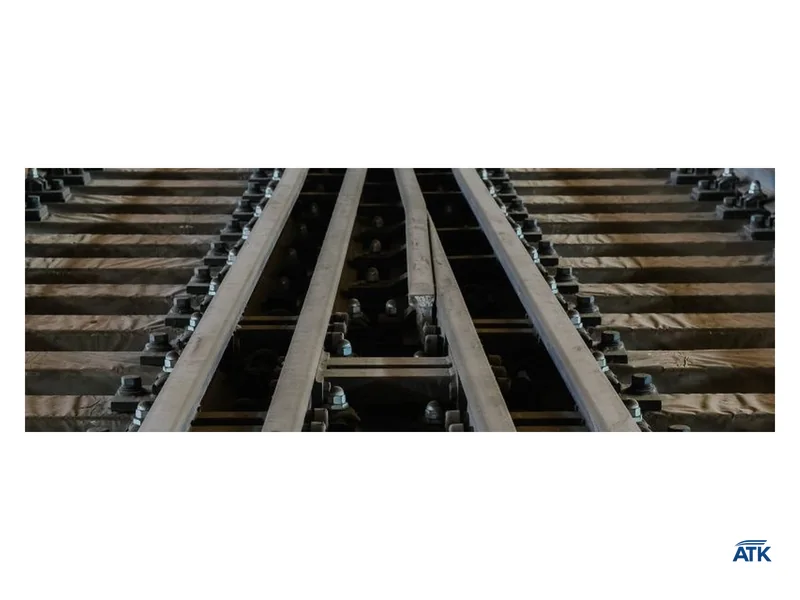
Complete No.9 and No.12 single turnouts for UIC60 / 60 kg/m and 50 kg/m rail
Switch rails, stock rails, guard rails, frogs and machined turnout parts supplied as a matched set
1435 mm / 1520 mm gauge programmes, 25 t design axle load, 600 mm turnout sleeper spacing
TB/T 412-2020 and TB/T 447-2020 manufacturing and acceptance basis, EN 13232 series where specified
High-manganese steel one-piece cast frogs and full-length hardened rail heads
Insulated gauge blocks and insulated joints for track-circuited layouts
Slide plates, integral cast slide baseplates, roller slide plates and spring roller devices
No.7 - No.17 spare gauge blocks, P80 / P40 / P30 transition pads for 1:20 rail cant
Non-standard turnouts built to the approved drawing, including left-hand mirror builds and custom rail sections
A complete turnout is not a single part. It is a matched assembly of rails, cast and machined components, fastenings and bearers that lets a wheelset leave one track and enter another without losing guidance. On plain line the two rails stay parallel. In a turnout they converge, cross and separate again, and the wheel flange has to be controlled through every millimetre of that crossing. That is why a turnout attracts more impact load, more wear and more inspection time than the same length of straight track. Wear concentrates at the frog.
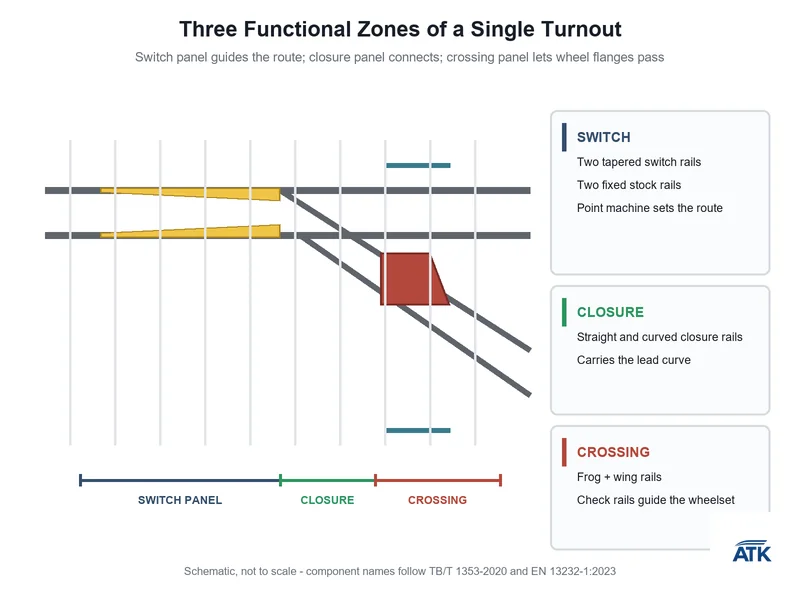
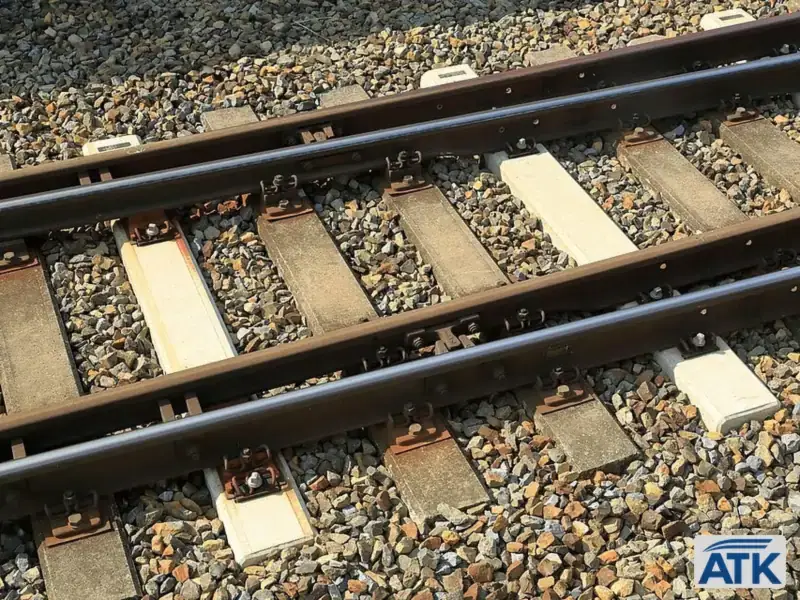
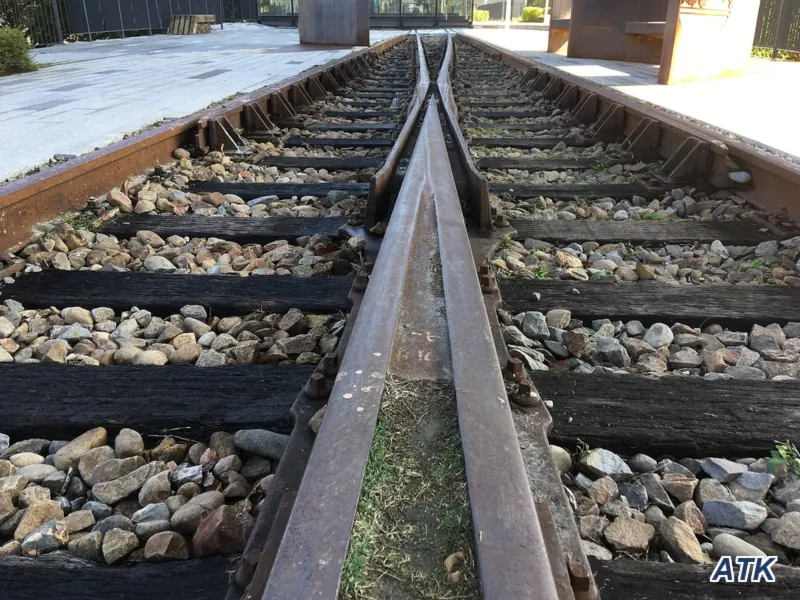
Three zones do the work. The switch panel holds two tapered movable switch rails between two fixed stock rails; a point machine pushes one blade against its stock rail and holds the other clear. The closure panel carries straight and curved closure rails from the switch heels to the crossing. The crossing panel contains the frog, where one wheel path crosses the other, plus check rails that keep the wheelset aligned while the tread is briefly unsupported. Fixed frogs leave a flangeway gap; movable-point frogs close it for the selected route.
Buyers often ask for "a turnout" and mean only the rail set. The quotation changes completely once bearers, fastenings, operating equipment and insulated joints enter the scope. State the boundary before the price is discussed.
The switch panel is where the route is chosen, and it is also where most field faults start. A blade that does not sit fully home against its stock rail will fail detection and hold the signal at red. Ballast, ice or a worn roller slide plate is enough to stop it closing. A few millimetres is enough. Detection then fails. The fit, throw and wear limits that keep it closing are set out for the switch rail and stock rail pair.
Turnout, railroad switch, points and crossings, switch and crossing - four names appear in tender documents, and they do not describe different hardware. North American specifications tend to say "turnout" or "switch"; British and Commonwealth documents say "points"; European standards use "switches and crossings" or S&C for the whole family. A frog in US usage is a crossing in EN 13232-1:2023 terminology. A stock rail is a fixed running rail; a switch rail is the movable blade.
Three nearby words cause expensive mistakes. A diamond crossing lets two tracks cross at grade but provides no route from one to the other. A crossover is a pair of turnouts connecting two parallel tracks, not a single assembly. A slip switch combines a crossing with one or two connecting routes. A layout drawing shows which one is needed. Substitutions cost time on site.
Model names matter more than generic descriptions. For how the number is chosen against speed, axle load and layout, see the turnout number selection guide.The No.9 single turnout for UIC60 (60 kg/m) rail, the No.12 single turnout, the No.9 for 50 kg/m rail, symmetrical turnouts, three-way turnouts and crossovers each have their own geometry, axle load and speed case. "12-head grinding train" was specific enough for a maintenance vehicle; "12 turnout" is not specific enough to quote. Put the rail section, gauge, number and drawing reference in the first message.
Four groups make up the supply, and the split is worth keeping on the enquiry because it exposes missing items early.
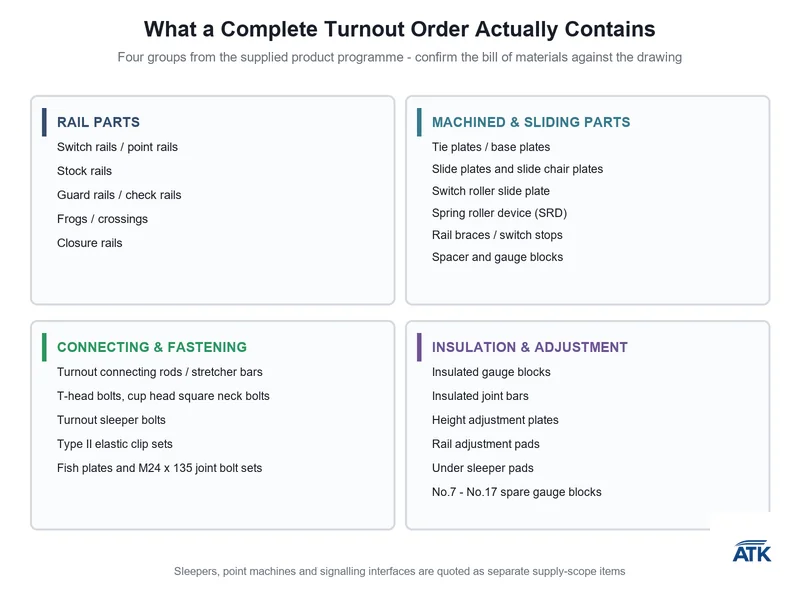
Group | Parts in the programme | Why it matters |
Rail parts | Switch rails / point rails, stock rails, guard rails / check rails, frogs / crossings, closure rails | Profiles, lengths and machining have to match the approved drawing |
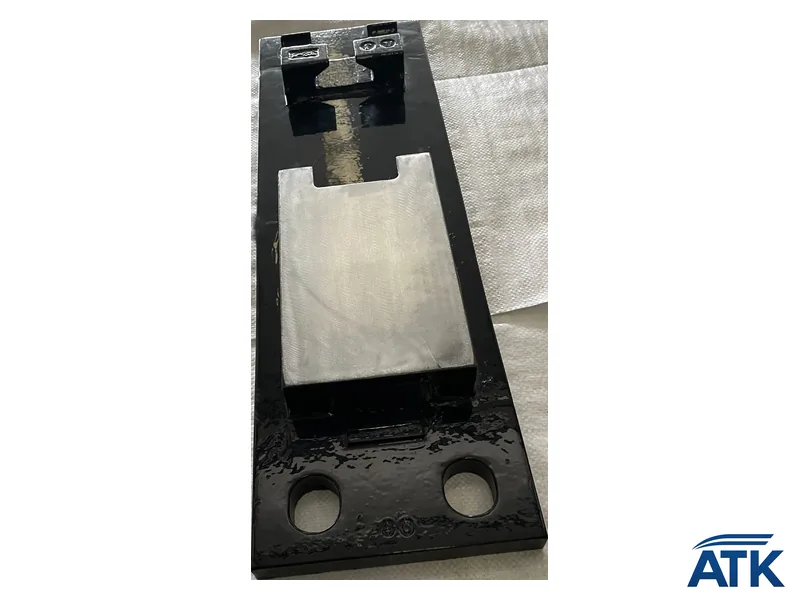
Machined & sliding parts | Tie plates / base plates, slide plates, slide chair plates, switch roller slide plates, spring roller devices, rail braces, spacer and gauge blocks | These set the sliding surface and the gauge through the switch panel |
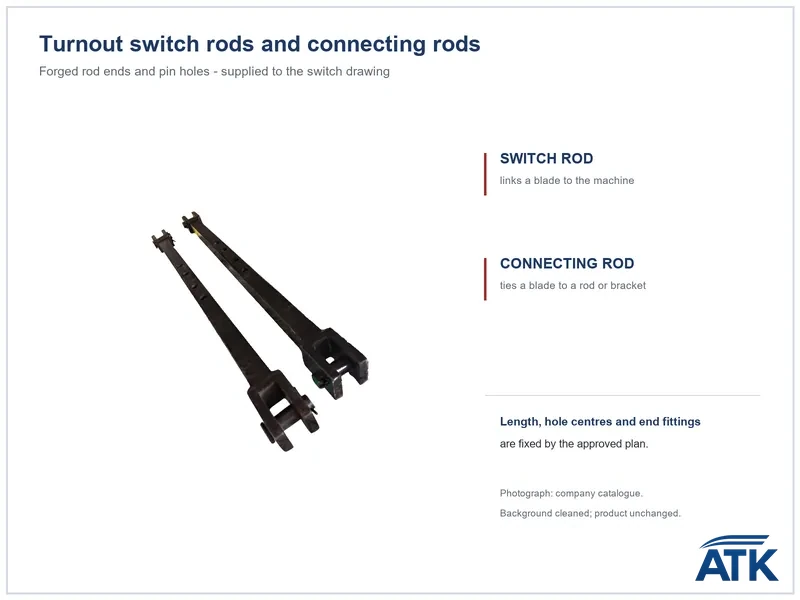
Connecting & fastening | Turnout connecting rods, T-head bolts, cup head square neck bolts, turnout sleeper bolts, Type II elastic clip sets, fish plates and M24 x 135 joint bolt sets | Bolt grade, thread tolerance and coating are specified per order |
Insulation & adjustment | Insulated gauge blocks, insulated joint bars, height adjustment plates, rail adjustment pads, under sleeper pads, No.7 - No.17 spare gauge blocks | Needed wherever track circuits or 1:20 rail cant transitions are involved |
A joint specified down to the last bush is still let down by the wrong bolt grade, so railway track bolts and their matching nuts and washers belong on the same purchase list. Sleepers, point machines and signalling interfaces are quoted as separate supply-scope items unless the order says otherwise; on timber-sleeper layouts, [screw spikes] are part of that anchoring scope. Turnout components ordered this way are easier to reconcile with the approved drawing. The bill of materials, not the rail dimensions alone, decides what arrives on site. Scope decides the price.
Two parameter sets are worth reading side by side. Both are published catalogue values for 60 kg/m rail; the approved project drawing governs every order. Numbers alone will not do.
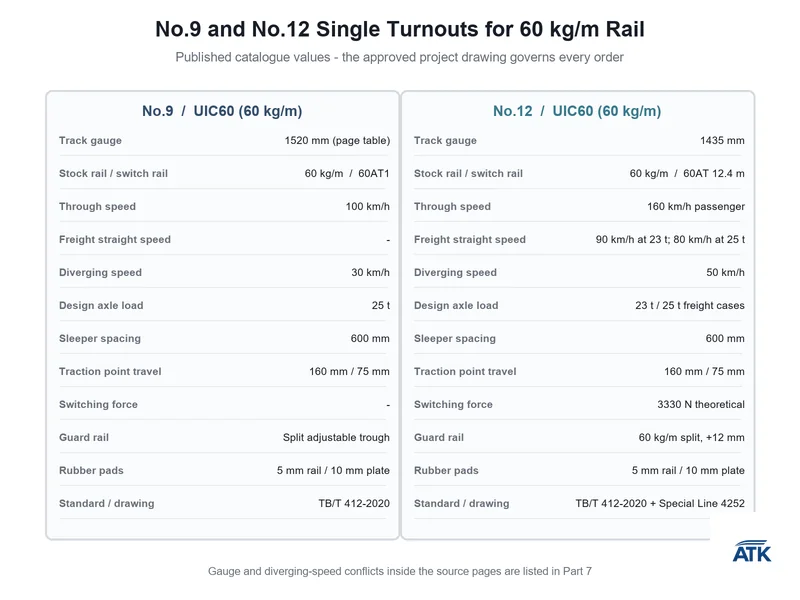
Item | No.9 UIC60 (60 kg/m) | No.12 UIC60 (60 kg/m) |
Track gauge | 1520 mm (source page table) | 1435 mm |
Stock rail / switch rail | 60 kg/m / 60AT1 | 60 kg/m / 60AT 12.4 m elastic bendable |
Maximum through speed | 100 km/h | 160 km/h passenger trains |
Freight straight speed | not stated | 90 km/h at 23 t; 80 km/h at 25 t |
Diverging speed | 30 km/h | 50 km/h |
Design axle load | 25 t | 23 t / 25 t freight cases |
Turnout sleeper spacing | 600 mm (locally adjustable) | 600 mm |
Traction point travel | 160 mm / 75 mm | 160 mm / 75 mm |
Theoretical switching force | not stated | 3330 N |
Guard rail | Split adjustable trough | 60 kg/m split type, 12 mm above stock rail top |
Rubber pads | 5 mm under rail / 10 mm under plate | 5 mm under rail / 10 mm under plate |
Standard / drawing | TB/T 412 | TB412 plus Special Line 4252 |
Configuration | Rail and gauge | Through speed | Diverging speed | Blade and frog notes |
No.9 | 60 kg/m, 1520 mm gauge | 100 km/h | 30 km/h | Straight blades, straight frog and circular lead curves |
No.12 | 60 kg/m, 1435 mm gauge | 160 km/h passenger | 50 km/h | 12.4 m bendable 60AT blades with a concealed tip and heel stop |
No.9 | 50 kg/m rail | 100 km/h passenger, 80 km/h freight | 35 km/h | 6.45 m 50AT straight blade and channel-type guard rail |
Three catalogue cases recur in enquiries. On 60 kg/m rail the No.9 is rated 100 km/h through at 1520 mm gauge and 30 km/h on the branch. Its No.12 counterpart is built for 1435 mm gauge, 160 km/h passenger service and a 50 km/h branch. A third case uses 50 kg/m rail: 100 km/h passenger, 80 km/h freight, 35 km/h diverging. Each has a distinct blade profile, frog and bearer schedule, so quote against the drawing rather than the number alone.
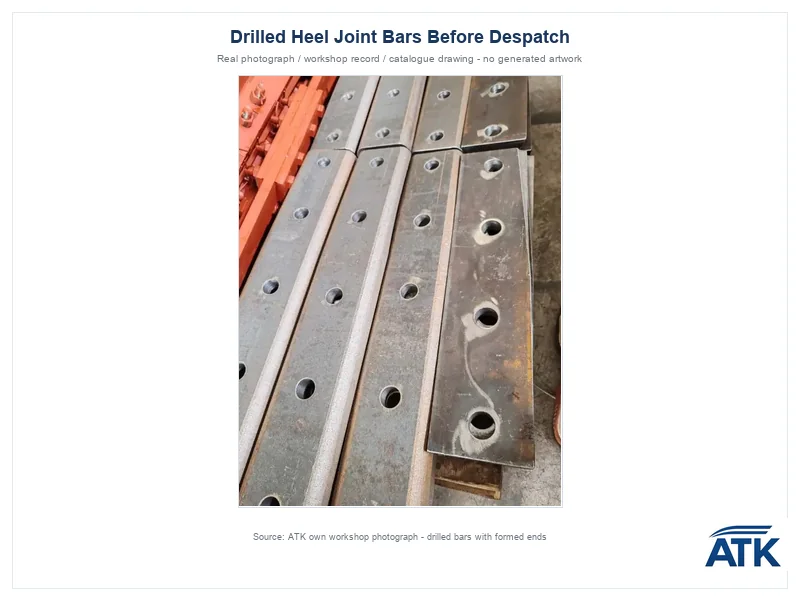
The No.9 set uses straight switch rails, a straight frog and circular lead curves; the crossing is cast in one piece from high-manganese steel and all rail heads are hardened full length. At the heel of those switch rails the connection uses a formed bar rather than a standard one - see the heel fishplate page.Two traction points move the blades. The set carries 52.6 m of rail, a standard 8 mm joint gap, fish plates with M24 x 135 joint bolts and Type II elastic clip sets. The layout drawing marks insulated joints with an "I"; the remaining joints are standard and drilled for joint bolts. Bearers No.1-65 sit perpendicular to the straight track, No.66-67 are twisted for the transition, and No.68-70 sit perpendicular to the diverging track. The design is right-hand; a left-hand set is built and laid as its mirror image.
No.12 uses 12.4 m 60AT elastically bendable switch rails with a hidden tip and a heel stopper, split external locking and spring strip slide plates. Guard rail tie plates use spring clips to fasten the stock rails. Gauge blocks are No.13 on the working side, No.11 on the non-working side, No.13 / No.11 on either side of the high-manganese frog, and insulated gauge blocks on both sides of an insulated joint. Spare No.7 - No.17 blocks cover field adjustment.
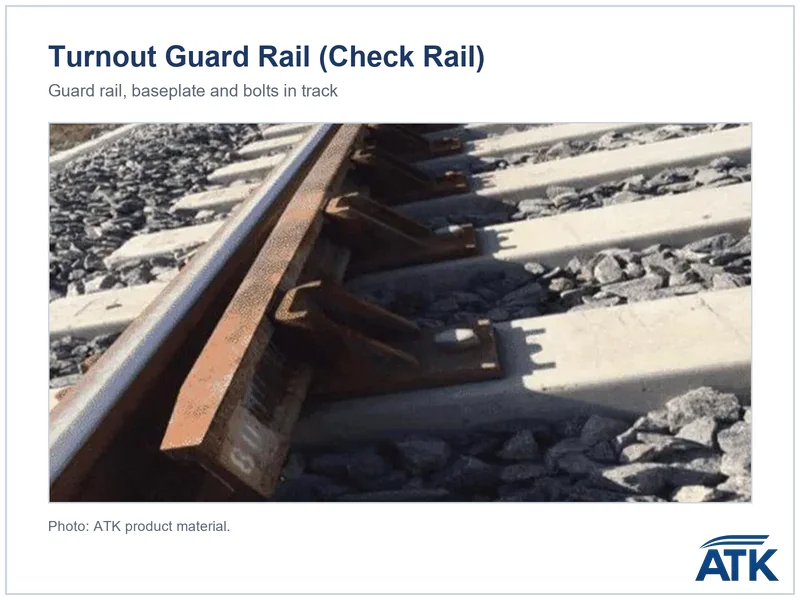
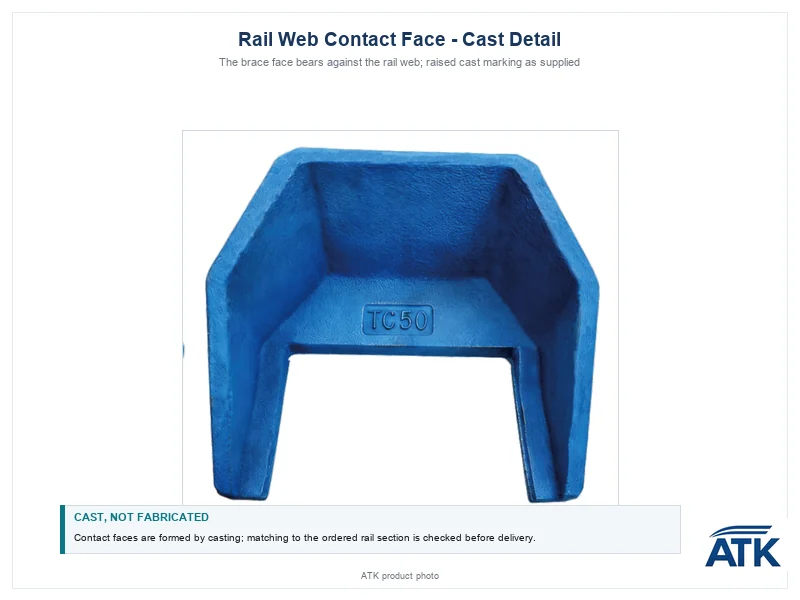
A third common case is the No.9 for 50 kg/m rail: 6.45 m 50AT straight switch rail, 100 km/h straight for passenger trains, 80 km/h for freight, 35 km/h diverging, a single 152 mm traction stroke, channel guard rails 12 mm above the stock rail top, and a 23-step concrete bearer length list from 2.3 m to 4.8 m. Its rubber pads are 5 mm under the rail and frog, 7 mm under the guard rail base plate and 10 mm elsewhere. Rear length is extended by 721 mm and fishplate connections are used at the frog heel. The UIC60 sets are different. Their drawing decides. That 12 mm step and the flangeway behind it are set by the channel guard rail, which is ordered to its own drawing.
The number describes the crossing angle. A 1:9 geometry gives a diverging-route speed around 40 km/h in general European practice; a 1:18.5 geometry can reach 100 km/h and above depending on curve radius. High-speed designs are quoted for 220-320 km/h on the through route and 160-220 km/h on the diverging route. Those figures come from published engineering commentary, not from the ATK programme, and they are not a substitute for the project's own speed case.
A larger number does not by itself establish a permitted speed. Branch radius, switch length, cant, axle load and the crossing type all enter the calculation together. EN 13232-2:2023 sets out the geometric design process and EN 13232-3:2023 the wheel-rail interaction limits; EN 13232-9:2023 covers layout acceptance. On the 50 kg/m No.9 the lead curve radius is measured from the working side of the outer rail, and the guard check gauge is checked where the point rail head is 20 to 30 mm wide.
Read the drawing before the headline. Two suppliers can both write "No.12" and deliver different lengths, sleeper layouts and speeds. The number is a starting point for a conversation about geometry, not a complete specification.
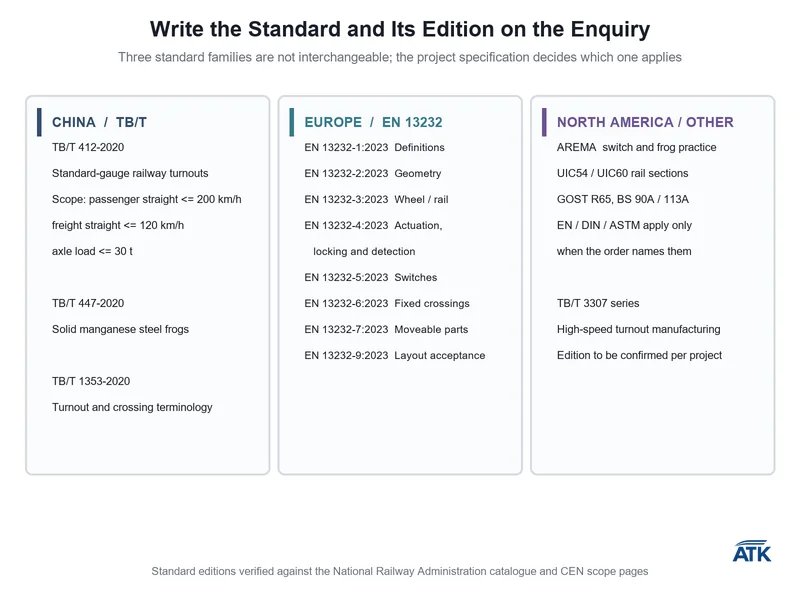
TB/T 412-2020 covers standard-gauge railway turnouts: technical requirements, workshop assembly and laying, inspection methods and rules, marking, packing and storage. The National Railway Administration catalogue gives its scope as passenger straight speeds up to 200 km/h, freight straight speeds up to 120 km/h and axle loads up to 30 t. TB/T 447-2020 covers solid manganese steel frogs - design, manufacture, assembly, inspection and storage - and replaced TB/T 447-2004. TB/T 1353-2020 is the terminology standard for turnouts and crossings. The TB/T 3307 series addresses high-speed turnout manufacturing; the exact part and edition should be confirmed against the project specification rather than assumed.
The EN 13232 series applies to Vignole (flat-bottom) rail and is split by subject: Part 1 definitions, Part 2 geometric design, Part 3 wheel-rail interaction, Part 4 actuation, locking and detection, Part 5 switches, Part 6 fixed common and obtuse crossings, Part 7 crossings with moveable parts, Part 8 expansion devices, Part 9 layouts. The 2023 editions supersede the 2003/2005 versions and their amendments. EN 13232-4:2023 is the reference when the point machine, locking and detection interface is in scope.
AREMA practice, UIC 54 / UIC 60 rail sections, GOST R65 and BS 90A / 113A appear in international tenders. EN, DIN, ASTM and other documents apply only when the order names them. Other parts are governed by the ordered drawing and technical agreement: rail section, gauge, material, strength grade, thread tolerance, heat treatment and coating. Writing "TB412" on an enquiry without the edition is how two factories end up quoting different acceptance criteria. The edition matters.
For the clip series and the rail-foot dimensions that belong on the fixing drawing, see WJK crane rail clips model range.
On a track-circuited layout, the turnout drawing has to say which joints are insulated. The No.9 technical requirements mark those joints with an "I" and leave the rest as standard drilled joints; the No.12 arrangement places insulated gauge blocks on both sides of each insulated joint. Insulated gauge blocks stop the fastening system bridging the gap electrically. Leave them out and the track circuit can report a false occupancy that no amount of signalling adjustment will fix. The signal stays red.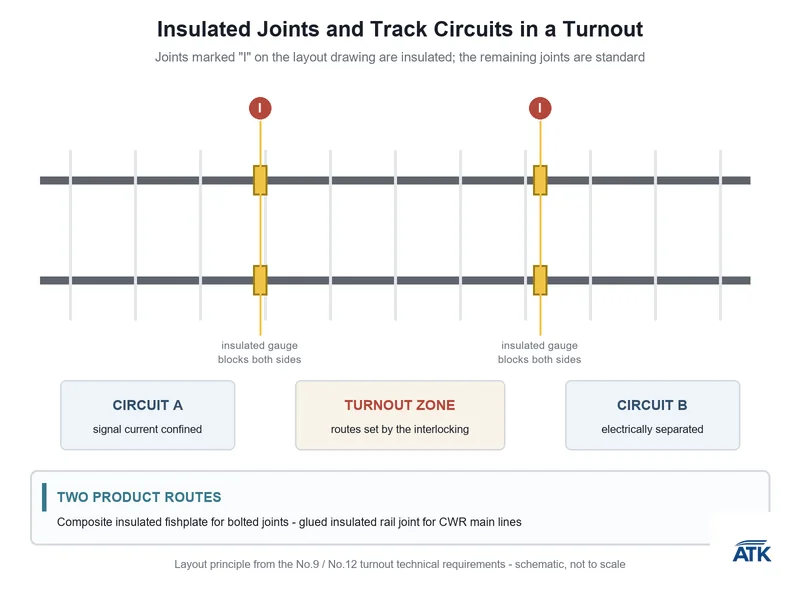
Two constructions cover most enquiries. The composite insulated fishplate suits bolted joints where the bar, bushes and end post can be replaced during maintenance. The glued insulated rail joint is used on CWR mainlines where a bonded, high-strength assembly is needed and the joint is treated as a factory-made unit. Both need the rail section, hole pattern, insulation resistance basis and the specified test method on the order, not just a length.
Where the insulated joint sits relative to the switch toe, the frog and the feed or relay end is a signalling design decision. It is shown on the layout drawing, and it changes the bill of materials. Confirm it before the quotation is fixed.
For the bolt grade, nut set and locking method used where the joint is insulated, see railway fish bolts and lockbolts ordering.
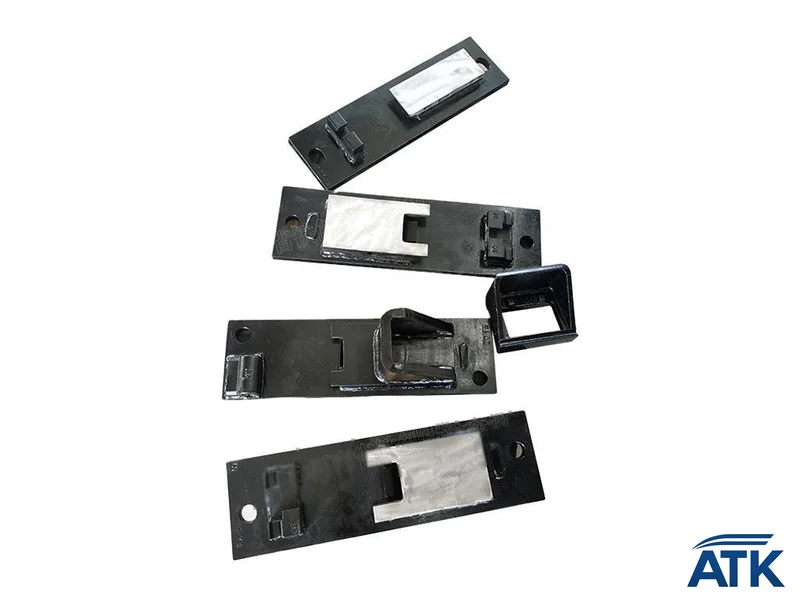
A switch rail has to slide every time the route changes, and it slides on a plate that carries the wheel load at the same time. A slide baseplate supports both the movable blade and the stock rail, keeps the sliding surface low-friction and passes the load into the bearer. A dry or contaminated surface raises the force needed to move the blade; the point machine then reports incomplete closure. That is a mechanical fault with a signalling consequence. The blade must close.
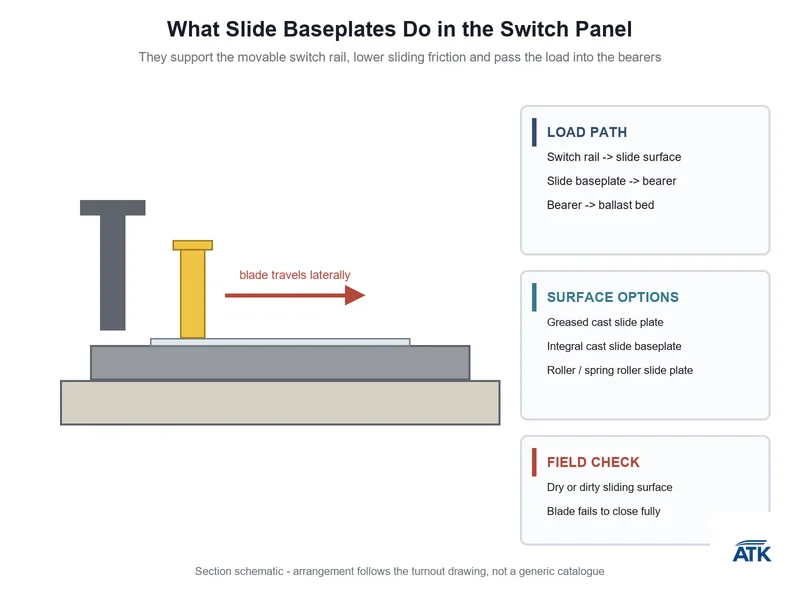
The programme covers greased cast slide plates, roller and switch roller slide plates, spring roller devices, slide chair plates and the integral cast slide baseplate for turnouts, which combines a cast-steel body with a stainless-steel sliding surface. Plate types A to E for 60 kg/m rail differ in their a and b dimensions - A is symmetrical, B to E are not, and right-hand and left-hand turnouts need different parts. Slide plates are selected against the actual turnout layout, not by rail weight alone.
The cast assembly also has a fatigue case. The test basis for one published design is TB/T 3396.4-2015 with a 5 million cycle assembly fatigue requirement; which inspection records apply to a given lot is confirmed when the order is placed. Greasing interval, roller condition and the flatness of the sliding surface belong on the maintenance card. Grease is a maintenance item.
Mainline and conventional railways use simple turnouts, crossovers and curved turnouts at station approaches, junctions, passing loops and siding connections; straight speed, rail profile and crossing design dominate the selection. Heavy-haul and freight yards add axle load and traffic density, and they favour simple, three-way and slip arrangements where space is tight. Metro depots and urban lines care about signalling interfaces, switch operating equipment and restricted installation space.
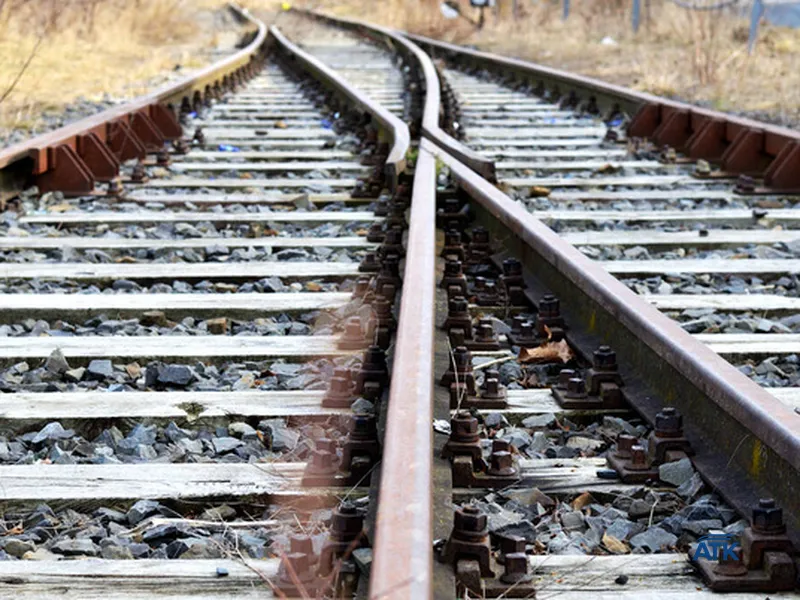
Industrial and mining railways bring high axle loads, tight curves, dust and frequent shunting. Ports and logistics terminals need yard layouts that match existing tracks and loading connections. A rail head in the switch panel sees all of this: impact at the blade tip, lateral force at the frog and repeated sliding wear on the plates below.
The same No.9 geometry will not serve all of them. State the traffic case, the environmental conditions and the maintenance access on the enquiry so the material, coating and crossing type can be chosen for the site.
TB/T 412-2020 explicitly covers workshop assembly and laying, which is why a complete railway turnout is normally assembled and checked before it leaves the factory. Concrete bearers are laid on a ballasted trackbed in the No.9 arrangement. The 60 kg/m No.9 drawing numbers its bearers by zone - 1 to 65 perpendicular to the straight track, 66 and 67 twisted, 68 to 70 perpendicular to the diverging track. The 50 kg/m No.9 lists 23 bearer lengths from 2.3 m to 4.8 m with quantities. Those two lists belong to two different designs. They must not be combined.
Machined plates and gauge blocks are checked against the same drawing: overall dimensions, hole diameter and spacing, connection interfaces, marking and identification. Inspection criteria and tolerances come from the specified standard or the approved project documents; a generic tolerance applied to every part is not a valid acceptance basis. Material certificates, dimensional records and traceability documents are agreed per order, and which of them are issued is confirmed at that point.
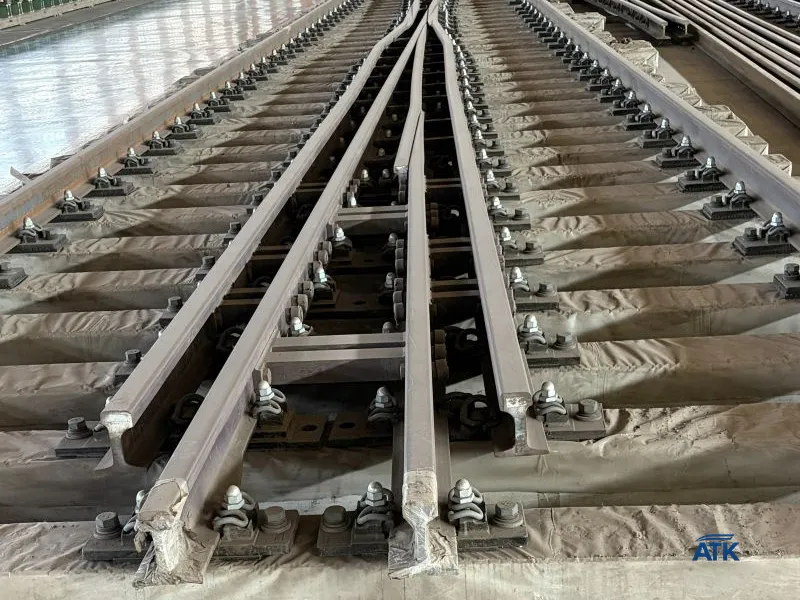
Supply scope is where quotations drift apart. Some orders include concrete bearers and the fastening system; others buy only switch rails, a frog and selected spare parts. Point machines, detection equipment and signalling interfaces are usually separate. Packing, identification of multi-turnout orders, loading arrangements, shipping documents and the delivery schedule are confirmed before dispatch. Long rails, cast frogs and plate sets do not travel well in a single unmarked bundle.
Incomplete blade closure is the failure everyone meets first. Ballast, ice, a worn roller or a dry sliding surface holds the switch rail off the stock rail, and detection refuses to confirm the route. Point machines are among the most failure-prone items on the permanent way; condition monitoring of motor current and stroke is used by several infrastructure managers to catch the trend before the signal fails.
At the crossing, the frog takes impact that plain line never sees. A fixed frog leaves the tread briefly unsupported, so check rails and their clearances matter. On the 50 kg/m No.9, guard check gauge and guard face gauge are measured where the point rail head is 20-30 mm wide, and a 3 mm adjustment shim is used when the guard rail gauge is out. No.7 - No.17 spare gauge blocks handle field gauge correction. A 1:20 rail cant connection uses transition pads P80, P40 and P30; where the adjoining track has no cant, those pads are omitted and standard baseplates take their place.What fails first at that crossing, and why wear is rarely the deciding factor, is set out in why railway frogs fail.
An integral cast slide plate is worth opening up during a scheduled inspection. Look for scoring on the sliding surface, loose switch-tie bolts and any gap at the slide table joint. Rail-end batter at the joint, crushed insulating bushes and a loose fishplate bolt are cheap to fix during a possession and expensive afterwards. Keep the torque, gauge and closure checks on one card with the date and the bearer numbers.
Customised, non-standard turnouts are built to the approved drawing, not to a catalogue row. The gauge, rail section, turnout number, branch geometry, axle load, speed case, crossing type, fastening system, insulation plan and coating all come from the project. Left-hand sets are manufactured and laid as the mirror image of the right-hand drawing. Rail sections in the programme include 43 / 50 / 60 / 75 kg/m (P43, P50, P60, P75), UIC 54 / UIC 60, GOST R65, AREMA 115RE-119RE and 132RE-136RE-141RE, and BS 90A / 113A; special profiles are made to drawing.
Minimum order quantity, lead time, packing method, warranty scope, destination port and the inspection basis are confirmed against the configuration and the shipping plan. Trial production against a customer drawing is available before a full batch. Fastenings, steel rails and joint components can be combined in one enquiry when the material list and drawings are sent together.
The practical first message is short: turnout type and quantity, applicable standard and edition, drawing number, gauge and rail profile, number and geometry, speed and axle load, required supply scope, destination and target schedule. A layout drawing still under review is enough to start the technical discussion.
A turnout connects one track to a diverging route. A crossover is two turnouts plus the connecting track between two parallel lines. A diamond crossing has no transfer route at all.
No. Number, branch radius, switch length, cant, axle load and crossing type are checked together against the approved design. The project speed case governs.
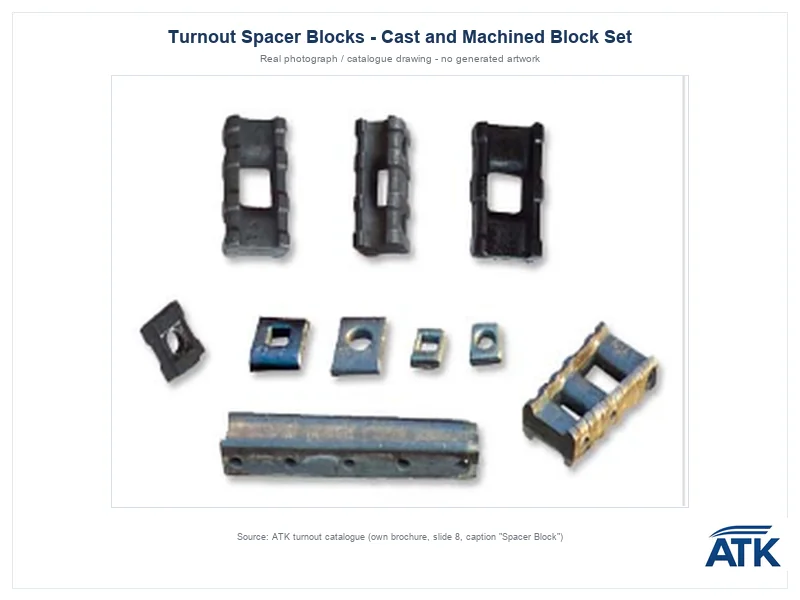
Yes. Switch rails, frogs, guard rails, slide plates, rail braces, gauge blocks and fastenings can be ordered against a part number or drawing. Among those line items, the spacer and gauge blocks are the machined pieces that hold the stock rail and switch rail at a fixed interval through the switch heel - see the turnout spacer block page.For replacement parts, send the original marking, dimensions, rail profile and clear photos.
TB/T 412-2020 is the Chinese standard for standard-gauge turnouts, with TB/T 447-2020 for solid manganese steel frogs. The plates under those rails are a separate product family; the railway baseplate page sets out their standards, materials and inspection.EN 13232 series applies to Vignole rail in Europe. AREMA practice and UIC / GOST / BS rail sections appear in international tenders. The order must name the standard and edition.
They are when the layout drawing marks them. Insulated gauge blocks, insulated joint bars and the joint type are then listed in the bill of materials; the rest of the joints stay standard.
It supports the switch rail and stock rail through the movable section, gives the blade a low-friction surface and transfers the load to the bearer. Greased, roller and integral cast versions are selected against the turnout design.
Yes. The left-hand set is manufactured and laid as the mirror image of the right-hand drawing. Plate types B to E are handed; type A is symmetrical.
Yes. Non-standard gauge, rail section, geometry, insulation plan and coating are confirmed against the approved drawing and technical agreement before production.
Dimensional records, material documentation, marking and traceability are agreed per order. Which inspection documents apply to a given lot is confirmed when the order is placed.
Yes. A mixed order can combine a turnout with crane rail clips, fishplates, bolts and other fastening parts when the full material list and drawings arrive together.
Send the layout drawing, the rail section and the standard edition with the first enquiry. Where a track circuit is involved, mark the insulated joints on the drawing and state which insulated construction the signalling design calls for; both routes and their selection basis are described above. If the drawing is still under review, the available track arrangement and intended train movements are enough to start. Send the drawing with it. To begin, contact us with the turnout type, quantity, gauge, number, axle load, speed case, supply scope and destination; the configuration can then be reviewed against the programme before a quotation is issued.
We have recommended some of our Related products to you. I hope you will be interested.
 English
 Русский