
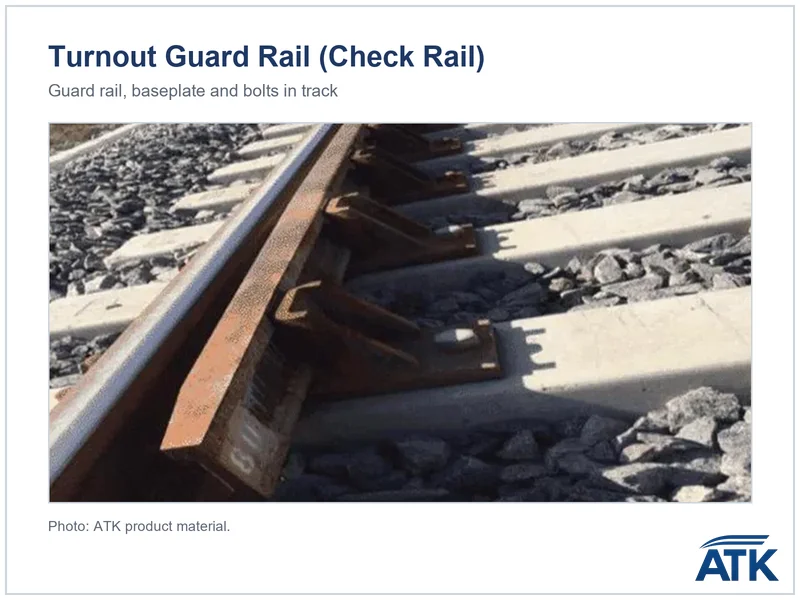
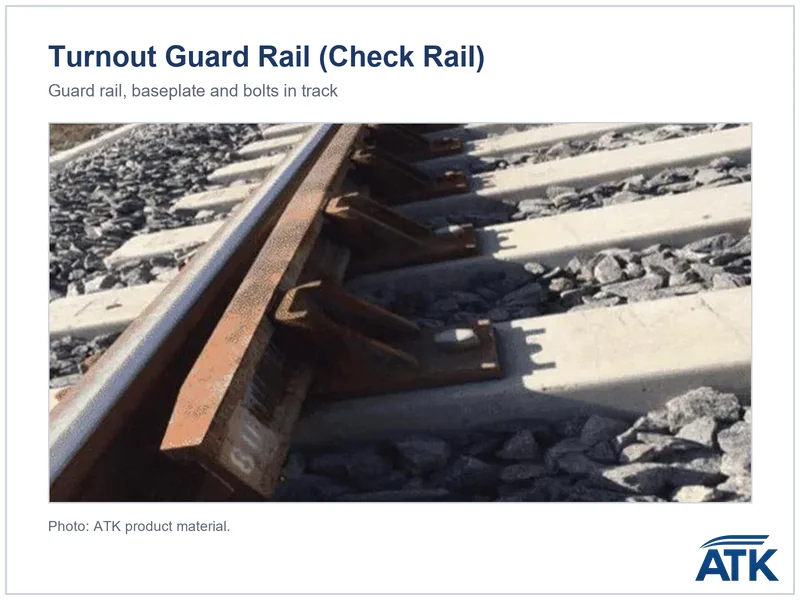
Turnout guard rail and check rail
Channel, H-section and filler-type construction
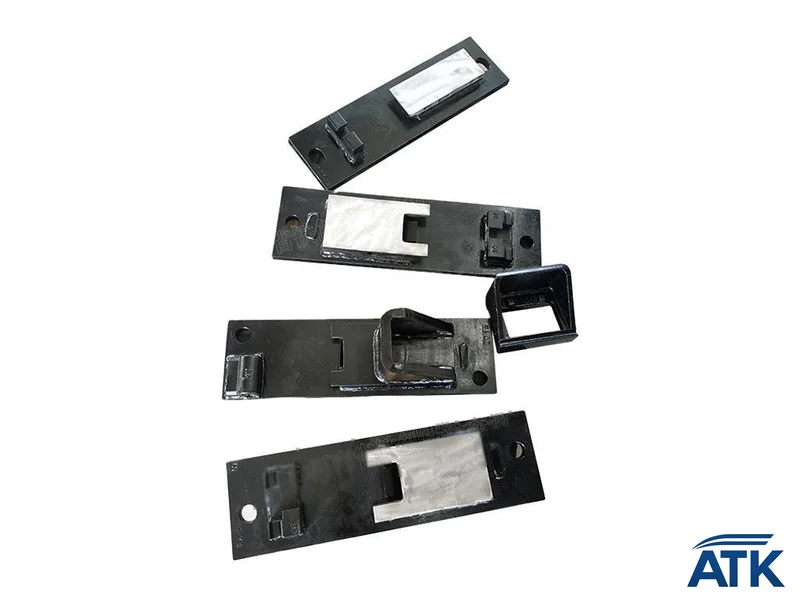
Guard rail baseplates, clamps and M24 bolts
42 mm flangeway at the plain section
Guard check 1391 mm, guard face 1348 mm
Shims in 2 to 10 mm stock
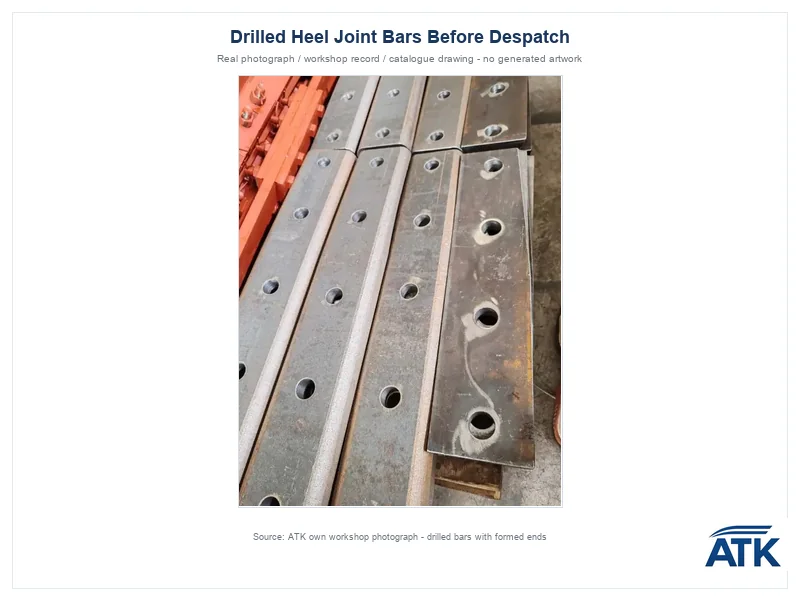
Planing, hole pattern and flare to drawing
Built to the approved turnout drawing
Request a quotation
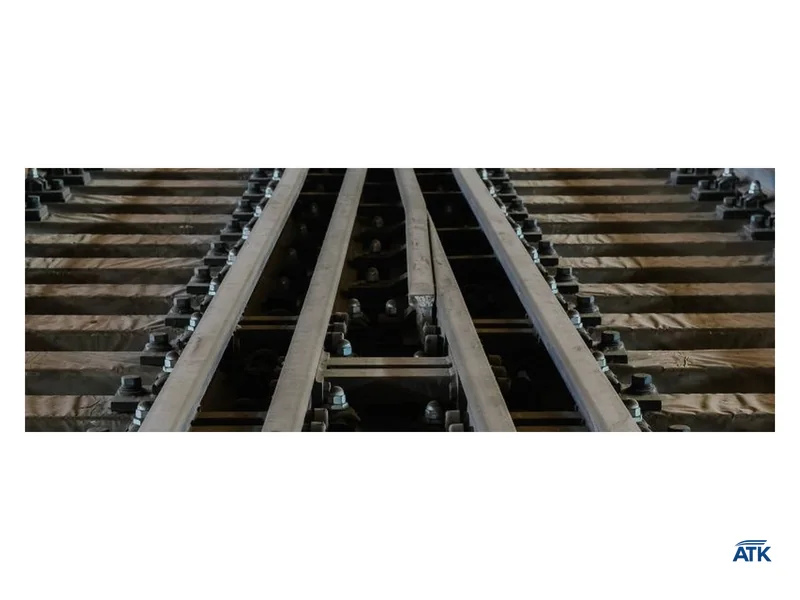
A guard rail is the short rail laid inside the running rail, opposite the crossing. It does not carry the wheel tread. Its face steers the flange so that the wheel on the far side passes the crossing gap instead of striking the vee or taking the wrong flangeway.
At a fixed crossing the tread loses support over the flangeway. A wheelset that sits slightly off centre will let one flange drop into the gap, and the result is a wheel climbing the vee at low speed or splitting the crossing at speed. The guard rail closes that possibility by giving the flange a fixed channel to run in on the opposite side of the same track.
That job shapes the whole part. The rail is not a running rail, so nothing is asked of its tread. Its working face is a guide, so side wear is the wear that matters, not head wear. And the flangeway it forms is a setting, not a manufacturing accident, which is why every type of guard rail has some way of adjusting it.
ATK supplies guard rails as channel section, as H-section bars machined from ordinary rail, and as filler-type assemblies with spacing blocks, together with the guard rail baseplates, blocks, shims and bolts that go with them. Units are made to the approved turnout drawing, not to a catalogue length.
Through the crossing, the wheel that is on the crossing side crosses the flangeway with nothing under its tread. Whether it happens cleanly is decided by a pair of measurements:
· Guard check gauge. From the working face of the vee to the outer face of the guard rail head. Below the minimum, the wheel flange can strike the vee.
· Guard face gauge. From the working face of the wing rail to the same guard rail face. Above the maximum, the flange can ride against the guard rail and climb it.
The two limits are an upper and a lower bound on the same wheelset position. A set that passes one and fails the other has moved. The cause is usually wear on the guard rail face, a shim stack added without measuring, or a stock rail ground without the guard rail being reset afterwards.
Measurements are taken with a track gauge at the points the drawing specifies, not wherever the inspector happens to stand. On a turnout with gauge widening on the diverging route the readings move along the assembly, so a single number taken at one sleeper means very little.
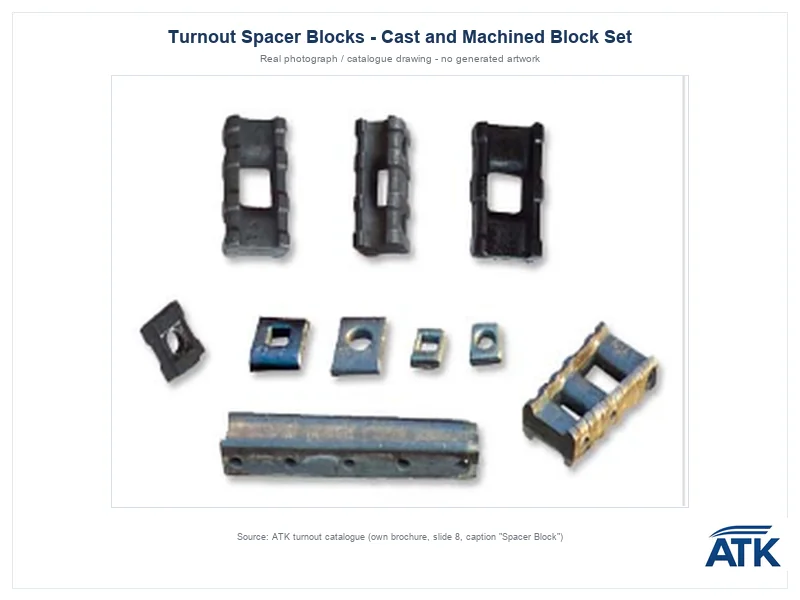
Filler-type guard rail. The guard rail is tied to the running rail by spacing blocks, and the flangeway is set by the thickness of those blocks. The arrangement is stiff and simple, and the blocks are the part that wears or works loose. Repair is by replacing blocks and bolts rather than the rail.
H-section guard rail. An ordinary rail section is machined into an H profile so the guard rail can sit beside the running rail without being bolted through it. The two rails stay separate, which makes the flangeway adjustable, and the cost is a heavy machining operation on every unit.
Channel-type guard rail. A dedicated rolled channel section, used with its own baseplate, clip and shim stack. It uses the least steel of the three and is the common form on Chinese mainline work. Adjustment is by shims between the guard rail and the baseplate.
Planed bar with end and separator blocks. The North American pattern: a rail planed and beveled along the guarding face, supplied as an assembly with end blocks, separator blocks, bolts and spring washers. The assembly arrives with the flangeway already set by the blocks.
A buyer comparing quotations needs to know which of these is being quoted. The four are not interchangeable, and a channel-type quotation set against a filler-type drawing will not fit the existing baseplates.
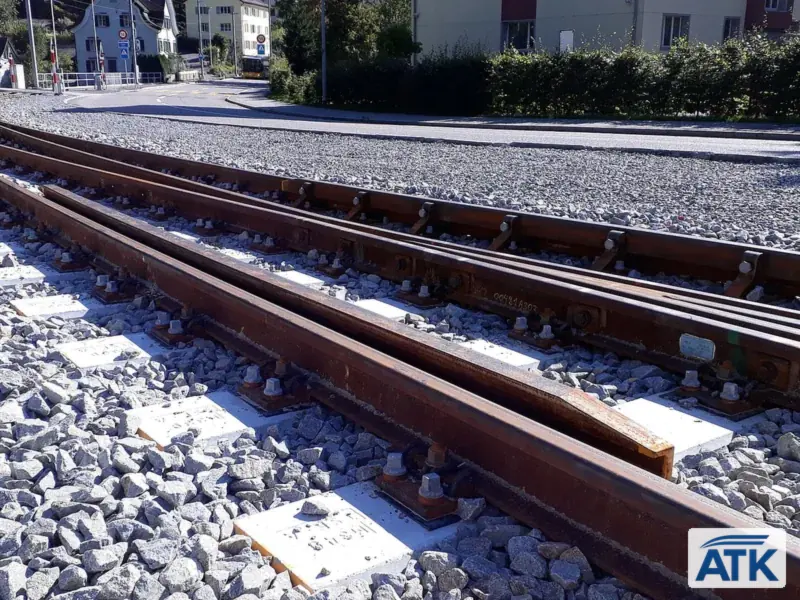
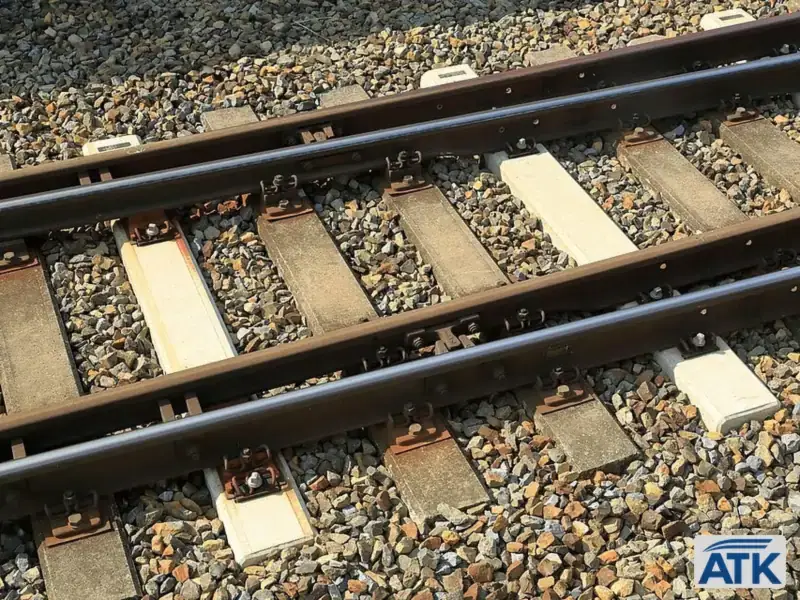
The guard rail needs a seat and a clamp, and on common Chinese designs one plate does both. The baseplate carries a shoulder for the running rail on one side and a seat for the guard rail on the other. The pair is held in a fixed relationship that way, instead of being bolted rail to rail.
The running rail is clamped from the gauge side, either by a socket formed into the plate or by a spring strip fixed to it. That clamp load is what stops the stock rail rolling toward the track centre, which is exactly the direction the guard rail sits in. Wear or a break in the socket shows up first as movement in the two gauge readings, not as anything visible from the cess.
Bolts are M24. Shims sit between the plate and the guard rail, and the stack is what a fitter changes when a reading is out. Nothing about the plate is adjustable in service, so a cracked one is replaced rather than repaired.
A guard rail order is rarely one bar. What arrives depends on the drawing, and the line items are worth agreeing before the quotation rather than after it.
· Guard rail bar, machined to length with the flare, buffer section and hole pattern the drawing calls for.
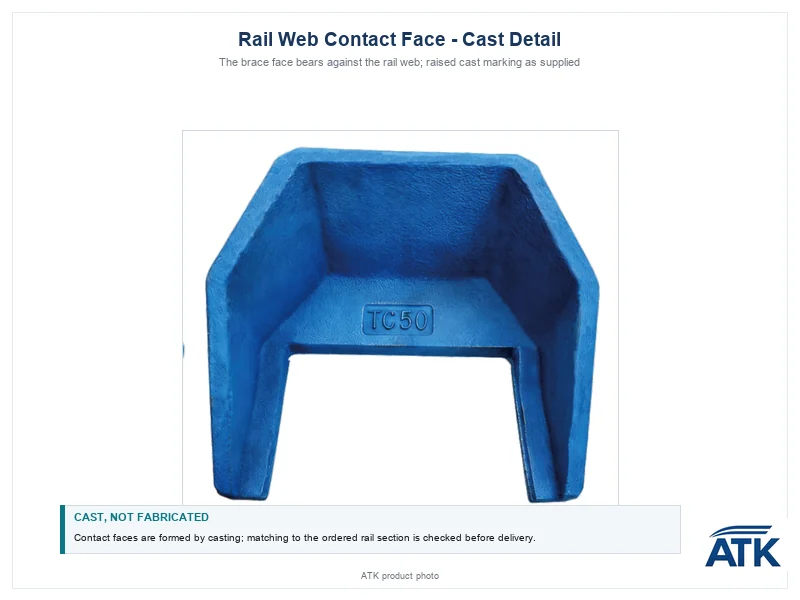
· Baseplates, one per fastening position, cast or fabricated to the same drawing.
· Clamps or spring strips, where the plate does not form them itself.
· Shim set in 2 to 10 mm stock, packed loose so the fitter sets the stack in track.
· M24 bolts, nuts, washers and anti-rotation tabs.
· Separator or spacer blocks, only where the design is filler-type.
Blocks are quoted and packed as their own line item, and a design that uses them needs the block thickness settled at the same time as the flangeway. Where the parts are ordered together, the assembly can be dry-built and marked before dispatch, so the fitter is not opening holes on site.
Item | Value |
Guard rail flangeway, plain section | 42 mm, +3 / −1 mm |
Flangeway, buffer section end | not less than 65 mm |
Crossing vee flangeway (the other half of the pair) | 46 mm, +3 / −1 mm |
Guard check gauge | not less than 1391 mm where passenger trains run; 1388 mm on freight-only lines |
Guard face gauge | not more than 1348 mm |
Permissible side wear before replacement | 10 mm |
Guard rail head above running rail head | 12 mm design (none on the 75-type turnout); investigate above 22 mm |
Shim stock | 2, 3, 5, 8 and 10 mm; at most two per baseplate, total not over 15 mm |
Guard rail bolts | M24; plain-section bolts longer than the standard by 10 mm |
Guard rail baseplate | cast or fabricated, to the turnout drawing |
The metric values above are the Chinese maintenance limits for conventional lines, plus the shop-floor practice that goes with them. They describe how the assembly is set and judged in service, not a factory tolerance on a bare rail.
North American practice measures the same pair from its own wheel standard and lands on different numbers. Guard check gauge is 54-5/8 in (1387.5 mm), guard face gauge 52-3/4 in (1339.9 mm), and guardrail flangeway 1-7/8 in (47.6 mm). A guard rail built to one drawing should not be checked against the other system's figures.
Along the bar the guard rail changes function twice. A straight guarding face does the work in the middle. A buffer section at each end brings the flangeway down to the working width, and a flared opening leads the flange in without a strike.
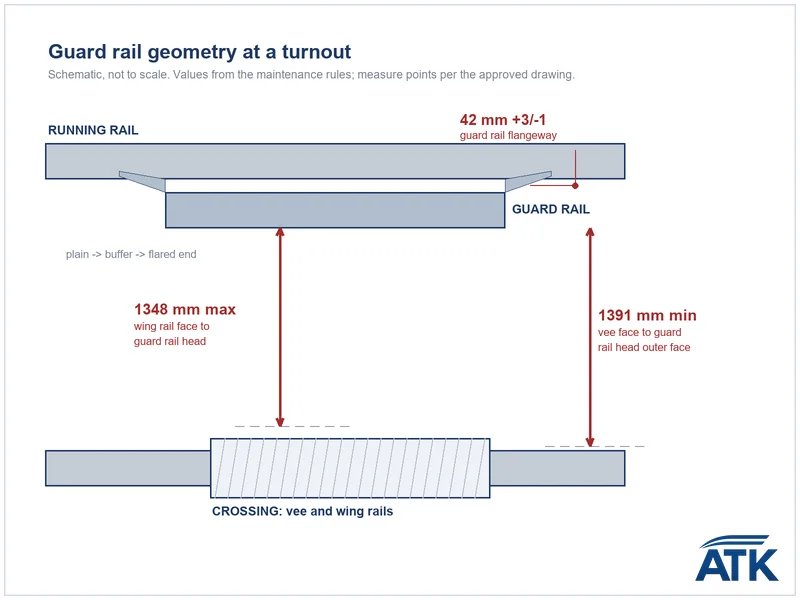
The plain section runs from roughly the throat of the crossing to the point where the vee is about 50 mm wide, with a short extension each side. The opening end is machined to a flare of roughly 150 mm of length, and its whole purpose is to be contacted by nothing in normal running. Contact marks on the flare are a fault report, not wear.
Where the diverging route carries gauge widening, the flangeway widens with it by the same amount, at both the plain section and the buffer end. A guard rail set to 42 mm on a route running at 1445 mm gauge is set wrong, and the error shows up as flange contact at the flare. Where the drawing leaves the flangeway or the widening blank, ask before setting shims: send us the turnout drawing and the two values get marked on it.
Inspection is on the dimensions that decide fit, not on the appearance of the bar:
· Section and grade of the rail or channel, against the drawing.
· Straightness of the guarding face, checked along its full length.
· Planed end geometry: flare length, buffer transition, and the absence of burrs on the guiding edge.
· Hole positions and spacing, checked against the matching baseplate and blocks.
· Flangeway at the plain section with the assembly dry-built, and at the buffer end.
· Shim stack fitted and recorded, since the stack is what the installer will find on site.
· Head height above the running rail, measured on the assembly.
Acceptance items and limits are agreed in the technical agreement. The guard rail is a component with dimensions, not a certified product, and no type-approval claim is made for it.
1. Seat the guard rail baseplates and check them against the sleeper spacing on the drawing.
2. Land the guard rail, fit the blocks or spacers, and insert the bolts without final tightening.
3. Set the flangeway with shims at the plain section, then check the buffer end.
4. Measure guard check gauge and guard face gauge at the points the drawing gives.
5. Tighten in the sequence for the assembly, fit anti-rotation tabs or lock washers, and re-measure after tightening.
Adjust the guard rail with shims. Moving the running rail to chase a gauge reading changes the track gauge, and the turnout is then wrong in a second place.
Grind build-up on the stock rail, vee and wing rail before shimming, not after. Shim stacks added on top of a burr disappear as soon as the burr is ground away, and the gauge reading that follows will be out of limits with no wear involved.
Every bolt has to be present. Where two bolts at one location are missing or broken, the turnout comes out of service rather than being run at reduced speed. On a guard rail this rule is not paperwork: the blocks are what hold the flangeway, and a loose block moves it.
Side wear decides the life of the part. At 10 mm the guard rail is replaced, because the face that steers the flange has gone and the gauge readings can no longer be held.
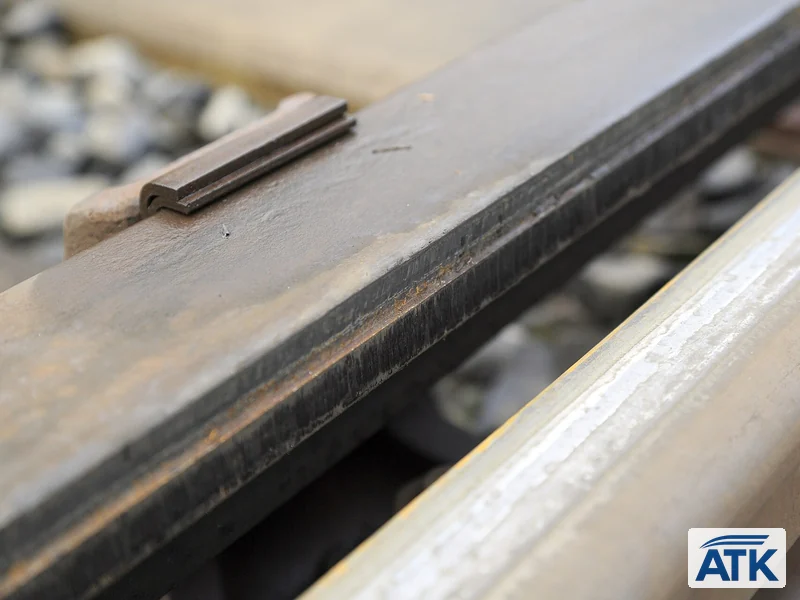
Mixed fleets leave their own record on that face. Where tram-profile and standard wheels share a turnout, the wear band sits at a different height on the head, and reading it tells you which vehicle is doing the damage before anyone condemns the rail.
Replace or repair the baseplate when it is cracked or broken. Treat a growing height difference between guard rail and running rail before a locomotive trip cock starts catching the guard rail head.
Check the guard rail interval and the wing rail interval on small-number turnouts. The toe end of the crossing is where a wheelset arrives with the worst attitude, and the flare is the first thing it touches when the interval is too wide.
Keep the measurement record with the turnout. A guard rail shimmed three times in a year is telling you the stock rail or the blocks are moving. The next inspection should look at that, not at the shims.
Before quoting, we need the rail section, the turnout number and hand, and either the drawing or the part number. The flangeway target, the fastening type and the baseplate pattern follow from those.
What can be made to order: overall length, number and spacing of holes, flare and buffer geometry, block thickness stack, baseplate pattern, and the choice between channel, H-section and filler-type construction. Surface treatment is agreed per order.
What is not ours to change: the turnout geometry. The guard rail is made to the approved drawing, and a change to the flangeway is a design change that belongs with the track designer, not with the supplier.
Request a quotation with the drawing and the rail section, and state whether the assembly is to be supplied with blocks, shims and bolts or as the bar alone.
Yes. Check rail is the British term and guard rail the North American one, for the same component in the same position.
No. Only the flange touches it. The tread runs on the stock rail and the crossing, which is why side wear limits its life and head wear does not.
No. That standard covers switch and crossing rails that carry wheels, and it excludes guard rails that do not. A supplier claiming EN 13674-2 for a guard rail is citing a scope that does not reach the part.
42 mm with +3/−1 mm tolerance at the plain section in Chinese practice, and not less than 65 mm at the buffer end. On the diverging route the width increases with the gauge widening.
Guard check gauge and guard face gauge. One stops the flange striking the vee, the other stops it climbing the guard rail, and both are measured at the points the drawing gives.
Generally 12 mm on Chinese turnouts, so a worn wheel does not drop onto the flange path. The 75-type has no such step, and a growing difference is a reason to look at the pads under the running rail.
Yes, with shims: 2 to 10 mm stock, at most two per baseplate and not over 15 mm in total. Beyond that the baseplate position or the blocks are wrong.
At 10 mm of side wear, when its baseplate is cracked, or when the bolts holding it can no longer be kept tight. Two missing or broken bolts at one location take the turnout out of service.
Yes, as an assembly or as separate line items. Say which when ordering, because blocks and shims are quoted and packed separately from the bar.
Yes, planed and beveled with end and separator blocks, to the drawing and the flangeway it specifies. The imperial figures above are for orientation only.
On request, as a matched set: bar, baseplates, clamps, shims and bolts. Say whether the assembly should be dry-built and marked or the parts shipped loose.
Either, depending on the design. A socket or spring-strip plate clamps the running rail from the gauge side; under a clip system the clip does that job and the plate only seats the guard rail.
Yes, as separate line items. Give the plate part number or the drawing, because a clamp from one plate family will not fit another.
Rail section, turnout number and hand, drawing or part number, and whether baseplates, blocks, shims and bolts are in scope.
The guard rail is ordered with the parts around it: the railway frog it protects and the turnout spacer blocks that set its flangeway. At the other end of the same turnout sit the switch rail and stock rail, and the complete turnout they are all matched into.
We have recommended some of our Related products to you. I hope you will be interested.
 English
 Русский