
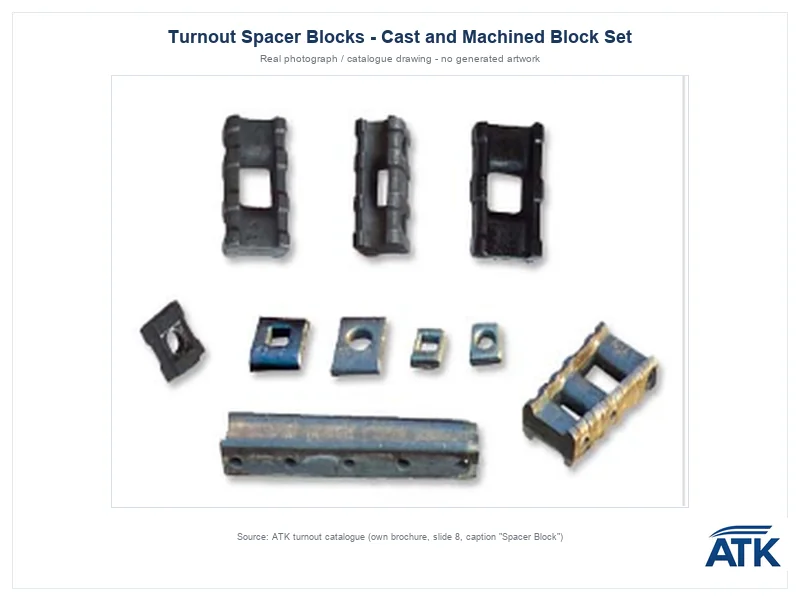
Turnout spacer blocks to the ordered drawing
Switch heel, frog and guard rail applications
Bolted and floating heel block types
Cast steel, cast iron and welded steel construction
Rail sections 43-75 kg/m, UIC 54/60, AREMA 115RE-141RE
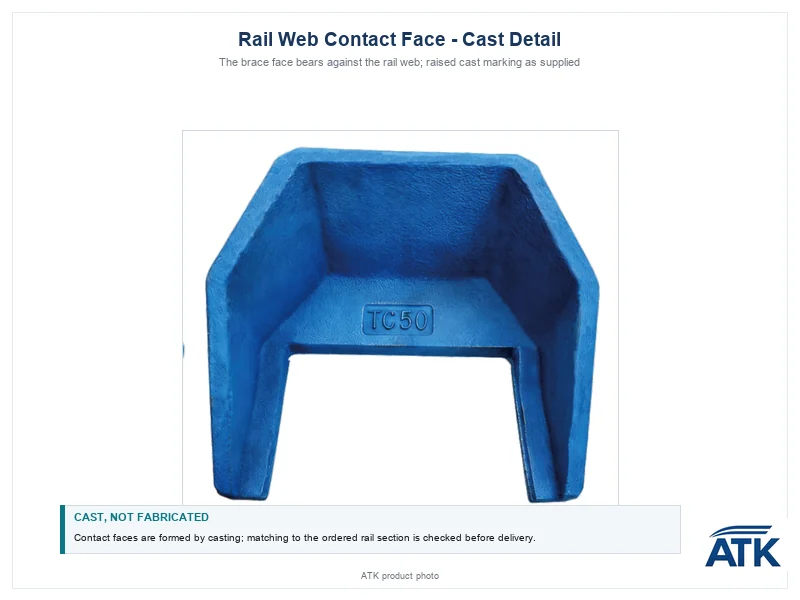
Bolt holes and joint-bar faces machined after casting
Insulated versions for track-circuited layouts
TB/T 412-2020 and EN 13232-7 vocabulary
Complete turnout sets and custom specifications
A spacer block is the part fitted between two rails to hold them at a fixed interval. TB/T 1353-2020, the Chinese railway industry standard for turnout and crossing vocabulary, defines it in exactly those words: a component installed between two rails to maintain their fixed spacing. The wording is short, but the job covers some of the most heavily loaded joints in a turnout - the heel of the switch, the crossing, and the ends of the guard rail. Chinese maintenance manuals call the switch-heel version a steel brick and give it two duties: holding the flangeway width at the switch-rail heel, and working with the heel joint bars to tie the stock rail, switch rail and closure rail into one frame.
Two rails that must stay a set distance apart take lateral load from every wheelset. Bolts on their own cannot hold gauge. The block between the rails carries the compression, the bolts keep the assembly closed, and the group passes force down into the slide baseplates and sleepers under them. EN 13232-7, the European vocabulary standard for switch and crossing components, makes the same point from the other direction: distance blocks are there to give the turnout strength and support, and to transmit track forces according to the design concept. They are structural parts, not packing.
ATK lists the part in its turnout catalogue under the heading Distance / Spacer Blocks, alongside the rest of the machined hardware - slide plates, connecting rods, braces - the parts that turn a set of rails into a working switch.
In practice the same casting is quoted under several English names, and a buyer who asks for just one of them may not realise the other names are pointing at the same part.
TB/T 1353-2020 uses spacing block. EN 13232-7 uses distance block for the general component, plus two finer terms: spacer blocks (or studs) where they give lateral support to a movable point rail, and flangeway blocks where they hold the flangeway gap between a point rail and a wing rail. North American practice, following AREMA drawings, calls the assembly at the switch heel a heel block - and most search traffic and most catalogue pages in the US and AREMA markets use that term.
The tram-and-transit vocabulary is blunter. The MARTA track maintenance manual defines the heel block as steel or iron filler placed between the stock rail and the switch rail at the switch heel and held with through bolts, which maintains the space between the rails, holds track gauge, and provides a hinge-like connection that lets the switch change position. In a depot, where the same hardware turns over faster than on a main line, that plain-language definition is the one the local crew actually quotes when they order replacements.
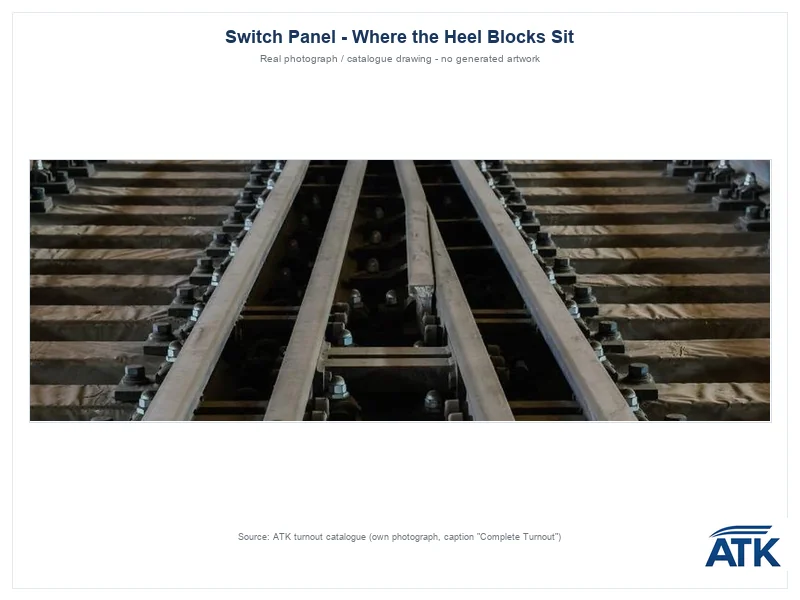
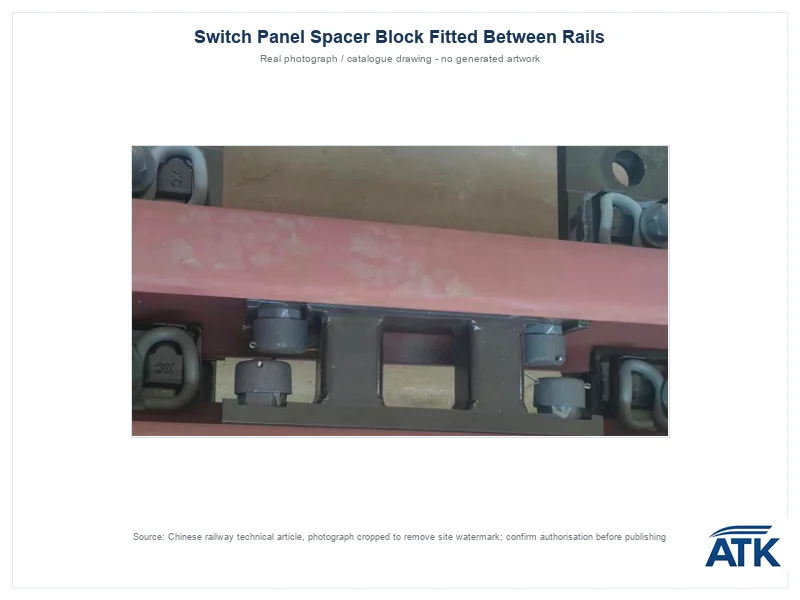
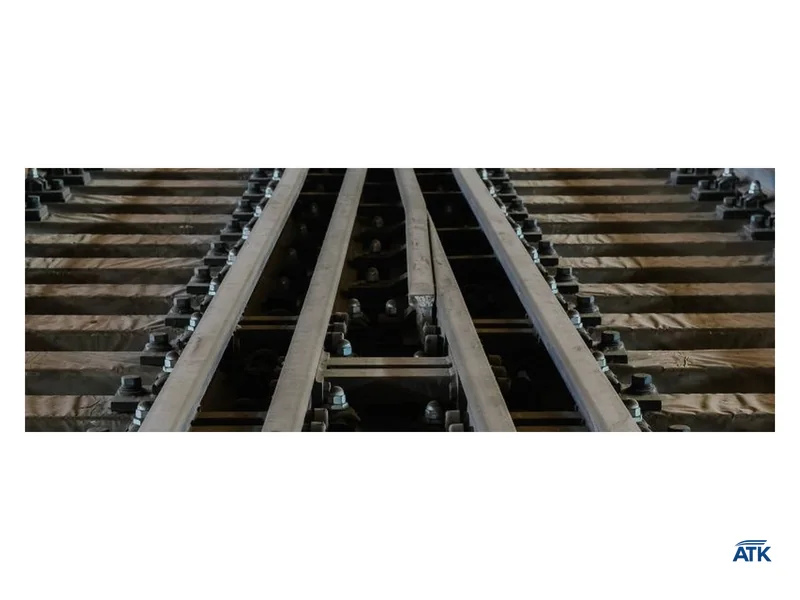
A single turnout carries spacing blocks in three main positions, and the duty differs at each one. Chinese high-speed turnout practice classifies them further by location - switch panel, switch heel, anti-jump (throat) and long/short point rail at the crossing - so one word can cover several different castings.
At the switch heel, the block ties each switch rail to its stock rail. This is the classic heel block duty, and it is the position where wrong parts cause the most visible trouble, because the switch rails have to pivot there.
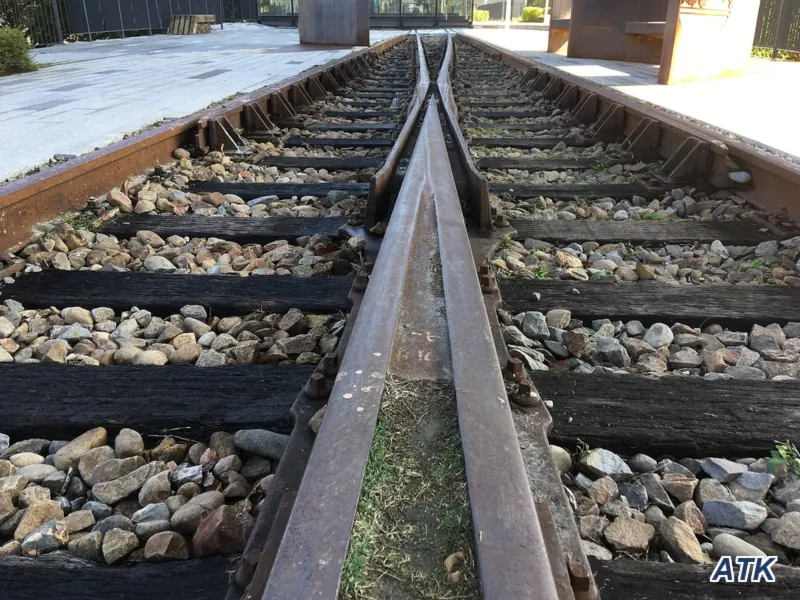
At the frog of a rail-built or fabricated crossing, blocks connect the point rail to the wing rails and hold the crossing geometry. Where the frog has a movable point, EN 13232-7's spacer blocks or studs provide the lateral support for the point as it moves between positions.
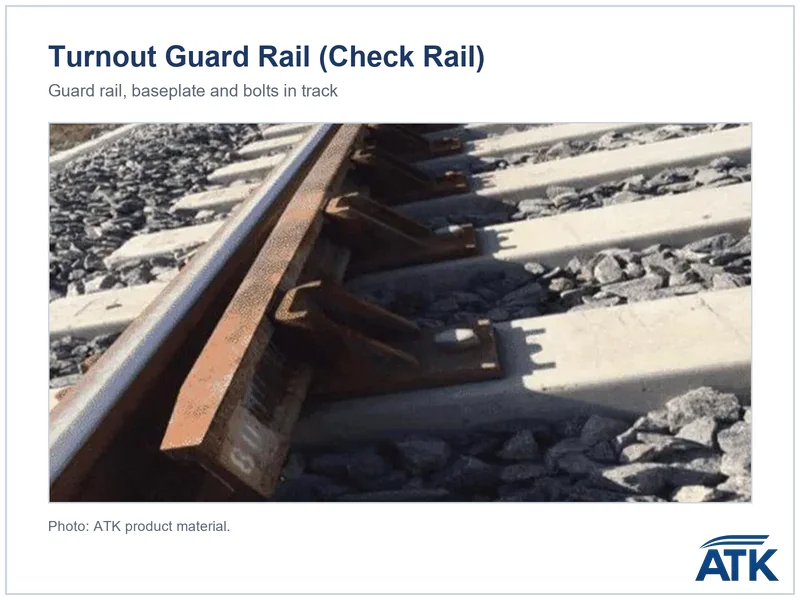
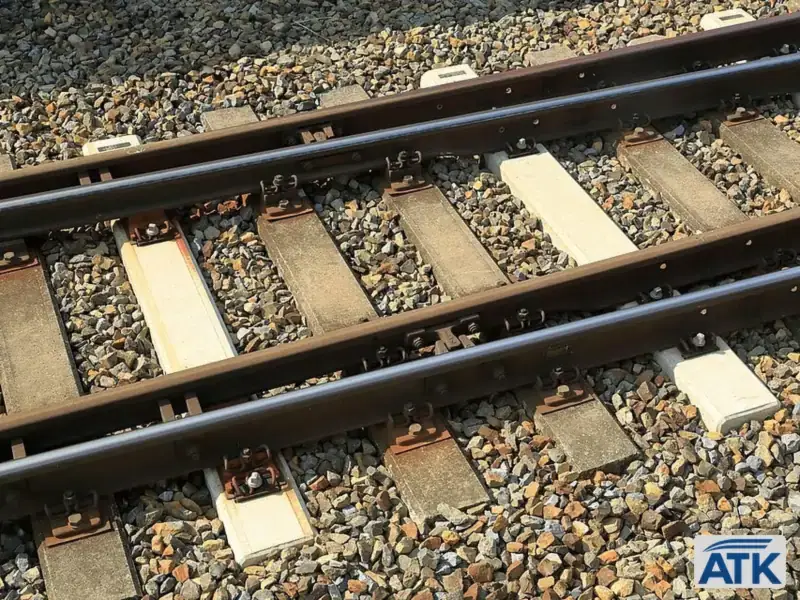
At the guard rail, blocks join the check rail to the running rail and set the flangeway width that steers wheelsets through the crossing. Chinese practice gives this arrangement its own name - the filler-type guard rail, again from TB/T 1353-2020.
The rest of this page takes the three positions in turn, because the ordering details differ even though the part looks similar.
On the ground, the three positions rarely arrive as a tidy list. An inspector walking a turnout usually finds one of them first: a heel block with its bolt torque gone, a flangeway block the traffic has hammered loose at the frog, or a guard rail that has begun to drift. They are the same shape of casting in each case, but the load each one carries is different, and that difference is what the switch drawing records.
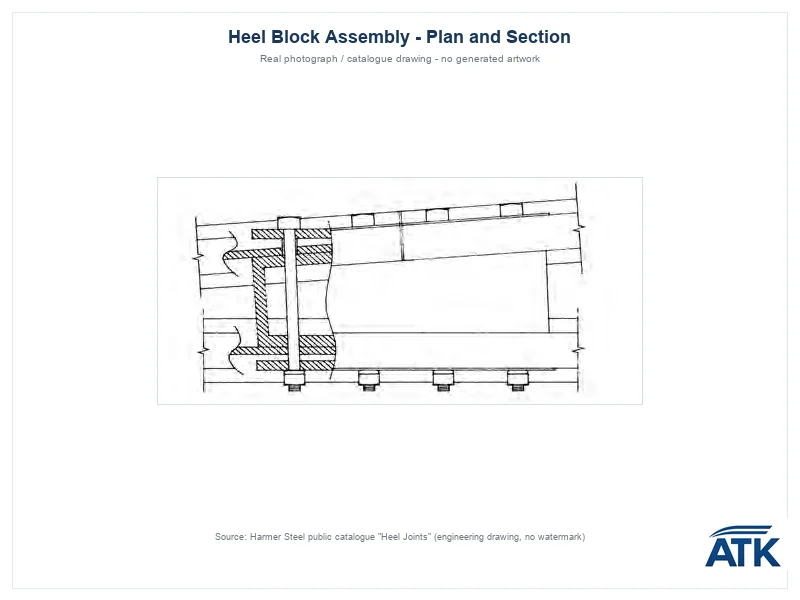
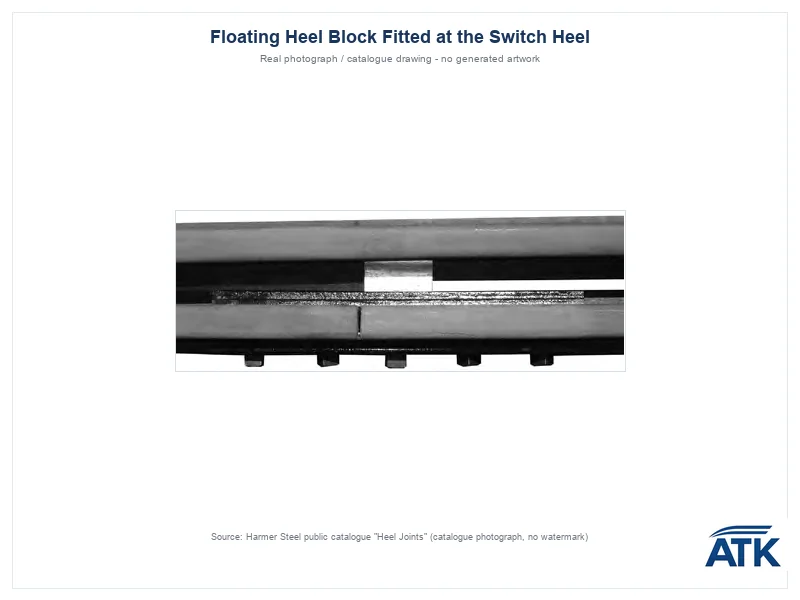
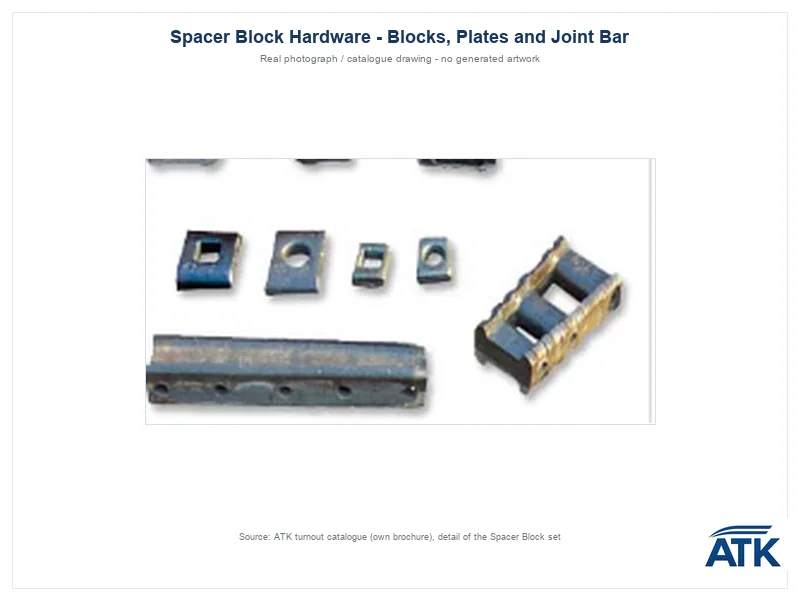
At the heel of the switch, the block does three jobs at once. It holds the gauge-side distance between the stock rail and the switch rail. It adds strength and rigidity to a joint that would otherwise flex. And it works as the hinge of the whole switch: the switch rails rotate about this connection every time the route changes.
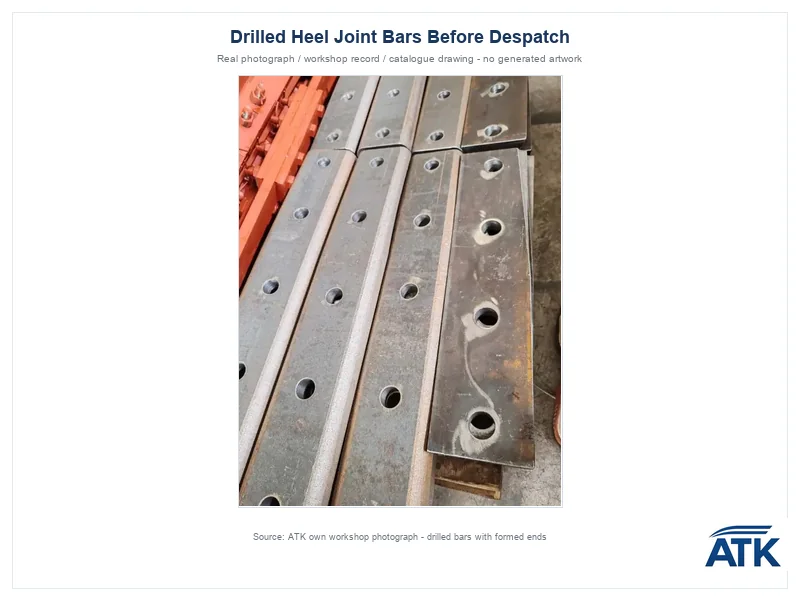
The hardware follows a fixed pattern. A standard heel block assembly is made up of the block, a bent-and-planed bar, an outside bar, a pipe thimble and the bolts. The bent-and-planed bar in that list is a machined part in its own right - see the heel joint bar page.The block sits between the two rails; the bent bar and the outside bar - either a D-bar strap or a standard joint bar - close the assembly, and the thimble lets the group be drawn tight while the point still moves. Square-head bolts are usual with a D-bar and track bolts with a joint bar, and a shoulder bolt sometimes replaces the thimble. Suppliers in the AREMA market catalogue the joint as a 4-hole or 5-hole heel block, with the hole pattern matching the joint bars and the switch design number. Special plates sit under the heel block assembly; the turnout plates immediately beyond it raise the closure rail to the level of the switch point heel where uniform riser plates are used.
Two dimensions decide whether a replacement block will actually fit. One is the heel spread - the distance between the gauge side of the stock rail and the gauge side of the switch point at the heel. The other is the hole spacing in the joint bar, catalogued as the G-H-G dimension: hole diameter, elevation and spacing. Get either one wrong and the assembly either binds the switch or leaves the gauge loose.
How the block joins the rails is a design decision of its own. Chinese high-speed turnout practice uses three arrangements: high-strength bolts on their own, high-strength bolts plus a structural adhesive layer at the steel interface, and a direct weld to the rail web. Bolted joints are simple to inspect and let a damaged bolt or block be replaced on its own. The bolted-and-bonded version stiffens the interface and slows torque loss in the heavily loaded crossing area, but it is harder to dismantle. A welded block removes the bolt group entirely and transfers load evenly, though a damaged part can only be cut out and re-welded. The switch drawing names which one applies.
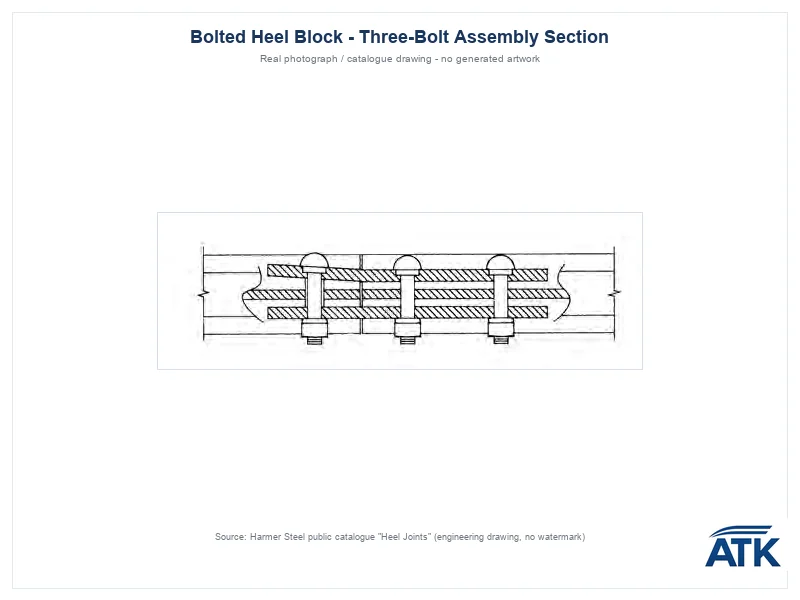
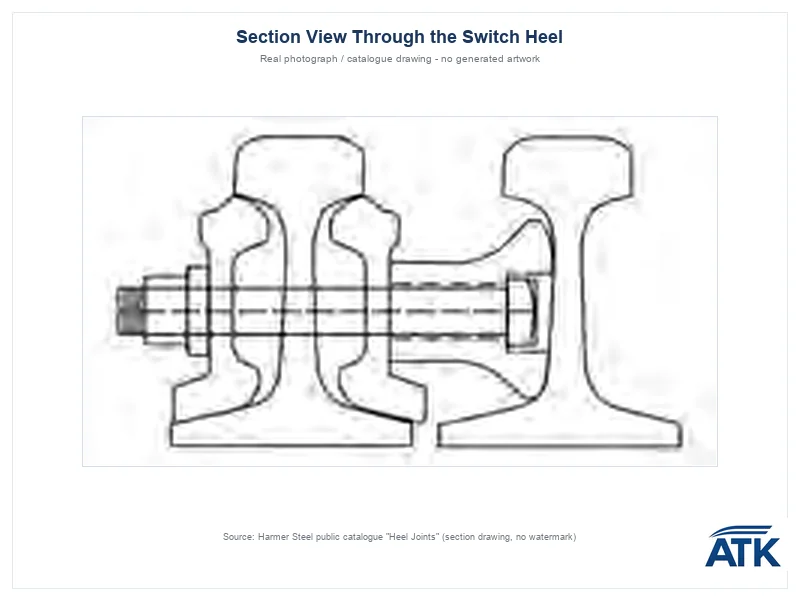
Two heel block designs are in service, and the choice follows the switch design rather than preference.
The conventional bolted heel block closes a joint that moves. The switch rail pivots at the block, joint bars and through bolts complete the connection, and the block keeps the rails at the correct distance between their gauge sides. It is the standard arrangement for shorter switch points and for turnouts that see moderate duty.
The floating heel block takes a different view of the same problem. The switch rail flexes over its length instead of pivoting at a joint, and the block acts as a bearing point between the switch rail and the stock rail that limits movement. Longer switch points on heavily trafficked lines are specified this way - a US transit procurement, for example, calls for floating heel block assemblies on its 16 ft 6 in, 19 ft 6 in and 26 ft points, with the block on the straight side in cast steel, Class B.
Catalogue descriptions make the distinction plain: a floating heel block does not bolt through the stock rail. A single-hole version bolts to the joint bars and bears against the stock rail, so the hole in the switch point does not have to be oversized for a thimble. For switches in continuously welded rail, a CWR-style block bolts directly to the switch point with two bolts and needs no joint bars at all.
The same procurement shows how far the detail can go: where a restraining rail reaches the heel block, the casting incorporates a flangeway flare to keep guarding the curve as far along the block as possible, and that particular block is cast in manganese steel. None of this is exotic - it is one casting family with design options - but it is why heel blocks are ordered against the switch drawing rather than picked from a shelf.
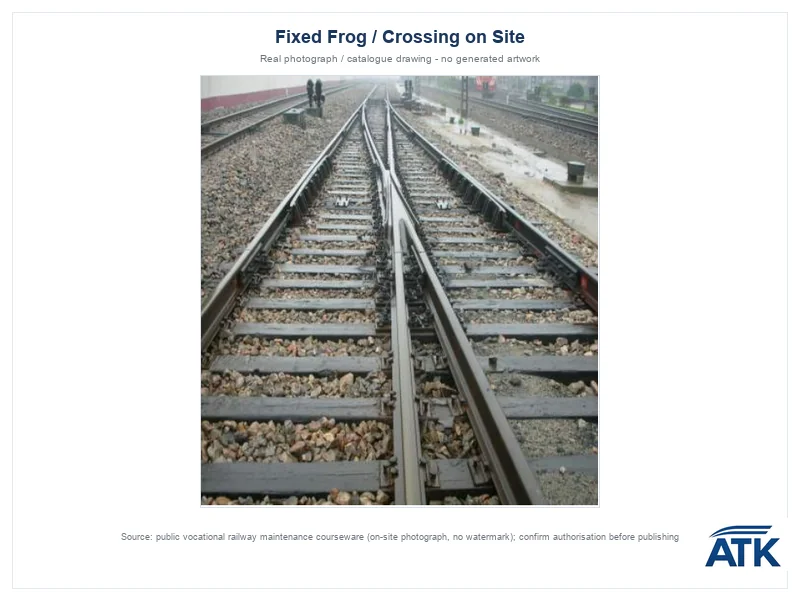
At the crossing, blocks hold the gap between the point rail and the wing rails. EN 13232-7 calls the members that maintain this gap flangeway blocks and notes that distance blocks transmit track forces according to the design concept. Chinese high-speed practice names the long and short point rail blocks at the crossing separately, because the wheel loads here are among the highest anywhere in the turnout: the wheel transfers from one running edge to the other across a very short length.
The flangeway is the dimension that matters. Flangeway blocks hold the gap between the point rail and the wing rail - wide enough for the wheel flange, narrow enough that the wheel is guided. Wear widens the gap past its setting, traffic hammers the blocks loose, and the crossing starts to feel rough long before anything looks broken. Monobloc cast manganese crossings do away with the assembled block group altogether; fabricated and rail-built crossings keep it, which is why replacement blocks stay in steady demand.
For frogs with a movable point, the lateral support members are the spacer blocks or studs named in EN 13232-7 - smaller parts than a switch heel block, but with the same structural role: they transmit the track forces that the moving point cannot absorb on its own. Relay crews keep frog block sets in stock for the same reason: a set renewed over a weekend possession buys years of crossing life without replacing the crossing itself.
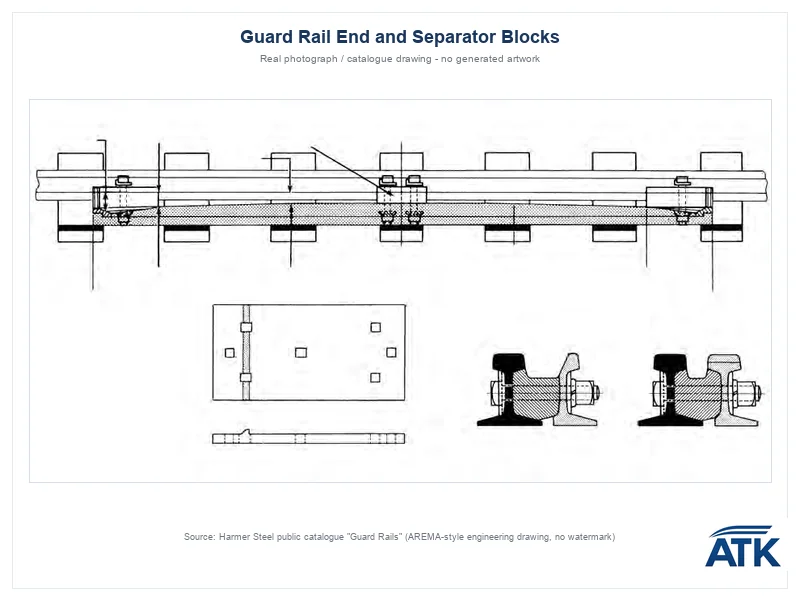
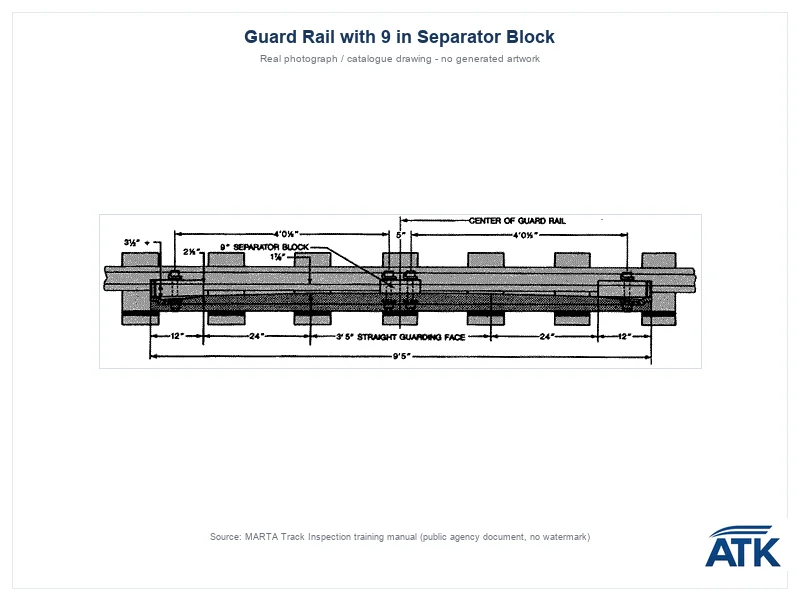
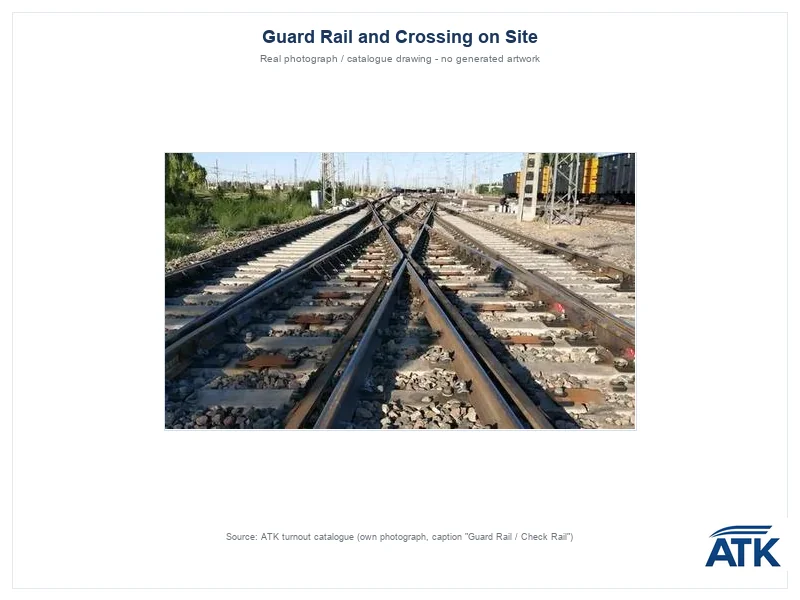
TB/T 1353-2020 gives a name to the guard-rail arrangement built from spacing blocks: the filler-type guard rail, a check rail connected to the running rail with spacing blocks. The blocks set the flangeway between check rail and running rail, and the same bolts hold the guard rail against the lateral loads it collects as it steers wheelsets through the crossing.
Industrial practice works the same way. Catalogue guard rails for industrial turnouts ship as assemblies with their flangeway blocks and bolts included, typically three block positions along the guard rail, so the flangeway is set at installation rather than adjusted in the field. AREMA-style guard rail drawings name the end blocks and separator blocks separately, and show a section through each. Insulated and non-insulated versions exist, following the same split as gauge plates and switch rods.
For a buyer maintaining older turnouts, this is the position where a small order of blocks and bolts restores a guard rail that would otherwise be replaced whole - the check rail itself often has years of wear left in it. When it does have to go, the guard rail is made to the turnout drawing, with the flare, hole pattern and flangeway set before the blocks are matched to it.
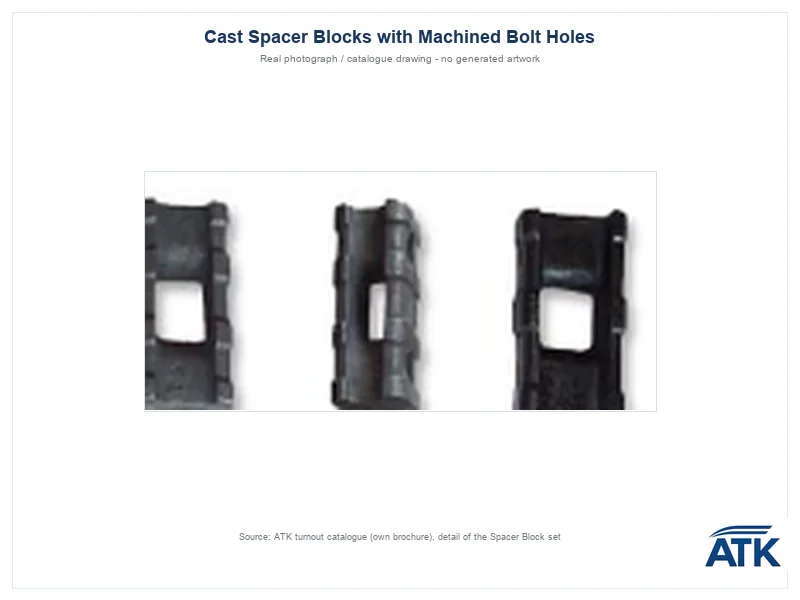
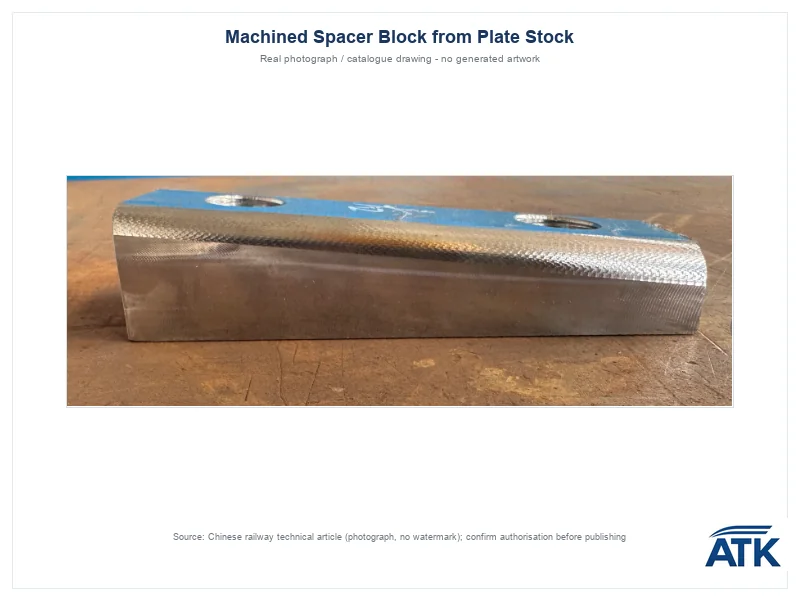
The casting families are settled practice across suppliers. Heel blocks and distance blocks are furnished in cast steel, cast iron or welded steel construction; foundries serving the permanent-way market produce them in grey iron and spheroidal-graphite iron alongside their steel castings. Chinese high-speed turnout drawings name cast carbon steel, plain structural steel and low-alloy high-strength steel grades for different duties, and the grade is confirmed on the ordered drawing. Transit specifications pin the grade where duty demands it - cast steel, Class B, for floating heel blocks on the straight side of a switch - and cast manganese steel is specified where a restraining rail reaches the heel block and the casting has to carry a flangeway flare.
Manufacture follows three routes: a one-piece casting, a welded fabrication, or a block machined from plate or bar stock. Castings suit irregular shapes, welded builds give layout flexibility, and machined blocks give the tightest dimensional control for high-speed assemblies.
What decides the material in practice is the drawing. ATK's turnout range is supplied the same way as the rest of its machined parts: the ordered drawing and technical agreement govern rail section, gauge, material, strength grade, heat treatment and coating. A block for a 60 kg/m mainline switch and one for a UIC60 depot turnout can look alike in a photograph and share nothing else.
Manufacture is straightforward machining after casting, and that is the point: bolt holes, joint-bar faces and rail seats are machined so the G-H-G hole pattern and the gauge-side distances land where the switch design expects them. Tolerances come from the switch drawing rather than a general table, because the same block pattern serves different rail sections with different cant and gauge-side distances. A casting that skips the machining step saves nothing, because the assembly will not close.
Where track circuits run through a turnout, the rail separation has to be electrical as well as mechanical. Insulated versions of the block hardware are supplied for these layouts. The insulation arrangement belongs to the signalling design and is confirmed on the ordered drawing rather than chosen from a general catalogue; the mechanical block underneath is still matched to the same switch drawing as the plain version.
The same logic that puts insulated joint bars at rail ends in signalised territory applies here. Gauge plates and switch rods in the AREMA catalogue are offered in insulated and non-insulated types for exactly this reason, and spacing blocks follow suit. For depot and metro turnouts wired into the signalling system, an enquiry that says "insulated heel blocks, match the existing track circuit layout" is normal, and it is answered from the same drawings as the plain blocks.
Outside the turnout, glued insulated rail joints complete the insulated track; inside it, the insulated block hardware keeps the switch and crossing areas continuous with the circuit design.
Item | Description |
Product | Turnout spacer block / distance block / switch heel block assembly |
Types by position | Switch panel blocks; switch heel blocks; anti-jump (throat) blocks; long / short point rail blocks; flangeway blocks; filler-type guard rail blocks |
Types by connection | High-strength bolted; bolted and bonded; welded to the rail web |
Types by construction | One-piece casting; welded fabrication; machined from plate or bar stock |
Heel designs | Bolted heel block assembly; floating heel block; CWR-style floating block |
Materials | Cast steel, cast iron (grey / spheroidal-graphite), carbon structural steel, low-alloy high-strength steel, welded steel; cast manganese steel where specified - grade confirmed on the ordered drawing |
Insulated versions | Supplied where the track circuit layout requires them |
Rail sections | 43 / 50 / 60 / 75 kg/m (P43-P75); UIC 54 / UIC 60; AREMA 115RE-141RE; BS 90A / 113A; others to drawing |
Governing standards | TB/T 412-2020 turnouts (design, manufacture and inspection); TB/T 1353-2020 terminology; EN 13232-7 component vocabulary; AREMA practice for switch heel block assemblies |
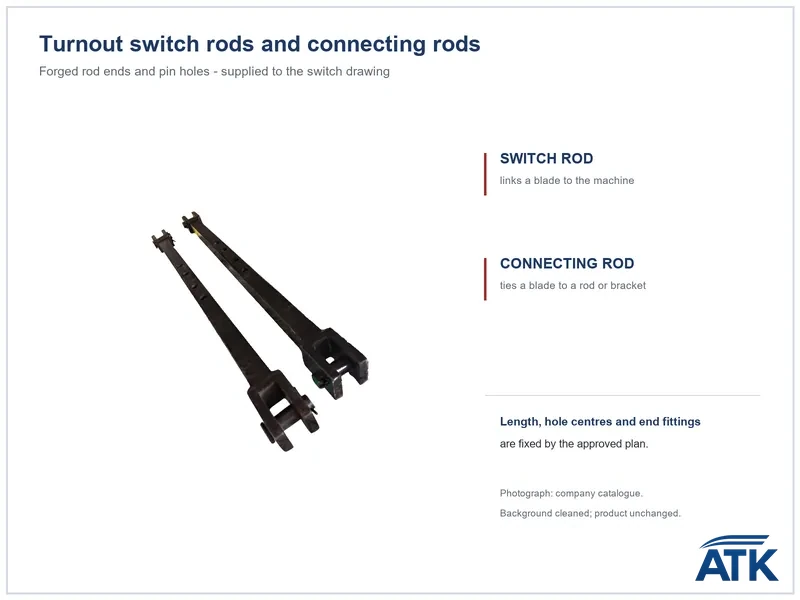
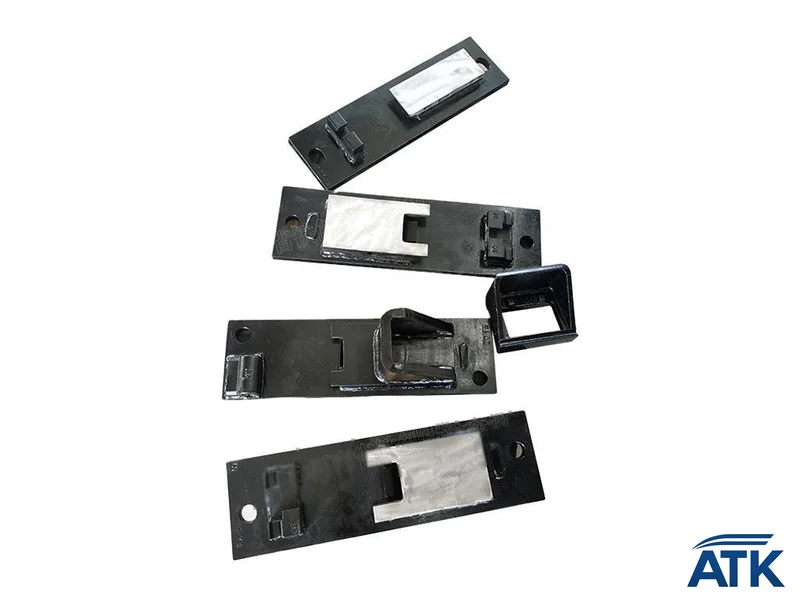
Related parts | Rail braces, slide plates, heel plates, joint bars, connecting rods, gauge blocks |
Dimension control | Heel spread, joint-bar hole pattern (G-H-G), gauge-side distances machined to the switch drawing |
Supply basis | Ordered drawing and technical agreement; custom specifications available |
Every dimension on this table is controlled by the switch drawing, not by a general catalogue number - which is why the ordering section below asks for the drawing data.
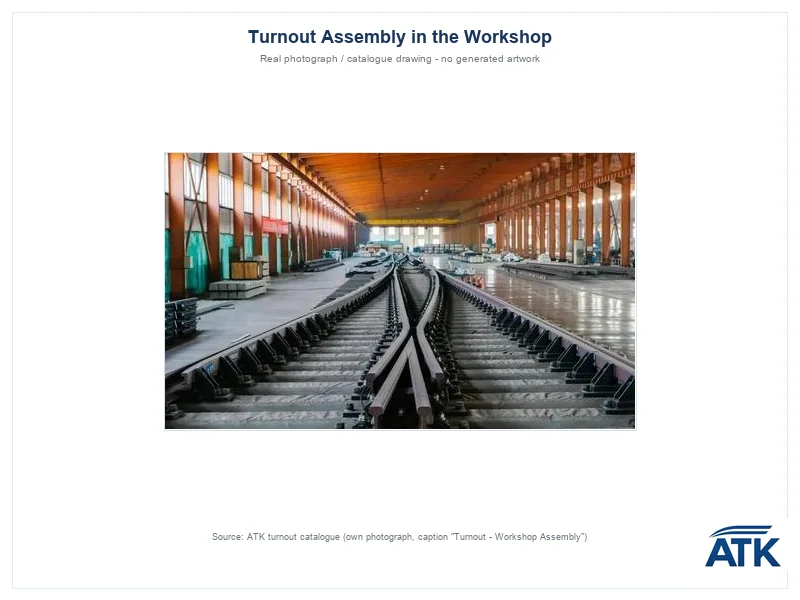
The block hardware in this range serves four recurring situations.
Mainline and freight turnouts take bolted heel blocks on conventional switch designs and floating assemblies where point lengths and traffic demand them. Metro and depot turnouts - and anywhere track circuits pass through the switch - call for insulated versions matched to the signalling layout. Industrial and mining lines lean on the filler-type guard rail hardware, where block-and-bolt assemblies keep older crossings protected. And relay work - reconditioning turnouts that have been in service for decades - is the steady background demand, because the blocks are the parts that wear first at the heel and the frog.
Ordering needs six pieces of information, and suppliers who follow AREMA switch practice will ask for all of them:
1. Rail section and switch design number - the block is matched to both, and one switch design can have several block variants.
2. Heel spread - the gauge-side distance the block must hold.
3. Point length and whether the point is level with the stock rail at the heel - riser style, graduated or uniform, changes the block geometry.
4. Joint-bar hole data - G-H-G: hole diameter, elevation and spacing, if the block is ordered separately from the bars.
5. Right-hand or left-hand point, and whether the order is for a pair or a single side.
6. Bolted or floating type, and material if the specification names it.
A drawing or a rubbing of the old block shortens all six answers to one. With a drawing in hand, quotation is a machining exercise; without one, the first exchange is always the same question - what switch is this block going into. The connection method - bolted, bolted-and-bonded or welded - is fixed by the switch drawing, so it is worth stating on the enquiry even when the dimensions come from a sample.
For turnout numbers and geometry behind the switch design, the turnout number selection guide on this site explains how No. 9, No. 12 and No. 18 turnouts differ. For the parts around the block, complete turnout assemblies and rail braces cover the rest of the machined hardware group.
A part fitted between two rails to hold them at a fixed interval. TB/T 1353-2020 calls it a spacing block; EN 13232-7 calls the same family distance blocks; in the AREMA world the switch-heel version is the heel block.
No. A gauge block is a fastening-system part that sets gauge at the rail seat; a spacer block connects two rails to each other and carries forces between them. Both appear in a turnout, and mixing the two names in an enquiry usually delays the quotation.
The bolted block closes a joint at which the switch rail pivots. The floating block does not close a moving joint; the switch rail flexes over its length and the block acts as a bearing point that limits movement. Longer points on busy lines use the floating arrangement.
The distance between the gauge side of the stock rail and the gauge side of the switch point at the heel. It is one of the two dimensions - with the joint-bar hole spacing - that decide whether a replacement block fits.
Yes, if you can give the switch design number, rail section, heel spread, point length and joint-bar hole data, or send a sample block or a dimensional rubbing. Suppliers match the pattern from that information.
Where a track circuit passes through the turnout, yes - insulated sleeves and pads keep the rails electrically separated while the block still carries mechanical load. Plain blocks are used where no circuit is affected.
Cast steel, cast iron including spheroidal-graphite iron, and welded steel construction are all standard; manganese steel appears where wheel contact runs onto the block. The ordered drawing and technical agreement govern the material for the specific turnout.
Gauge readings at the heel drifting from the switch drawing, bolts that will not hold torque, a visible gap opening between block face and rail, or a switch that feels stiff at the point. Any of these at the heel is a reason to check the block and the joint bars together.
Rail section, switch design number, heel spread, point length, riser style, joint-bar hole pattern, right- or left-hand, bolted or floating type, material if specified, and quantity - or simply the switch drawing.
Yes. Rail sections from 43 to 75 kg/m, UIC 54/60, AREMA 115RE-141RE and BS 90A/113A are all in the range, and blocks are machined to the ordered drawing whichever standard the switch follows.
A note on sources: the terminology and the component roles used on this page follow TB/T 1353-2020 (turnout and crossing vocabulary) and EN 13232-7 (switch and crossing components); the heel-block assembly practice follows AREMA Chapter 3 and TB/T 412-2020. The names and the photographs come from ATK's own turnout catalogue and from publicly available supplier and transit-agency maintenance material. The page was prepared by ATK's turnout-components engineering staff as a working reference for maintenance engineers and purchasing teams specifying replacement blocks, and it draws on the current editions of those standards.
We have recommended some of our Related products to you. I hope you will be interested.
 English
 Русский