
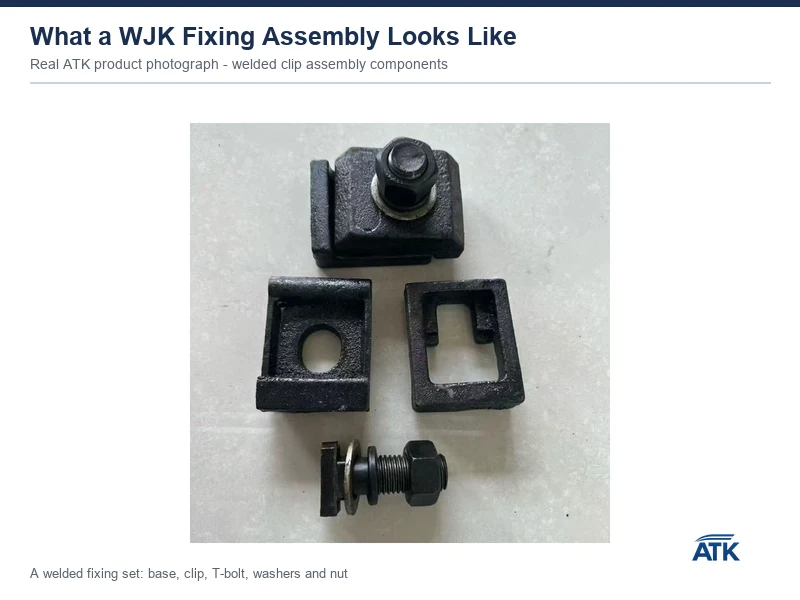
WJK is a standardised welded clip type under JB/T 10543-2018, not an English abbreviation or a made-up model
The suffix is the rail: WJK-QU70 to WJK-QU120, plus TG38 to TG60; SWJK, HWJK and WJKC serve different site conditions
The atlas chain B = b + 2e + 2s ties the rail section to the minimum girder upper-flange width
500/600 mm spacing comes from 23G525 notes by lifting capacity; 150/220 N.m and 45/55 kN come from product data, not GB 50278
9116 is a separate low-profile clip family with a different torque - do not mix its figures into a WJK enquiry
Send rail profile, flange width, duty class, a/b/e/s/B and the drawing revision to get a firm quote
A WJK clip is not chosen by its name. It is chosen by the rail under it and the beam beneath it. A QU100 rail has a 150 mm foot and a QU120 has a 170 mm foot, so a clip sized for one cannot simply be moved to the other. Yet most enquiries for crane rail clips arrive with a model number and nothing about the rail section, the girder flange or the duty class. The quote that comes back is then a guess, and the mismatch is found on site.
This guide sets out the WJK model range, the dimension chain that links a rail section to a fixing, and the fields that belong on a request for quotation. The numbers are separated by where they come from: what the code says, what the atlas says, and what product data says. Those three are often copied into the same supplier table, which is how the confusion starts.
WJK is a welded rail-clip product family that originated with a Chinese manufacturer and was later adopted as a model type in an industry standard. It is not an English abbreviation. No authoritative source expands the three letters, and any page that offers an English full form is guessing. Keep the designation as WJK.
The standard is JB/T 10543-2018, *Fixed Devices for Crane and Transport Rails*. Its scope names WJK and SWJK fixed devices alongside HDGY, LHJY, LHSDK, QGL, TGL, SGL and GDB7 types. It was issued on 30 April 2018, took effect on 1 December 2018, and replaced JB/T 10543-2006. The scope note lists the rail sections covered. It runs from GB/T 11264 light rails at 9 to 30 kg/m, through GB/T 2585 rails at 38 to 75 kg/m, to QU70, QU80, QU100 and QU120 under YB/T 5055.
A different standard, JB/T 13125-2017, is often quoted alongside it. That one covers LHFC, LHTZ and LHSTK fixed parts only. It does not define WJK. If a specification cites JB/T 13125 for a WJK clip, ask which clause is meant before treating it as a compliance requirement.
So the WJK name sits in a real standard, but the standard fixes the type, dimensions and marking of the device. It does not size the device to your crane. That still takes the rail and the beam.
The suffix in a WJK designation is the rail section, not a load rating. WJK-QU70 fits QU70 rail; WJK-QU120 fits QU120. The range set out in the atlas selection tables runs WJK-TG38, WJK-TG43, WJK-TG50, WJK-TG60, WJK-QU70, WJK-QU80, WJK-QU100 and WJK-QU120.
Several related families appear on the same atlas pages:
Family | What changes | When it is considered |
WJK | Standard welded fixing | General crane runway on a steel girder |
SWJK | Reduced-height welded fixing | Horizontal guide wheels need clearance at the rail head |
HWJK | Thicker form used with an elastic pad | Resilient mounting is specified |
WJKC | Heavy-duty form | Crane lifting capacity above roughly 350 t |
Do not treat these as grades of one clip in a catalogue. They are different constructions for different site conditions, and each has its own dimensions.
One more clarification matters. The 9116 / 08 / 37 low-profile clip family is not a WJK variant. It is a separate welded clip design with its own figures, including a tightening torque around 125 N·m. Mixing 9116 figures into a WJK enquiry produces a quote for the wrong assembly. If a drawing names 9116, say so explicitly rather than translating it into a WJK model.
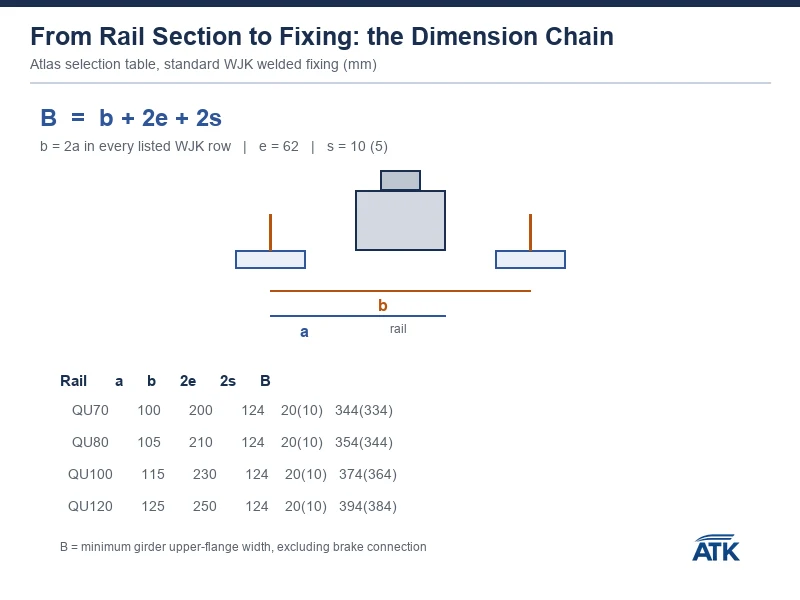
The designations in the atlas carry a small set of dimensions. Understanding them is more useful than memorising a model list.
- a is the distance from the T-bolt centre to the rail centre.
- b is the distance between the two T-bolt centres.
- e and s describe the edge distances at the base.
- B is the minimum width of the crane-girder upper flange needed by the fixing, excluding the brake-system connection.
The atlas table states B = b + 2e + 2s. For the standard WJK range the table gives e = 62 mm and s = 10 mm, with a bracketed 5 mm alternative used where only the weld zone under the base is being measured. In every listed WJK row, b equals 2a. That is an observed relationship in the table, not a formula the atlas prints as such, so quote it as a table relationship rather than a universal rule.
Rail | a (mm) | b (mm) | 2e | 2s | B (mm) |
QU70 | 100 | 200 | 124 | 20 (10) | 344 (334) |
QU80 | 105 | 210 | 124 | 20 (10) | 354 (344) |
QU100 | 115 | 230 | 124 | 20 (10) | 374 (364) |
QU120 | 125 | 250 | 124 | 20 (10) | 394 (384) |
These are atlas figures, published in the selection tables associated with 23G525 and its predecessor. They are the starting point for checking whether a fixing fits, not a substitute for the project drawing.
The practical point is that rail foot width alone does not decide the fixing. QU100 has a 150 mm foot, yet the standard WJK-QU100 needs a girder upper flange of at least 374 mm, or 364 mm where the bracketed value applies. A buyer who reports only the rail section has left out the dimension that decides whether the clip can be welded at all.
Three figures appear in almost every WJK supplier table: 500 or 600 mm spacing, 150 or 220 N·m torque, and 45 or 55 kN lateral capacity. They are real figures, but they come from different places and carry different conditions. Treating them as one block of "standard values" is the most common source of a bad order.
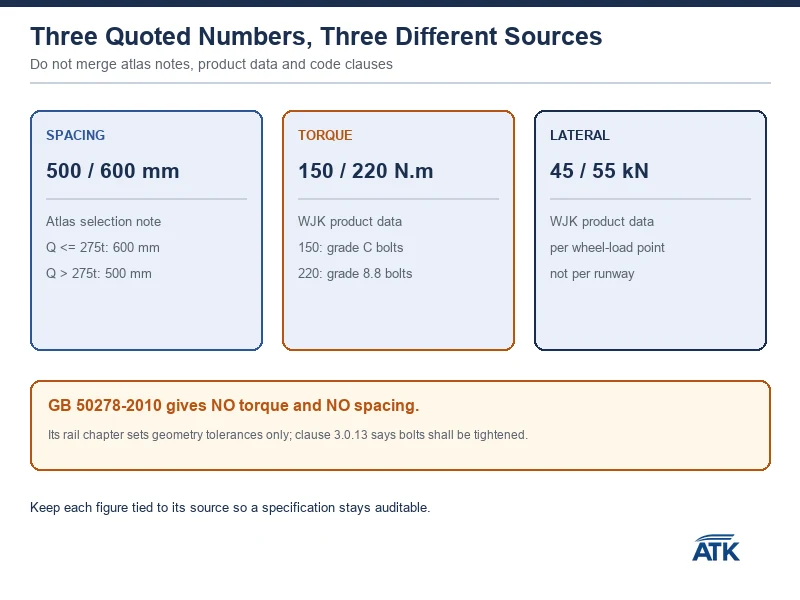
Spacing — from the atlas selection notes. The welded-fixing selection tables in 05G525 and the current 23G525 carry a note on spacing. Fixing spacing follows crane lifting capacity: 600 mm where Q is 275 t or less, 500 mm where Q exceeds 275 t. Fixings are set in pairs, one on each side of the rail. This is an atlas note, not a clause in the installation code.
Torque and lateral capacity — from product data. The figures quoted in WJK technical data pair with the materials and bolting:
Base and bolt | Torque quoted | Lateral capacity quoted |
Q235 base, grade C bolts | 150 N·m | 45 kN |
Q345 base, grade 8.8 bolts | 220 N·m | 55 kN |
The lateral figure is the maximum side force at one wheel-load point, not a capacity for the whole runway. Published tables do not agree on whether the pairing is driven by duty class or by lifting capacity, so state the material and bolt grade on the enquiry and confirm the figure against the project drawing.
What the installation code actually says. GB 50278-2010, *Code for Construction and Acceptance of Crane Installation Engineering*, gives geometric tolerances in its rail chapter. Track centre offset is limited by half the girder web thickness and 10 mm; top-of-rail level deviation is 5 mm for suspended cranes and 10 mm otherwise; the same-section relative difference is 5 or 10 mm. Clause 3.0.13 says only that bolts shall be tightened once the rail has been adjusted to meet requirements. It gives no torque value and no fixing spacing.
That distinction is worth protecting in a specification. When someone writes "150 N·m to GB 50278", the citation is wrong even if the number suits the job. Ask for the source of the figure, then confirm it against the clip material certificate.
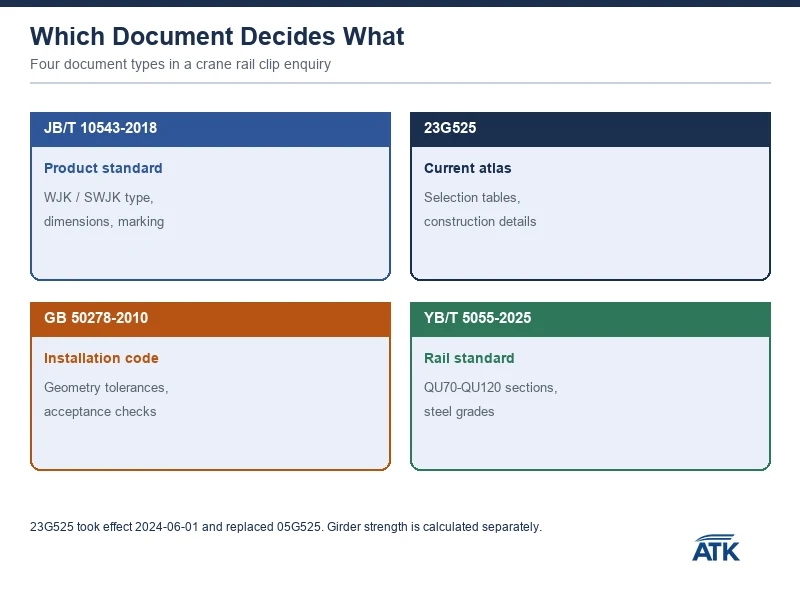
Four document types show up in a crane rail enquiry, and they are not interchangeable.
Document | What it fixes | What it does not fix |
JB/T 10543-2018 | WJK and SWJK device types, dimensions, marking, technical requirements | Your crane's wheel load or fixing layout |
23G525 | Current atlas for crane-rail connections on steel girders; selection tables and detail drawings | Calculation of girder strength and stability |
GB 50278-2010 | Installation tolerances and acceptance checks | Torque and clip spacing values |
YB/T 5055-2025 | QU70 to QU120 rail sections and steel grades | Clip design or fixing geometry |
23G525 took effect on 1 June 2024 and replaced 05G525. Its scope covers solid-web steel crane girders in industrial buildings and open trestles, and its contents include rail splices, rail-to-girder fixings, expansion joints and end stops. The atlas index includes welded-fixing selection tables and GDGL-1 to GDGL-7 rail clamp fixings. It is a construction detail document. The general notes state that girder strength, stability and fatigue are calculated separately.
The rail standard also changed. YB/T 5055-2025 was issued on 19 August 2025 and took effect on 1 March 2026, replacing the 2014 edition. Older product pages still quote 2014. Name the edition in the enquiry so the supplier does not quote against a superseded section table.
Reporting the rail number but not the flange. A WJK-QU100 designation tells the supplier the rail. It does not tell them whether your girder has the 374 mm upper flange the standard fixing needs. If the flange is narrower, a reduced SWJK form or a different fixing route must be discussed before pricing.
Assuming a smaller clip is a cheaper clip. SWJK is reduced in height to clear horizontal guide wheels. It is not a budget version of WJK. Its dimensions differ, and published tables for some SWJK sections disagree with each other. Ask for the confirmed drawing values rather than a catalogue row.
Carrying a 9116 torque into a WJK order. The 9116 family uses a different bolt and a different torque. A request that quotes 125 N·m and a WJK model at the same time describes two products.
Citing a code for a catalogue value. Installation tolerances belong to GB 50278; spacing comes from the atlas note; torque and lateral figures come from product data. Keeping them separate makes a specification auditable.
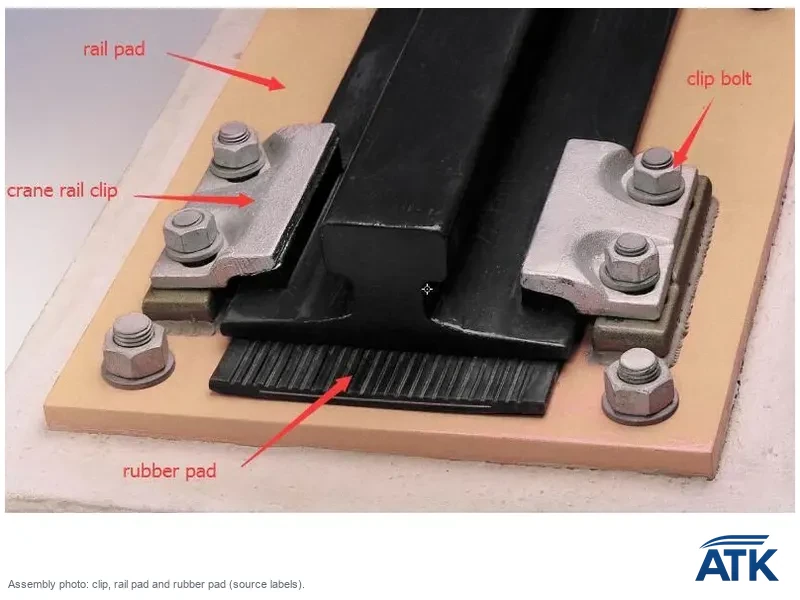
Ignoring the pad. If an elastic rail pad is specified, the fixing has to suit the greater assembly height and the pad has to be continuous or intermittent as designed. GB 50278 clause 3.0.11 requires the rail to sit tight on the pad before bolts are tightened, with a shim plate added where a gap remains.
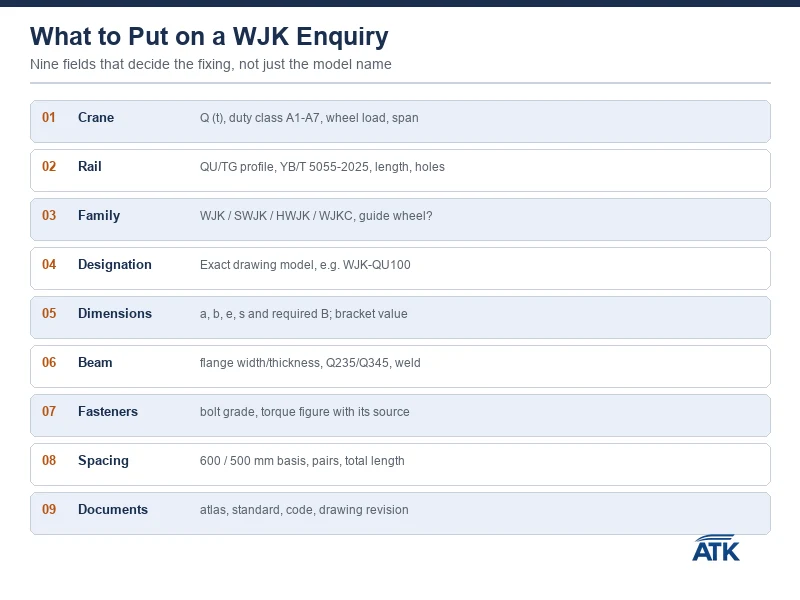
A clip cannot be priced from a name alone. The fields below are the ones that decide the fixing, and sending them together avoids the second round of questions that delays a quotation. Copy the list into your RFQ and fill what you know; mark the rest as "to be confirmed" rather than guessing.
Crane and duty. Lifting capacity Q in tonnes, duty class such as A1 to A7 under ISO 4301, single wheel load, wheelbase, span and travel speed. Fixing spacing is selected by lifting capacity, and lateral force is checked at each wheel-load point.
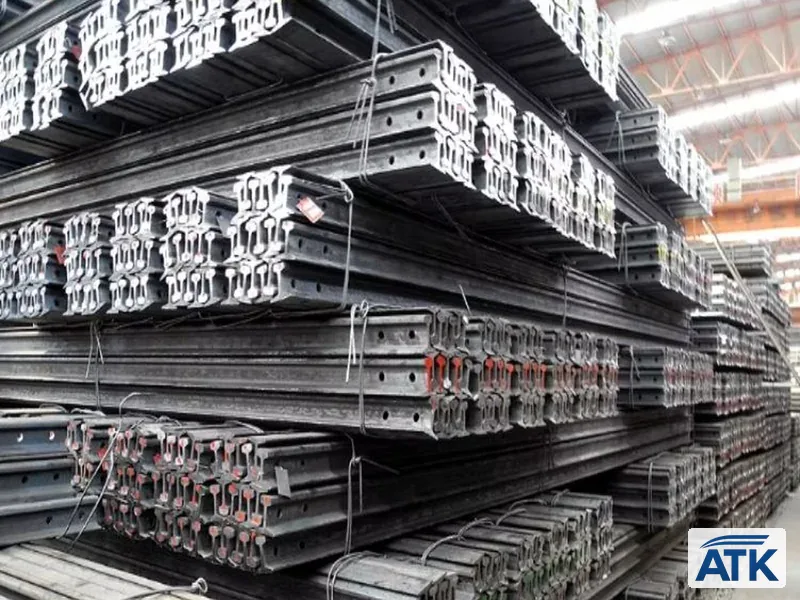
Rail. Profile designation, for example QU70, QU80, QU100, QU120 or TG38, TG43, TG50, TG60. Rail standard and edition, currently YB/T 5055-2025 for QU sections. Rail length, whether holes are drilled, and any head treatment.
Clip family and designation. State WJK, SWJK, HWJK or WJKC, and say whether a horizontal guide wheel is fitted. Give the model exactly as written on the drawing, such as WJK-QU100. If the drawing names a 9116-style low-profile clip, say so rather than converting it to a WJK model.
Dimensions to confirm. The values of a, b, e and s, and the required B. When a bracketed value appears, state which one applies. These values decide whether the fixing fits the girder.
Beam and weld. Upper flange width and thickness, beam material such as Q235 or Q345, weld pattern, and electrode type such as E4315 or E5015. A standard clip needs a flange wide enough for the weld run.
Fasteners and torque. Bolt grade, whether grade C or 8.8, and the torque figure with its source. If the drawing names 150 or 220 N·m, note the basis instead of presenting it as a code requirement.
Spacing and quantity. Spacing with its basis, 600 mm at Q of 275 t or less and 500 mm above it in the atlas notes. State the pairs per position and the total track length so quantity can be checked.
Pad and environment. Pad type, thickness and whether it runs the full length or sits under individual fixings. Add corrosion protection, marking and inspection certificate requirements, and the destination country for export documents.
Reference documents. The atlas edition, the product standard, the installation code and the project drawing revision. A revision number ends most arguments about which detail applies.
Both, in sequence. It began as a manufacturer's registered product family and was later written into JB/T 10543-2018 as a device type. Treat it as a standard type name, and still confirm the drawing dimensions for your rail and girder.
No. Its scope lists LHFC, LHTZ and LHSTK types. If a tender cites it for a WJK clip, ask for the clause before accepting the reference.
SWJK is the reduced-height family, used where horizontal guide wheels need clearance. It is not simply a smaller WJK, and its dimensions must be taken from a confirmed drawing.
Product data quotes 150 N·m with grade C bolting and 220 N·m with grade 8.8 bolting. GB 50278-2010 gives no torque figure. Confirm against the project drawing and the clip material certificate.
From the selection-table notes associated with 05G525 and 23G525: 600 mm at lifting capacity up to 275 t, 500 mm above it. It is an atlas note, not an installation-code clause.
No. QU100 has a 150 mm foot and QU120 a 170 mm foot, a 20 mm difference. The fixing geometry and the required flange width both change.
No. It is a separate low-profile clip family with its own bolt and torque. Do not mix its figures into a WJK enquiry.
No. JB/T 10543-2018 fixes device types, dimensions and marking. Spacing follows the atlas selection notes and the project design.
YB/T 5055-2025 for QU sections, effective 1 March 2026. Naming the edition avoids a quote built on the superseded 2014 table.
Yes. The B value in the atlas is the minimum upper-flange width the fixing needs. Without it, a supplier cannot confirm that the clip can be welded and braced as drawn.
Send the rail profile, the girder upper-flange width, the crane duty class and the drawing revision together, and a WJK fixing can be matched to the job rather than guessed from a model name. The WJK rail fixing assemblies listed on our crane rail clips page show the welded and bolted forms we supply, and our team can check the dimension chain against your drawing before quoting. To start that check, use the contact us form and attach the rail and beam details listed above.
We have recommended some of our Related products to you. I hope you will be interested.
 English
 Русский