
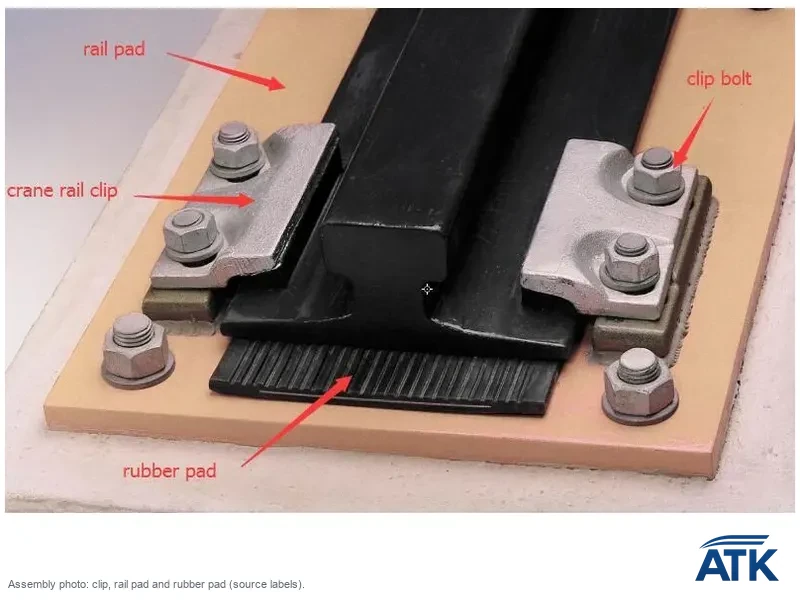
Sorts out sole plate, baseplate, rail pad and shim by their position in a crane runway stack, with the continuous versus individual choice, function-based specification and a five-field enquiry checklist.
One drawing says soleplate. The next says baseplate. A third asks for pads and means a rubber layer under the rail. Two of those words may name the same steel part; the third names a different layer entirely. A soleplate is a structural plate; a rail pad is an interface layer between rail and support. Ordering the wrong one leads to a quote that looks right and a delivery that cannot be fitted.
A sole plate or baseplate is the structural plate that gives the rail and its clips a mounting surface and passes wheel load into the girder or beam. A rail pad is the resilient layer between the rail foot and that support. A shim corrects level under a plate. They work together and none of them substitutes for another.
Supplier catalogues are not consistent, and no single standard fixes all four terms in English. Place them in the stack and the four words collapse into three positions: a structural plate, a resilient pad, and a shim used for level.
Term | Sits where | Main job | Typical material |
Sole plate / soleplate | Between rail assembly and girder or beam | Defined mounting surface, load spread | Steel plate, continuous or individual |
Baseplate | Same layer, often the individual form | Mounting interface for clips and rail seat | Cast or forged steel |
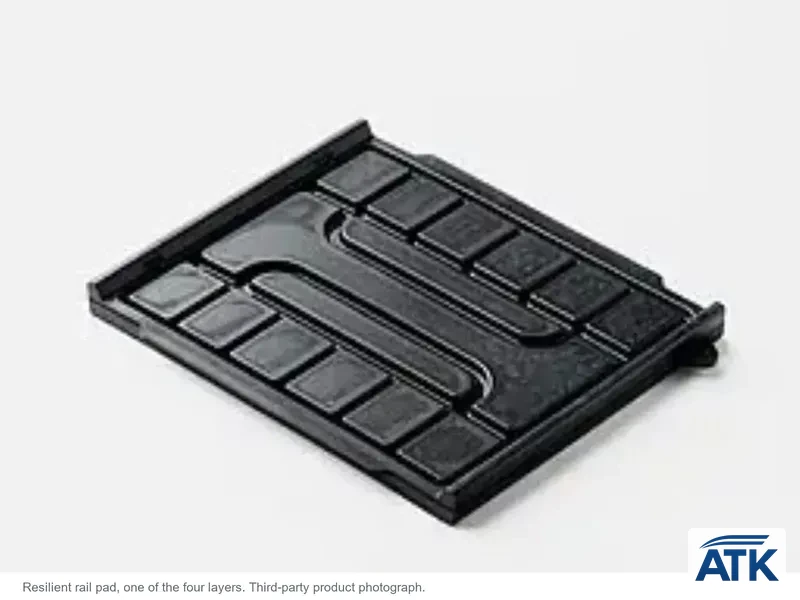
Rail pad | Between rail foot and plate or beam | Resilient interface, contact distribution, sometimes insulation | Rubber, steel-reinforced rubber, EVA |
Shim | Under the plate | Level correction at installation | Steel, sometimes stacked |
A pad does not replace a plate unless the engineered design specifically allows it. Supply literature uses baseplate and soleplate almost interchangeably — which is exactly why the drawing matters more than the word.
In crane runway work the two words normally describe the same layer: the plate under the rail that carries load into the supporting structure. Soleplate is common in British and European supply literature. Baseplate appears more often in catalogues that also serve conventional track. A supplier may call a continuous steel strip a soleplate and an individual plate under one clip a baseplate.
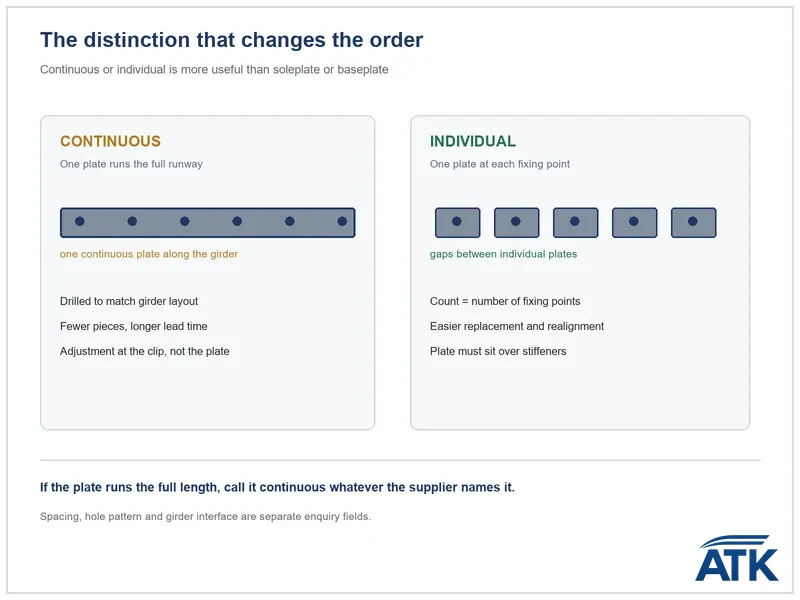
That distinction — continuous versus individual — is the one that changes the order. A continuous sole plate runs along the runway and can be drilled to match the girder. An individual plate sits at each fastening point. The choice affects hole pattern, quantity, installation method and how the rail is later adjusted.
Individual plates are commonly cast in QT450-10 ductile iron or forged from steel. Sizes often run 150 × 200 mm to 200 × 300 mm with a minimum thickness of 20 mm, but these are catalogue values, not a universal rule. Do not read the word alone. Read the drawing dimension: if the plate runs the full length, it is continuous whatever the supplier calls it.
A rail pad is specified by function, not just thickness. Resilience, electrical isolation, contact pressure distribution and damping of certain vibration transmission are separate functions a pad may or may not be asked to perform. A thicker or softer pad is not automatically better — excessive deflection changes rail elevation and the way the fastening behaves.
Compound choice runs NBR, EPDM, EVA and polyurethane; steel-reinforced rubber is used where an embedded flat strip has to resist lateral extrusion under high wheel load. Discrete elastomeric pads are commonly quoted at Shore A 75 ± 5 with retaining lips at the sides. Shore hardness and thickness are project values. They belong on the specification, not in a generic description.
The practical test: if the part is meant to compress and recover under the rail, it is a pad. If it is meant to hold geometry, it is a plate.
A shim goes under the plate to bring the rail into level during installation or after settlement. It is a correction device. It does not replace a proper bearing surface, and it does not fix a girder that was fabricated out of tolerance.
Chinese installation practice treats shims as a bounded system: individual shim thicknesses of 2, 3, 5, 8 and 10 mm, no more than two shims under one plate, and total build-up no more than 15 mm. These figures come from maintenance guidance rather than a product standard. Where a project specification gives different limits, the project governs.
If a runway needs repeated shimming, the cause is usually structural or a settlement problem — not a shortage of shims.
Three failure patterns show up in enquiries.
Asking for "pads" and receiving a plate. A buyer who wants resilience under a QU80 rail writes "rail pad" on the order. The supplier quotes a steel soleplate because that is what the runway drawing shows at that position. Neither side is wrong about the word; the function was never stated.
Ordering baseplates by name, not by fastening pattern. A baseplate with the wrong clip interface arrives with correct-looking dimensions. It cannot accept the clip that is already on site. Rail profile, track gauge, hole positions and connection interfaces are four separate things to confirm — the part name covers none of them.
Treating soleplate and rail seat as synonyms. Some suppliers describe a formed rail seat on a continuous plate as a separate item. Others include it. The enquiry should say whether the seat is machined into the plate, welded on, or formed by the pad.
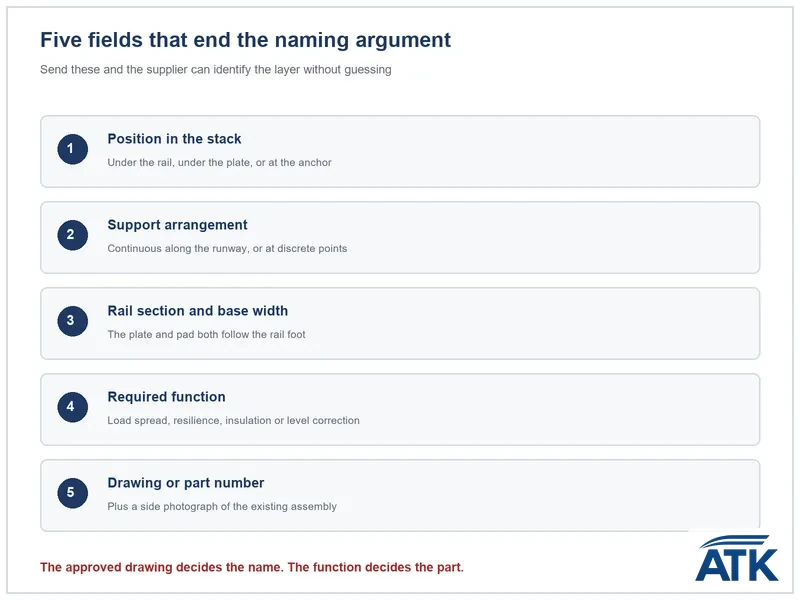
Send these five items and the terminology stops mattering:
· Position in the stack — under the rail, under the plate, or at the anchor
· Whether the support is continuous along the runway or at discrete points
· Rail section and base width
· Function required — load spread, resilience, insulation or level correction
· Drawing number or the original part number if this is a replacement
A photograph of the existing assembly from the side shows the stack better than a close-up of one part. Include it when the drawing is missing.
The four parts sit in one chain. The plate spreads load and gives the clip a surface. The pad manages the interface between rail and plate. The shim sets level. The clip system holds the rail laterally; the clip layout decides how many fixing points the plates must serve. If one layer is specified by name alone, the chain breaks at the interface.
In crane runway work they usually describe the same structural layer. Suppliers use continuous versus individual to distinguish forms.
No. A pad manages the interface; a plate carries and spreads load into the structure.
It corrects rail level under the plate. It is not a substitute for a proper bearing surface.
Soleplate is more common in British and European supply literature. Baseplate appears widely in general track catalogues.
No. Insulation is one possible function. State it in the enquiry if the design needs it.
Maintenance guidance commonly limits this to two per plate, with total build-up no more than 15 mm. Project limits govern.
Usually yes, to avoid steel-to-steel contact. Confirm the function and thickness against the runway design.
A side photograph of the full stack, the rail section, base width and the position of the part in the assembly.
No. Material, thickness, hole pattern and interface geometry all change the part.
The approved drawing. Treat catalogue words as hints and confirm the function.
The names describe one layer of the runway. The plates, pads, shims and clips that occupy that layer each have their own guide.
Send the drawing or the side photograph with the rail section and the position in the stack marked. Request a quotation with the required function stated — load spread, resilience, insulation or level correction.
We have recommended some of our Related products to you. I hope you will be interested.
 English
 Русский