
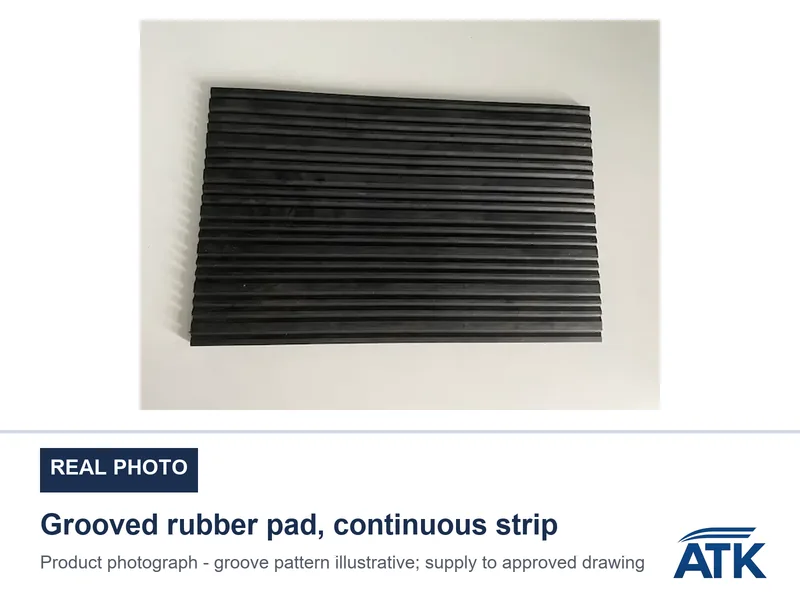
Crane rail rubber pads sit between the rail foot and its support, spreading wheel load and damping vibration
Plain elastomer, grooved composite and steel-backed construction are separate products, not one default
Steel insert is supplied only when the order and drawing call for it
Pad width follows the measured rail foot: QU70 120 mm, QU80 130 mm, QU100 150 mm, QU120 170 mm
Continuous strip suits a continuous soleplate; individual pads suit discrete soleplates
Hardness must carry its test method - a bare Shore A figure is not comparable
EN 13146-9 covers static and dynamic stiffness test methods; EN 13481 is an assembly performance series
GB/T 21527-2008 is the current Chinese product standard; TB/T 2626-1995 is superseded
No honest fixed service life - inspect for thinning, groove cracking, hardening and sideways movement
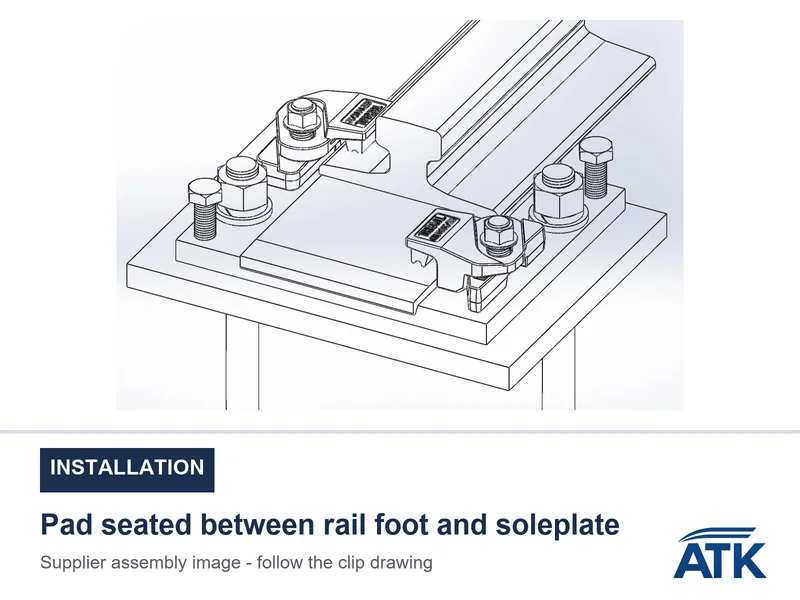
Crane rail pads sit between the rail foot and the sole plate. Rubber, resilient and steel-backed types are selected by crane duty, rail section and whether the pad is continuous or fitted at each bearer. QU70 to QU120 profiles are covered. The pad controls local stress and vibration; track level is set by shims below the plate, not by the pad.
Crane rail rubber pads are the resilient layer between the rail foot and the surface that carries them — a steel soleplate, a crane girder flange, or a concrete support. The rail is bolted down through clips, but the crane rail pad is what decides how the wheel load actually enters the structure. Remove it and the rail foot bears directly on steel: every wheel pass becomes a metal-to-metal impact, the contact wears, the fastening loosens, and the girder sees a sharper dynamic load than it was detailed for. The pad never works alone: its working thickness changes the level the shims have to correct, and its compression decides whether the clip still seats on the rail foot. How the whole chain is chosen is covered in crane rail fastening system
Construction | When it is used | What it controls | Note |
Plain elastomer | Modest duty; continuous support | Load spreading and basic damping | Single moulded layer |
Grooved composite | Rising wheel load | Stiffens as grooves close | Soft at first contact |
Steel-backed | High lateral load | Limits sideways squeeze | Only when drawing calls for it |
The pad does four jobs at once. It spreads a concentrated wheel load over a larger bearing area. It absorbs the small irregularities that no girder or soleplate is perfectly free of. It damps vibration and reduces structure-borne noise. And on insulated or signal-controlled runways, the right compound contributes electrical resistance instead of shorting the circuit. None of these jobs is optional, and a pad chosen only by its price per metre usually fails at one of them.
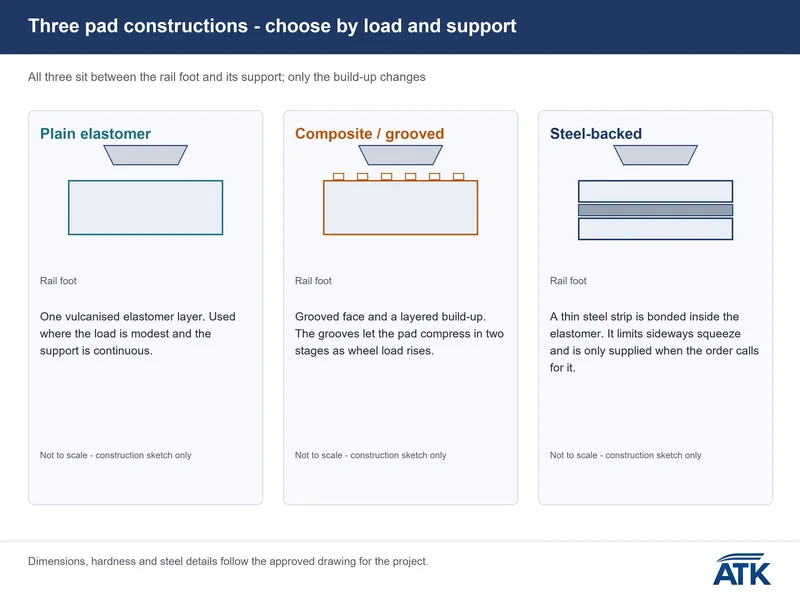
Runways generally use one of three constructions. A plain elastomer pad is a single moulded layer, used where the duty is modest and the pad sits on a continuous support. A composite or grooved pad has a shaped running face whose channels let the pad stiffen as the wheel load rises — soft at first contact, firmer once the grooves close. A steel backed crane rail pad — written steel-backed in most catalogues — has a thin steel strip bonded inside the elastomer, which limits sideways squeeze under high lateral load. The steel-backed form is a separate product: it is supplied only when the order and the drawing call for it. Not every crane rail pad contains steel.
Where the rail and soleplate are the subject, the matching range is set out under crane rail clips and welded rail clamps.
The pad does not select itself by crane capacity. It follows the rail — specifically the width of the rail foot — because the pad has to sit fully under the foot without projecting into the clips or the runway clearance.
For the common Chinese QU crane rail series, the published section dimensions are:
Rail section | Foot width |
QU70 | 120 mm |
QU80 | 130 mm |
QU100 | 150 mm |
QU120 | 170 mm |
These are rail profile values, published to YB/T 5055 and consistent across several rail makers; the rail drawing for the project governs if it differs.Section drawings and mass per metre sit under crane rail sections; this page uses only the foot width, because that is what the pad follows. A crane rail pad for QU70 is therefore a different part from a crane rail pad for QU100: the foot widths are 120 mm and 150 mm, not the numbers in the designations. QU70 is often quoted first because the number in the designation is the nominal head width, not the foot width. A pad ordered against "QU70" without checking the foot width is a common source of a strip that is either too wide for the clips or too narrow to carry the load.
The usual rule in crane runway practice is that the pad is made slightly narrower than the rail foot — commonly a few millimetres — so that the pad edge never interferes with the clip nose or the rail web. The exact reduction is a detail of the clip and pad drawing, not a universal figure. The same applies to DIN A-section rails, JIS crane rails and the AREMA crane sections: the designation gives you a starting point, the rail drawing gives you the foot width, and the foot width gives you the pad width.
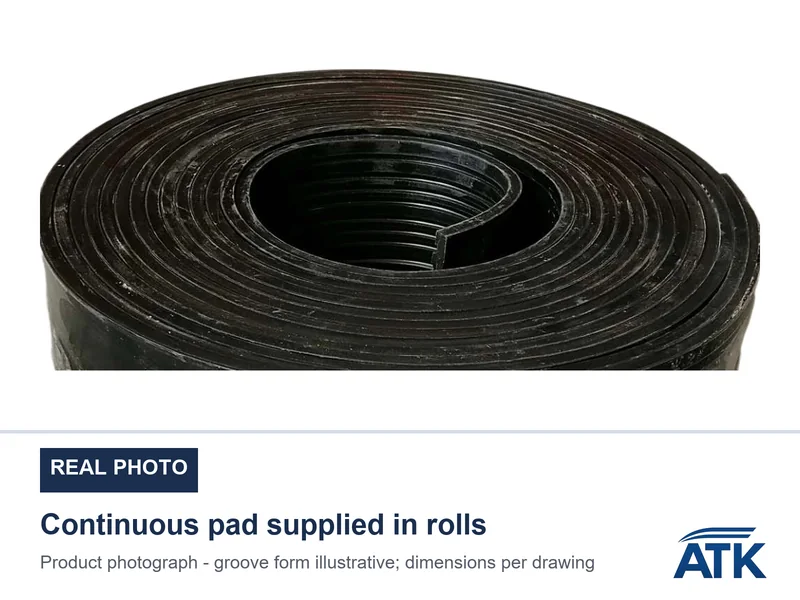
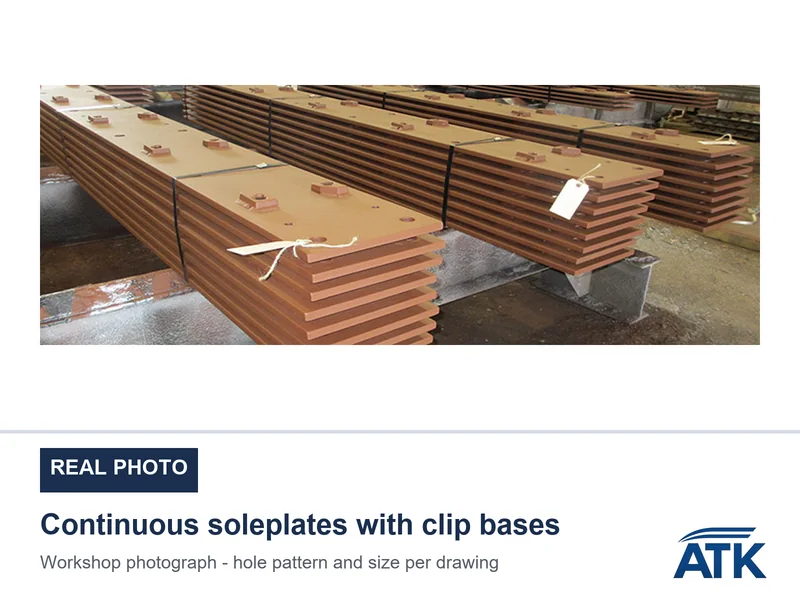
Continuous strips and individual pads are the two supply forms. A continuous pad runs the length of the runway and suits a steel soleplate or a continuously supported rail. An individual pad is cut to one soleplate and suits discrete support points. Both can use the same elastomer; what changes is the support condition and the way the pad is held in place.The steel plate beneath that pad is its own specification - type, thickness, anchor pattern and any shims needed to set the level. See crane rail sole plates and height adjustment shims.
The elastomer is the working element. Compound selection is a material decision, not a colour choice. Different polymers tolerate oil, heat, ozone and low temperature in quite different ways. A compound that performs well in a covered workshop can fail early on an exposed quay. The project environment decides the compound; a supplier who quotes one "rubber" for every climate is guessing.Choosing between constructions, thicknesses and compounds is a separate decision - see the crane rail rubber pads selection guide.
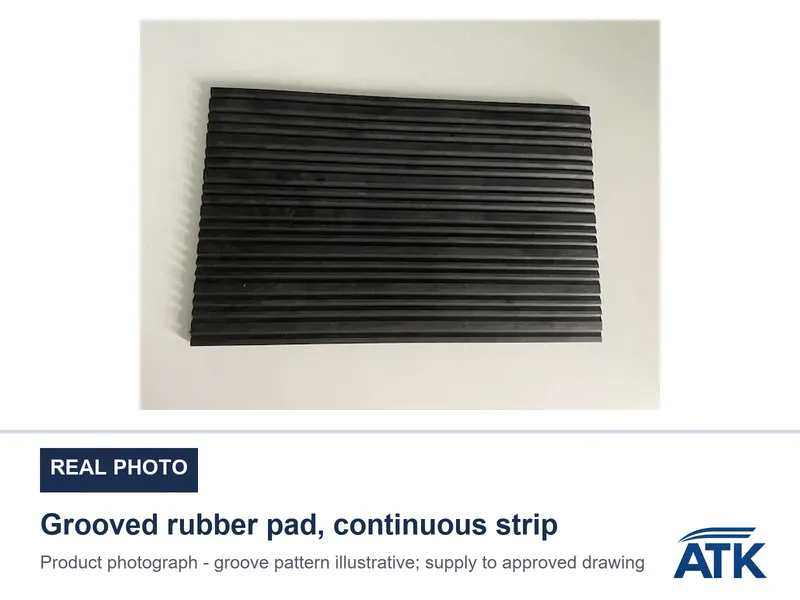
A moulded pad leaves the press with its section and its surface pattern set. The grooves seen on many crane pads are not decoration. They give the pad a two-stage response: the voids close first under the clip preload, then the solid section carries the wheel load. That is why groove geometry, depth and tolerance belong on the drawing, and why a groove copied from another supplier's catalogue is not interchangeable with the one the clip was designed for.
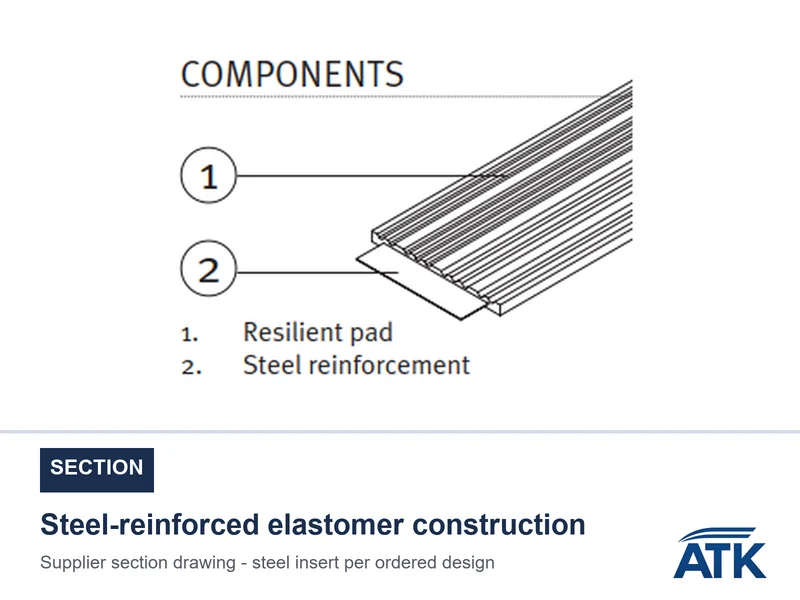
Where a steel-backed pad is specified, the strip is prepared before moulding — cleaned and roughened so the elastomer bonds to it — and the rubber is vulcanised onto it. The steel is there to resist lateral extrusion and to keep the pad stable when the crane brakes or skews. It is not a wear surface and it does not make the pad rigid. A steel-backed pad that delaminates has lost the reason it was bought, which is why bond integrity belongs in the inspection plan, not just in the material description.
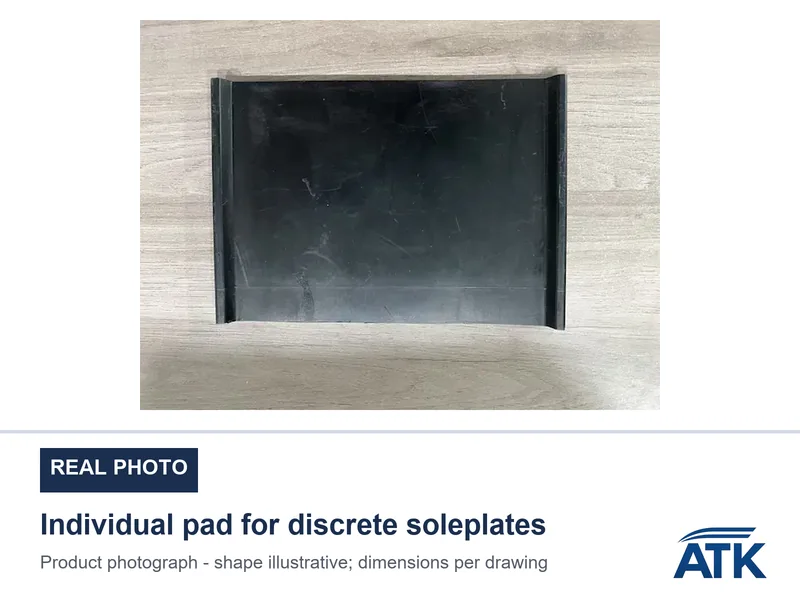
Individual pads are moulded to a plan shape, sometimes with end features that help locate the pad on a discrete soleplate. The locating feature is part of the fastening arrangement; if the soleplate or clip layout changes, the pad has to be reviewed with it. Holes, slots and edge profiles are set from the soleplate drawing rather than added on site.
A crane rail pad is made to the runway, not pulled from a shelf by crane size. The items that define an order are the rail section and its foot width, the support it sits on, the clip that holds it, and the environment it has to survive. Four of those are project facts; only the compound is a supplier choice, and even that is bounded by the project's temperature and chemical exposure.
Item | What the enquiry must fix | Why it decides the pad |
Rail section | QU70 / QU80 / QU100 / QU120, DIN A, JIS or AREMA designation, with the rail drawing | Foot width sets pad width; designation alone is not enough |
Pad form | Continuous strip or individual pad, with length and layout | Follows whether the support is continuous or made of discrete soleplates |
Width | Slightly narrower than the measured rail foot, per clip drawing | Protects the clip nose and keeps the pad clear of the web |
Thickness | As shown on the approved pad drawing | Controls deflection and the height of the rail above the support |
Compound | Elastomer type named in the order or project specification | Oil, heat, ozone and cold behaviour are material properties, not finishes |
Hardness | Tested to an agreed method, with the reported value on the drawing | Governs how the pad shares load with the clip preload |
Steel insert | Only when the design calls for steel-backed construction | A bonded strip changes the part; it is not a default option |
Groove pattern | Geometry and tolerance from the drawing | Sets the two-stage compression behaviour |
Electrical requirement | Insulated joint or signal circuit, where relevant | Decides whether resistance testing applies |
Quantity and cut length | Total metres or piece count, and any custom cut lengths | Affects moulding, packing and lead time |
Customisation is normal for this product. Width, thickness, cut length, hole or slot positions, edge form, groove geometry and the presence or absence of a steel insert are all made to the drawing. The fit cannot be customised after the fact. Once a strip has been cut too wide for the clip, the drawing has to be reopened and the pad remade.
Send the rail drawing and the clip drawing together. They describe the same interface from two sides, and a pad designed from only one of them is a guess.
Inspection starts with the things that can be checked on every batch: dimensions, appearance and hardness. Length and width are measured against the drawing, thickness is checked at several points along the strip, and the faces are examined for moulding defects, cuts, inclusions or delamination. For a steel-backed pad, the bond between the strip and the elastomer is inspected specifically — a surface that looks sound can still hide an unbonded area.
Hardness is reported against an identified method rather than as a bare number. A Shore A figure without the test standard and the test condition is difficult to compare between suppliers, because the method and the conditioning of the specimen both affect the result. The same principle applies to tensile properties and compression set: ask which method produced the figure before comparing two datasheets.
Stiffness is the performance check that matters most in service, and it is a system property as much as a material one. EN 13146-9 sets laboratory procedures for determining the static and dynamic stiffness of rail pads, baseplate pads and complete fastening assemblies. Results depend on the test set-up, so a stiffness value quoted for a bare pad is not automatically the stiffness of that pad under a fitted clip.
This distinction is worth stating plainly. EN 13481 is a performance-requirement series for fastening systems, and EN 13146 is a test-method series. A single pad does not hold independent "compliance" to an assembly requirement. What a buyer should request is the type-test evidence for the assembly, with the pad, rail section, soleplate and clip configuration named, plus the batch records for the pad itself.
For Chinese projects, GB/T 21527-2008 is the current national product standard for elastomer pads used in rail, urban transit and mining applications. Its English title is "Elastic pads for rail transit fasten system", and it covers classification, marking, technical requirements, test methods and inspection rules. TB/T 2626-1995 has been superseded, so a drawing that still cites it needs to be queried rather than followed. Other standards apply to specific fastening systems and to elastic iron baseplates; they are not interchangeable with a plain crane rail pad.
The documents normally offered with a batch are a dimensional and visual inspection record, a hardness result against the stated method, and any further test the order names — compression set, low-temperature behaviour, oil resistance, electrical resistance or assembly stiffness. If a project requires third-party inspection, name it in the enquiry; it is a scope decision, not a default.
The runway is harder on a pad than a main-line railway is. Wheel loads are high, speeds are low, and much of the movement is starting, braking and skewing rather than free rolling. Lateral force is therefore a design input, not a footnote, and it is the reason a steel insert is sometimes specified. A pad that survives vertical load alone can still be squeezed sideways out of the rail seat.
Environment decides the compound. Outdoor quays and container terminals bring ultraviolet exposure, salt and rain. Steel mills and foundries bring radiant heat and scale. Ports and maintenance sheds bring oil and grease. Cold-store or high-latitude sites bring a low-temperature requirement that a general-purpose compound may not meet. Ask which of these is present before asking for a hardness value.
The groove pattern is worth looking at closely, because it is where a tired pad often fails first. A roll of continuous strip shows the section clearly: the channels run along the rail, and their roots are the points to inspect once the pad has been in service.
There is no honest fixed service life to quote for a crane rail pad. Published "years" figures come from supplier marketing and depend on duty class, wheel load, climate, alignment and maintenance, none of which is known at the enquiry stage. What can be specified is a condition-based replacement rule. Inspect the pad for permanent thinning, cracking at the groove roots, loss of edge shape, hardening, oil swelling, and any sign that the pad has moved sideways out of the seat. A pad that has lost its thickness no longer controls the rail height or the load path, even if it still looks intact from a distance.
On a padded runway the clip has to apply a controlled vertical force. Too little and the pad can walk under the rail; too much and the elastomer is pre-compressed to the point where it stops working as a resilient layer. This is a setting to check at installation and again after the first period of service, not a torque figure to copy from a different clip.
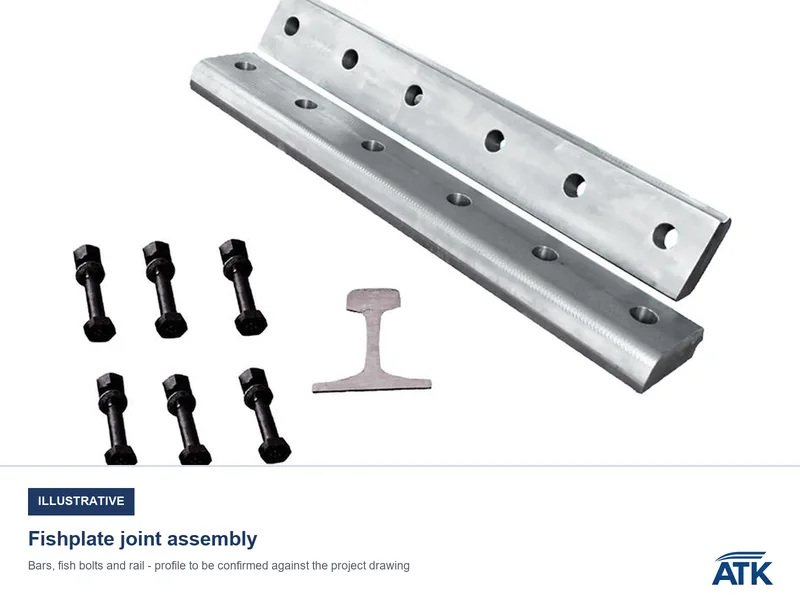
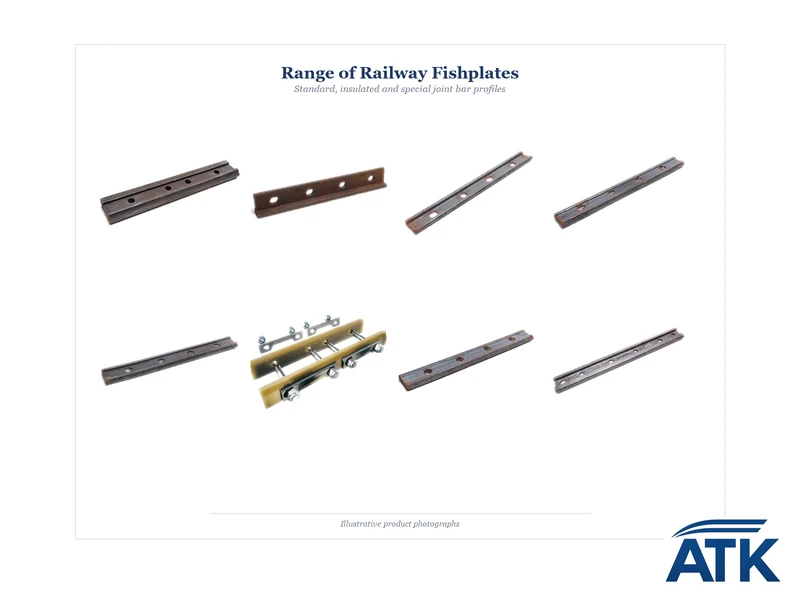
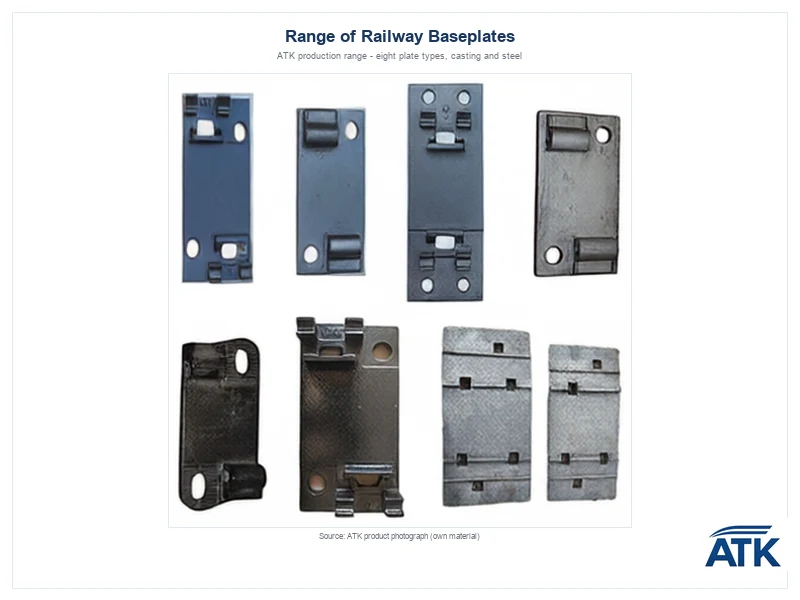
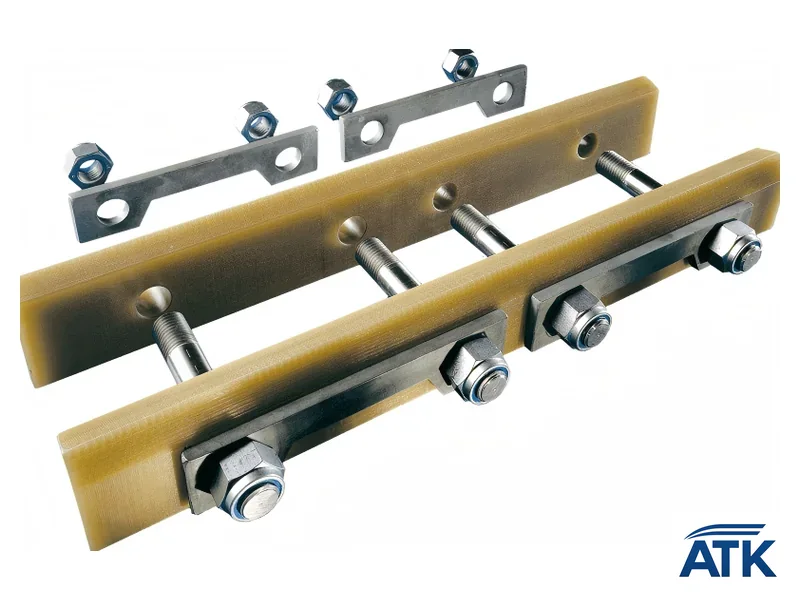
For the clip and baseplate that complete the assembly, see rail joints and fishplate products.
A pad installed badly performs like a cheaper pad. The support surface has to be clean, dry and free of weld spatter, burrs and projecting bolt heads before the strip is laid down. Steel beneath a continuous pad is normally left unpainted where the pad seats: paint is a layer that can shear, and a pad that slides on paint will not stay under the rail.For a continuous run, keep each installed piece long enough to span at least three clip pairs: a short offcut cannot spread the load into the support, and its ends will lift. Debris trapped under the strip creates a hard point, and a hard point under a wheel becomes a fatigue crack in the soleplate.
Set the rail on the pad and check that the foot bears along the full width before the clips are tightened. Then bring the clips down evenly. A resilient pad is not a spacer to be compressed as far as the bolt will go. The clip has to hold the rail with a controlled vertical force. That force keeps the pad seated and still leaves it free to flex under the wheel. If the clip nose is fouling the pad edge, the pad is too wide or lying off-centre, and tighter bolts will not fix it.
Where the rail is welded on the runway, protect the pad from the heat of the weld. Either withdraw the strip from the weld zone or place a thermal barrier over it; rubber damaged by welding heat does not recover, and the damaged section will be the first place the pad tears.
After the first period of service, walk the runway and check four things. Look for sideways movement, a change in rail height, a flattened groove face where the wheels run, and loss of clip preload. Record what you find. A pavement-style "replace every N years" rule has no basis here; the condition of the pad and the duty of the crane decide.
It sits between the rail foot and its support and spreads the wheel load over a wider area. It also absorbs small irregularities in the support, damps vibration and noise, and — where the project requires it — contributes electrical insulation. Removing it does not just make the runway noisier; it changes the load path into the girder.
Not from one stock width. The foot widths are 120 mm and 150 mm respectively, and the pad is made slightly narrower than the foot it serves. A pad cut for a QU70 will leave part of a QU100 foot unsupported; a pad cut for a QU100 will foul the clips on a QU70. The rail drawing settles it.
A continuous pad runs along the rail and suits a steel soleplate or continuous support. An individual pad is cut to one discrete soleplate. They can use the same compound, but they are not interchangeable layouts — the support condition decides which one belongs on the runway.
When the runway sees significant lateral force — braking, skewing, guide rollers, or high side thrust on curves — and the design calls for the strip to resist sideways squeeze. It is a separate construction with a bonded steel insert, supplied only when the order and drawing include it. Do not assume a quoted pad is steel-backed because the catalogue shows one.
Hardness has to be stated with the test method and the project requirement behind it. A Shore A number on its own is not comparable between suppliers, and a harder pad is not automatically better: too hard and it stops protecting the support, too soft and it extrudes sideways. Ask what the clip was designed to preload.
There is no reliable fixed term. Life depends on duty class, wheel load, climate, alignment and maintenance. Inspect for permanent thinning, cracking at the groove roots, loss of edge shape, hardening, oil swelling and sideways movement, and replace on condition. Any "X years" figure quoted without those inputs is a marketing number.
Test methods are covered by the EN 13146 series; EN 13146-9 addresses static and dynamic stiffness of rail pads, baseplate pads and assemblies. In China, GB/T 21527-2008 covers elastomer pads for rail transit fastening systems. EN 13481 is a performance-requirement series for fastening systems, not a certificate a single pad can hold. Ask for the assembly type-test evidence and the pad's own batch records.
Not as a like-for-like substitution. Crane runways have higher wheel loads at lower speeds and much more starting and braking force. The compound, thickness and reinforcement are chosen for that loading. A pad specified for a light-rail or main-line track has not been checked for it.
The rail section and foot width, the soleplate and clip drawing, whether the support is continuous or discrete, the duty class and crane capacity, the site temperature and oil or chemical exposure, and whether the joint is insulated. A photo of the existing runway helps, but it cannot replace the dimensions.
Continuous strip is normally cut with a saw to the rail length, following the installation rule for the system. Keep pieces long enough to span several clip pairs. The cut end should be square and clean; a torn or tapered end leaves a soft spot under the rail.
Send the rail designation with its profile drawing, the soleplate and clip drawing, and the measured foot width if the rail is already installed. State whether the support is a continuous steel soleplate, a girder flange or discrete soleplates, and give the crane duty class, rated capacity and the site temperature range. Where oil, salt, radiant heat or an insulated circuit is involved, say so in the first message.
For a steel-backed pad, confirm that the design calls for a bonded steel insert and state the bond inspection expected. If a drawing is not available, send the pad thickness, hardness result with its test method, groove pattern, cut length and photographs of the existing seat.
Quotations are made to the confirmed drawing, and anything left open in the enquiry is stated as an assumption on the quotation rather than buried in it. For a specific runway, use the Contact Us page.
We have recommended some of our Related products to you. I hope you will be interested.
 English
 Русский