
Crane rail pads are chosen for the support condition and the duty, not by crane size or rail designation
Continuous pads suit continuous soleplates; individual pads suit discrete support points
Specify a steel-backed pad for braking, skewing, guide rollers or curve thrust - not as a default upgrade
Pad thickness follows wheel load, support, clip deflection and compound together; a copied number transfers nothing
Pad width follows the measured rail foot: QU70 and QU100 are 120 mm and 150 mm, not the head widths
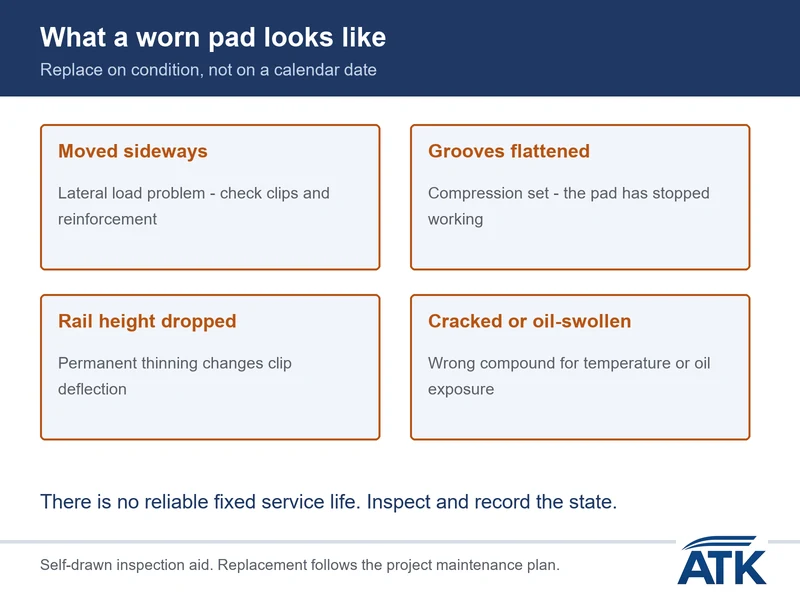
There is no fixed service life - inspect for sideways creep, flattened grooves, thinning and oil swelling
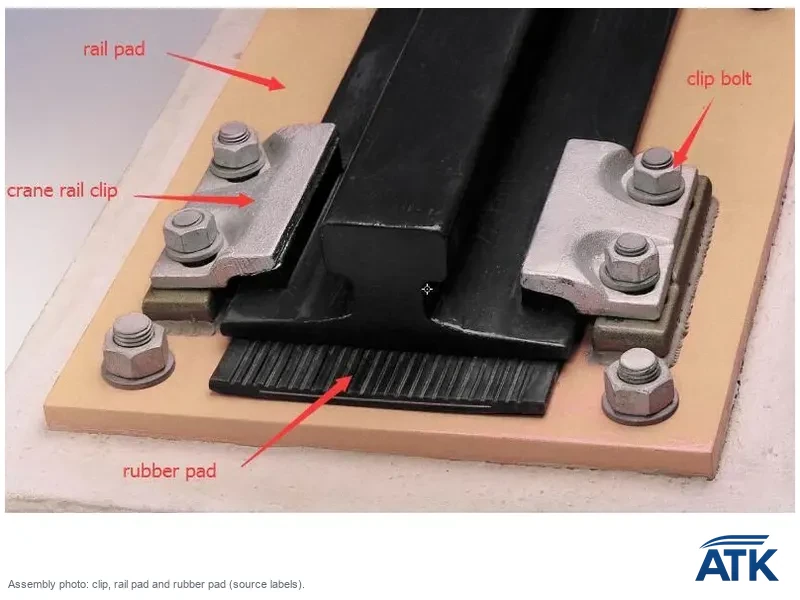
A crane rail pad is the elastomer layer between the rail foot and whatever carries it — a steel soleplate, a girder flange, or a concrete support. It is a small part of the runway and a decisive one. The wheel load reaches the structure through this layer, so the pad decides whether that load is spread evenly across the foot or concentrated at a high spot that cracks the grout and loosens the clips.Where this part sits relative to a sole plate or shim is explained in crane rail sole plate, baseplate or rail pad.
Buyers often describe it as "the rubber under the rail," which is true but incomplete. It also absorbs the shock of starting and braking and damps structure-borne noise. It keeps the rail electrically separated from the girder, and acts as the sacrificial wear face — wearing before the rail foot or soleplate does, at a fraction of their replacement cost.
That is why selection is a purchase decision, not a catalogue lookup. The same rail can sit on a soft pad that quiets a workshop crane and on a stiff reinforced pad that keeps a heavy port runway in line. Both are "a pad for that rail." Only one is right for the duty.
This guide is about choosing between them — what the types are, and when the steel-backed version earns its cost. It also covers how to think about thickness without copying a number from a competitor's table, and what to check before a batch is ordered. The products, their construction and inspection are set out on the crane rail rubber pads product page. The decision is where this guide begins. Everything below is written for buyers choosing crane rail pads, not for engineers designing the elastomer.
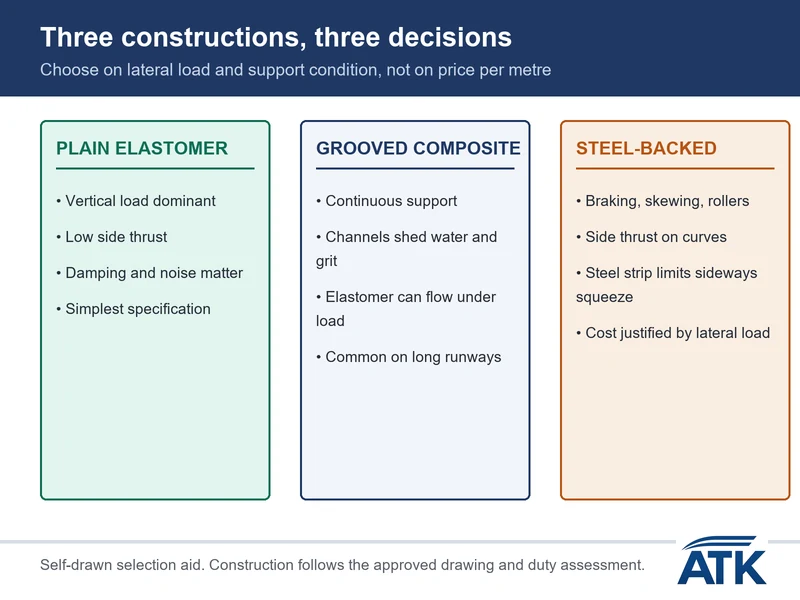
The rail pad types that cover almost every runway are set out below, and the choice is decided by the support, not by the crane.
Criterion | Plain pad | Grooved composite pad | Steel-backed pad |
Construction | Single elastomer layer | Shaped running face with channels | Elastomer bonded to a steel insert |
Stiffness as load rises | Broadly constant | Rises as the channels close | Set by the insert, least deflection |
Fits best where | Light to medium duty, continuous support | Medium to heavy duty, vibration-sensitive runways | Braking, skewing, guide rollers, curve thrust |
Gap left for a shim | Widest tolerance to level correction | Moderate | Least — the insert does not compress |
Failure signature | Thinning, creep, oil swell | Flattened grooves, cracks at groove roots | Debonding at insert edge, edge crushing |
Wrong choice when | Heavy wheel loads on discrete plates | Clip deflection is already at its limit | Used as a default upgrade with no thrust problem |
A continuous pad is supplied as a long strip that follows the rail for its full run. It belongs under a continuous steel soleplate or a continuously grouted support, where the whole foot is carried along its length. Heavy wheel loads and long runways favour it because there are no gaps between pads for the rail to bridge. A grooved upper face is common on this form; the channels give the elastomer somewhere to flow under load and help shed water and grit from the seat.
An individual pad is a single piece sized to one plate. It belongs where supports are discrete — one plate per clip station — and it suits lighter duties and layouts that need to be opened up for adjustment or replacement. Its ends are often raised so the pad locates on the plate during fitting. Individual pads are not a cheaper continuous pad: they solve a different support condition.
Within either form there is a second division that matters more at the enquiry stage: plain elastomer, or elastomer with an internal steel strip. The next section deals with that.
The practical question to ask is therefore not "which pad is best" but "is my rail continuously supported or supported at points." Once that is answered, the form follows. A pad bought in the wrong form cannot be corrected by changing its hardness.
Support condition | Pad form | Reason |
Continuous soleplate running the full length | Continuous strip | No joints for the pad to catch, and load spreads along the plate |
Discrete soleplates at each clip station | Individual pad, punched to the plate hole pattern | A strip would bridge the gaps and be crushed at the unsupported edges |
Rail seated directly on a girder flange | Continuous strip; steel-backed where thrust exists | The flange edge is a hard line — the pad must not overhang it |
Rail on a grouted concrete beam | Continuous strip | Grout gives a flat seat, so individual pads add nothing |
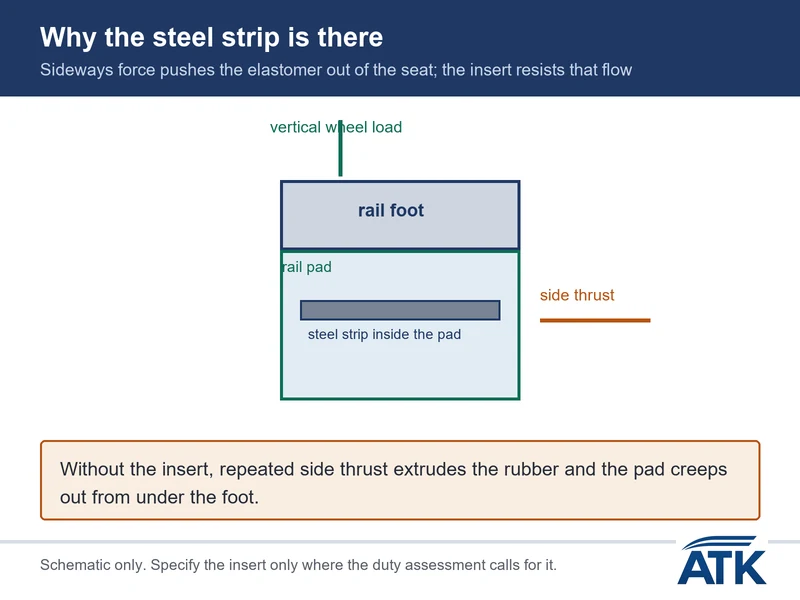
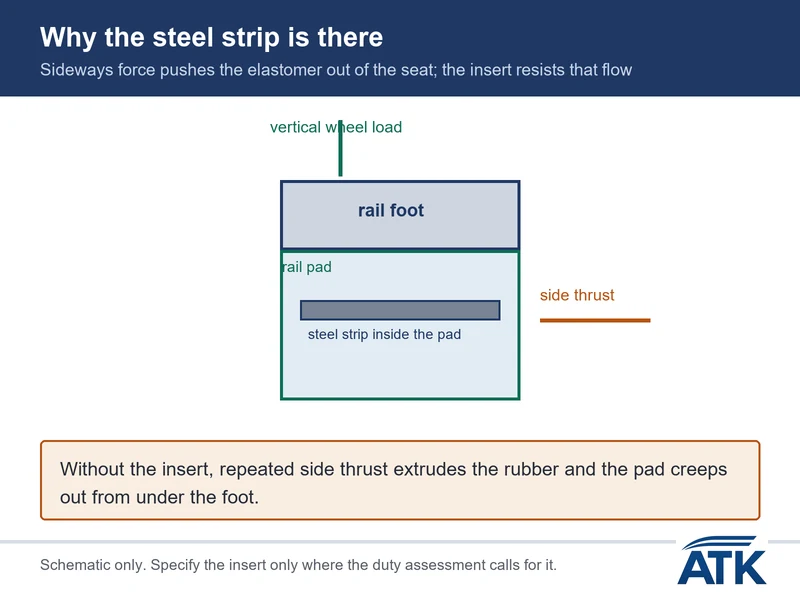
The steel-backed pad exists for one reason: under high lateral load, plain elastomer squeezes sideways out of the seat. A crane that skews, brakes hard, or runs against guide rollers puts force across the rail, not just down through it. A steel strip vulcanised into the pad resists that sideways flow and keeps the pad where it was placed.
That does not make steel-backed the premium choice for every runway. It makes it the right choice for a specific condition.
Choose a plain rubber pad where the load is mainly vertical, side thrust is low, and the support is even — typical of indoor cranes, light-duty runways and situations where damping and noise matter more than lateral stability. Plain pads are simpler, and on the right job they are sufficient.
Choose a steel-backed rubber pad where the runway sees braking, skewing, guide rollers, curve side thrust, or high wheel loads on a short bearing area. The steel is inside the elastomer, not a plate bolted under it; the pad still behaves as a resilient layer. Where the order does not call for that construction, the pad is supplied without it. It is a specification, not an upgrade that comes with every product.
The test at the enquiry stage is simple: describe the sideways action on the runway. If nobody can describe it, the steel strip is being specified by habit rather than by need.
Crane rail pad thickness is the question buyers ask most and the one that cannot be answered by rail designation. Search results will offer a 3–6 mm pad here, a 5–12 mm range there, and a single "general" thickness somewhere else. Those figures belong to different compounds, different wheel loads and different support stiffness. None of them is a standard, and none can be transferred to your runway by matching the rail number
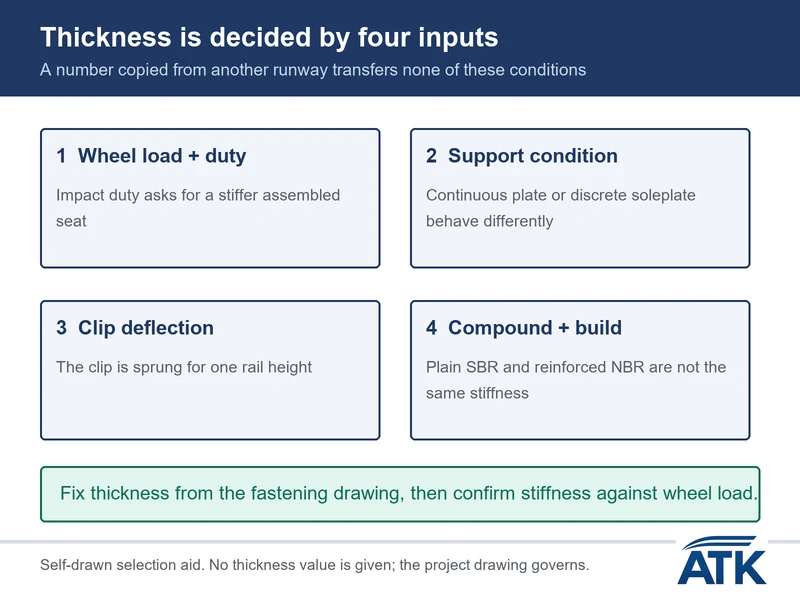
Thickness is settled in one order, and the order is the point. Wheel load sets the minimum. The support — continuous or discrete — sets how that load is distributed. The clip and its working deflection set the maximum, because the clip is sprung for a rail height. The compound then decides how much of that range is actually usable.
Thickness sets how much the pad deflects under the wheel and therefore how the load is shared with the clip. A pad that is too soft lets the rail move, which fatigues the clip and lets the joint pump. A pad that is too hard gives back almost no damping and concentrates load at any high spot on the soleplate. Both failures look like a fastening problem on site, and both start with a thickness chosen from a catalogue.
Rail pad selection is made from four inputs, in this order:
- Wheel load and duty class — the starting point. Higher loads and impact duty ask for a stiffer assembled seat, not simply a thicker pad.
- Support condition — a continuous soleplate and a single plate under each clip behave differently under the same pad.
- Clip design and its working deflection — the clip is sprung for a particular rail height. Change the pad thickness and the clip toe load changes with it.
- Compound and construction — the same thickness in a plain SBR pad and in a steel-reinforced NBR pad does not give the same stiffness.
The stiffness of an elastomer is load-dependent, and the static figure in a datasheet is not the dynamic stiffness the runway sees under passing wheels. This is why a thickness recommendation needs the duty, the clip and the compound together — a number on its own is not a specification.
Two details catch buyers out here. A grooved pad of the same nominal thickness is softer than a plain one, because the channels remove material from the load path; swapping the two without re-checking the clip load is a real mistake. And where the runway has to be electrically separated from the girder, a very thin pad can be punctured by scale or a burr on the rail foot. The thickness has to keep that insulation intact, not just carry the load.
Thickness also belongs on the drawing with a tolerance and a stated measurement condition. Rubber is measured after conditioning, and a figure from one supplier's datasheet is not automatically comparable with another's. Stiffness is a property of the assembled fastening, not of the pad in isolation, so it is the assembly that has to be checked.
The safe route is to fix the thickness from the fastening assembly drawing, which already accounts for clip deflection and rail height, and to confirm the required stiffness with the pad supplier against your wheel load. If a supplier quotes a thickness without asking about wheel load or clip type, the quote is a guess.
A good pad installed badly performs like a cheaper one. Most site problems trace back to the seat rather than the compound.
Start with the support. A steel soleplate or girder flange must be clean and dry, with weld spatter, burrs and protruding bolt heads removed. A single projection under a continuous strip creates a hard point that the pad cannot bridge, and the rail will rock on it. On concrete, the grout or levelling layer must have reached its strength and be flat before the pad is laid.
Lay the pad so it sits fully under the rail foot without projecting far enough to be crushed at the edge, and without leaving the foot overhanging a gap. For continuous strip, cut with a saw to the run length and avoid short offcuts that cannot span several clip pairs. Line the joint up before the rail comes down; a twisted strip stays twisted under load.
Bring the clips down progressively across the group and recheck the level after the first pass — the pad and the grout both bed in as load comes on. Tightening to a figure copied from another assembly is a common mistake: the torque that gives the right preload depends on the pad thickness and stiffness as well as the bolt. Use the figure in the project's installation instruction.
On a walk after the runway has taken traffic, check four things. The pad has not crept sideways. The rail height has not changed. The grooved face is not flattened where the wheels run. The clips still hold their load.
The rail number is a designation, not a pad width. QU70 is 70 mm across the head but 120 mm across the foot; QU100 is 100 mm at the head and 150 mm at the foot; QU120 is 120 mm and 170 mm respectively. A pad is sized against the foot, because that is the face it supports.
This is the most common source of a wrong order. A buyer who reads "QU100" and orders a pad by the head width gets a strip far too narrow for the foot. A buyer who assumes QU120 uses the same pad as QU100 misses a 20 mm difference in foot width alone
Measure across the foot at the line where the clip toe actually lands, not at the widest point of the base. Those two lines are not the same, and a pad that covers one but not the other lets the toe pinch the pad edge — preload then goes into rubber instead of steel.
The compatibility rule is therefore about fit, not interchangeability:
- The pad must cover the foot without projecting so far that the clip or the wheel path loads its edge.
- The pad width follows the measured foot of the installed rail, not a catalogue table, where an existing runway is being relined.
- The hole pattern, if the pad is pre-punched for individual plates, follows the soleplate drawing.
- The rail section, the clip and the pad are reviewed together: changing one changes the height stack.
Standard sections give a starting point, not a release to manufacture. Confirm the foot width from the rail drawing or by measurement, and treat that number as the input to the pad order.
Most pad failures announce themselves before the pad is destroyed. Knowing what to look for turns a replacement decision into a planned job rather than an unplanned stop.
The pad has moved sideways. A strip that has crept out from under the foot is a lateral-load problem, not a pad-quality problem. Check the side thrust, the clip seating and whether a plain pad was specified where a reinforced one was needed.
What you see | What it usually means | What to do first |
Pad crept out sideways from under the foot | Side thrust exceeds what the clips resist | Check clip preload and side thrust before replacing the pad |
Grooves flattened, face hardened | Heat and age; stiffness has risen | Replace, then re-check rail level |
Permanent thinning under the foot | Load beyond the pad range, or support moved | Review thickness and support together |
Oil swelling at the edge | Contamination, or water sitting on the plate | Fix drainage before changing compound |
Debonding at the steel insert edge | Edge crushing or shear at the insert | Check plate flatness and pad overhang |
The grooved face has flattened in the wheel path. The channels are there to give the elastomer room to flow and to shed contamination. A section worn smooth under the running band means the pad has taken its compression set and has stopped doing its job.
The rail height has dropped. Permanent thinning under load reduces the assembled height and changes the clip deflection. Measure it rather than judging by eye; a few millimetres is enough to matter to the fastening.
The surface is cracked or oil-swollen. Cracking at the roots of the grooves points to a compound unsuited to the temperature or to ozone exposure. Swelling and softening point to oil or grease in an SBR pad that should have been an oil-resistant grade.
A joint pumps even though the bolts were torqued. The pad is only one part of that assembly. Look at the hole condition in the bar, the seating of the clips and the level of the support before replacing the pad.
There is no honest fixed service life. Life depends on wheel load, duty class, climate, alignment and maintenance, and any supplier quoting a single number without those inputs is guessing. Inspect for the conditions above and replace on state, not on a calendar.
Nearly every pad is made to the runway rather than pulled from a shelf by crane size. An enquiry that carries the right information can be priced once; one that does not will come back with questions.
Send these items:
- the rail designation and its profile drawing, or the measured foot width on an installed runway;
- whether the support is continuous or a set of individual soleplates;
- the soleplate and clip drawing, so the pad width and any pre-punched holes match the plate;
- wheel load, crane duty class and whether the runway sees braking, skewing or guide rollers;
- site conditions: temperature range, oil or grease exposure, salt air, UV;
- the pad form — continuous strip or individual — and the compound you want, if already specified;
- whether an internal steel strip is required by the design, with the reason;
- any hardness, stiffness or test requirement named by the project, with its test method;
- the quantity, the length of run and the inspection documents expected with delivery.
A photograph of the existing pad helps locate it, but it cannot carry dimensions or a compound specification. If the level survey or the clip drawing is not yet available, say so — the quotation can state the assumption instead of quietly pricing a pad that will not fit.
For the clip and soleplate that sit above the pad, see crane rail clips and welded rail clamps. For the steel plate underneath, see crane rail sole plates and height adjustment shims.
The material family is similar, the duty is not. A crane runway carries high wheel loads at low speed, with frequent starting, braking and skewing. A mainline pad is designed for a different load and speed regime. A railway pad is not a like-for-like substitution on a crane runway.
No. Their foot widths are 120 mm and 150 mm. The pad is made to the foot it supports, not to the number in the rail designation.
No. Thickness changes stiffness and clip deflection together. A pad chosen only for softness can let the rail move and fatigue the clips. The value has to suit the assembly, not just the noise target.
No. The grooves remove material from the load path, so a grooved pad of the same nominal thickness is softer than a plain one. They are not interchangeable without re-checking the clip load and the rail height.
When the runway puts significant force across the rail — braking, skewing, guide rollers or curve thrust — and the pad must resist sideways squeeze. Where that action is absent, a plain pad is usually sufficient.
State the test method alongside any hardness value, and say which project requirement it answers. A figure quoted without those two things cannot be compared across suppliers, and raising hardness is not the same as improving the pad.
There is no reliable fixed term. Look for permanent thinning, cracks at the groove roots, a hardened face, oil swell and creep. Replacement follows what the inspection finds.
Continuous strip is normally cut with a saw, following the installation rule for the system. Keep each piece long enough to span several clip pairs.
Yes. Hole positions follow the soleplate drawing, not a standard pattern. Send the plate drawing with the enquiry.
Can a steel-backed pad be drilled on site?
No. The insert is bonded into the pad, and drilling breaks that bond and leaves bare steel at the hole edge. Send the plate hole pattern with the order instead.
Will oil or standing water damage the pad?
It depends on the compound, and the sign is swelling at the edge rather than a sudden failure. Fix the drainage and the seating first; a pad replaced on a plate that still holds water will fail the same way.
Send the rail section with its foot width, the support condition, the clip and soleplate drawings, the wheel load and duty class, and the site environment. State whether the pad should be continuous or individual and whether the design calls for an internal steel strip. If a hardness, stiffness or inspection requirement applies, name it with its method. Where a value is still open, say so — the quotation will carry it as an assumption rather than hide it. For a specific runway, use the Contact Us page.
We have recommended some of our Related products to you. I hope you will be interested.
 English
 Русский