
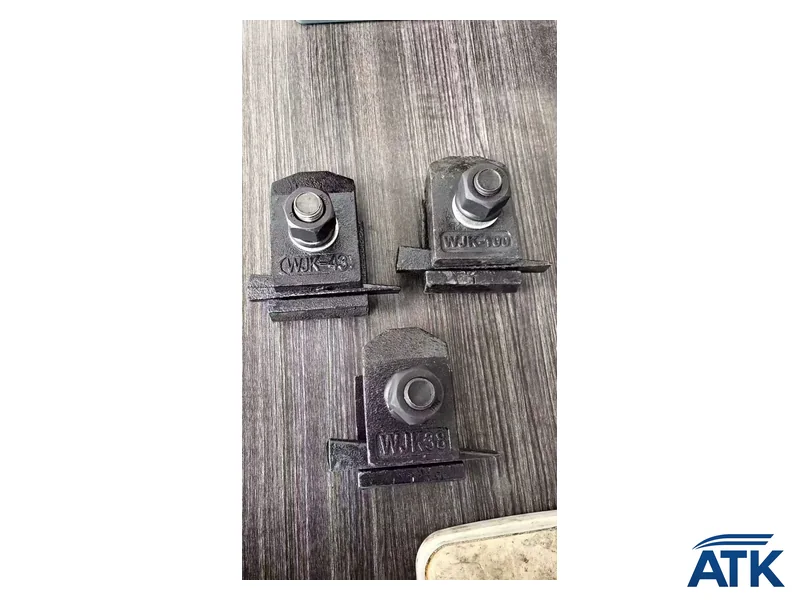
Welded crane rail clips to 23G525 for QU70 / QU80 / QU100 / QU120 and TG38-TG60 rails
Q235 / Q345 cast steel base and top cover with Grade 8.8 T-bolts
Maximum lateral load 45-55 kN per wheel load point
Wedge-adjusted gauge, spherical T-bolt seat, self-locking assembly
Bolt torque 150 N·m medium duty / 220 N·m heavy duty, clip pitch 600 / 500 mm
Single-bolt and double-bolt plates, low-height SWJK and reinforced HWJK versions
Plain, black oxide, zinc plated or hot-dip galvanised finish
Trial production to your rail section, girder width and crane duty class
Crane rail clips hold the rail foot to the sole plate or bearer. WJK and SWJK are standard fixed assemblies for QU70–QU120 and TG38–TG60 rails in Q235 or Q345; welded clamps and bolted types are used where the rail is adjusted or replaced often. Selection depends on rail section, lateral load and whether the runway needs frequent realignment.
Crane rail clips are the cast assemblies that hold a crane rail down onto a steel runway girder. Each clip has to do three jobs at the same time. It clamps the rail foot to the girder, it carries the sideways push from the crane wheels into the supporting steel, and it still lets the rail grow and shrink lengthways as the temperature changes. A mainline railway fastening is elastic and comparatively light. A crane runway is different: the wheel loads are concentrated, the flanges hit the rail sideways, and the fixing has to be a bolted or welded steel component rather than a spring clip. A clip is one link in a longer chain. The pad under the rail, the plate under the pad and the bolts that preload the assembly all limit what the clip can do, and the full chain is set out in crane rail fastening system.
Type | Standard | Rail section | Material | Basis |
WJK | JB/T 10543-2018 | QU70–QU120; TG38–TG60 | Q235 / Q345 | By drawing and technical agreement |
SWJK | JB/T 10543-2018 | Low-profile runway | Q235 / Q345 | By drawing and technical agreement |
Welded clamp | 23G525 | Steel crane girder | Q235 / Q345 | Weld procedure to approved drawing |
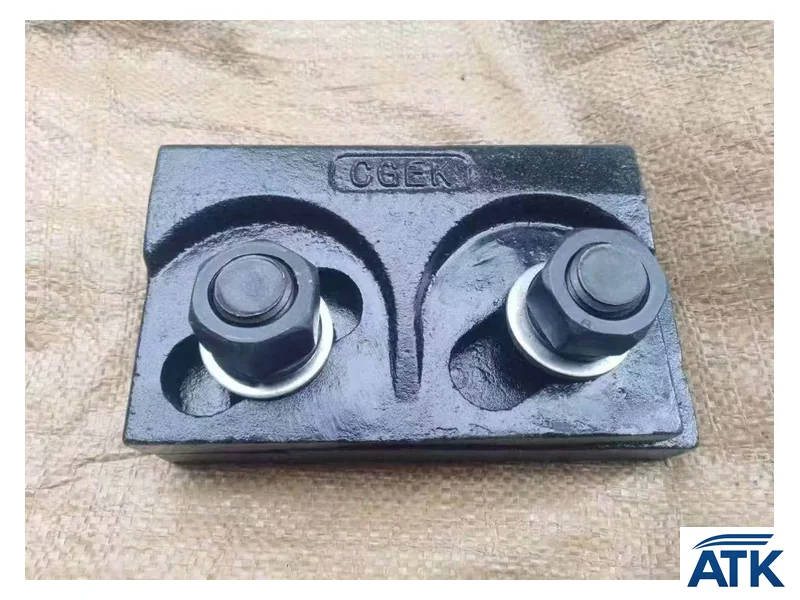
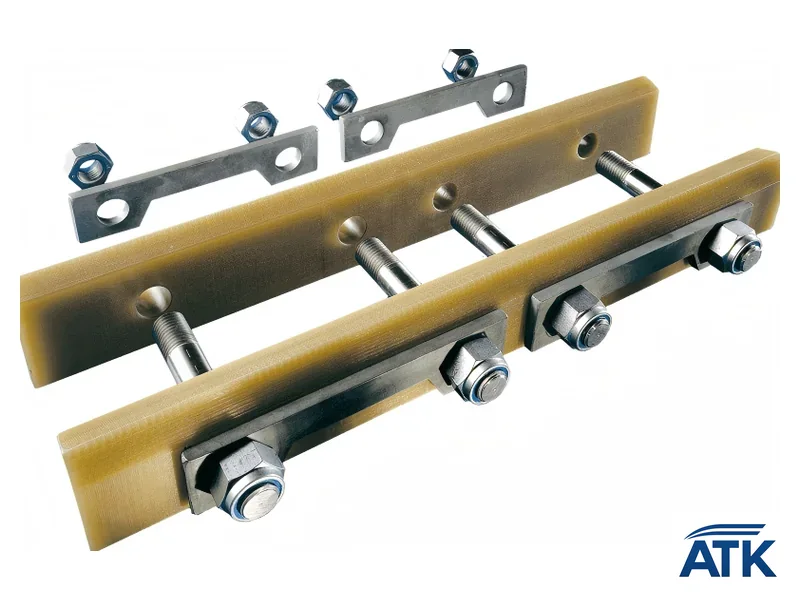
The WJK-type welded clip is the version most often used on steel crane beams. Its base is welded to the top flange of the girder, so no holes are drilled through the beam and the girder section is not weakened. A T-bolt, a wedge adjusting plate and a top cover sit on that base. Tightening the nut pulls the cover down onto the rail foot. The lower end of the T-bolt sits in a spherical seat in the base, so the bolt can lean a few degrees when a horizontal impact arrives instead of taking the load in bending. That one detail is why this design survives heavy-duty crane service.
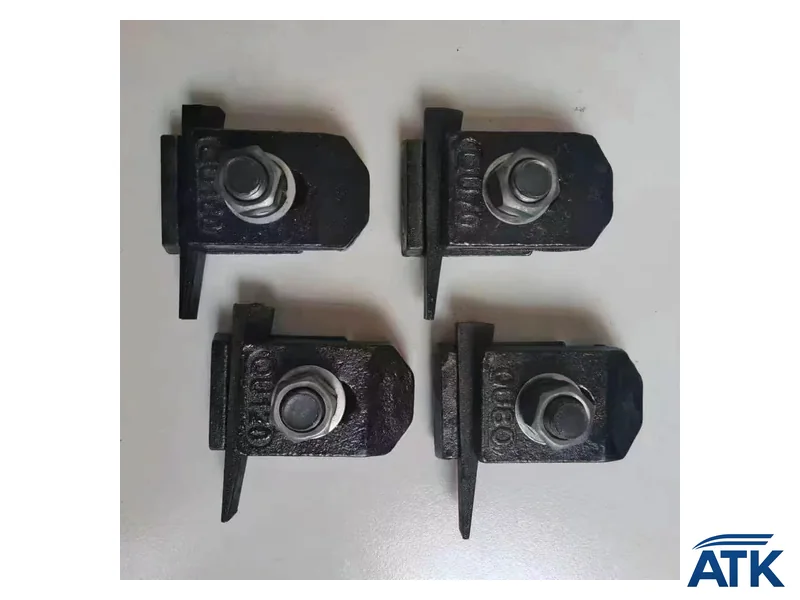
Clips are installed in pairs, one on each side of the rail, at a fixed pitch along the runway. The rail is not rigidly locked: the clip resists movement across the track but allows a small amount of movement along it. On runways with a resilient pad under the rail, that controlled float is what keeps the pad from working its way out. The pad that makes this float possible is its own specification - material, thickness, width against the rail foot and inspection basis. See crane rail rubber pads for how that layer is chosen.
Buyers arrive with several names for this part. In crane runway work, crane rail clip and crane rail clamp mean the same assembly; rail clip on its own can also mean an elastic spring clip on a railway sleeper, which is a different product. Those differences are set out in the rail clip terminology guide; this page uses clip for the crane runway part and keeps clamp only where a supplier catalogue uses it.
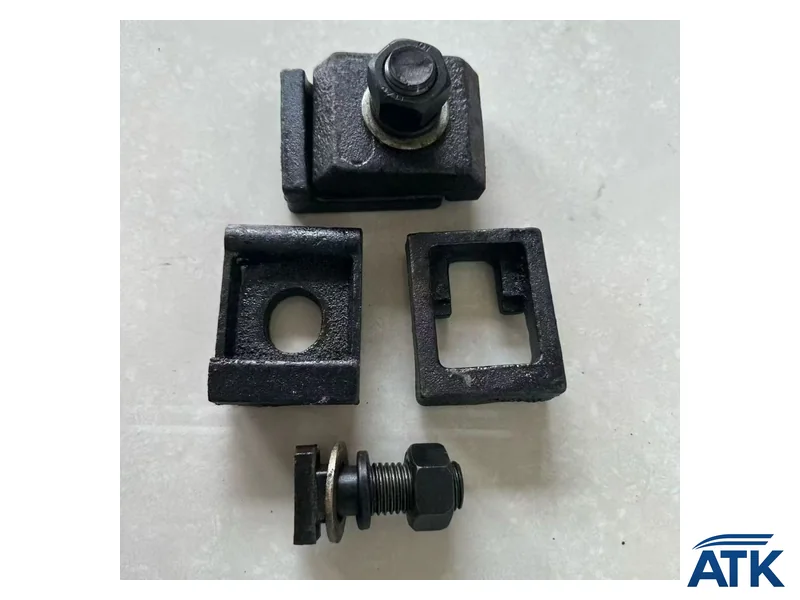
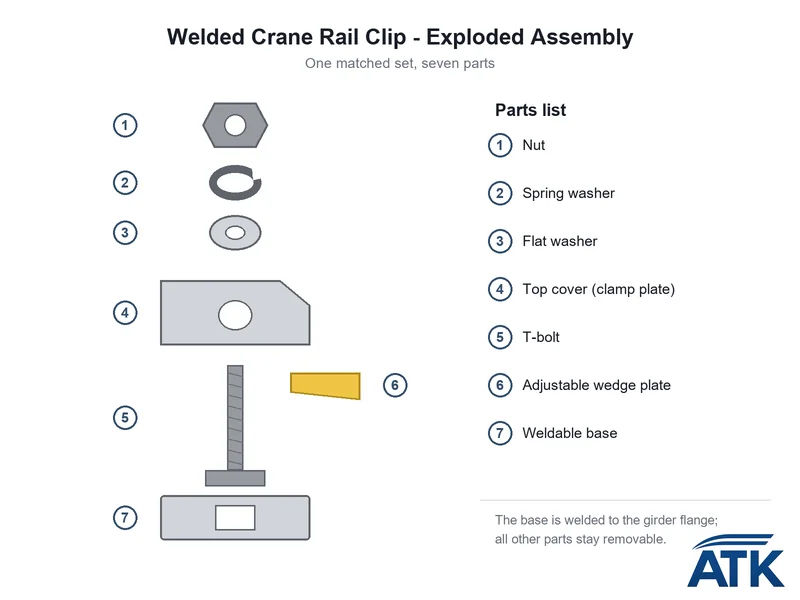
A clip is sold as a matched set, not as a single plate. The standard welded assembly has seven parts:
1. Base plate (weldable, sits on the girder flange)
2. Top cover or clamp plate, profiled to match the rail foot
3. Adjustable wedge plate for gauge setting
4. T-bolt with a spherical lower seat
5. Nut
6. Spring washer
7. Flat washer
Some specifications call the wedge plate a pin or an adjusting plate; the function is the same. The washers are not optional hardware. A spring washer holds preload when the crane brakes and starts, and a hardened flat washer spreads the nut load so the cover is not brinelled. Where the rail sits on a resilient pad, an elastomeric nose or a composite rubber pad is added to the set. On a bare steel girder the rail is hard-mounted and the pad is omitted.
A welded crane rail clip is made in a fixed route: lost-wax pattern, casting, annealing, machining, welding, assembly and inspection. The route is chosen because the clip is a convoluted steel shape with a seat, a wedge slot and lugs that would be expensive to cut from plate.
The base, top cover and wedge are normally investment cast, then annealed to relieve casting stress before any machining. Machining brings the rail-contact face and the wedge face flat; those two faces decide whether the assembly holds preload after months of braking loads. Casting dimensional tolerance is read against GB/T 6414 (CT6) where the drawing names it. A porous casting or a wedge face that was not machined flat will relax in service - casting quality matters more than the number of parts in the set.
The base is then welded to the girder flange or an embedded plate. The electrode has to match the base steel: E4315 for Q235, E5015 for Q345, both low-hydrogen. Medium-duty cranes (A4-A5) take a two-side weld; heavy and extra-heavy duty cranes (A6-A8) take a three-side weld. The weld is the fatigue source in this assembly, so its size and appearance are checked against the duty class rather than treated as decoration.
Assembly is the last step: T-bolt in its spherical seat, wedge with the grooved face upward, then top cover, flat washer, spring washer and nut in that order. The spring washer is not optional hardware; it holds preload when the crane brakes and starts. Every step above is confirmed against the approved drawing and the order - the route and the acceptance criteria are not universal across rail sections.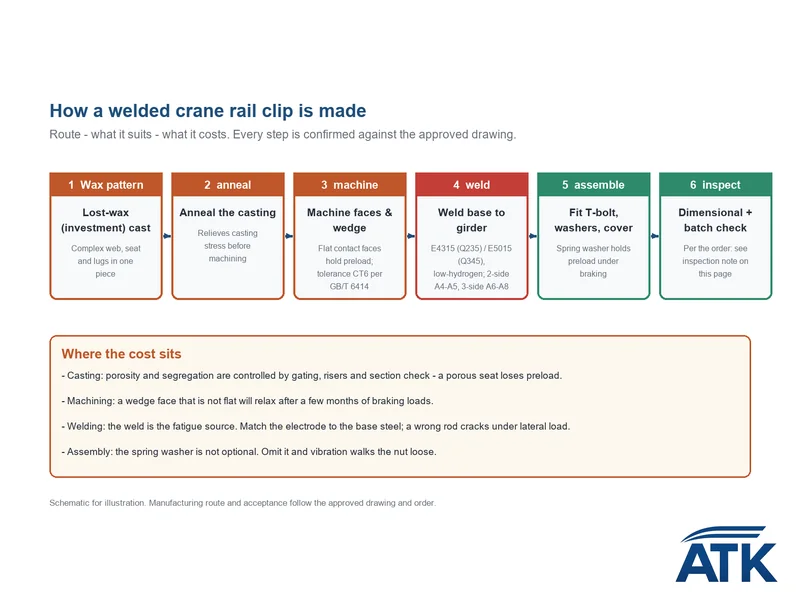
Inspection has to be described at two levels, and the two are often confused in supplier literature. One level is the individual component; the other is the complete fastening assembly. They are not the same test object and one does not certify the other.
On the components supplied, inspection covers material, mechanics, dimensions and finish. Material is confirmed by heat or melt certificate - chemistry and grade such as Q235, Q345 or ZG270-500. Tensile properties and hardness are checked where the drawing calls for them. Dimensions are checked against the approved drawing, with casting tolerance read to GB/T 6414 (CT6) where named and machined faces and hole positions measured against the drawing. Coating type and thickness are checked to the specified finish. The weld is checked for appearance and size against the duty class.
The second level is the assembly type test. European fastening test methods such as EN 13146 apply to the complete fastening assembly - the clip, baseplate where relevant, rail and support built as they will be used in track. Clamping force, longitudinal restraint, rotation resistance and stiffness are assembly results; they are not numbers that belong to a single clip or plate. EN 13146-7, for example, states that the procedure applies to a complete fastening assembly and is not applicable to an embedded-rail system or to a system that does not act on the rail foot.
That distinction matters when a datasheet claims a single clip or plate is "certified to EN 13146". It is not a valid statement: a component has no independent compliance to an assembly standard. What a buyer should ask for is the assembly type-test report, together with confirmation that the tested specimen matches the rail section, pad and support on the project. On this page, dimensional and batch inspection records, material certificates and a certificate of compliance to the named standard are described as supplied per order - they are not presented as ATK test results for a named batch.On the girder, those document checks turn into site checks: flange width before welding, wedge setting before torque, weld acceptance and pad contact. The crane rail clip installation and inspection checklist sets them out in working order, with the records a handover review will ask for. When a clip loosens or a weld toe opens, the cause is rarely the part itself. The crane rail clip failure guide separates seven failure modes and sets out what to check before replacing anything.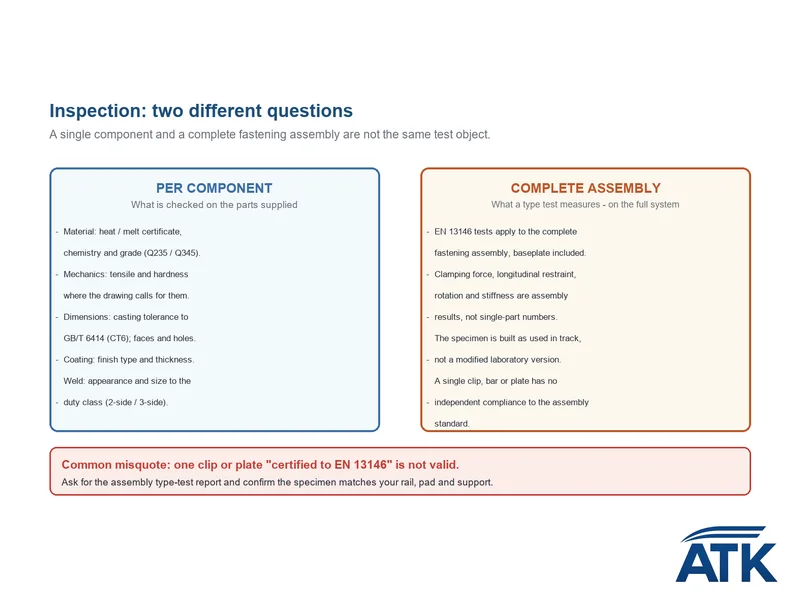
The WJK family covers the heavy rail sections TG38, TG43, TG50, TG60 and the crane rail sections QU70, QU80, QU100 and QU120; some catalogues add TG24 and TG75. Each model number carries its rail section, and the selection table below fixes the dimensions for that section.
Three variations appear in enquiries. SWJK is the compact version, with a lower installed height for runways where the clearance is tight or the crane has horizontal guide rollers.A note on what Series 3 and Series 4 mean in supplier catalogues is in the series guide. HWJK is the reinforced version used with an elastic composite rubber pad under the rail, usually on cranes with a high duty cycle. Suppliers also quote single-bolt welded clips (9116, 9120, 7116, 7120) and double-bolt clips (9216, 9220, 7216, 7220), which are common on imported-style low-profile runways.
The other split is welded versus bolted. A welded base gives the highest lateral resistance and is the usual choice for port container cranes, steel mills and heavy-duty gantries, but it needs a welder, the right low-hydrogen electrodes and a clean girder flange. A bolted clip is easier to replace and re-align, which suits workshops, logistics systems and any site where welding on the girder is restricted. European-style double-wedge clips with a vulcanised rubber nose are a third route; they are adjustable over a wider range and are often specified on projects with an engineer's clip schedule. We supply the welded WJK-type family as standard and can quote the other routes against a drawing.
The figures below are the selection values published in the Chinese national standard drawing 23G525 and in supplier catalogues for the WJK family. They are standard and catalogue values, not ATK test results for a specific batch. Confirm which inspection documents are available for your order when we quote.
Rail section | Clip model | a (mm) | b (mm) | 2e (mm) | 2s (mm) | B = b+2e+2s (mm) |
38 kg/m | WJK-TG38 | 97 | 194 | 124 | 20 (10) | 338 (328) |
43 kg/m | WJK-TG43 | 97 | 194 | 124 | 20 (10) | 338 (328) |
50 kg/m | WJK-TG50 | 106 | 212 | 124 | 20 (10) | 356 (346) |
60 kg/m | WJK-TG60 | 115 | 230 | 124 | 20 (10) | 374 (364) |
QU70 | WJK-QU70 | 100 | 200 | 124 | 20 (10) | 344 (334) |
QU80 | WJK-QU80 | 105 | 210 | 124 | 20 (10) | 354 (344) |
QU100 | WJK-QU100 | 115 | 230 | 124 | 20 (10) | 374 (364) |
QU120 | WJK-QU120 | 125 | 250 | 124 | 20 (10) | 394 (384) |
Item | Standard WJK (Q235) | Reinforced WJK (Q345) | Compact SWJK | Source / note |
Adapted rail sections | QU70/80/100/120; TG38/43/50/60 | QU70/80/100/120; TG38-60 | QU70/80/100/120 | 23G525 selection table |
Base / cover material | Q235 cast steel | Q345 cast steel (ZG270-500 on some specs) | Q345 cast steel | 23G525 note 2; ZG270-500 from catalogues |
Bolt grade | Grade C / 4.8 | Grade 8.8 (45 steel) | Grade 8.8 | 23G525 selection table |
Max lateral load | 45 kN | 55 kN | 40 kN | WJK product data; type-test basis on request |
Bolt torque | 150 N·m (medium duty) | 220 N·m (heavy duty) | per assembly / duty | WJK product data; 23G525 sets the duty class, not the torque |
Clip pitch | 600 mm (Q ≤ 275 t) | 500 mm (Q > 275 t) | per layout | 23G525 spacing rule |
Finish | Plain / black oxide | Zinc plated / hot-dip galvanised | to site environment | chosen for the site, not a price list |
Weld | 2-side A4-A5 (E4315) | 3-side A6-A8 (E5015) | 2-side (E5015) | electrode matched to base steel |
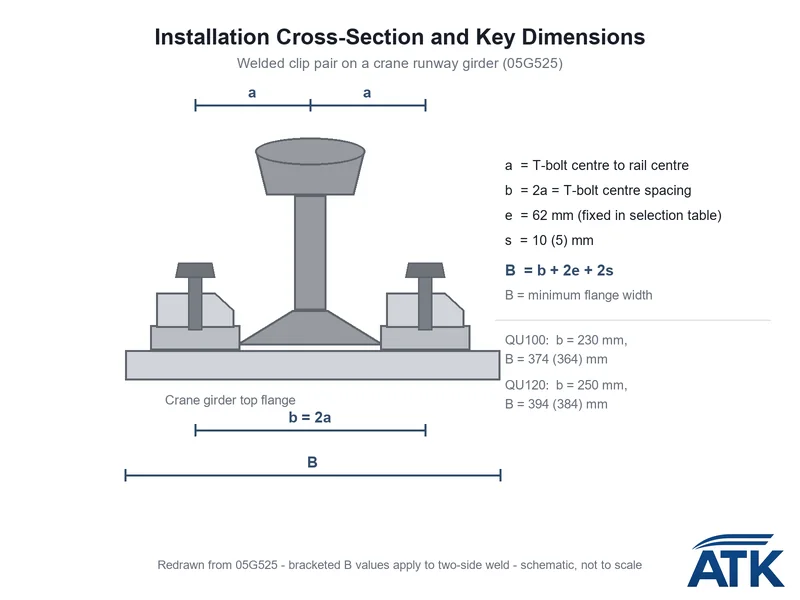
a is the distance from the T-bolt centre to the rail centre, and b is the centre-to-centre distance between the two T-bolts, so b = 2a across the whole family. B is the minimum required width of the girder top flange, excluding the braking system connection; the bracketed figure applies where the base is welded on two sides only.
Parameter | Typical value | Basis |
Washer | Steel flat washer, 100 HV performance class; spring washer 65Mn or 60Si2Mn | Supplier catalogues, GB fastener standards |
Installed height | About 81-85 mm standard, about 71 mm compact (SWJK) | Supplier catalogues |
One number needs a warning. Some marketing pages claim a lateral capacity of 130 kN or more for a welded clip, and imported adjustable clips are rated anywhere from 21 kN to 300 kN depending on the bolt grade and model. Those figures come from different products and different test setups. A standard WJK clip is specified at 45-55 kN in the WJK product technical data; we do not quote a higher number without a matching type-test record.
The main reference for the welded WJK family in China is the national standard drawing 23G525, Crane Rail Connections and Stops. Its selection table fixes the model for each rail section, the a / b / e / s / B dimensions, the base material (Q235 or Q345 cast steel), a Grade 8.8 bolt, the electrode grade, the weld pattern and the clip pitch. It also states that the drawing was compiled from the technical data of the registered WJK product. Torque and lateral-load ratings are not printed on that sheet: they come from the WJK product technical data behind the drawing and from supplier catalogues, which is why we name the source whenever we quote them.
Other references that appear in project documents: JB/T 10543-2018, Rail fasteners for lifting and transporting, which names WJK and SWJK as standard models and is the reference to cite for this family; JB/T 13125, which covers the LHFC, LHTZ and LHSTK series and does not apply to WJK; and GB/T 6414 for casting dimensional tolerance (CT6). Older GB material and fastener standards still govern cast steel, Q235 steel, nuts, flat washers and spring washers. On North American projects, engineers usually work to CMAA and AISE crane runway guidance, which is where the requirement comes from that a clip should allow longitudinal rail float while limiting lateral movement. European projects often name the rail section standard and a clip data sheet with a declared side-load rating instead.
None of these standards makes the clip universal. The rail section, the girder flange width and the crane duty class have to be read together. For where insulated joints belong in the circuit, see the insulated joint location guide.A clip that fits a QU100 rail may still be wrong if B is larger than the available flange, or if the crane has guide rollers and the standard-height cover fouls them. The bolts that hold the rail down follow the same reading; hook-bolt and joint-bolt selection is covered in the crane rail fastening bolts guide.
Port and intermodal terminals are the biggest group. Ship-to-shore cranes and rubber-tyred gantry cranes put high, repeated lateral loads into their runways, and the clip is what keeps the rail gauge stable while the crane travels. When the enquiry also covers the joint, choosing the right joint bar is explained separately. Steel mills are next: ladle cranes, slab handlers and coil cranes run almost continuously, often in heat and dust, so the welded base and a heavy-duty bolt grade are the normal choice. For the rail section that sits under each clip and the fields that decide a quote, see WJK model range and ordering fields.
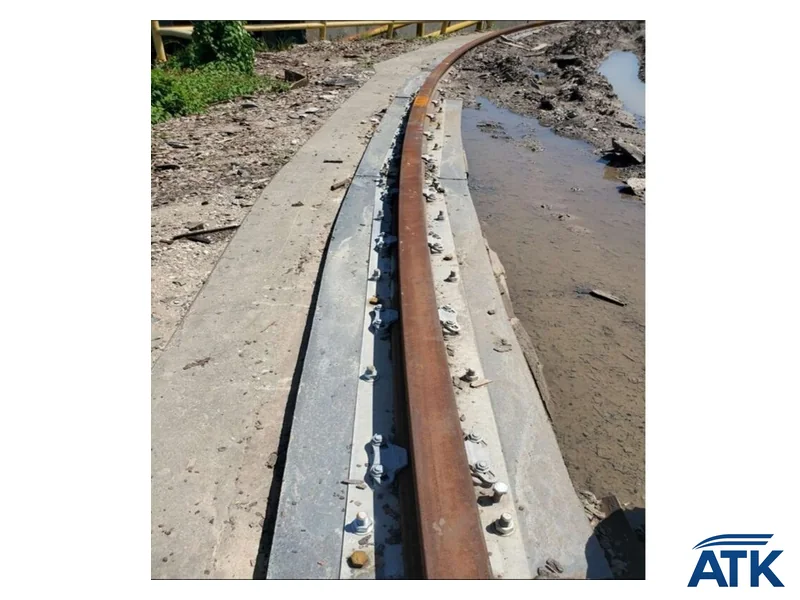
Shipyards and heavy fabrication shops use long gantry runways where alignment tolerances are tight. Warehouses and automated storage and retrieval systems use smaller rail sections but run stacker cranes at high cycle counts, which makes the spring washer and the pad arrangement more important than the raw side-load number. The same clips appear in power plants, mines, transfer cart tracks, ground-level transport rails and the refurbishment of older concrete crane beams where a steel plate is embedded to take the weld.
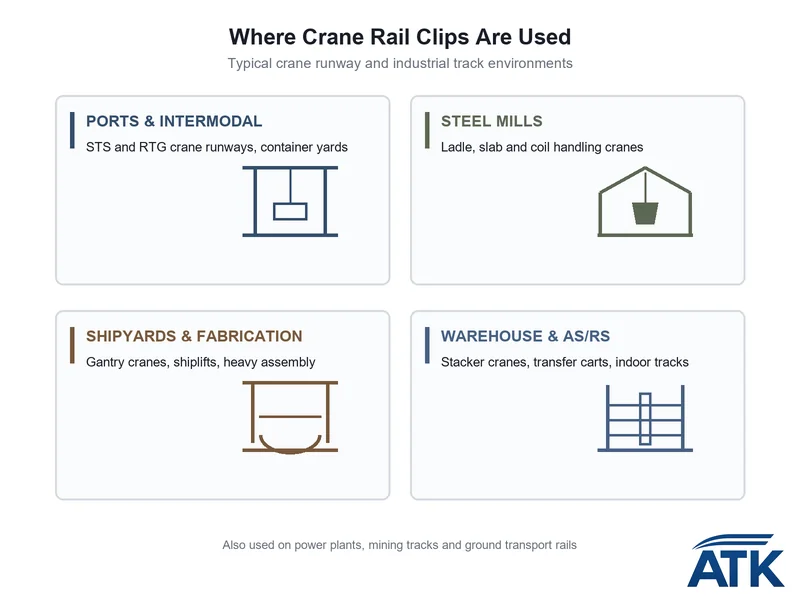
Two special cases are worth flagging early. Cranes fitted with horizontal guide rollers need a low-profile clip, otherwise the cover fouls the roller. Runways with a resilient pad need a clip that applies a controlled vertical force without over-compressing the rubber; over-compression transfers rail movement straight into the bolt and shortens its fatigue life. Tell us which of these applies in the first message, because it changes the model we recommend.
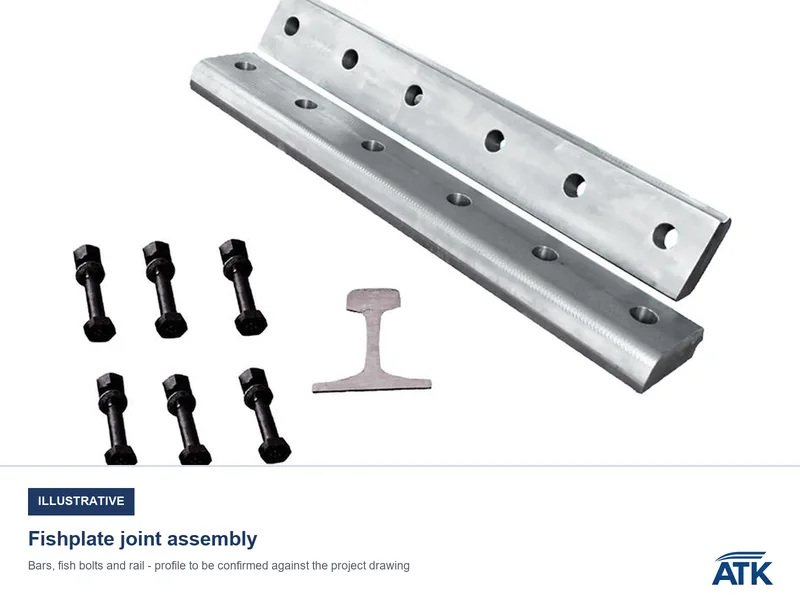
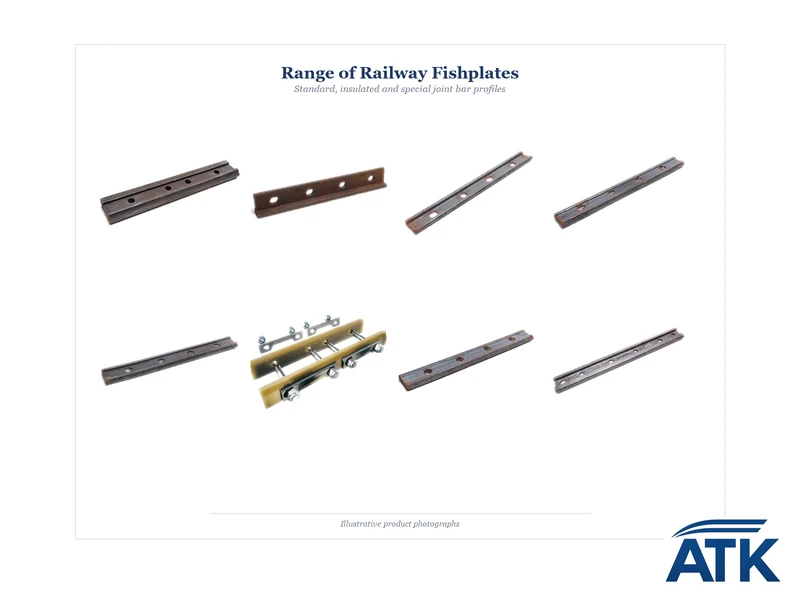
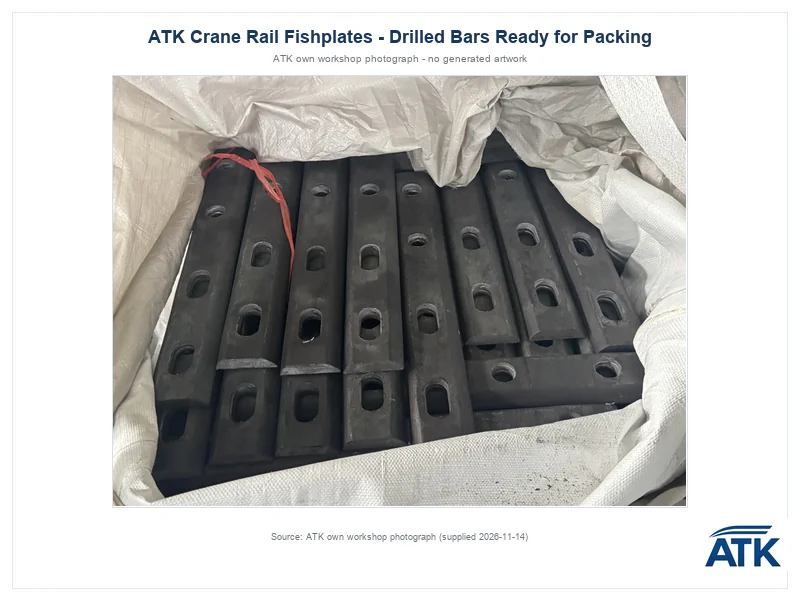
For the rail itself, see our steel rails page; for the joint components that sit in the same fastening family, see crane rail fastenings, insulated fishplates and our glued insulated rail joint assembly.
Start with the girder. The top flange must be level, clean and painted before the clips go on, and the rail joints must be aligned and levelled. Steel plates are embedded in concrete beams where the base cannot be welded directly to steel.
The usual sequence is: weld the base to the embedded plate or flange, position the T-bolt in its spherical seat, put the wedge plate in with the grooved face upward, then fit the top cover, flat washer, spring washer and nut in that order. Move the wedge until the rail centreline and gauge are right, then tighten the nut in stages and record the final torque. Install one pair of clips on both sides of the rail at the specified pitch. Do not strike the cover to seat it, and do not weld within the clip assembly after the bolts are torqued.
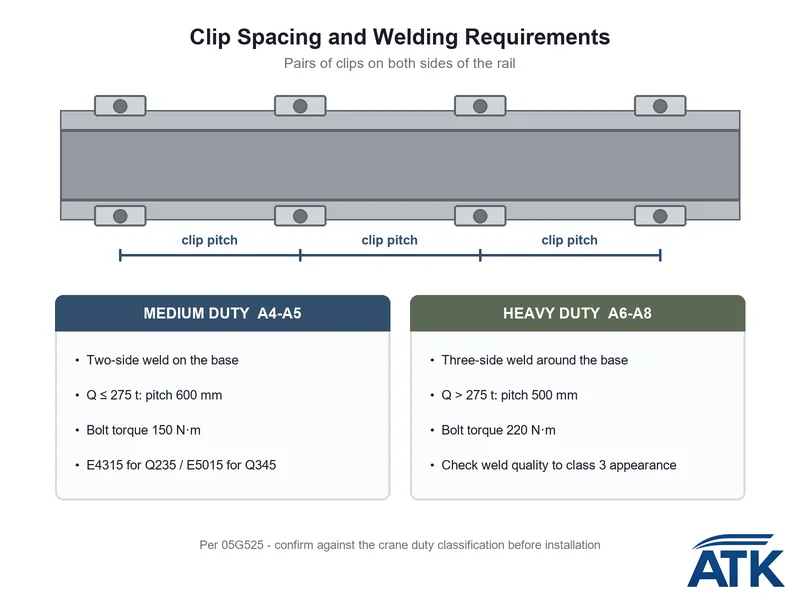
Three details cause most of the on-site problems. The electrode has to match the base material: E4315 for Q235 and E5015 for Q345, both low-hydrogen. Medium-duty cranes (A4-A5) take a two-side weld; heavy and extra-heavy duty cranes (A6-A8) take a three-side weld, with the weld appearance checked to class 3. The pitch is not a free choice either: 600 mm for cranes up to 275 t and 500 mm above that. Widening the pitch to save a few clips increases rail deflection and pad creep.
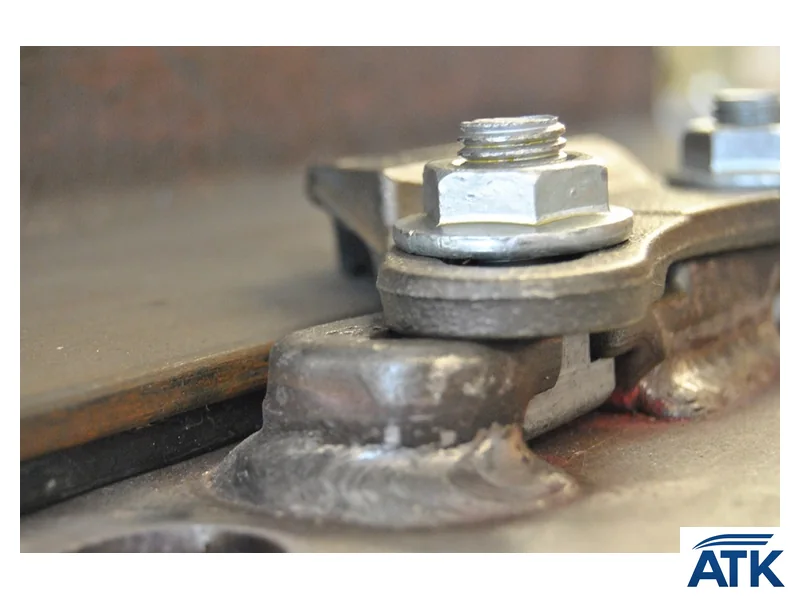
A clip fails gradually, so the maintenance routine matters more than the catalogue number. For what happens at the joint itself, see the rail joint problem diagnosis.On a scheduled inspection, check bolt torque, look for a gap between the cover nose and the rail foot, measure gauge at the same points each time, and look at the weld toes for cracks. On a padded runway, check whether the pad has crept out from under the rail foot.
Dimensional control starts before packing. Cast clip bodies, welded bases, T-bolts and wedge blocks are checked with calipers against the approved drawing — sections, bores, thread length and hole positions. The readings on any one piece are specific to that job and are not the catalogue values quoted in the table above; the drawing governs acceptance.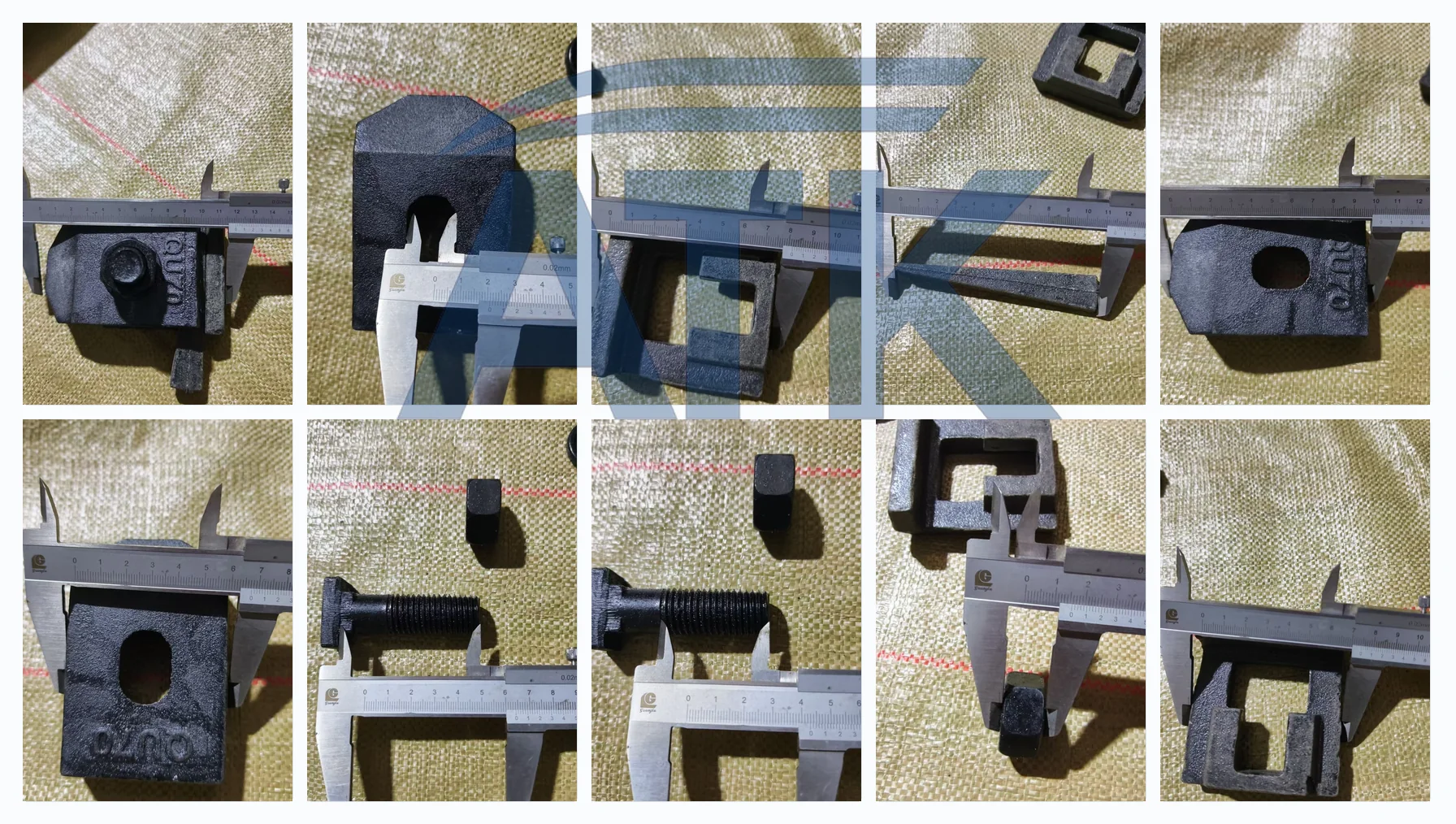
The common failure modes are predictable. Vibration loosens the nut if the spring washer was omitted or re-used. A single-bolt clip can twist when the rail moves lengthways, and that camming action pushes the rail out of alignment; a two-part wedge clip resists it better. Dirty water and rust in the base recess seize the bolt and make the next adjustment impossible. On welded bases, an undersized fillet weld or a weld made with the wrong electrode cracks under repeated horizontal load. In coastal and mining environments, a plain black finish corrodes far faster than galvanising.
If one clip is loose, do not simply tighten it harder. Check the adjacent pair, the gauge and the weld toes first - a single loose clip is often a symptom of a rail that has moved. Replace bolts and washers as a matched set from the same batch.
Send the following in the first message and we can confirm feasibility before quoting: the rail section (QU70 / QU80 / QU100 / QU120 / TG38 / TG43 / TG50 / TG60, or a DIN or ASCE profile), the crane rated capacity and duty class (A4-A8 or an equivalent), the girder top flange width available for B, whether the crane has horizontal guide rollers, and whether the rail sits on a resilient pad.
Then add the bolt grade, the required lateral load and the test method if the project names one, the surface finish, the quantity and whether you want the clips supplied with pads and T-bolts as a full set. A girder drawing or a photo of the existing runway tells us more than a paragraph of description, especially on refurbishment jobs where the flange width is the limiting dimension. We check the profile and the dimensions before quoting rather than revise the price after the drawing arrives.
In this industry the two words are used for the same part. Strictly, a clip often means a lighter or elastic component and a clamp a heavier bolted or welded one. Joint bars are a separate part again; the crane rail fishplate page covers them.A temporary device that stops a wagon on a stub track is also called a rail clamp, but it is a different product.
WJK-QU100, with a = 115 mm, b = 230 mm (the centre-to-centre distance between the two T-bolts, so b = 2a) and B = 374 (364) mm. The bracketed figure applies when the base is welded on two sides only. Check that your girder flange is at least that wide before ordering.
For a standard WJK clip to 23G525, 45 kN with a Q235 base and a Grade C bolt, or 55 kN with a Q345 base and a Grade 8.8 bolt. Higher figures quoted online belong to different clip designs or to marketing material; ask for the type-test basis before comparing them.
150 N·m for medium-duty cranes and 220 N·m for heavy-duty cranes, applied in stages and recorded. Imported adjustable clips with larger bolts use higher values - 200 to 1000 N·m depending on the model - so never copy a torque figure from another clip's data sheet.
One pair every 600 mm for cranes rated up to 275 t, and every 500 mm above that. The pair sits on both sides of the rail at the same station.
Welded for heavy-duty port, steel mill and high-cycle gantry runways where lateral resistance dominates. Bolted where you need to re-align or replace clips without welding on the girder, or where site rules restrict hot work. We can quote both against a drawing.
Yes, but they need the right version. A low-height SWJK-type clip clears horizontal guide rollers. Padded runways need a controlled vertical force on the rubber nose: too little lets dirt and water in, too much transfers rail movement into the bolt.
Plain or black oxide for dry indoor runways, zinc plating for general industrial use, and hot-dip galvanising for coastal, port and mining sites. Tell us the environment; the finish is chosen for the site, not from a price list.
The usual set is dimensional inspection records, material certificates for the castings and the bolt batch, and a certificate of compliance to the named standard. We confirm which documents apply to your order in the quotation. Third-party inspection is an option if the project calls for it, and is not included as standard.
Yes. Crane rail clips, steel rails, insulated fishplates, turnout components, track maintenance tools and fasteners & hardware can go into one enquiry and one shipment, which usually saves more on freight than it costs in consolidation.
Send the rail section, the crane capacity and duty class, the girder flange width, the quantity and whether you need a welded or bolted clip. We can develop and trial-produce crane rail clips to your drawing - QU, TG, DIN or ASCE rail sections - and will confirm the specification before quoting. A datasheet, samples or a project price are available - contact us. For a mixed order, ask about our steel rails, crane rail fastenings, insulated fishplates and fasteners & hardware in the same enquiry.
We have recommended some of our Related products to you. I hope you will be interested.
 English
 Русский