
Crane rail joint problems by symptom, cause and practical fix
1 mm step and the impact load at every wheel pass
Why joint bolts keep loosening and when it is the foundation
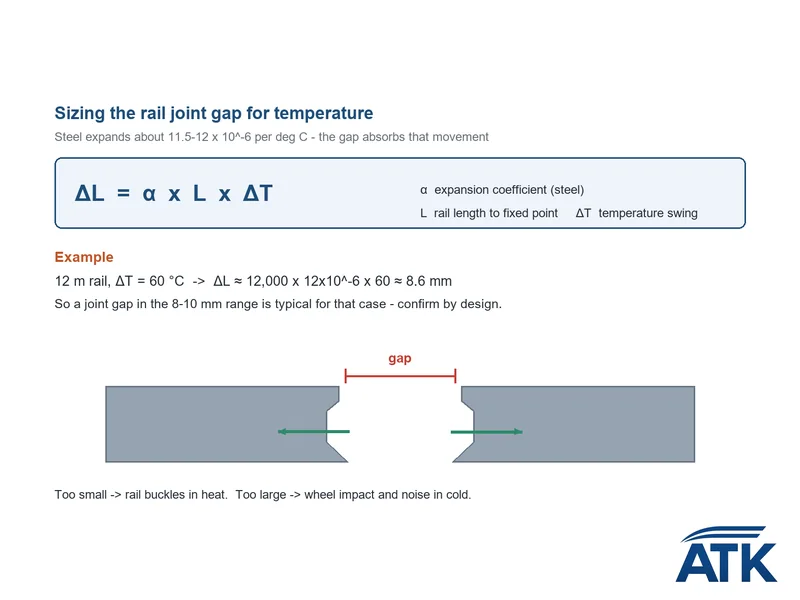
Joint gap sizing with alpha x L x delta T
Flange climbing, rail gnawing and derailment at the joint
Cracks at the weld and rail-head spalling
Welded vs fishplate: how each joint fails
Inspection rhythm and joint layout rules
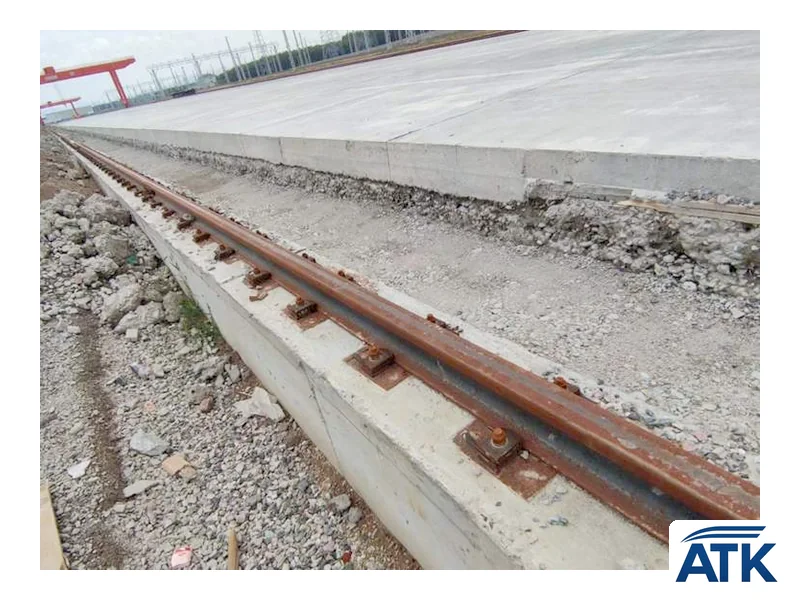
The messages that arrive about crane rail joints rarely ask for a product. They describe a noise, a bump, a bolt that will not stay tight, or a wheel that has climbed off the rail. Someone has a runway that has worked for years and has recently started to misbehave, and they want to know what changed. This article works through those complaints in the order a maintenance team actually meets them: what you feel, what you see, what causes it, and what can be done about it.
A joint is where two rail ends meet. Everything else on a runway is designed to be continuous; the joint is the deliberate interruption. That is why most runway faults either start at a joint or show up there first.
A crane runway carries repeated, moving, sometimes off-centre loads. Wheels pass over the same metres thousands of times a shift. A welded rail or a single continuous length spreads that load into the beam below. A bolted fishplate joint does not. It has two rail ends, a small gap, a pair of bars and a handful of bolts, and every wheel crossing turns that assembly into a short impact event.
Nothing here is unusual or defective. It is simply the geometry. A wheel rolling onto a rail end that sits a fraction high meets a step; a wheel rolling into a gap meets an edge. The impact load is several times the static wheel load, and it repeats. Over time it works bolts loose, drums out the bearing area under the rail, and starts cracks. The usual question — "which joint is best?" — is less useful than "what is this joint being asked to do, and is it still able to do it?"
RULES: A joint has to keep the running surface level, hold the rail ends in line, and let the rail move with temperature. Lose any one of those and the symptoms below follow.
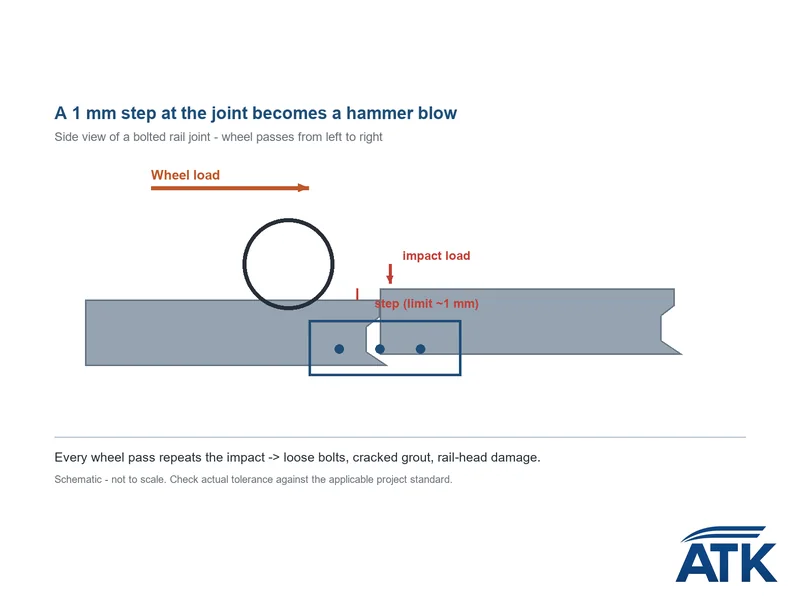
Run a hand along the rail head across the joint, or watch a wheel pass. A step, a dip, or a rhythmic knock as the crane travels is the classic sign of a joint that has lost its level. Industry guidance puts the acceptable vertical step at a joint at around 1 mm; past that, each wheel pass behaves like a small hammer blow on the rail end and the beam beneath it. GB 50278-2010 clause 3.0.8, widely quoted in crane rail installation guides, limits the vertical offset and the lateral misalignment at a fishplate joint to 1 mm each, with a gap no greater than 2 mm. GB/T 10183-2023 uses the same 1 mm step and 1 mm lateral figure for installation tolerances.
A step appears for a few reasons. The support under one rail end settles while the other does not. A clip or soleplate corrodes and lets one side drop. The joint was never ground level after welding. Or the rail head has worn unevenly on one side of the joint because the wheels are tracking badly. The bump is a symptom; the cause is often somewhere else in the support system, and grinding the rail alone will not hold the fix for long.
The practical check is a straightedge across the joint and a feeler gauge at the step, measured cold and again after a hot shift. A step that changes with temperature points to a gap or anchorage problem rather than simple wear.
This is the most common complaint and the one most often misdiagnosed. A fitter retorques the joint bolts, and within weeks they are loose again. The instinct is to blame the bolt grade or fit a stronger nut. Sometimes that helps, but on its own it rarely fixes the cause.
Loose joint bolts generally come from one of four sources. Installation torque was never reached in the first place, often because a torque wrench was not used. Vibration from frequent starting and braking gradually defeats the preload; metallurgical and port cranes with heavy suspended loads are the worst cases. The support under the joint has settled or deformed, so the bolts are carrying tension or shear they were not designed for. Or heat and corrosion have changed the fit at the thread and the contact faces.
The fourth source is worth dwelling on. Maintenance writing from Chinese crane suppliers makes the same point from a different angle: when a fixing bolt comes loose again shortly after being tightened, the problem is frequently the foundation, not the bolt. Soft or hollow concrete under the rail keeps settling and the preload bleeds away. Re-tightening in a loop treats the symptom. The durable answer is to repair the bearing surface, then re-torque to the specified value and use a locking device — a lock washer, a prevailing-torque nut or a thread-locking compound — to resist the vibration.
One more check that is easy to skip: verify the hole pattern and bolt set match the rail section. A bar drilled for one rail on a rail with a different web and hole layout will never clamp evenly, and no amount of torque will make it sit flat. For the specification side of that match, see our guide on how to choose crane rail fishplates, which covers section, hole pattern and bolt selection in detail.
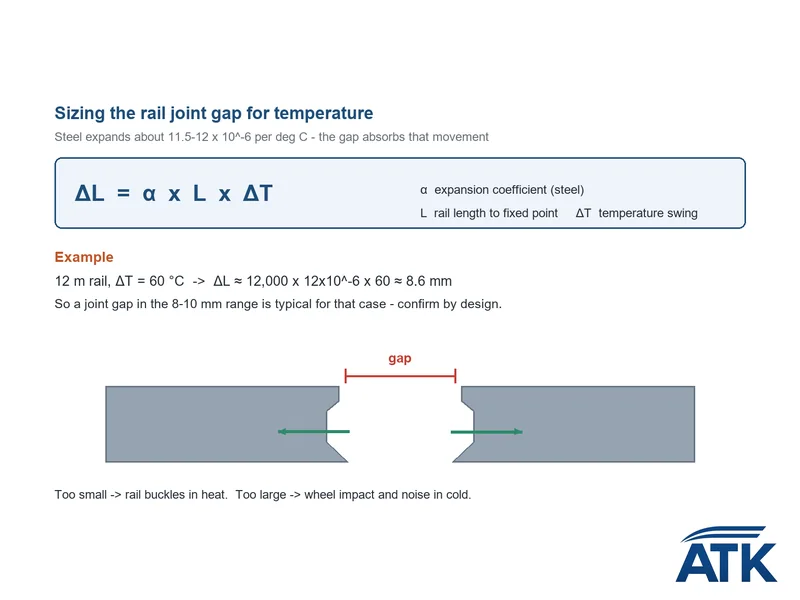
Rails grow in heat and shrink in cold. Steel expands at roughly 11.5 to 12 × 10⁻⁶ per °C, so a 12 m rail crossing a 60 °C temperature swing changes length by about 8.6 mm. The joint gap exists to absorb that movement. Get it wrong in either direction and the joint misbehaves.
Too small, and the rail ends press against each other in summer. The rail can buckle, climb, or push the fastening sideways; anchors and clip bolts take a load they were not meant to carry. Too large, and the wheel meets a widening slot in cold weather — more noise, more impact, and a place for a wheel flange to catch. A closed-up joint is often the first visible sign that the rail is being pushed out of tolerance.
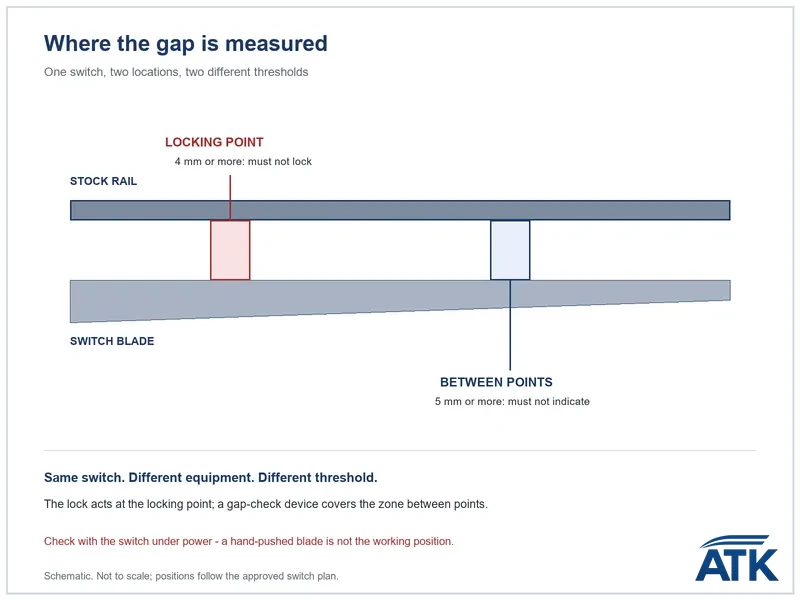
Sizing is a calculation, not a rule of thumb. The working formula used in runway engineering is ΔL = α × L × ΔT, with a small safety margin added. Published guidance from crane runway suppliers gives a sense of the scale: short runways may rely on ordinary splice gaps of 1–3 mm; a 50–100 m runway may need one expansion joint around 10–15 mm; longer runs need more joints sized by the same calculation. None of those numbers is universal — the design sets the gap, and the joints should be checked against it during inspection.
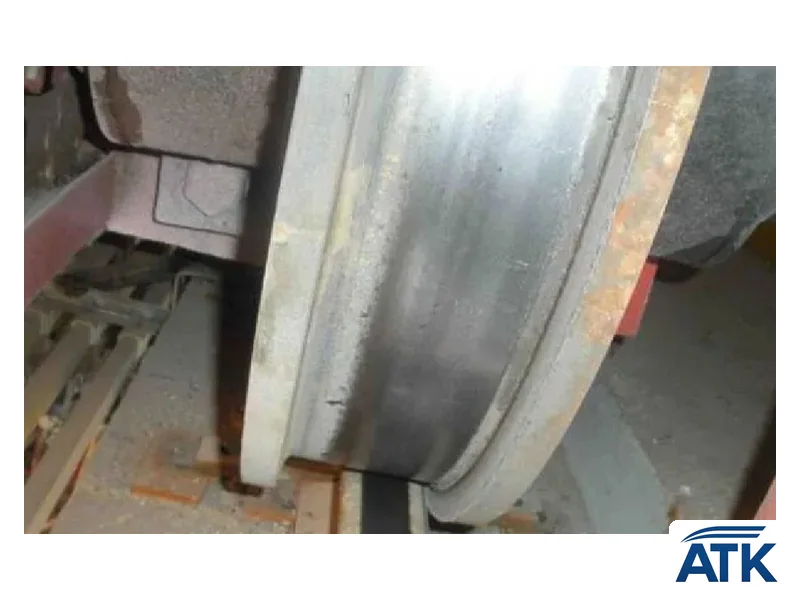
A bad joint rarely derails a crane on its own, but it is often where a longer-running problem finally shows. A wheel that is already being pushed sideways meets a step or a wide gap at the joint, takes a sudden lateral force, and the flange can ride up the rail head. Chinese training material states the risk plainly: with severe rail gnawing and an oversized joint gap, the flange can climb onto the rail top and cause derailment.
That is the part the joint owns — the step, the gap, the lost alignment at the rail ends. Span error, cross-level and flange wear belong to the wider runway and are dealt with elsewhere. What matters here is that the two interact. Fix the joint and ignore the alignment, or realign and leave a wide gap at the joint, and the problem usually moves further down the runway rather than going away. If the same joint keeps throwing a wheel, treat the rail ends and the runway together.
Welded joints are smooth to run on, but they concentrate heat and stress in a small zone, and that is where cracks start. Repair guidance from rail welding specialists is consistent on one point: a crack must be fully removed back to sound metal before any weld is laid over it. Welding over a visible crack traps the original defect underneath and often drives it into the heat-affected zone. After a repair weld, the rail head has to be ground back to the correct profile, and the area inspected before the crane returns to service.
On bolted joints the damage looks different. Loose fishplates, worn bolts or an unsupported joint end let the rail ends move under each wheel, and that movement can start surface spalling at the joint. Once head loss at the joint passes roughly a fifth of the section, the usual recommendation is to replace the rail length rather than keep grinding it back.
Cracks that keep returning at the same joint are a sign to look upstream. Recurring cracks at a beam splice or support often mean structural movement or overload, not a bad weld. The repair that lasts is the one that restores load transfer through the rail, the fixings and the support together.
Corrosion is slow and easy to ignore until a fastener at the joint fails. Moisture and process dust get into the fishing faces and the threads; clamping force drops and the joint starts to move. The fix is unglamorous but effective: clean the contact faces, treat or replace corroded fasteners, and improve drainage where water stands. On a planned shutdown, loosening the full bolt set, cleaning the threads, applying a thread-locking compound and reassembling to torque resets the whole joint rather than the one bolt that looked loose.
Buyers often ask which joint type is better. The honest answer is that each fails in its own way, and the choice depends on the runway.
A welded joint gives the smoothest ride and the least noise. It suits high-duty runways where smoothness matters and where the rail will not need to be taken apart. Its weaknesses are concentrated at the weld: poor preparation, wrong consumables or uncontrolled heat input leave a crack risk, and the finished joint must be ground flush. It also makes future rail replacement more involved.
A bolted fishplate joint is the workhorse. It is quick to install, easy to inspect and easy to replace, and it accommodates movement and future dismantling. Its weaknesses are the ones running through this article: bolts work loose, the joint needs a gap, and it needs a level running surface maintained by inspection. The bars themselves are a wear item in a way a weld is not.
Both coexist on most real runways. A common arrangement is welded lengths joined by bolted joints at expansion points, with a 45-degree scarf cut used where a smoother wheel transition is needed at a mechanical joint. The practical question is not which type is universally better but whether the joint you have is still doing its three jobs — level, aligned, and free to move.
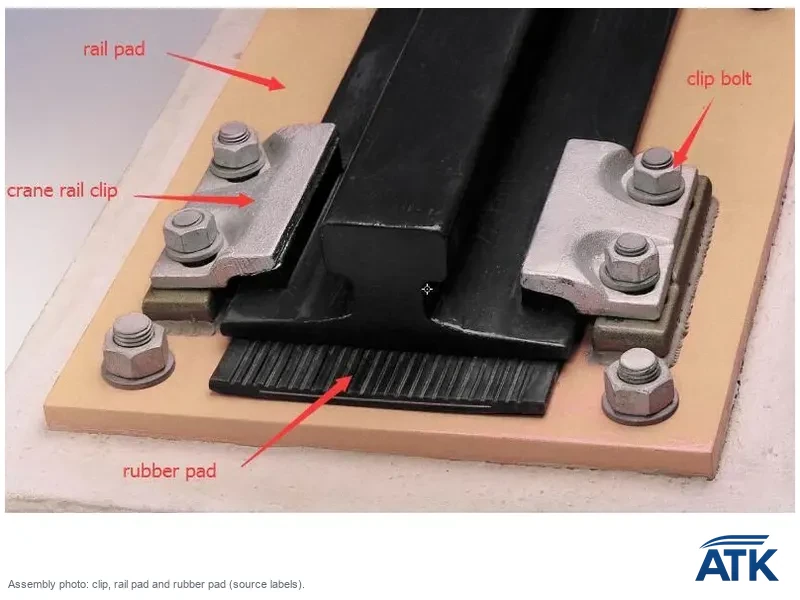
Our crane runway clip layout guide covers how the fastening around the joint supports those jobs, and the crane rail section page explains the rail profiles these joints are made for.For the clip and baseplate parts themselves, see the crane rail clip product page.
Inspection intervals published for runway beams give a useful template, and they scale with how hard the runway works:
- Every shift or weekly: clear debris from the rail, and listen and feel for unusual noise or vibration as the crane travels.
- Monthly: check clip tightness, measure rail head wear, check the expansion gap, and look for loose bolts at joints.
- Annually: run a full alignment survey, measure camber, inspect flange and web for cracks at welds, torque-check anchor bolts, and assess corrosion.
- Every four years: ultrasonic thickness testing of beam web and flanges at high-stress zones, fatigue crack inspection and a foundation settlement survey.
For the joint specifically, a short list catches most problems early: measure the step and lateral offset with a straightedge and feeler gauge; confirm the gap is within the design value; check every joint bolt with a torque wrench and look for a torque stripe or locking device; look for rust or fretting at the fishplate faces; and confirm the bearing area under the joint has not settled. Record the numbers. A trend in the record tells you more than a single reading, and it is what separates a joint that is wearing normally from one that is about to fail.
Two layout rules come up repeatedly in installation guidance, and both are cheap to get right at design time and expensive to fix later.
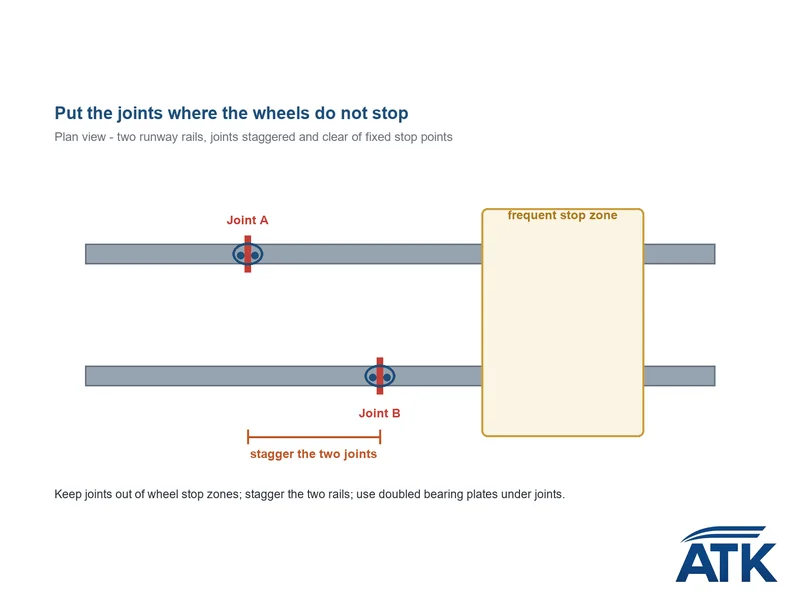
First, do not put a joint where wheels stop often — under the cab, at a fixed loading or unloading point, or beside a limit switch. A stationary wheel parked over a joint hammers the same spot every cycle. Second, stagger the joints on the two rails so they do not fall at the same cross-section. If both rails have a joint opposite each other, the crane can lose guidance on both sides at once.
Joint support deserves the same attention. Because stress concentrates there, installation guidance for square steel rails calls for a bearing plate at the joint that is twice the width of the ordinary bearing plates. Clamps should be denser near joints, held to the specified torque, and never welded solid to the girder — a rail welded tight cannot expand, and it will arch or tear at the fastening when the temperature rises.
None of this is exotic. It is the difference between a joint that survives a maintenance cycle and one that becomes a recurring job.
It depends on rail length, temperature swing and the design. A common engineering figure is 8–10 mm where a 12 m rail sees a 60 °C change. GB 50278-2010 limits a fishplate joint gap to 2 mm for the ordinary splice; expansion joints are set by the project design. Always follow the design value for your runway.
Usually insufficient installation torque, repeated start/stop vibration, settlement under the joint, or corrosion. Fit a locking device and re-torque to specification — but if the bolts loosen again quickly, inspect the foundation before blaming the bolt.
A vertical step over about 1 mm from settlement, corrosion, uneven wear or a weld that was never ground flush. Check with a straightedge and feeler gauge, cold and hot.
Yes. Cracks start in the heat-affected zone when preparation, consumables or heat input are wrong. The crack must be removed back to sound metal before re-welding, then the head ground to profile and inspected.
Yes. Staggering avoids both rails losing guidance at the same cross-section. Keep joints out of areas where wheels regularly stop.
A visible step or burr, a knock as the wheel passes, shiny metal shavings on the rail side, or a feeler-gauge reading above the allowed step. Grind to restore a level running surface, then recheck.
Around 1 mm is the usual upper limit in installation standards such as GB 50278-2010 and GB/T 10183-2023. Beyond that, impact load rises sharply with every wheel pass.
Light visual checks each shift or week, a monthly pass on tightness and gap, and a full alignment survey annually. High-duty outdoor runways need more frequent checks.
Indirectly, yes. Loose bars let rail ends move, which damages the head and wheels; combined with gauge error or flange wear, a joint can be the point where a wheel climbs the rail.
On a runway with repeated vibration, a locking device — lock washer, prevailing-torque nut or thread-locking compound — is normal practice. It supports, rather than replaces, correct installation torque.
A joint cut at 45 degrees so the two rail ends overlap, giving a smoother wheel transition than a square butt joint. It is used where impact at a mechanical joint needs reducing.
Sometimes, if the cause was low installation torque. If the bolts keep loosening, re-tightening alone will not hold — check the bearing surface, the gap and the fastening layout.
A joint that fails once is a repair. A joint that fails every few months is a design or support problem wearing a repair costume. If the same step, the same loose bolts or the same crack returns, look at the load path as a whole — rail, bars, bolts, soleplates, beam and wheels — rather than the rail end in isolation.
For a replacement joint, the details that matter are the rail section, the hole pattern, the bolt set and the surface finish. Describe the symptom, the rail section and the duty cycle, and a supplier can tell you whether the answer is a new bar, a different joint type, or something further down the support chain. The crane rail fishplate page lists the bars those conversations usually end with.
We have recommended some of our Related products to you. I hope you will be interested.
 English
 Русский