
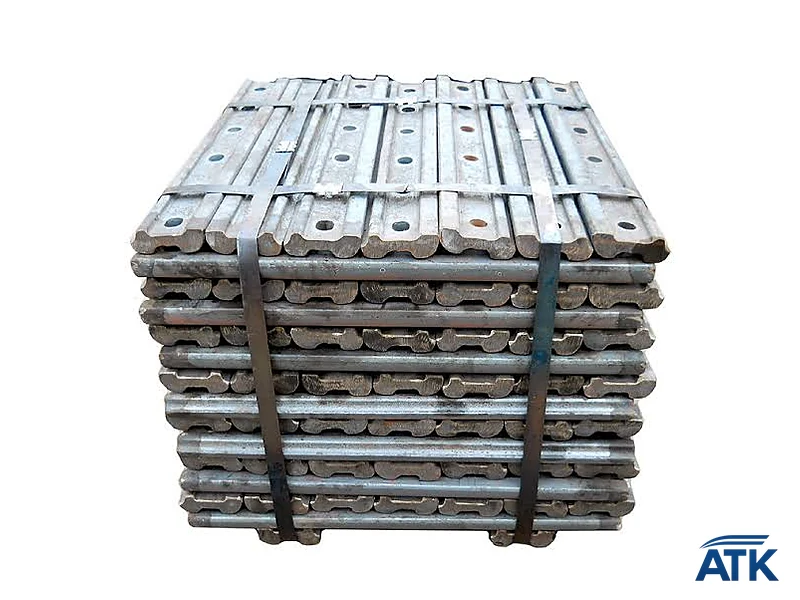
GOST 33184-2014 double-headed fishplates
1R-65 six-hole 1000 mm and 2R-65 four-hole 800 mm
R50, R65 and R75 broad-gauge rails
M54 steel, 860 MPa tensile minimum
235-388 HB hardness band
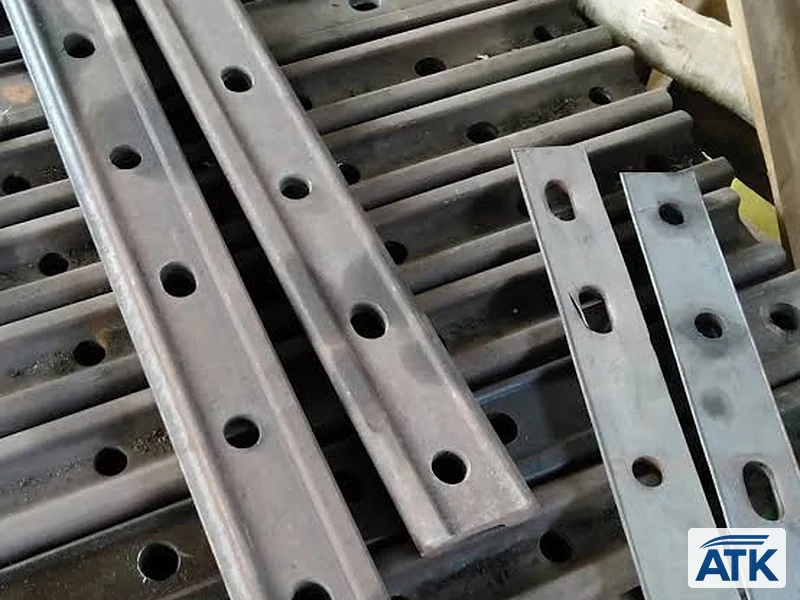
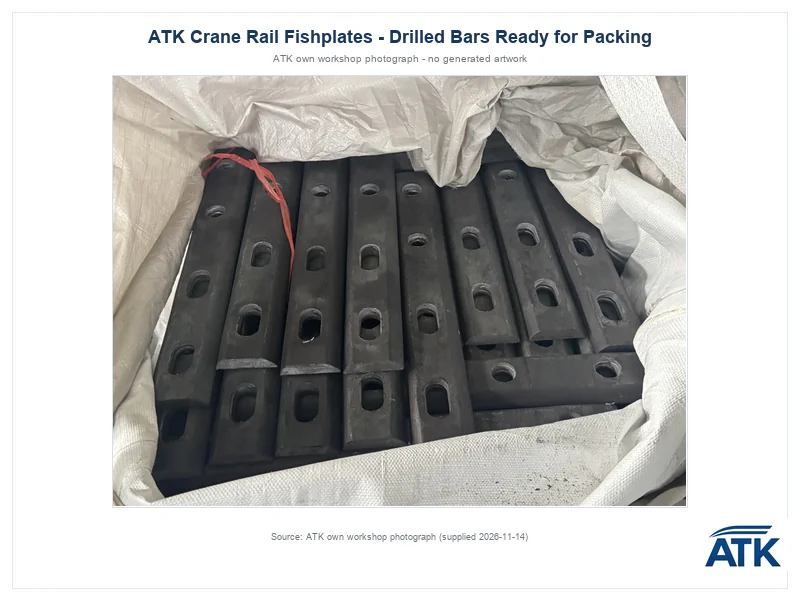
Round and oval hole patterns to drawing
Bolts to GOST 11530-2014
Built to the approved plate drawing
Request a quotation
A GOST fishplate is the double-headed joint bar used on 1520 mm broad-gauge track. The current technical standard is GOST 33184-2014, which covers bars for R50, R65 and R75 rails in both conductive and insulating joints. Two designations cover most of the traffic: 1R-65 at 1000 mm with six holes, and 2R-65 at 800 mm with four.
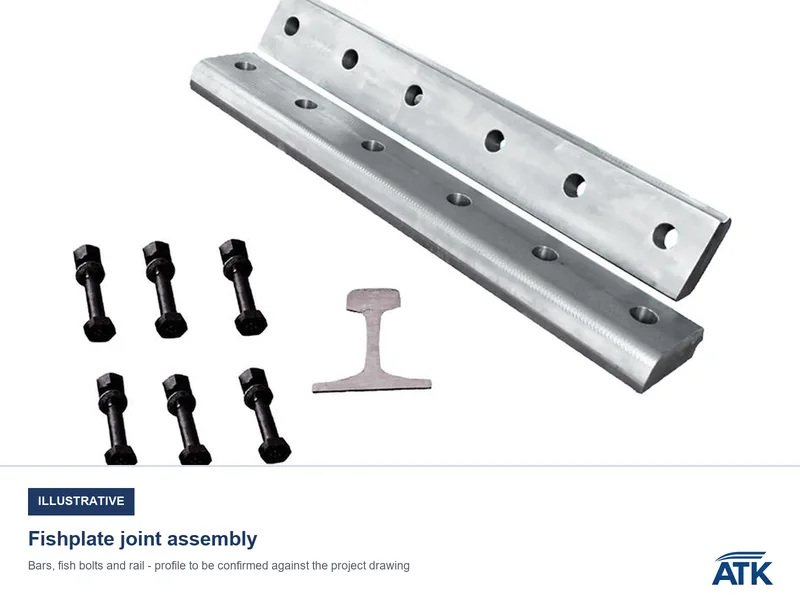
Russian and CIS track is still built and repaired with bolted joints on a large scale. A joint holds two rail ends in line, takes the impact of every wheelset and keeps the gap from opening under thermal movement. The bar does that work through its double-headed section: the two heads grip the rail head and foot from outside while the bolts pull the pair together across the web.
The design has not changed much in fifty years. What has changed is the document it is made to. That distinction matters more than any single dimension here, and it is where most catalogue entries for this product are out of date.
The bar works as a short beam across the gap. Its upper head hooks under the rail head, its lower head hooks over the rail foot, and the bolts pull both plates against the web. Wheel load passes from the rail head into the plate heads, through the plate section, and out into the sleepers either side of the joint.
Two consequences follow, and they explain most of what goes wrong at a joint. The contact between plate head and rail head is small, so it carries high pressure and wears first; a plate whose head has worn away cannot grip, however sound the rest of the bar looks. And the bolts are not there to carry the wheel load, only to keep the plates in contact with the web, which is why a joint can look tight and still be working loose under traffic.
Every dimension on a GOST plate follows from that geometry. The head profile matches the rail section. The height puts the plate heads on the fishing surfaces. The hole pattern spreads the clamp along the web.
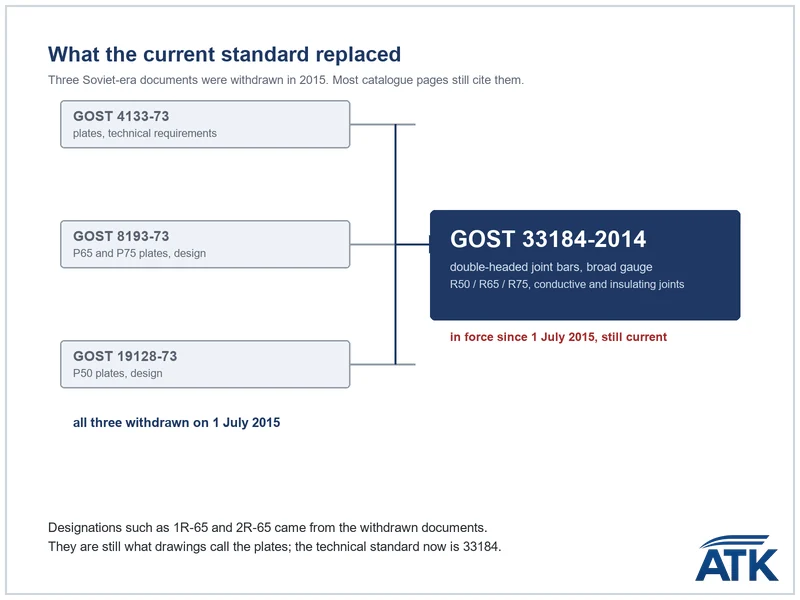
GOST 33184-2014 replaced three older documents when it came into force on 1 July 2015. GOST 4133-73 held the technical requirements. GOST 8193-73 held the design and dimensions of P65 and P75 plates, and GOST 19128-73 the same for P50.
The standard is written for 1520 mm broad gauge. It names the rail documents it works with: GOST 18267 or GOST 24182 for the R50, R65 and R75 sections. Inside the Russian Federation, GOST R 51685-2013 takes that role. A plate ordered to 33184 is therefore tied to a rail section as well as to a joint design. A project that has re-railed with a different profile needs the plate checked against the new rail, not just the old plate number.
The plates themselves did not change with the standard. Designations such as 1R-65 and 2R-65 come from GOST 8193-73, and drawings still use them. So a specification that says "1R-65 to GOST 8193-73" is describing a real part to a withdrawn document. A quotation that answers it in those terms tells you the supplier has not checked the document status since 2015.
Our position is simple: the geometry follows the drawing the customer holds, and the technical requirements follow GOST 33184-2014 unless the project names an edition in writing.
The two R65 plates are the same section rolled to different lengths, drilled to different patterns.
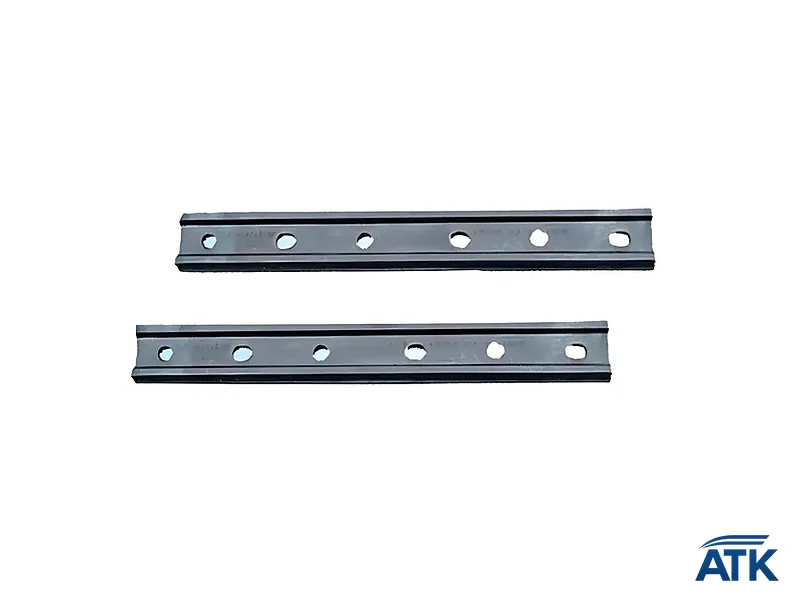
1R-65. 1000 mm long, six holes. The longer bar spreads bolt load along more of the web, and this is the plate used where R65 meets R75 rail.
2R-65. 800 mm long, four holes. The standard dimensions this plate as chain dimensions measured from one end, and lists several executions with different hole positions, so the spacing is read off the execution the drawing names rather than assumed from the length. Where a joint has to take up movement, the drawing may call for slotted holes; that is a feature of the execution, not of the 800 mm length.
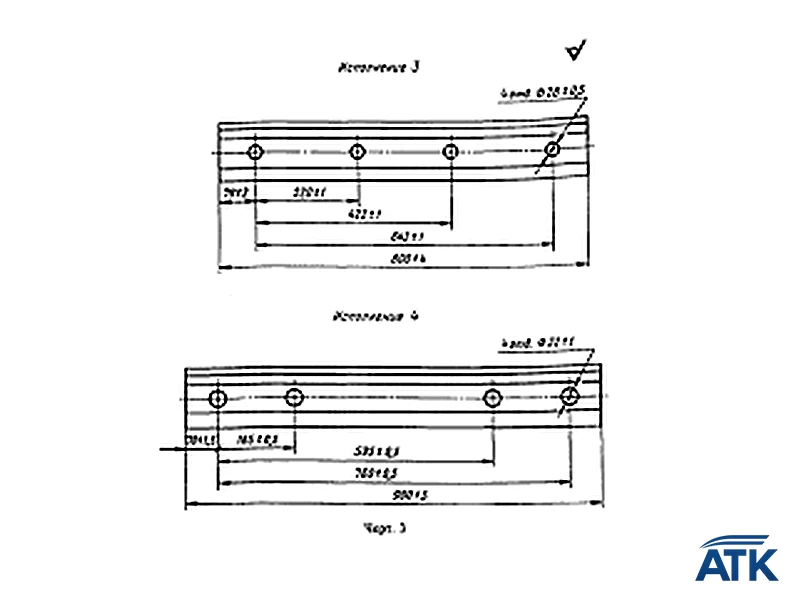
P50 plates. R50 is in the scope of GOST 33184-2014. Plates for that rail are shorter and drilled for a four-hole joint; the dimension comes from the drawing, since the design standard that fixed it is withdrawn.
Item | 1R-65 | 2R-65 |
Rail | R65, R75 | R65, R75 |
Length | 1000 mm | 800 mm |
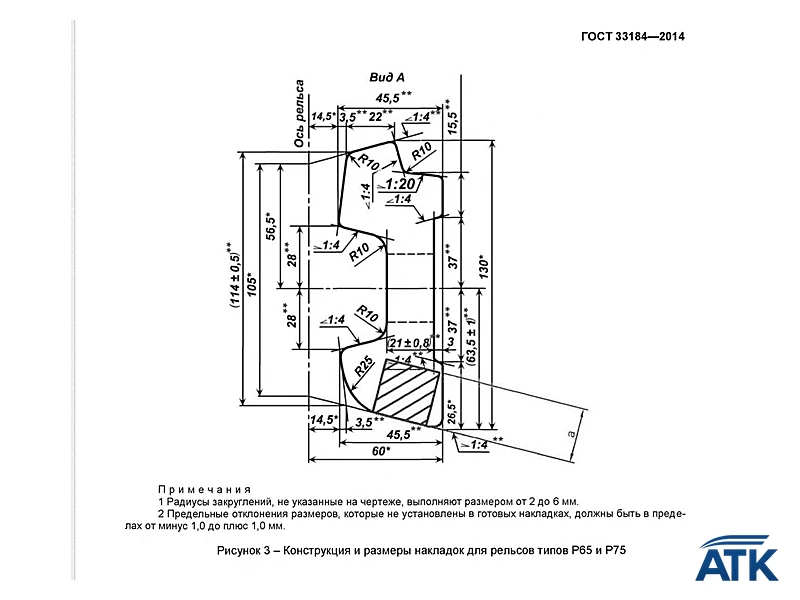
Section height | 114 ± 0.5 mm | 114 ± 0.5 mm |
Head width | 45.5 mm | 45.5 mm |
Base width | 60 mm | 60 mm |
Holes | 6 | 4 |
Hole positions | per the execution on the drawing | per the execution on the drawing |
Section area | 38.45 cm² | 38.45 cm² |
Unit weight | 28.5 kg | 23.78 kg |
Pieces per tonne | about 35 | 42 |
Steel | M54 open-hearth | M54 open-hearth |
Carbon content | 0.45–0.62 % | 0.45–0.62 % |
Tensile strength | not less than 860 MPa | not less than 860 MPa |
Yield strength | not less than 540 MPa | not less than 540 MPa |
Hardness | 235–388 HB | 235–388 HB |
Joint bolts | per drawing, GOST 11530-2014 | per drawing, GOST 11530-2014 |
The section is the same for R65 and R75 plates; length and hole pattern are what differ between the two designations. Radii not dimensioned on the drawing are made between 2 and 6 mm, and any dimension the drawing leaves without a tolerance is held within minus 1.0 and plus 1.0 mm.
Catalogue values for the six-hole bar run between 28.5 and 29.3 kg depending on who is publishing. That spread is part real rolling tolerance and part copied data. The number that matters for freight is the one on our packing list, and it is weighed, not quoted.
Both plates are made from M54 open-hearth steel with carbon between 0.45 and 0.62 %. That is a medium-carbon steel chosen for wear resistance at the head contact and for enough toughness that a plate bends before it cracks when a joint is hammered home.
Tensile strength is specified at not less than 860 MPa and yield at not less than 540 MPa, with Brinell hardness in the 235 to 388 HB band. The hardness band matters as much as the strength: too soft and the head wears where the wheel passes, too hard and the plate is brittle at low temperature on a Siberian winter.
If a project asks for a different grade, that is a design change, not a substitution. We make to the drawing and record the heat number against the delivery.
Bolts for these joints are specified by GOST 11530-2014, which covers round-head and oval-head joint bolts in M22, M24 and M27 for P38 through P75 rails, accuracy class C.
Which of the three a given joint takes is decided by the plate drawing, not by the rail alone, and this is where published sources disagree: some attach M24 to the R65 joint and some attach M27. Both exist. The hole diameter on the plate in front of you settles it, and a supplier who quotes a bolt size without asking for the drawing is guessing.
Slotted holes, where the execution has them, need a bolt that can slide in the slot and a washer that spreads the clamp. On a four-hole plate, bring the non-slotted holes up first and the slotted pair last, so the plate does not creep along the rail as it is finally pulled up.
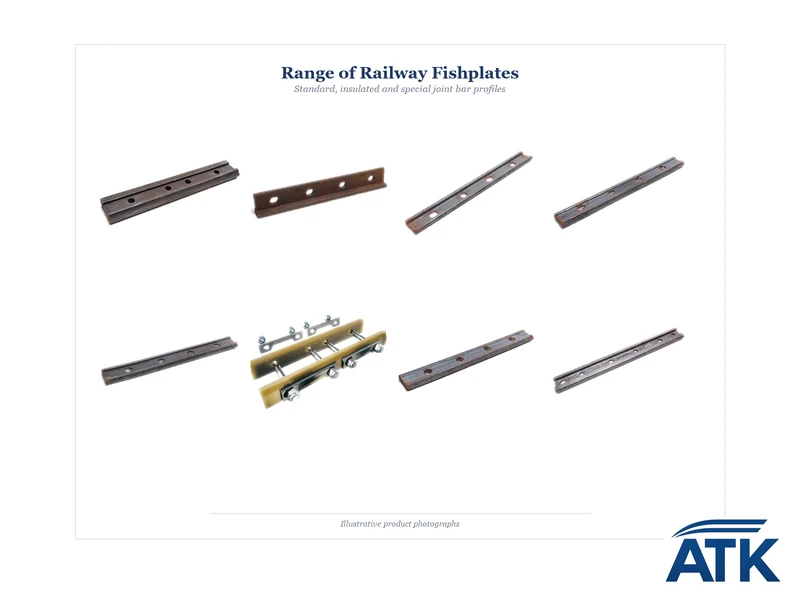
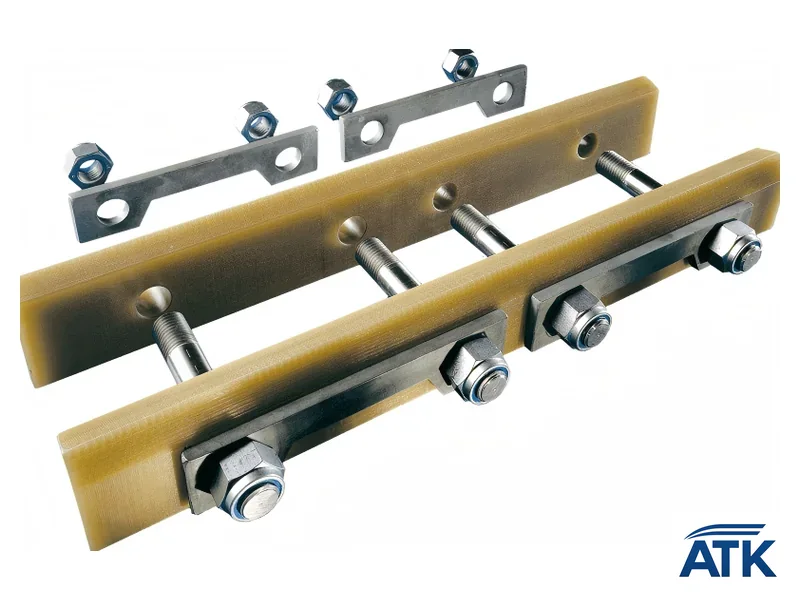
GOST 33184-2014 covers bars for insulating joints as well as conductive ones. An insulated joint interrupts the track circuit, and the bar carries the load while the insulation keeps the two rail ends electrically separate. That is a different assembly with end plates and insulating sleeves, and it is supplied to the same rail profiles.
Transition joints join two different rail sections, most often R65 to R75. They are a pair of plates machined or forged to bridge both profiles, and they are ordered against a drawing rather than a catalogue number.
The standard's acceptance rests on a set of test methods that it references: tensile testing, Brinell hardness, bend testing, macrostructure examination and the sampling rules that say how many bars a lot represents.
What that means for a delivery:
· Chemical composition checked against the M54 range, carbon first.
· Tensile and yield on a sample from the lot, not from a separate test bar.
· Brinell hardness across the head, since the head is the surface that wears.
· Bend test, which is what catches a plate that is hard but not tough.
· Dimensions: length, height, hole diameter, slot position where the execution has one, and the head profile that grips the rail.
· Marking and heat number recorded against the delivery.
Acceptance items and limits are fixed in the technical agreement. We supply test records per lot. Where a project needs conformity documents, those are issued by a certification body and agreed before the order; the standard number alone does not produce them.
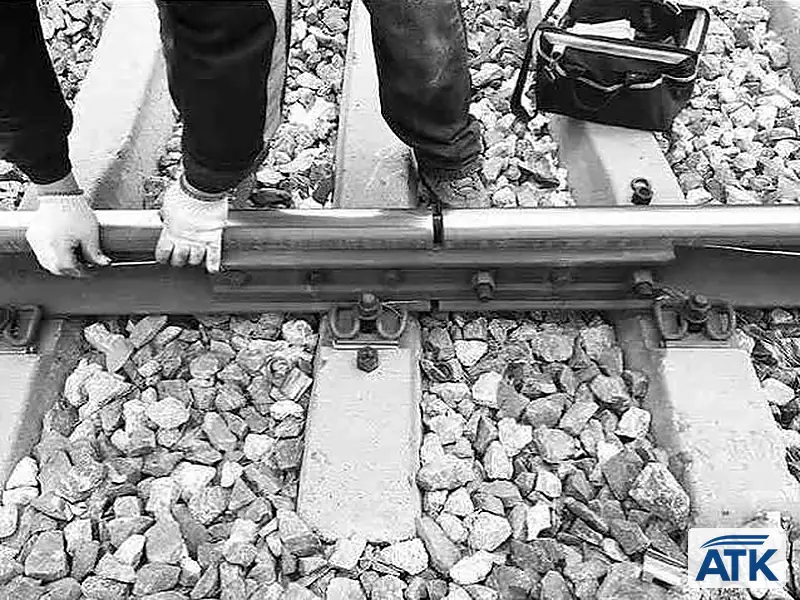
1. Clean the rail ends and the plate seats. Scale under a plate is a gap that closes later, and a joint that loosens after a week is usually a joint that was assembled over dirt.
2. Offer the plates to both sides of the web and enter the bolts without final tightening.
3. Check the gap at the rail ends and the alignment of the running surfaces. A step here is felt by every wheel.
4. Tighten to the torque in the technical agreement, working from the middle of the plate outward so the plate does not rock.
5. Re-check the torque after the first trains have passed. Settling is normal; a joint still losing torque after that is a joint with a wrong plate or a worn rail end.
Two mistakes account for most early failures. Leaving out the washer under an oval-head bolt, which lets the head bite into the slot. And re-using plates whose holes have elongated, which cannot be tightened back into position because the bolt has nowhere to sit.
Plates are re-usable. A plate that comes off during a rail change can go back into service if the heads are not worn through the contact band and the holes are still round. The decision points are the hole and the head: a hole that has worn into a slot, or a head worn enough that it no longer grips, and the plate is scrap.
Check the joint after a rail change for the first month. A joint that keeps needing torque is telling you either the rail ends are worn at the fishing surfaces or the plates are from a different drawing than the rail.
Before quoting we need: rail type, plate designation or drawing, hole pattern, whether the joint is conductive, insulating or a transition, and the bolt size if it is in scope.
What can be made to order: length, hole pattern including any slot, head profile, steel grade where the project specifies one, coating (plain oiled, black, painted or galvanised) and marking.
What we do not do is re-design a joint. The plate is made to the drawing, and a change in hole position or head profile is a design decision that belongs with the track designer.
Request a quotation with the plate drawing and the rail section. If the drawing is old and cites GOST 8193-73, send it anyway; the dimensions are still valid and we will state on the quotation which standard the bars are made to.
Yes. The Cyrillic Р and the Latin R are the same letter in this designation, and both appear in English-language documents.
The six-hole bar spreads load over a longer length of web, which suits mainline joints. The four-hole plate suits joints that need to take up movement and be adjusted on site. Strength is not the deciding factor; the joint design is.
No. It was withdrawn on 1 July 2015 and replaced by GOST 33184-2014, together with GOST 4133-73 and GOST 19128-73. The designations from those documents are still used on drawings.
M54 open-hearth steel, carbon 0.45 to 0.62 %, with tensile strength of at least 860 MPa, yield of at least 540 MPa and hardness of 235 to 388 HB.
Some executions do, where the joint has to take up movement. It is a property of the execution, not of the plate length, and the drawing says which.
GOST 11530-2014 covers M22, M24 and M27 joint bolts. The plate drawing decides which, and published sources do not agree, so the hole diameter on your drawing is the answer.
On request, as a set: plates, bolts, nuts and washers. Say so when ordering, because they are separate line items.
Yes. R50 is within the scope of GOST 33184-2014. The plate is shorter and drilled for a four-hole joint, and the dimensions come from the drawing.
Yes, as assemblies with the insulating components included. That is a different product from a plain bar and is quoted separately.
Yes, if the heads still grip and the holes are still round. An elongated hole or a worn head means the plate goes to scrap.
Plain oiled for delivery inside the CIS, paint where the plates are visible in a station area, and galvanising where the joint sits in a wet or coastal environment. The choice is confirmed per order.
Rail type, plate designation or drawing, hole pattern, joint type, bolt size if in scope, quantity and coating.
These plates are ordered with the rest of the joint. Railway fishplates covers the other standards we make. Where the joint has to break the track circuit, see glued insulated rail joints and the composite insulated joint bars. The bolts are on fish bolts and nuts.
We have recommended some of our Related products to you. I hope you will be interested.
 English
 Русский