
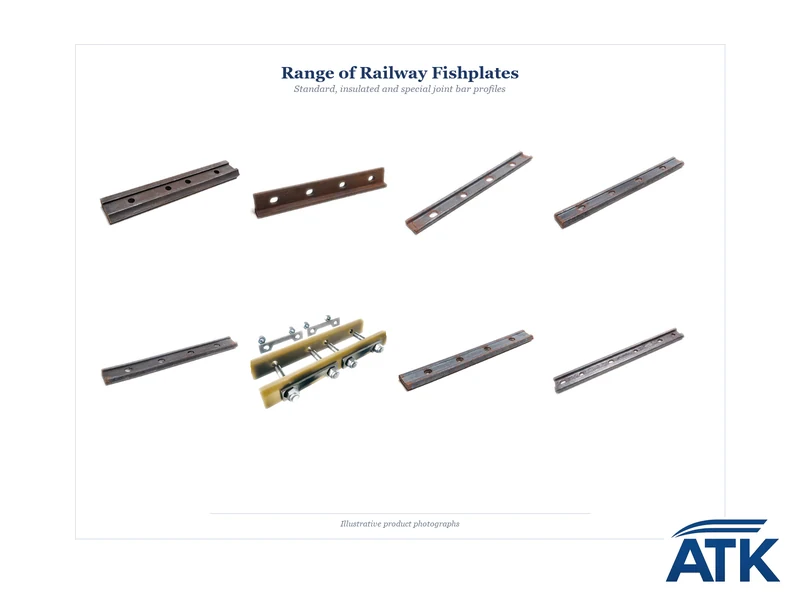
Steel railway fishplates and joint bars for jointed track, turnouts and industrial lines
Bars matched to the rail section and to the drilling on the approved drawing
Grade 55 and 56Nb carbon steel, quenched and self-tempered, 227 to 388 HBW
Rolled or forged routes, holes hot-punched or drilled and chamfered
TB/T 2345-2008, AREMA Ch.4 Part 3, IRS 80864-4, EN 16843, BS 47-1, AS 1085.2, JIS E 1102, GOST 33184 referenced
Standard, joggled, compromise and insulated bar types
Chemistry, tensile, cold bend, hardness, macrostructure and inclusion checks with batch records
Mill certificate, dimensional report and third-party inspection where specified
Enquiries reviewed from a drawing, a sample or measured dimensions of the installed joint
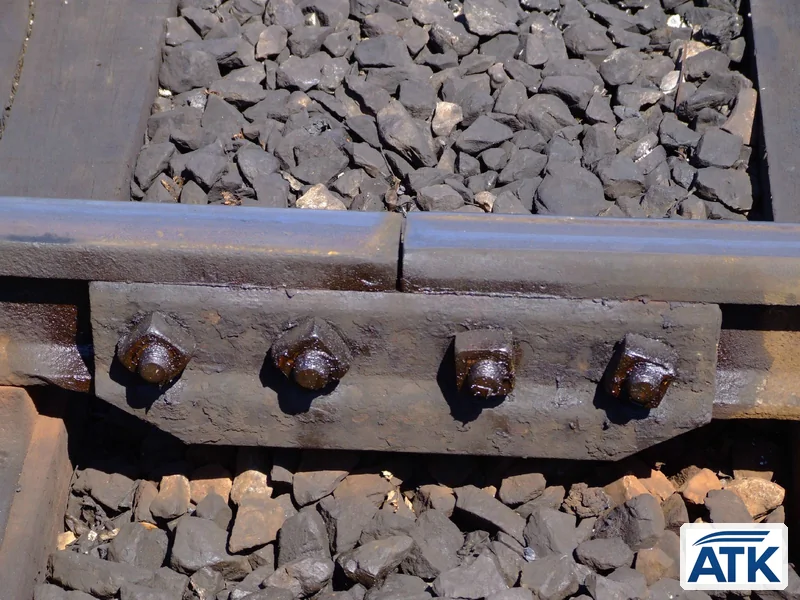
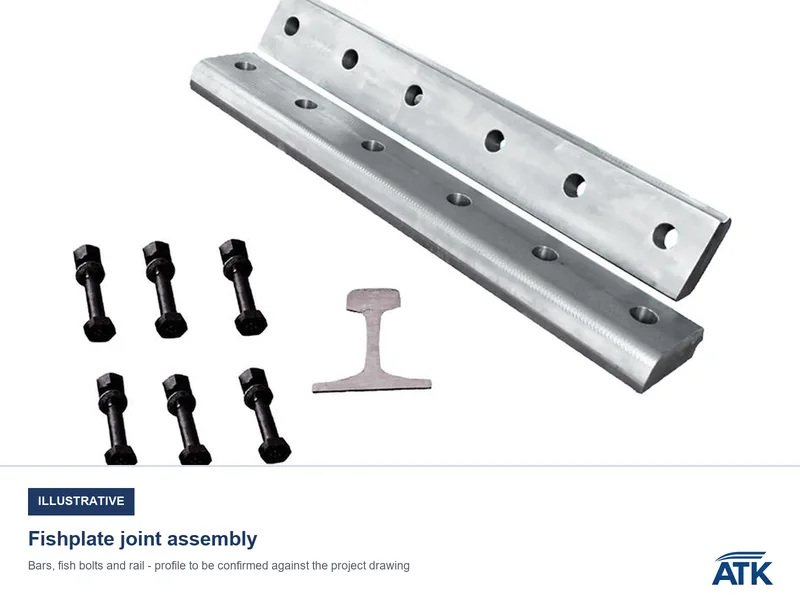
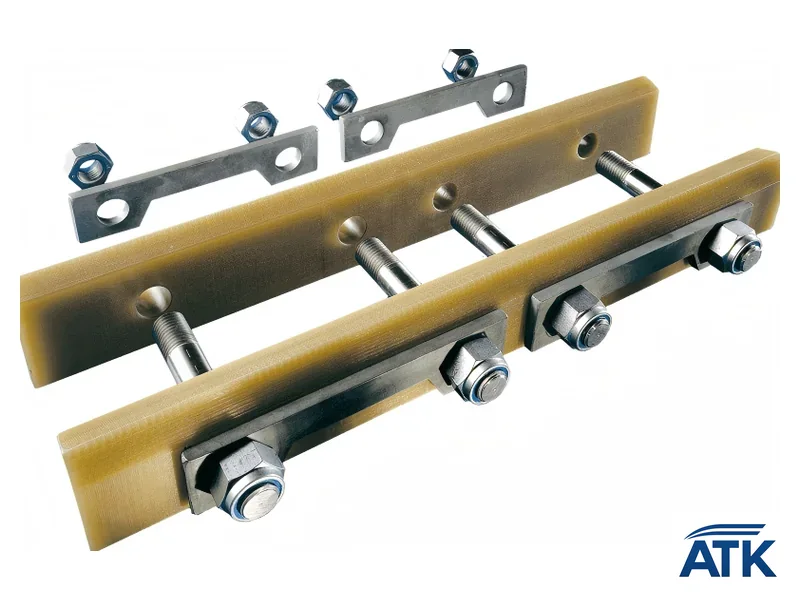
Two rails meet. Between the machined ends there is a gap, and across that gap the track has to behave as if it were continuous. A fishplate does that job: a pair of steel bars bolted to the webs of the two rail ends, clamped hard enough that the joint carries the wheel load in bending and shear instead of letting each rail end act on its own.
The mechanics are worth a moment, because everything else here follows from them. A rail is a beam. Cut it and the beam loses its continuity, so the joint becomes the softest point in the track. Wheels arrive at that soft point with an impact rather than a smooth roll. The bars restore section modulus on both sides of the web and spread the load across the bolt group, which is why a joint is described by its bars and bolts together and never by the bar alone.
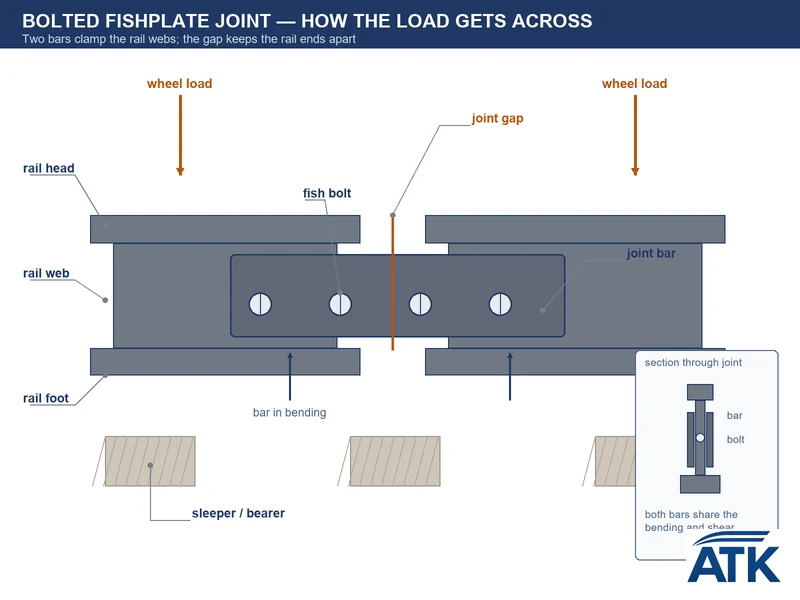
Measured stress in joint bars has been published from FRA-sponsored joint bar research and from tests at the Facility for Accelerated Service Testing. On a good foundation under a unit coal train, bending tensile stress at the bottom of the bar was about 170 MPa; on degraded ballast the same measurement reached 415 MPa. Thermal stress can add up to about 130 MPa and residual stress about another 130 MPa, with the published combined working figure near 410 MPa. Bars are sized and heat treated against numbers of that order, not against a nominal wheel load divided by two.
Three properties then decide whether a particular bar is the right one. The section has to match the rail, because the fishing angles, bar depth and hole positions are cut for one profile. The steel has to survive repeated bending without cracking from the bottom edge or from a bolt hole. And the joint has to be assembled at the right gap and the right torque, because a loose joint turns a bar into a hammer and a rail end into an anvil.
The difference between a plain railway fishplate and the bars used on crane runways is not cosmetic. A crane runway bar follows a QU or DIN section and a runway detail, and those crane rail fishplates are specified from a different set of drawings. Ordinary track bars follow the rail standard named in the contract and the drilling that goes with it. The two families share a name and a function, and almost nothing else.
Four words describe the same component. Fishplate is the British and international term and the one most tenders use. Joint bar is the North American term and the one AREMA uses. Splice bar appears in older specifications and in some export contracts. Angle bar is the older British trade name, still heard on light rail and industrial sidings.
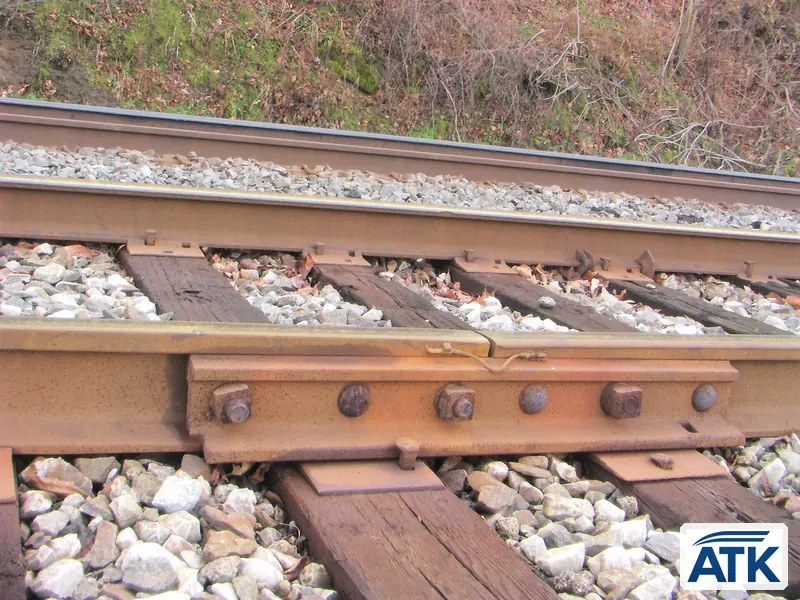
The word fishplate does not come from fish. It comes from the fish, the reinforced joint used in early bullhead track, and the plate that clamped it. Bullhead rail needed a chair and a pair of plates that sat in the fishing planes on either side of the web. Flat-bottom rail kept the idea and changed the geometry. The modern bar sits inside the fishing chamber, under the head and above the foot, and its contact faces are shaped to the rail profile rather than flat.
A purchase specification should pick one word and then give the drawing number. "Joint bar for 60 kg/m rail" does not define a bar, because the rail section alone leaves the bar length, hole count, hole pitch, hole shape, contact face profile and material open. Two suppliers can both quote a 60 kg/m bar and deliver parts that will not interchange.For the UIC54 (54 E1) and UIC60 (60 E1) sections in particular, the drawing-based approach is set out on the UIC54 and UIC60 fishplates page, with the compatible sections, hole arrangements and inspection checks.
Four variants cause most of the confusion at enquiry stage.
A standard bar joins two rails of the same section. A compromise bar, also called a transition bar, joins two different sections — 115RE to 90 lb, UIC54 to UIC60, 50 kg/m to 60 kg/m — and is machined or forged to a different profile on each half, with the two running surfaces lined up.When the choice itself is the question - whether a compromise joint is needed, how the two profiles and hole patterns are matched, and what the drawing must fix - see the compromise fishplates guide.
A joggled bar is set for emergency or temporary repair of a broken rail or a failed weld. It is shaped to clear the rail head on the running surface side and is designed to be fitted quickly at reduced line speed, not to become a permanent joint.
An insulated bar separates the two rail ends electrically so that a track circuit can work. The steel bar stays, and insulation is added at the contact faces, the bolt holes and the end post. Where the assembly is bonded with structural epoxy it is a glued insulated rail joint rather than a plain bar with insulating washers, and it is specified as an assembly with its own test requirements.
The first thing to settle in a tender is what kind of document is being cited. Three layers get mixed up constantly. Material standards describe how the steel is made. Product standards describe the bar as a delivered item, including holes and tests. Joint-level standards describe the bars, bolts, insulation and assembly performance together. A supplier who claims a joint-level approval for a loose bar has misunderstood one of the three.
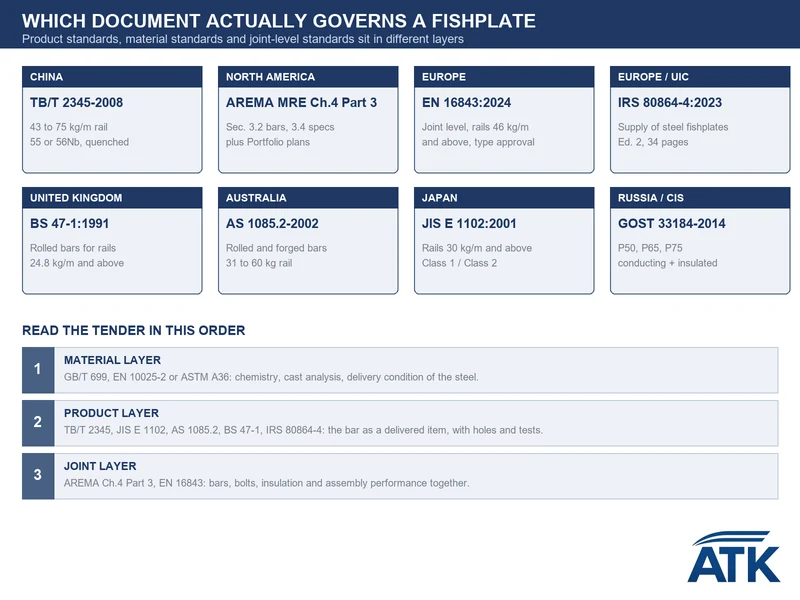
China has a product standard written for exactly this part. TB/T 2345-2008, 43 kg/m to 75 kg/m rail joint bar — technical specifications for the procurement, was issued on 6 September 2008, took effect on 1 December 2008, and replaced TB/T 2345-1993. It covers bars for 43, 50, 60 and 75 kg/m rail, and it goes further than most: steelmaking route, two permitted grades, dimensional forms and gauges, mechanical properties, macrostructure, decarburisation depth, non-metallic inclusions, surface quality, test methods, inspection rules and retest rules.
North America works from recommended practice rather than a product standard. AREMA's Manual for Railway Engineering carries the joint material in Chapter 4, Rail, Part 3, Joining of Rail: §3.1 on the general characteristics of a rail joint, §3.2 on joint bars and assemblies, §3.3 on rail drillings and bar punchings, and §3.4 on quenched carbon-steel bars, microalloyed bars and forged compromise bars. Section 3.5 covers track bolts and nuts, 3.6 spring washers, and 3.8 and 3.9 bonded and encapsulated insulated joints. Bar outlines and drilling details come from the Portfolio of Trackwork Plans. It is recommended practice, but a North American contract that names it makes it contractual.A system-level reading of that split is set out in **AREMA vs UIC Fish Plates**.
Europe now has a joint-level standard. EN 16843:2024, Railway applications — Infrastructure — Mechanical requirements for joints in running rails, covers flat-bottom rails of 46 kg/m and above, insulated and non-insulated fish-plated joints, and both stressed rail in continuous welded track and unstressed rail in jointed track. It sets mechanical and electrical requirements for type approval and for acceptance of insulated joints, whether factory-built or assembled on site. It deliberately excludes temporary joints, expansion devices covered by EN 13232-8, and the special joints inside switch constructions. The German version was published in April 2024.
For supply terms, UIC's own document is the reference most European operators still quote: IRS 80864-4, edition 2 of 2023, Supply of steel fishplates. It consolidates the content of UIC leaflets 864-4, 864-8 and 864-9 into a 34-page International Railway Solution.
The rest of the market falls back on long-lived national documents. BS 47-1:1991 covers rolled fishplates for rails of 24.8 kg/m (50 lb/yd) and above and explicitly leaves forged and cast bars outside its requirements; it remains the reference behind BS75R to BS113A bars. AS 1085.2-2002 covers bar-type rolled or forged fishplates used with rails rolled to AS 1085.1, gives full profiles for rolled bars from 31 to 60 kg rail and for forged bars at 50 and 60 kg, and sets out chemical composition, holes for fishbolts, tolerances, mass per pair, mechanical properties and a compliance appendix. JIS E 1102:2001 covers fishplates for rails of 30 kg/m and above and splits them into Class 1, unheat-treated, and Class 2, quenched and tempered, with acceptance testing at the manufacturer's works and a progressive sampling plan. GOST 33184-2014 covers double-headed bars for P50, P65 and P75 broad-gauge rail, for both conducting and insulating joints, and replaced three older Soviet-era documents in 2015. Germany keeps DIN 5902:1995 for fishplates on flat-bottom rails up to 54 kg/m.
India is the market where the drawing matters more than the standard number. Indian Railways works to IRS T-1 together with RDSO drawing numbers issued per rail section, and the standard, joggled and insulated variants each have their own drawing.
One practical note. Suppliers publish comparison tables that put a Chinese grade against a European or American grade and print the numbers side by side. Treat those tables as a starting point for a conversation, not as equivalence. TB/T 2345 grades its steel by chemistry and heat treatment; EN 10025-2 grades by minimum yield strength; ASTM grades by chemistry and tensile range. A substitution has to be proposed in writing and approved by the buyer.
TB/T 2345-2008 permits two grades, and the difference between them is instructive. Grade 55 is a plain medium-carbon steel: carbon 0.52 to 0.60 %, manganese 0.50 to 0.80 %, silicon 0.17 to 0.37 %, phosphorus and sulphur at 0.035 % maximum. Grade 56Nb adds niobium at 0.015 to 0.050 % and lifts silicon to 0.20–0.40 %. The niobium refines the grain, which shows up in the mechanical table.
For grade 55 the standard asks for a tensile strength of at least 785 MPa, yield of at least 520 MPa, elongation of at least 9 %, reduction of area of at least 20 %, hardness between 227 and 388 HBW, and a cold bend of 30° at a mandrel of three times the thickness with no cracking. Grade 56Nb raises the same figures to 845 MPa, 530 MPa, 10 %, 30 % and 235–388 HBW.
Read the hardness range carefully. It is wide on purpose. The bar has to be hard enough to resist wear at the contact faces and tough enough not to crack at the bottom edge, and those two demands pull in opposite directions. A supplier who quotes a single hardness number for all bars is describing one heat, not a specification.
Heat treatment is where most of the performance comes from, and it is not optional in either Chinese grade. The standard requires the bars to be quenched in hot water or oil and self-tempered, which is what produces that 227–388 HBW band in a bar rolled from 0.55 % carbon steel. JIS E 1102 draws the same line from the other direction by splitting fishplates into Class 1 and Class 2. AREMA §3.4 is written specifically for quenched carbon-steel bars, with separate clauses for microalloyed and forged compromise bars.
Outside those documents the market quotes a wider set of grades: 40#, 45#, 50# and 55# carbon steels, S355J2 to EN 10025-2, 60Mn and 60Si2Mn for heavier sections, and Q235B or S235 for light industrial and narrow-gauge work. What the bar actually gets is decided by the section and the duty. A Q235B bar for a siding and a 56Nb quenched bar for a 25-tonne axle mainline are both called fishplates, and they are not the same product.
Three other material points belong in the conversation. Killed steel from an electric furnace or a basic oxygen converter is a requirement in TB/T 2345, and it matters because a rimmed or inadequately deoxidised steel carries inclusions that become crack starters in a bar that flexes millions of times. Decarburisation on the surface is limited to 0.5 mm in the same standard, because a soft skin at the contact face wears and frets. Non-metallic inclusions are capped at level 2.5 for sulphides and 2.0 for oxides, silicates and globular oxides, which is the sort of clause that separates a bar specification from a steel order.
If the bar is part of a fastening package, the surrounding components are covered separately: the rail fastenings category lists the clips, pads and plates that work with the same rail, and their material standards are not interchangeable with the bar's.
Two forming routes are in use, and both produce a serviceable bar. The choice is commercial as much as metallurgical.
Rolling is the route for long runs of one section. A billet or bloom is reheated and passed through a series of rolls that form the bar profile, and the bar comes out as a continuous length that is cut to size. AS 1085.2 sets out full development profiles for rolled bars from 31 to 60 kg rail, which is a fair indication of how standardised the route is. Rolling gives a consistent section, a good surface, and a low unit cost once the rolls exist.
Forging is the route for heavy sections, compromise bars and short runs. A heated billet is shaped in a die, which allows a section that changes along the length — exactly what a transition bar needs, with one profile at one end and a different profile at the other. AS 1085.2 gives forged profiles for 50 and 60 kg rail; AREMA §3.4 has a clause for forged compromise bars; the Indian joggled bars are forged and then machined.
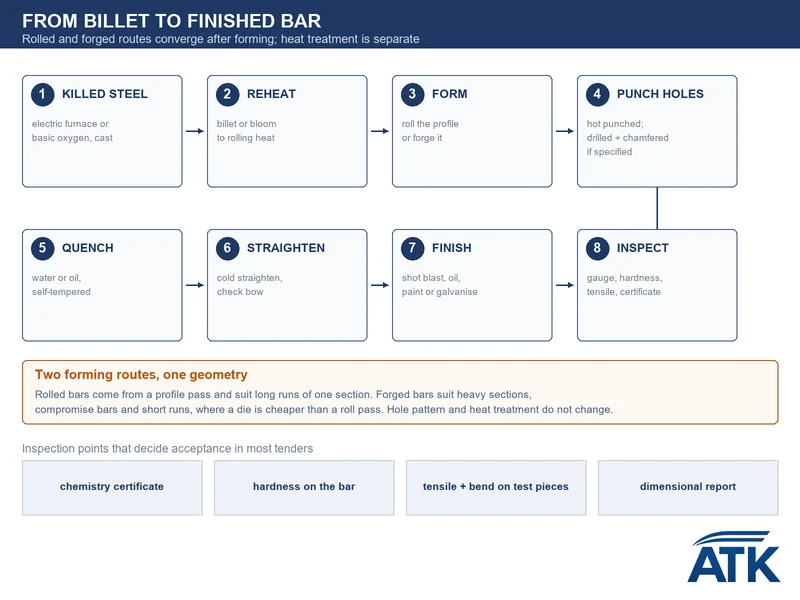
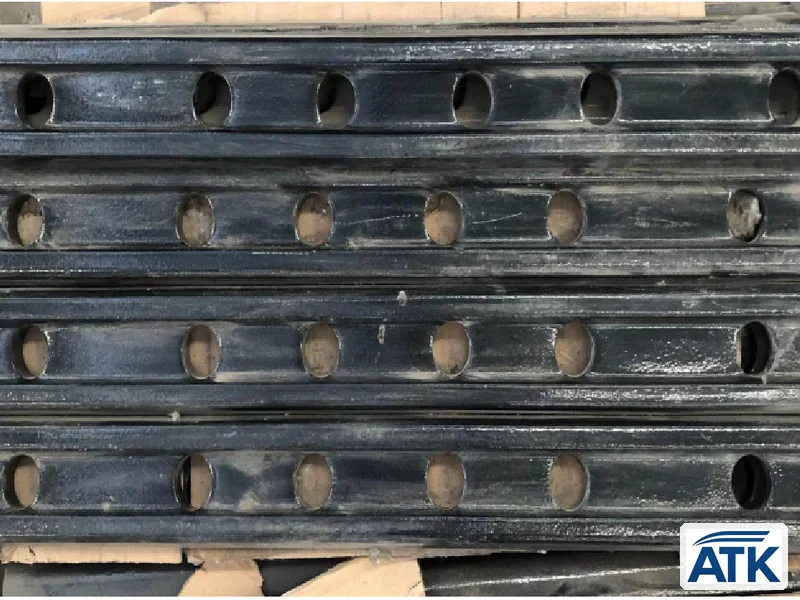
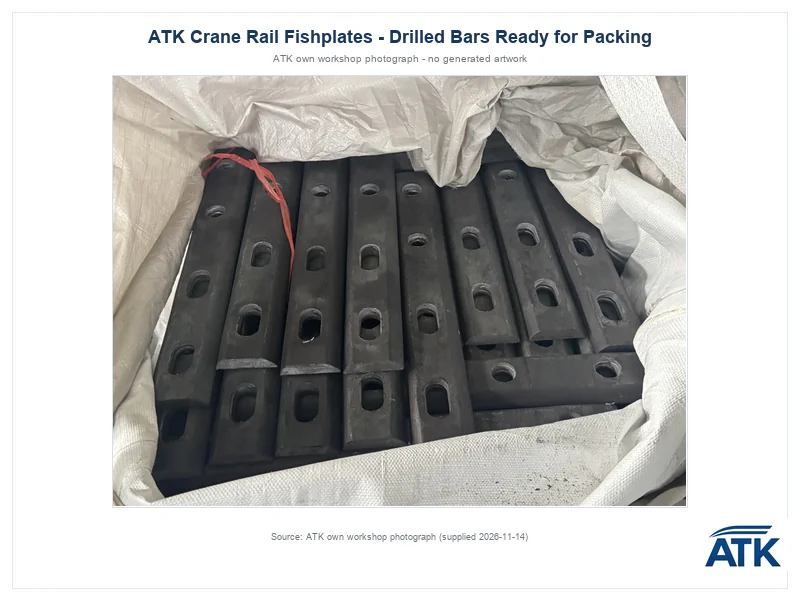
Holes come next, and the standard is specific about how. TB/T 2345 requires bolt holes to be punched hot, or drilled and then chamfered, with the hole centre line perpendicular to the side face of the bar. Hot punching is fast and leaves a hardened, slightly tapered hole; drilling is slower and gives a cleaner bore with a controlled diameter. Both are acceptable, and the choice is normally visible in the price and in the hole finish. What is not acceptable is a punched hole with a torn exit, a burr at the edge, or a hole that has been drilled off-centre and opened out to hide it.
Quenching follows, in hot water or oil with self-tempering, and then straightening. TB/T 2345 allows cold straightening but requires the bar to be free of twist afterwards, and it puts limits on bow in both the height and the plan direction. A bar that is straight enough to look right and still out of flat will not sit on both rail webs at once, and a bar that only touches at the ends will rock under load.
Finishing depends on the exposure. Plain oiled bar is normal for export packing. Oxide black comes from the rolling and quenching sequence. Paint is common on bars for visible track and for stock identification. Hot-dip galvanising to ISO 1461 is specified where the joint sits in a corrosive environment, and it needs care, because a thick zinc layer on a contact face changes the fit and can be damaged during tightening. The coating decision belongs on the drawing together with the thickness.
Marking closes the loop. TB/T 2345 requires bars to be marked and to come with a quality certificate. In practice that means the section designation, the heat number and the year rolled, stamped or rolled into the face of the bar. Buyers who have been through a failed batch tend to add one more requirement: the marking has to be readable after the coating is applied.
An enquiry that says "fishplate for 60 kg rail" will produce a quotation and, more often than not, a second round of questions. Six items decide the answer, and none of them can be inferred from the rail weight alone.
Rail section and standard edition. Sixty kilos per metre means different things in China, Europe and Australia. TB/T 2345 covers Chinese 60 kg/m rail; UIC60 has its own profile and its own drilling; AS 1085.2 60 kg is another section again. The rail drawing number, or the standard the rail was rolled to, settles it.
Joint type. Standard, compromise, joggled, insulated, or a heel bar for a switch. This is the single largest driver of price, because a compromise or joggled bar is machined or forged rather than rolled as a plain profile.
Bar length and hole pattern. Four holes at roughly 610 to 630 mm or six holes at roughly 790 to 915 mm covers most of the market, but the pitch, the end distance and the hole diameter have to match the rail drilling, and oval holes have to match oval-neck bolts. A bar with the right length and the wrong pitch is scrap.
Material and heat treatment. Which grade, and whether the bar is supplied as-rolled or quenched and tempered. If the contract names TB/T 2345 or JIS E 1102 Class 2, heat treatment is not a cost option; it is the specification.
Bolt set. Diameter, property class, head type and whether spring washers are included. The bolts are part of the joint, and a bar drilling that does not match the bolt shank will either rattle or refuse to assemble.
Documentation and inspection. A mill certificate alone, or certificate plus dimensional report plus third-party witness. This changes the price far more than most buyers expect, because it changes the amount of testing and the amount of material held for retest.
Two more inputs change the answer at the margin. Quantity decides whether a forged bar is economic, since a die or a machining set-up has to be paid for. Destination decides the coating and the packing, because a joint bound for a coastal site and a joint bound for a dry inland yard do not need the same finish.
A fishplate drawing does not need to be beautiful. It needs to be complete enough that two suppliers produce interchangeable parts. Fourteen dimensions and notes cover it, and the ones most often left out are at the end of the list.
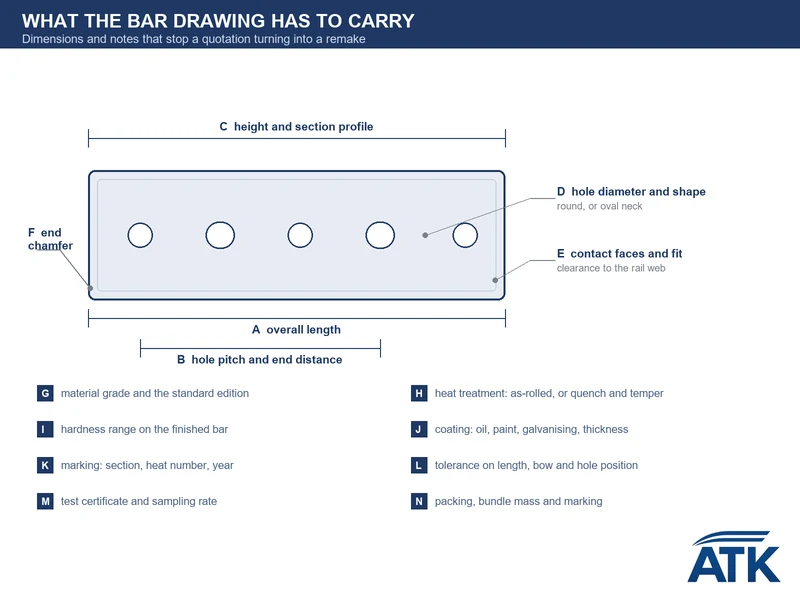
Overall length. Hole pitch and end distance, measured from a stated datum rather than from whichever end is convenient. Height, plus the section profile at the contact faces that sit under the rail head and on top of the foot. Hole diameter and shape, round or oval, with the oval orientation stated. The fit of the contact faces to the rail web, as a clearance rather than a hope. End chamfer, because a sharp end catches on the rail foot during fitting.
Then the notes. Material grade and the standard edition it is ordered to. Heat treatment, as-rolled or quench and temper. Hardness range on the finished bar. Coating and its thickness. Marking. Tolerances on length, bow in two directions and hole position. The test certificate and the sampling rate that goes with it. Packing, bundle mass and bundle marking.
Two of those deserve a sentence each. Tolerance on hole position is not housekeeping: if the bar holes and the rail holes do not line up, the fitter either reams the hole or forces the bolt, and both shorten the life of the joint. Bow tolerance matters for the same reason, because a bowed bar touches the rail at two points and frets at the rest.
Where a real dimensional drawing is not available, a bar can still be quoted from a sample or from measurements taken off the installed joint: bar length, height, hole diameter, pitch, end distance and the contact face profile. Photographs help, but only alongside measured numbers. A photograph on its own cannot tell a 24 mm hole from a 26 mm hole, and that difference decides whether the joint assembles on site.For the six measurements that make such a record usable, and the order the checks should follow, see the UIC54 vs UIC60 fishplate guide.
The same rail can carry a bar that lasts fifteen years and a bar that fails in two, depending on what the joint is asked to do. Six conditions do most of the work, and each one has a piece of information the buyer has to supply.
Axle load sets the bending demand. A joint under 25-tonne axles sees a much larger stress cycle than one under 12-tonne axles, and the fatigue detail that governs a fishplate is at the bottom edge and at the bolt holes. Cumulative tonnage then decides how many of those cycles arrive. A heavy-haul line moving 60 million gross tonnes a year puts more cycles through one joint in twelve months than a rural branch line puts through in a decade, which is why replacement intervals on the two are not comparable even when the bars are identical.
Curve radius changes the direction of the load as well as its size. On tight curves the bar sees lateral force against the contact faces and the bolt group carries a shear it was not primarily designed for. Joints in curves are the ones that come out of the track first, and published test work shows a higher stress state and more maintenance on curved track than on tangent.
Welded track changes the longitudinal picture. Where a joint sits inside continuous welded rail it carries thermal force that a jointed track joint never sees, because the rail cannot move. Insulated joints welded into CWR behave like the surrounding rail and can develop considerably higher thermal stress than a standard bolted joint, which is one reason the insulated family has its own standards and its own testing.
Support under the joint is the condition most often ignored in a quotation. A void under the sleeper next to the joint turns a smooth load transfer into an impact, and the 415 MPa figure quoted earlier came from exactly that condition. Bars cannot fix a soft foundation, but a heavier bar and a higher torque can buy time until the ballast is tamped.
Corrosion and temperature close the list. Pitting at a contact face or a hole edge becomes a crack starter in a part that flexes. And the temperature range fixes the joint gap: too little gap in summer puts the rail ends into compression, too much in winter lets them hammer.
Condition | Why it changes the bar | What to state in the enquiry |
Axle load and wheel load | Sets the bending and shear demand at the bar bottom and the bolt holes | Design axle load, and the line category the operator uses |
Cumulative tonnage (MGT) | Drives fatigue life and the replacement interval | Annual gross tonnage and the design life expected |
Curve radius | Lateral force works the contact faces and the bolt group | Minimum radius, cant and line speed |
Welded or jointed track | CWR adds longitudinal force the bar must carry | Whether the joint sits in CWR, and the rail neutral temperature |
Support under the joint | A void under the sleeper multiplies impact load | Sleeper type and spacing, ballast or slab condition |
Corrosion exposure | Pitting at faces and hole edges starts fatigue cracks | Coastal, tunnel, mining, de-icing salt or wash-down exposure |
Temperature range | Sets the gap and the thermal stress in the joint | Installation temperature and the seasonal range |
Signalling | An insulated joint is an electrical component too | Track circuit type and voltage class |
Maintenance access | Joints in pits or under end stops are checked rarely | Access constraints and the inspection regime |
A fishplate is easy to inspect badly. It looks right, it weighs right, and it can still be the wrong steel with a soft skin and a crack starter at a hole edge. The tests that catch that are not exotic, and most of them are already written into the product standards.
Chemistry comes first, by ladle analysis at the steelworks and by product analysis on the finished bar. TB/T 2345 fixes the composition ranges for both permitted grades and points to the permitted deviations for product analysis. In practice the certificate of the heat is the document that matters, because it follows the bars through the works.
Tensile testing gives the four numbers that appear in every quotation table: tensile strength, yield strength, elongation and reduction of area. The Chinese figures for grade 55 are 785 MPa, 520 MPa, 9 % and 20 % minimum; for 56Nb they are 845 MPa, 530 MPa, 10 % and 30 %. AS 1085.2 and JIS E 1102 set their own values and their own test pieces, which is why a bar cannot be called compliant with two product standards at once unless both are tested.
The cold bend test is the one that most often finds a bad heat. A bar is bent 30° around a mandrel three times its thickness and inspected for cracks. Steel that meets the tensile numbers but has been quenched too hard will fail here, and that is the point of the test.
Hardness is measured on the finished bar, normally in Brinell, and the permitted band is wide by design: 227 to 388 HBW for grade 55. A reading inside the band says the heat treatment ran. A single number quoted for the whole order says nothing.
Three metallurgical checks catch problems invisible to the eye. Macrostructure is assessed against the quality steel clauses of GB/T 699. Decarburisation depth at the surface is limited to 0.5 mm, because a soft skin at a contact face wears and frets. Non-metallic inclusions are counted, with sulphides capped at level 2.5 and oxides, silicates and globular oxides at 2.0. None of these show up in a dimensional check, and all three lead to cracking in service.
Dimensional inspection then checks the drawing: length, height, hole diameter, hole pitch, end distance, bow in the height and plan directions, and the contact face profile. Gauges and callipers do the work, and the records matter more than the instrument.
Visual inspection has its own clauses. No cracks, folds, blisters, inclusions or scabs on the surface. No filling or welding of defects — a bar with a welded-up defect is not a bar. No burrs at the ends or around the bolt holes, because a burr stops the bar seating and a seated bar is the whole point.
Where the bar is coated, coating thickness and adhesion are checked to the named standard — ISO 1461 for hot-dip galvanising. Where ultrasonic testing is required it is written into the technical agreement, because neither TB/T 2345 nor AS 1085.2 asks for it as routine, and offering it as a default would misstate what a normal batch receives.
Sampling and retest rules are part of the specification, not an administrative detail. JIS E 1102 carries a progressive sampling plan by the Wald method and a separate plan for resubmitted batches; AS 1085.2 has an appendix on the means of demonstrating compliance, including statistical sampling and product certification. A buyer who has not read those clauses can end up arguing about a batch that was, technically, accepted.
No standard assigns a service life to a fishplate, and any supplier who quotes one in years is guessing. The reason is in the maintenance practice: bolted bars are taken out, checked and put back, so the question is not how long a bar lasts but how long it stays in acceptable condition.
The usable data is in gross tonnage, not years. A survey of bonded insulated joints on a line carrying 45 to 58.5 million gross tonnes a year reported a projected median life of 155 MGT for 150 joints. An AREMA Committee 4 survey put the average life of bonded insulated joints at 252 MGT in tangent track and 207 MGT in curved track, across mainline track above 18 MGT a year. Analytical work suggests plain bolted bars fall in a similar range under heavy haul, and the FAST testing at Pueblo is consistent with that. Set those figures against a rail life of 900 to 1,800 MGT, and the same joint position may be renewed three to six times over the life of the rail.
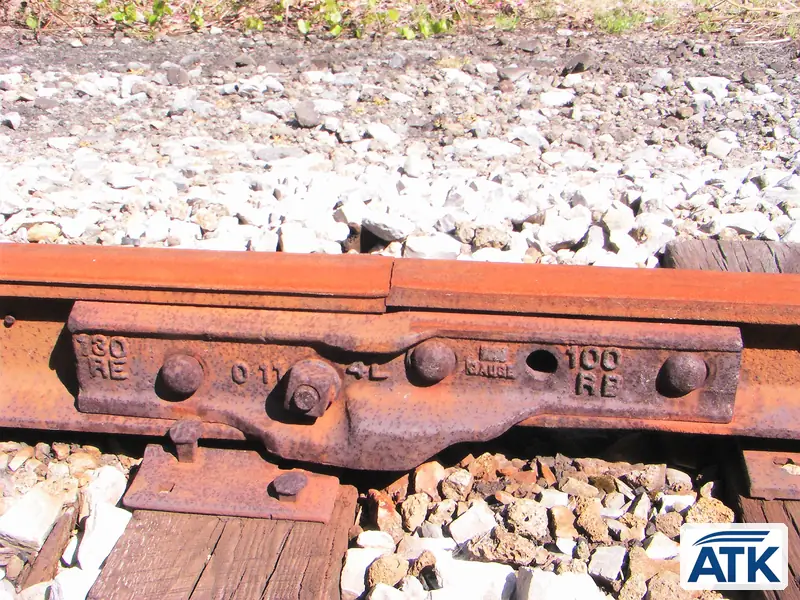
Insulated joints are the weakest members of the family and set the floor. Research on high-axle-load routes records insulated joints being replaced in as little as 12 to 18 months after roughly 200 MGT, and describes them as having the lowest service life of any running-surface component, switch points and crossing vees included. That is a property of the discontinuity and the end post, not a criticism of any one supplier.
Failure modes are worth knowing because they tell you what to look at. Cracks starting at the top edge of the bar grow slowly in a compressive field and are usually found before anything breaks. Cracks starting at the bottom edge grow in a tensile field and can break the bar before they are seen. Bolt hole cracks are common. Rail end battering at the joint face is the other routine finding, and it belongs to the rail rather than to the bar.
So replacement is condition-based: bar cracks, worn or fretted contact faces, elongated holes, damaged insulation, and a measured step or gap outside the line limit. Axle load, tonnage, curve radius and foundation condition set how often those checks need to happen. The bar specification can raise the ceiling; it cannot make the joint immortal.
A correct bar fitted badly performs worse than a cheap bar fitted well. Four steps carry most of the outcome.
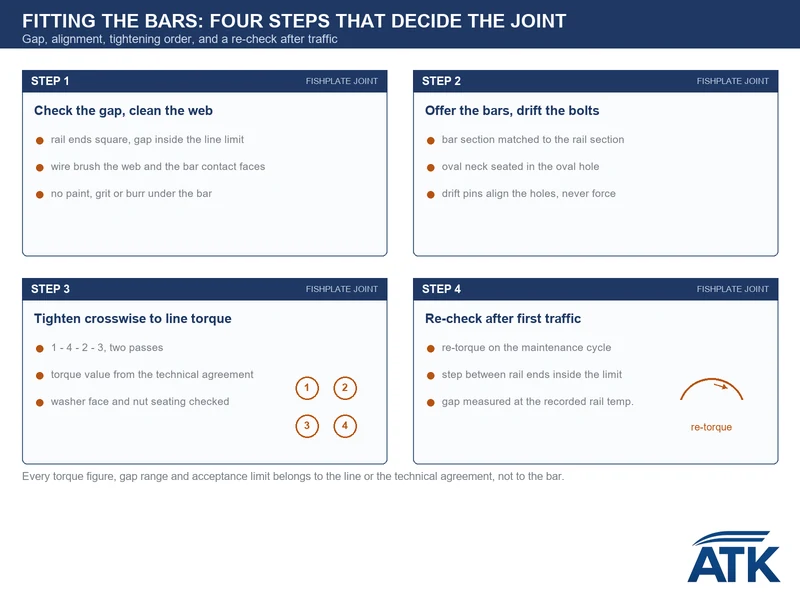
Check the gap and clean the surfaces. The rail ends should be square, the gap inside the limit set for the rail temperature, and the web and the bar contact faces free of paint, grit, scale and burr. A bar tightened onto grit is a bar that will fret.
Offer the bars and drift the bolts. The bar section has to match the rail section. Oval holes take the oval neck of the bolt, which stops the bolt turning while the nut is tightened; round holes take the threaded end. Drift pins align the holes before the bolts go in. Forcing a bolt through a misaligned hole reams the hole and removes the very material that carries the load.
Tighten crosswise, in two passes, to the torque in the technical agreement. The pattern matters more than the number of passes: working from one end of the bar drives the bar along the rail and leaves the far end loose. Torque values are line-specific and belong to the technical agreement or the infrastructure owner's standard, not to a catalogue. The bolt grade, the washer arrangement and the locking method are part of the same decision, and the railway track bolts page covers those in detail.
Re-check after traffic. Bolts settle, coatings crush, and a joint that was tight at handover is often not tight after the first thousand tonnes. Re-torque on the maintenance cycle, measure the step between rail ends, and record the gap against the rail temperature at the time of measurement.
Two habits prevent most joint problems. Keep the bars in pairs and do not mix old and new on the same joint, because a stiff bar opposite a worn one loads the bolts unevenly. And keep the foundation right: tamping under the joint does more for bar life than any change to the bar itself.
A quotation can be built from a drawing, a sample, or a set of measured numbers and photographs. What it cannot be built from is a rail weight on its own.
Send the rail section and the standard edition, the joint type, the bar length and drilling, the material grade and heat treatment, the bolt set, the coating, the quantity, the destination, and the documentation you need. If the drawing no longer exists, measure bar length, height, hole diameter, pitch, end distance and the contact profile of an unworn bar, and add photographs of the installed joint.
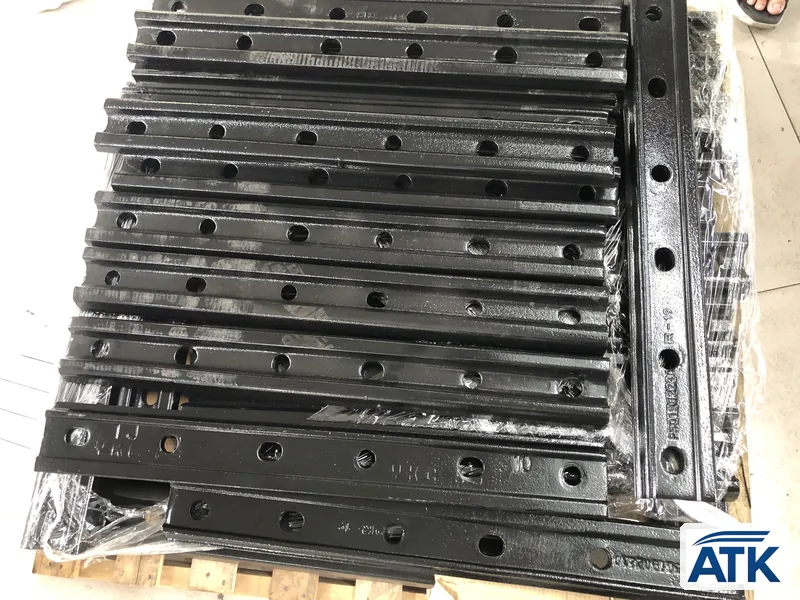
Bars travel as bundles on timber pallets, strapped and wrapped, with the bundle marked to match the packing list. Coated bars need interleaving or edge protection, because a galvanised contact face that has rubbed through in transit is a corrosion site from day one. Marking on the bar itself should survive the coating and the voyage: section designation, heat number and year.
Documentation is normally a mill certificate for the heat, a dimensional inspection report for the batch, and a coating certificate where coating is specified. Third-party inspection can be arranged to a buyer's scope when it is agreed before production rather than after. No inspection record or third-party report is claimed here as standard: both are order-specific and confirmed with the technical agreement.
Where a project names AREMA, EN 16843, IRS 80864-4, BS 47-1, AS 1085.2, JIS E 1102 or GOST 33184, the edition and the part should be confirmed in writing before the first bar is rolled, because the same standard number can mean a different requirement in a different edition. Send the drawing and the duty information through the contact us page and the specification will be confirmed before quoting.
Item | Basis |
Product | Railway fishplate / joint bar / splice bar, in standard, compromise, joggled and insulated form |
Rail sections | 43 to 75 kg/m Chinese rail, UIC54 and UIC60, BS75R to BS113A, AS 1085.1 sections 31 to 60 kg, JIS 30 to 60 kg, 115RE to 141RE, P50 to P75, to the rail named on the drawing |
Bar length | 4-hole about 610 to 630 mm, 6-hole about 790 to 915 mm, or to the drawing |
Hole pattern | Hole diameter, pitch, end distance and shape to the rail drilling; round or oval neck |
Material | Grade 55 or 56Nb to TB/T 2345-2008; other grades quoted to the standard named in the contract |
Steelmaking | Killed steel, electric furnace or basic oxygen converter, cast and rolled or forged |
Heat treatment | As-rolled, or quenched in water or oil and self-tempered |
Tensile strength | 785 MPa minimum (grade 55), 845 MPa minimum (56Nb) |
Yield strength | 520 MPa minimum (grade 55), 530 MPa minimum (56Nb) |
Elongation | 9 % minimum (grade 55), 10 % minimum (56Nb) |
Reduction of area | 20 % minimum (grade 55), 30 % minimum (56Nb) |
Hardness | 227 to 388 HBW (grade 55), 235 to 388 HBW (56Nb) |
Cold bend | 30° at mandrel d = 3a, no crack |
Surface finish | Plain oiled, oxide black, painted, or hot-dip galvanised to ISO 1461 |
Tests | Chemistry, tensile, cold bend, hardness, macrostructure, decarburisation, inclusions, dimensions, visual |
Marking | Section designation, heat number and year, surviving the coating |
Packing | Strapped bundles on timber pallets, wrapped, marked to the packing list |
Documentation | Mill certificate, dimensional report, coating certificate where applicable |
Yes for most practical purposes. Fishplate is the term used in Britain and in most international tenders; joint bar is the North American term and the one AREMA uses; splice bar and angle bar are older names for the same part. The component is a pair of steel bars bolted to the rail webs across a joint. What matters in a purchase order is the rail section and the drilling, not which of the four words is used.
No. Bar depth, fishing angles, contact faces and hole positions are cut for one rail profile, and a bar for 60 kg/m rail will not seat on a 50 kg/m rail web. Where two different sections have to be joined — 60 kg/m to 50 kg/m, or 115RE to 90 lb — the part is a compromise or transition bar, machined or forged to a different profile on each half.
Six-hole bars carry more bending moment over a longer length and are the norm on mainline and heavy-haul track; four-hole bars are common on lighter rail, industrial track and where the rail drilling is fixed at four holes. The deciding factor is the rail drilling, because the bar cannot have more holes than the rail. Bar length follows the hole count.
Heat treatment raises strength and wear resistance at the contact faces. TB/T 2345-2008 requires both of its grades to be quenched and self-tempered; JIS E 1102 splits fishplates into Class 1, unheat-treated, and Class 2, quenched and tempered. As-rolled bars still appear on light rail and low-duty industrial track, where the extra cost buys nothing.
It joins two rails of different sections while keeping the running surfaces and the gauge line aligned. One half of the bar is shaped for the heavier rail, the other for the lighter one, and the offset is not symmetrical, so the hand of the bar has to be stated on the order. A compromise bar is machined or forged rather than rolled as a plain profile.
Emergency and temporary repair. A joggled bar is shaped to clear the rail head on the running surface side, so it can be fitted over a broken rail or a failed weld quickly, at reduced line speed, until a permanent repair is made. It is not intended as a permanent joint and should not be specified as one.
It depends on the market. China has TB/T 2345-2008 as a product standard. North America uses AREMA Manual for Railway Engineering Chapter 4, Part 3, with bar details from the Portfolio of Trackwork Plans. Europe has EN 16843:2024 at joint level and IRS 80864-4:2023 for supply terms. The UK works to BS 47-1, Australia to AS 1085.2, Japan to JIS E 1102, Russia and the CIS to GOST 33184, and Germany to DIN 5902 for rails up to 54 kg/m. The plates themselves are covered on their own page: GOST 33184 fishplates for R50, R65 and R75, with the 1R-65 and 2R-65 designations and the three documents that standard replaced.
They can. The bolt set is part of the joint, not an accessory: diameter, property class, head type, washer and locking method all affect how the joint holds torque. Bolts are normally quoted with the bars so that the drilling and the bolt shank are matched at the works rather than on site.
Usually, yes. Measure bar length, height, hole diameter, hole pitch and end distance on an unworn bar, and record the contact face profile against the rail. Photographs of the installed joint and of the bar on its own help, but they have to come with measured numbers. A photograph cannot separate a 24 mm hole from a 26 mm one.
A mill certificate for the heat, a dimensional inspection report for the batch, and a coating certificate where coating is specified. Chemistry, tensile, cold bend, hardness, macrostructure, decarburisation and inclusion checks are the tests the product standards call for, with sampling and retest rules set by the same standards. Third-party inspection is arranged to the buyer's scope when it is agreed before production.
There is no standard figure in years, and bolted bars are reused, so the honest answer is condition-based. Published data is in gross tonnage: bonded insulated joints average around 250 MGT in tangent track and 200 MGT in curves, with the weakest sites replaced after roughly 200 MGT. Plain bars are expected to fall in a similar range under heavy haul. Axle load, tonnage, curve radius and foundation condition set the actual interval.
The rail section and standard edition, the joint type, bar length and drilling, material grade and heat treatment, bolt set, coating, quantity, destination and the documentation you require. A drawing or a sample shortens the process; measured dimensions and photographs of the installed joint are enough to start.
Dimensions, material grades, hole patterns, heat treatment, coating, test methods and inspection criteria are project-specific. They are confirmed against the approved drawing and the technical agreement. No universal catalogue dimensions, performance ratings or service intervals are implied on this page.
This page was put together by the rail fastening and trackwork engineering team at ATK, working from bar drawings, workshop records and the reference photographs used to illustrate the joint types. Standard numbers, editions and scopes were checked against the AREMA Manual for Railway Engineering table of contents for Chapter 4, the UIC shop listing for IRS 80864-4, the DIN notice for EN 16843:2024, the Standards Australia and JIS records for AS 1085.2 and JIS E 1102, the Rosstandart listing for GOST 33184, the text of TB/T 2345-2008, and published joint bar and insulated joint research from FRA-sponsored test programmes and AREMA committee surveys. Where a source is a supplier catalogue or a research paper rather than a standard, the text says so rather than presenting it as a requirement.
We have recommended some of our Related products to you. I hope you will be interested.
 English
 Русский