
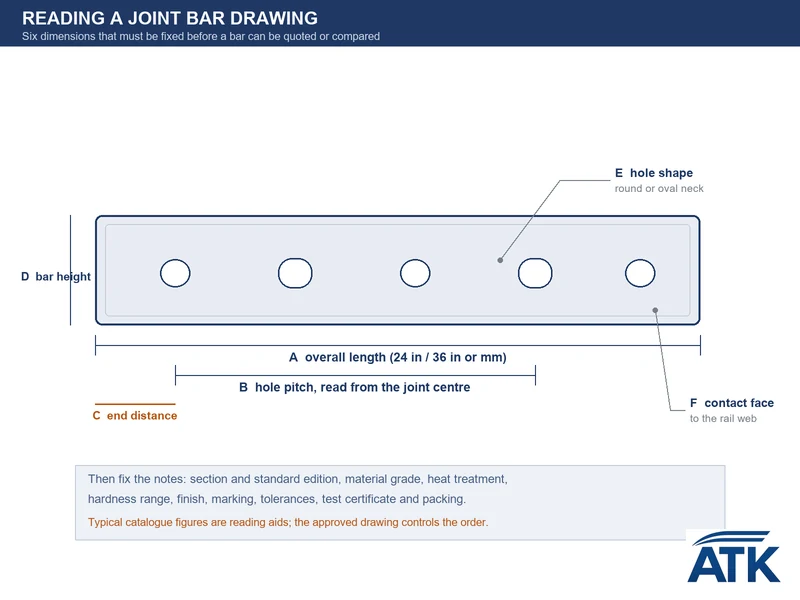
Fish plate is the plain steel bar that carries load across a bolted rail joint
AREMA joint bars sit in MRE Chapter 4 Part 3 practice and plans, not one supply standard
UIC fishplates are supplied to IRS 80864-4 edition 2 (2023)
Old UIC leaflets 864-4, 864-8 and 864-9 were consolidated, not kept as three current documents
Rail section and drilling decide the bar before any grade is named
Six drawing fields: length, pitch and end distance, hole shape, bar height, material and documents
Typical catalogue dimensions are reading aids, not acceptance values
Bolt class, washer and torque belong to the joint assembly, not the bar alone
Insulated joints carry mechanical and electrical requirements in both systems
A fish plate is the steel bar bolted to the web of two rail ends to keep them aligned and carry wheel load across the gap. An enquiry that says "AREMA or UIC fish plate, please compare" usually means one of two things. Either the buyer has a rail section from one system and a supplier list from the other, or someone has copied a specification line without knowing which document it came from. Both cases need the same answer: these two names do not sit at the same level.
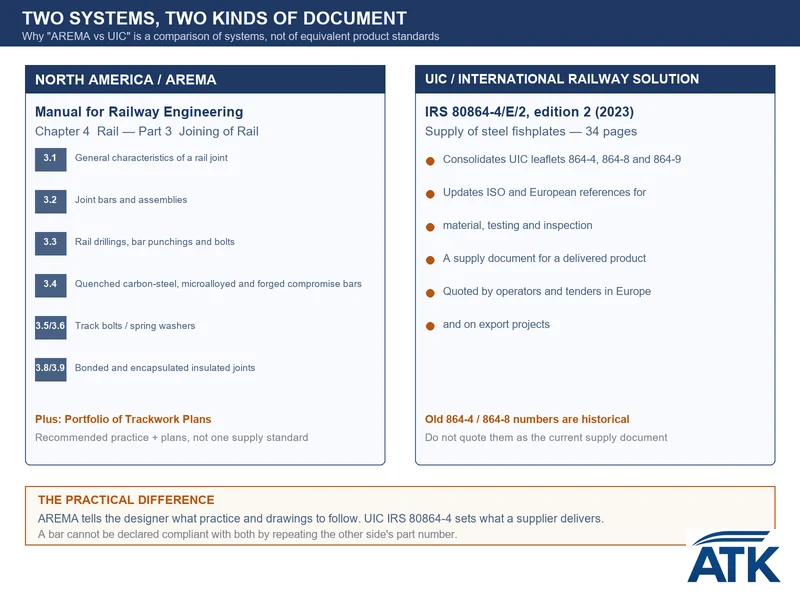
On the North American side there is no single product supply standard called "the AREMA fishplate standard". What exists is the Manual for Railway Engineering, Chapter 4, Rail, Part 3, Joining of Rail. Section 3.1 deals with the general characteristics of a rail joint, 3.2 with joint bars and assemblies, 3.3 with rail drillings and bar punchings, and 3.4 with quenched carbon-steel bars, microalloyed bars and forged compromise bars. Sections 3.5 and 3.6 cover track bolts and spring washers; 3.8 and 3.9 cover bonded and non-bonded insulated joints. Bar outlines and hole arrangements come from the Portfolio of Trackwork Plans. The manual is published as recommended practice, which becomes contractual only when a railway or a project names it in the specification.
The UIC side works differently. The current document is IRS 80864-4/E/2, edition 2 of 2023, Supply of steel fishplates, a 34-page International Railway Solution. It consolidates the old UIC leaflets 864-4, 864-8 and 864-9 and updates their references to ISO and European material, testing and inspection documents. It is a supply document for a delivered product, and it is what a European or export tender is likely to cite.
So the honest comparison is between a set of practice and plans on one side and a supply specification on the other. The two documents are not equivalent, and neither one replaces the approved drawing. A bar cannot be declared compliant with "both standards" by printing the other side's part number on the drawing. It can be made to a rail section, a drilling and a technical agreement that borrow from both, and that is a different thing.
The rest of this article follows that distinction. It explains what each document actually fixes, how the common rail sections and hole patterns are read, which material and inspection requirements belong where, and what information has to be on an enquiry before a supplier can quote a joint bar that fits.
Read the title of a document before reading its tables. Three quarters of the confusion in fishplate enquiries comes from treating a rail standard, a joint practice and a bar supply specification as interchangeable.
EN 13674-1 is a rail standard. Its scope is Vignole railway rails of 46 kg/m and above, for conventional and high-speed track. It defines profiles such as 60E1 and 60E2 and the steel grades used to roll them. It does not supply a fishplate. The same applies to JIS E 1101 for Japanese flat-bottom rail sections and to AS 1085.1 for Australian rail: they shape the rail that the bar must fit; they are not the bar's own delivery conditions.
AREMA Chapter 4 Part 3 sits one level closer to the joint. It describes joint characteristics, bars and assemblies, drilling and punching, quenched and microalloyed bars, bolts, washers and insulated joints. It tells the designer what practice to follow and the railway what to check. Detailed bar outlines are held in the Portfolio of Trackwork Plans, which is why a North American bar is normally identified by rail section and drilling rather than by a single document number.
IRS 80864-4 is a different instrument again. It is written for the supply of steel fishplates, with product requirements and references to current material and test standards. UIC's own publication page states that it integrates leaflets 864-4, 864-8 and 864-9. The old numbers still appear on many supplier websites, often side by side, but they are historical references, not three separate current documents.
Two national product standards are worth keeping in view because they show what a bar-only document looks like. BS 47-1:1991 covers rolled steel fishplates for rails of 24.8 kg/m (50 lb/yd) and above and explicitly leaves forged and cast bars outside its requirements. AS 1085.2-2002 covers bar-type rolled or forged fishplates for rails rolled to AS 1085.1, with full profiles for 31 to 60 kg rails. TB/T 2345-2008, in China, covers 43 to 75 kg/m rail joint bars with named steel grades, heat treatment, mechanical properties, decarburisation limits and inclusion limits. Those are bar standards in the same sense that IRS 80864-4 is a bar supply document. AREMA is not.
The practical consequence is simple. When a tender cites AREMA, ask which section, which plan and which railway specification. When it cites IRS 80864-4, ask for the edition and the rail profile. When it cites EN 13674-1, ask which rail profile the bar has to match, then stop treating that standard as a fishplate certificate.
Joint bars are cut to one rail profile, not to a weight class. Change the section and the bar height, fishing faces, length and hole layout all change with it. A bar made for UIC60 will not seat correctly on a Chinese 60 kg/m rail even though both carry "60 kilo" in their names. A 115RE bar will not line up with 132RE drilling.
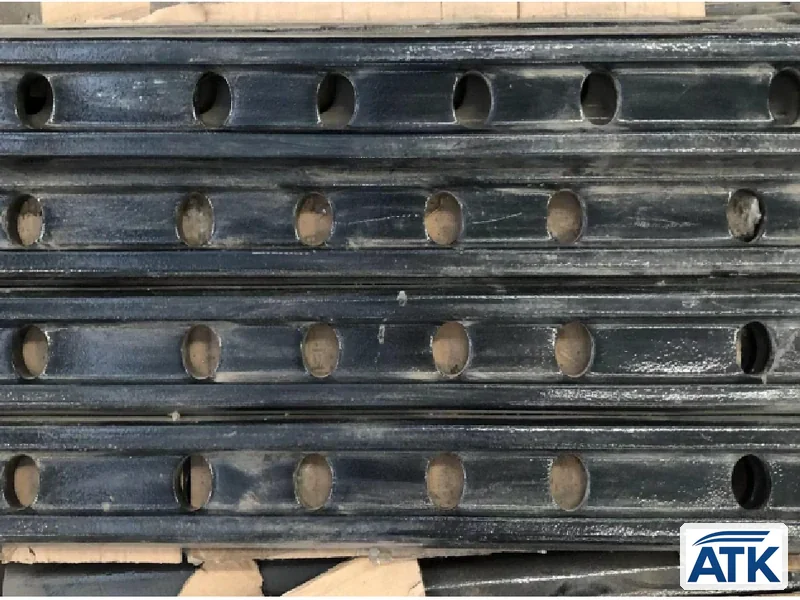
The North American sections that come up most often are 115RE, 119RE, 132RE and 136RE. 115RE is a common mainline and transit profile; 132RE and 136RE are heavier freight sections. Supplier tables commonly quote 4-hole bars at about 24 inches and 6-hole bars at about 36 inches for these sections. Those figures are useful as a first read of an old drawing, but they are not a substitute for the rail drilling on the site. The position of the centre holes, the end distance and the hole shape have to be measured or taken from the approved plan.
UIC54 and UIC60 are the European and export sections most often paired with IRS 80864-4. Published supplier tables quote a range of 4-hole and 6-hole arrangements for UIC60 — for example 630 mm with 26 mm holes, 600 mm with 28 mm holes, and 6-hole bars around 800 to 920 mm on UIC54 and UIC60. They are catalogue figures, not a universal table. Two manufacturers can issue different tables under the same "UIC864" label, which is one reason the consolidated 2023 document matters.For the product side of those two sections - matching profiles, hole arrangements, fish bolts and drawing-based specification - see the UIC54 and UIC60 fishplates page.
British practice uses BS rail designations — BS75R, BS80A, BS90A, BS100A and BS113A — with bar dimensions tied to BS 47-1. Australian work uses AS 1085.1 sections from 31 kg to 60 kg, with rolled bars up to 60 kg and forged bars at 50 and 60 kg under AS 1085.2. Japanese sections such as 50N and CR73 have their own profiles and drilling under JIS E 1102. Russian and CIS networks use P50, P65 and P75 under GOST 33184-2014, including conducting and insulating joints.
Across all of them the rule is the same: the rail name tells you which family of bar to look in; it does not finish the specification. The rail section standards behind the profile are a separate subject, and the rail profile decides the bar's contact geometry before any material grade is chosen.
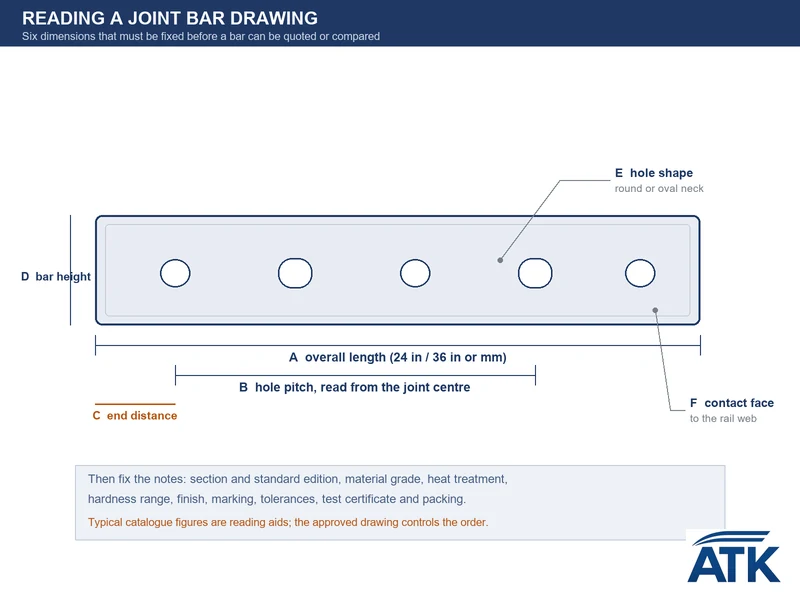
A specification for a bar answers six questions. If any one of them is missing, the quotation becomes an assumption.
The first is overall length, normally stated with the hole count — 24 inches or 36 inches, 610 mm or 915 mm, and so on. The second is hole pitch and end distance, measured from a stated datum. On a 6-hole North American bar the centre spacing is often quoted as a sequence such as 6 in × 6 in × 7-1/8 in × 6 in × 6 in in supplier certificates; treat that as a typical reading of a particular plan, not as a value to copy into a new order without checking the rail drilling.
The third is hole shape. Round holes and oval neck holes are not interchangeable. An oval neck matched to an oval hole stops the bolt turning while the nut is tightened; a round hole relies on other means. The fourth is bar height and the contact face profile that sits under the rail head and above the rail foot. If those faces do not match the rail web chamber, preload is lost at the first traffic.
The fifth is material and heat treatment. The sixth is the document pack: certificate, dimensional report, coating, marking and packing. It is the sixth item that most often decides whether a batch is accepted at the port, yet it is usually the last thing written into the enquiry.
Two further details close the drawing. End chamfer stops the bar catching the rail foot during fitting, and a straightness tolerance in both the vertical and plan directions makes sure the bar touches along its length rather than at two points. A bar that is visually straight but geometrically bowed will fret at the contact faces and loosen the bolt group.
Search results for "rail joint bar dimensions" return the same tables again and again: 115RE 4-hole 24 in at around 17 kg, 115RE 6-hole 36 in at around 25.5 kg, 132–136RE 4-hole at around 17.7 kg and 6-hole at around 26.6 kg; UIC60 4-hole 630 mm with 26 mm holes at around 18 kg; UIC54 6-hole 800 mm at around 20 kg. These numbers come from supplier catalogues and inspection certificates. They are consistent enough to be a useful reading aid and inconsistent enough that they should never be used as the sole acceptance basis.
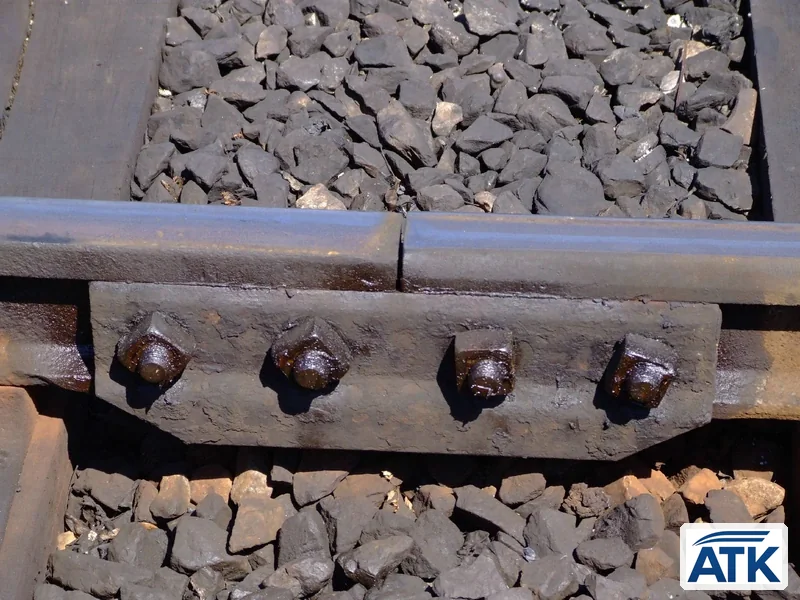
Use them to sanity-check an old bar. Length in the right range, hole count plausible, hole diameter near the bolt shank, bar height consistent with the rail. If the numbers are far out, stop and measure the installed joint.
Do not use them to write a new order. A weight per bar is a result of the profile, not a requirement. A hole diameter of 26 mm or 1-1/16 in belongs to a particular bolt and drilling pattern; changing it changes the joint. A 6-hole bar is not automatically stronger than a 4-hole bar on every site — the support under the joint and the condition of the rail ends matter as much as the extra bolts.
This is the point where the two systems differ in how they would settle the question. Under AREMA practice the designer would go to the relevant plan and the railway's specification, then confirm the drilling. Under IRS 80864-4 the supplier would work to the named profile and the supply requirements. In neither case does a copied catalogue row replace the approved drawing.
Material requirements are where a comparison table can mislead badly. You will see the same list of Chinese carbon grades — 40#, 45#, 50#, 55# — printed under AREMA, UIC, BS and DIN headings, as if the grade made the bar compliant. It does not. Each document defines its own chemistry, mechanical properties and heat treatment route, and the grade name alone is not a cross-reference.
TB/T 2345-2008 is the clearest example of a bar-specific material clause. It permits two grades, 55 and 56Nb, with 55 limited to 0.52–0.60 % carbon and 0.50–0.80 % manganese, and 56Nb carrying 0.015–0.050 % niobium. It requires killed steel from an electric or basic oxygen furnace, hot-punched holes or drilled and chamfered holes, and quenching in hot water or oil with self-tempering. Grade 55 has a minimum tensile strength of 785 MPa, yield of 520 MPa, elongation of 9 %, reduction of area of 20 % and a hardness band of 227 to 388 HBW. Grade 56Nb raises those figures to 845 MPa, 530 MPa, 10 %, 30 % and 235 to 388 HBW.
JIS E 1102:2001 takes a different route. It applies to bars for rail of 30 kg/m and heavier and divides them by treatment: Class 1 is supplied without heat treatment, Class 2 is quenched and tempered. Its acceptance tests are carried out at the works. AREMA §3.4 names three bar families — quenched carbon-steel, microalloyed and forged compromise bars — rather than one grade. UIC's IRS 80864-4 points into current ISO and European references for material, testing and inspection.
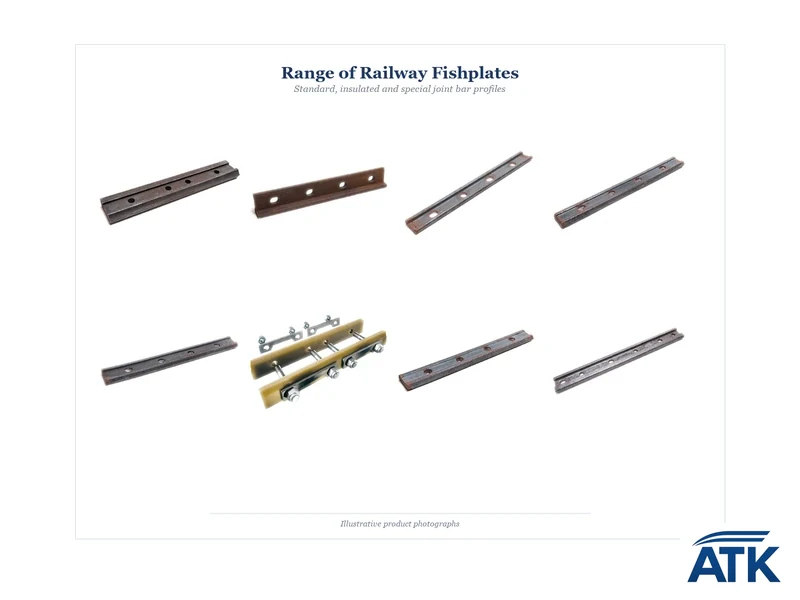
The practical reading is that heat treatment is part of the specification, not an optional upgrade. A quenched and tempered bar and an as-rolled bar may both be called a fishplate, but their wear resistance, toughness and fatigue behaviour are not the same. Where a tender names TB/T 2345 or JIS E 1102 Class 2, the heat treatment is already decided by the document. Where it names AREMA practice, the bar family has to be named on the drawing.
Cross-system equivalence has to be handled in writing. A Chinese 55# grade and a European structural grade are not the same delivery condition, and a performance figure in one standard does not transfer to another. If a buyer proposes a substitute, the response should be a written comparison with the chemistry and mechanical requirements side by side, approved before production.
One trap is worth naming directly. U71Mn is a rail steel grade, not a fishplate grade under TB/T 2345. Some catalogue tables print it as a fishplate material because the bar is supplied with a rail order. If that line reaches the purchase order, the material clause is wrong.
A joint bar does not work on its own. Two bars, four or six track bolts, nuts and spring washers form the assembly, and the behaviour of the joint depends on all of them. AREMA Chapter 4 Part 3 reflects that by placing joint bars, drilling and punching, track bolts and spring washers in the same part of the manual.
On North American joints, oval-neck bolts match oval holes so the bolt stays still while the nut is tightened. Round-hole patterns use a different bolt and a different locking method. The property class, nut type, washer arrangement and locking method belong on the drawing; a clause that says only "high strength bolts" gives the supplier nothing to quote.
This is also where the fish bolt search terms come from. Buyers type "rail fish bolts", "railway fish bolt", "high quality railway fish bolts" and "fish bolts supplier" when the bar is already selected and the fastening has failed or gone missing. Those searches are about replacement sets, not about the standard system behind the bar. A useful answer gives them the bar section, the drilling and the bolt geometry together — and points them at the bolt range rather than trying to sell a new joint from a single bolt description.
Lockbolts appear in a narrower set of enquiries: "insulated rail joint lockbolts" and "railway joint lockbolts". They belong to insulated joint assemblies where a controlled, non-loosening clamp is required. They are not ordinary fish bolts and should not be quoted as a direct substitute. Where a signalling boundary is involved, the insulated joint has to be specified as an assembly with its own mechanical and electrical requirements, not as a steel bar with a different bolt.
Torque is a line property. It comes from the railway's standard or the project technical agreement because it depends on the bolt grade, coating, washer and joint condition. Retorquing after initial traffic is part of normal maintenance: coatings settle and a joint that was tight at handover may not be tight after the first loaded trains. Published FRA-sponsored work also shows that support condition drives joint stress. Good ballast under a unit coal train gave a bending tensile stress around 170 MPa at the bottom of a joint bar; degraded foundation pushed the same measurement to 415 MPa. No upgrade to the bar makes a void under the sleeper harmless.
A plain steel fishplate carries load. An insulated joint also has to break the electrical path so that a track circuit can detect a train. That extra job changes the parts list and the test requirements: insulation at the contact faces, bushes or sleeves at the bolts, an end post between the rail ends, and an electrical acceptance value.
EN 16843:2024 covers mechanical requirements for joints in running rails on flat-bottom rail of 46 kg/m and above. It addresses insulated and non-insulated fish-plated joints in both stressed continuous welded rail and unstressed jointed track, and it sets mechanical and electrical requirements for type approval and acceptance of insulated joints. It excludes temporary joints, expansion devices covered by EN 13232-8 and special joints inside switch constructions. AREMA covers bonded and non-bonded insulated joints in Chapter 4 Part 3 sections 3.8 and 3.9.
That boundary matters on this site. The composite one-piece insulated fishplate, the glued steel-bar assembly and the plain steel bar are three different products with different drawings. A buyer who asks for "AREMA vs UIC insulated fishplates" usually wants one of the following: a steel bar for a plain joint, a bonded insulated assembly for a signalling boundary, or a replacement bolt set for an existing insulated joint. The enquiry has to say which. Where the answer is a bonded or composite assembly, it belongs on the insulated rail joints page, not in a plain bar quotation.
For a comparison article, the useful line is this: AREMA and UIC both recognise that insulated joints are part of the joint family, neither treats them as an ordinary steel bar, and the electrical requirement is decided by the signalling system, not by the bar standard.
Two joints with identical bars can age very differently. Axle load and cumulative tonnage set the fatigue demand. Curve radius adds lateral force to the bar and the bolt group. Continuous welded rail adds longitudinal force that a jointed track joint never sees. Corrosion pits at contact faces and hole edges become crack starters. Support under the joint is the condition most often missed: a void beneath the sleeper turns a smooth transfer into an impact, and that is exactly the condition that produced the 415 MPa bending stress quoted earlier.
Inspection follows the duty. Chemical analysis, tensile, cold bend, hardness, macrostructure, decarburisation depth, inclusion count, dimensions and visual condition are the classic product-level checks. TB/T 2345 includes all of them; JIS E 1102 adds progressive sampling plans. EN 16843 looks at the joint as an assembly, including electrical acceptance where insulation is present. Ultrasonic testing can be specified where the project asks for it, but it is not a routine requirement of either TB/T 2345 or AS 1085.2, so it should not be promised as a standard batch test.
Years are a poor unit for a part that is removed and refitted. The published way to discuss joint life is cumulative tonnage. Bonded insulated joints in an AREMA committee survey averaged 252 MGT on tangent and 207 MGT on curved track; another study of 150 joints on a 45–58.5 MGT-a-year line reported a median of 155 MGT. On high-axle-load routes, failures at around 200 MGT have meant replacement in 12–18 months. Plain bolted bars are thought to sit in the same band. With rail lasting 900–1,800 MGT, the same joint location may be renewed three to six times before the rail is changed.
Inspectors read the bar itself. A top-edge crack tends to develop slowly under compression, while a bottom-edge crack runs in tension and can fracture the bar between visits. Bolt holes and battered rail ends provide the other common clues. Out-of-limit step, elongated holes, worn faces or failed insulation are all reasons to take the joint out, rather than a calendar date.
The fastest way to get a wrong bar is to ask for "fishplates to AREMA or UIC" and stop there. Five inputs are needed before a supplier can quote: the rail section and standard edition; the governing document or plan; the drilling, including hole count, pitch, end distance and hole shape; the material grade, heat treatment and finish; and the documents required with the batch.
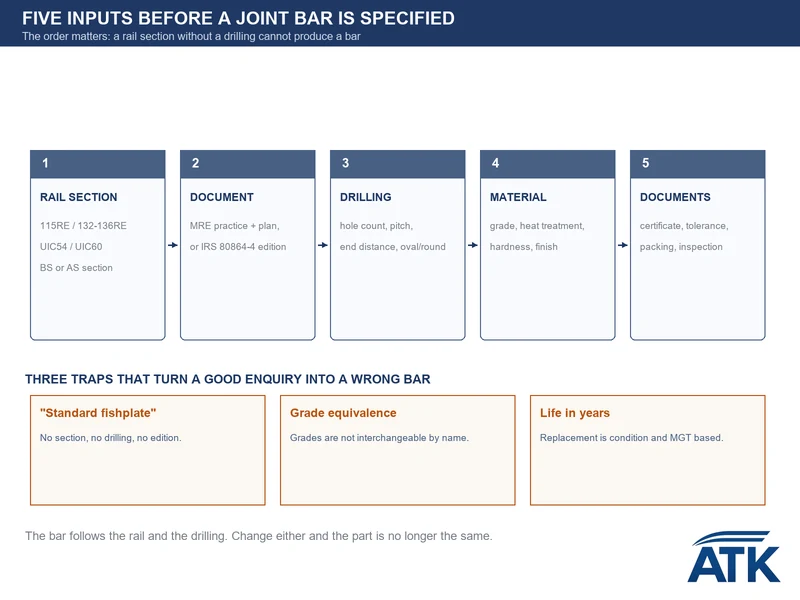
Write the first line of the enquiry as a claim about a document. If the rail is 115RE, name the section and the plan or railway specification. If it is UIC60, name the profile and IRS 80864-4 edition. Add whether the joint is plain, insulated, compromise or a temporary repair, because each of those changes the bar. Then give the quantity, destination and inspection documents.
For a replacement job where the drawing has been lost, measure an unworn bar: length, height, hole diameter, pitch, end distance and contact-face profile. Photographs help, but they do not replace numbers. A photograph cannot separate a 24 mm hole from a 26 mm one, and that single dimension decides whether the joint assembles on site.
For buyers who arrived through a fish-bolt search, the same rule applies in reverse. Send the bolt head profile, shank diameter, thread length and property class together with the bar drilling. A bolt that fits the hole but carries the wrong class will lose preload, and a joint that loses preload stops being a joint.
The comparison has a practical ending. AREMA offers practice, plans and a defined joint assembly; UIC offers a supply document for the bar. Neither displaces the rail section, the drilling or the project agreement. Put those three on the first line and material, bolts, coating and inspection can be quoted against something stable. Those plain steel bars belong to the fish plate range, with section and drilling confirmed per order.
A fish plate is the pair of steel bars bolted to the rail web at a joint. It carries load across the gap and keeps the two rail ends aligned. AREMA is not a product standard for that bar in the way BS 47-1, AS 1085.2, JIS E 1102 or IRS 80864-4 are. Its joint material sits in the Manual for Railway Engineering, Chapter 4, Rail, Part 3, Joining of Rail, with outlines and drilling in the Portfolio of Trackwork Plans. It becomes contractual when a railway or project names it.
IRS 80864-4/E/2, edition 2 of 2023, Supply of steel fishplates. UIC states that it consolidates leaflets 864-4, 864-8 and 864-9. Older UIC864-4 and UIC864-8 numbers are still printed on many supplier pages, but they are historical references.
It can be made for a rail section and drilling that suit a project referencing both, but it cannot be certified to two unlike documents by repeating the other side's part number. The governing document, edition, rail profile and drilling have to be stated, and the approval has to be in writing.
No. The bar height, fishing angles, contact faces and hole positions are cut for one rail profile. Even sections with a similar nominal mass have different web and foot geometry. A compromise bar is the correct part when two different sections have to be joined.
Those are the common 4-hole and 6-hole lengths in North American practice. They are useful as a first read of an old drawing. The actual length, pitch and end distance must come from the approved plan or the measured drilling on the rail.
It is a common way of writing centre-to-centre distances between successive holes on a 6-hole bar, with the widest gap at the joint centre. It appears in supplier certificates for particular plans. It is a reading aid, not a universal AREMA dimension to copy into a new drawing.
They serve different bolt systems. Oval neck holes stop the bolt turning while the nut is tightened; round holes need another locking method. Mixing a round-hole bar with oval-neck bolts is a common assembly error.
It depends on the document. TB/T 2345-2008 permits grades 55 and 56Nb; JIS E 1102 defines Class 1 and Class 2 by heat treatment; AREMA §3.4 names quenched carbon-steel, microalloyed and forged compromise bars. Chinese, European and American grades are not interchangeable by name. U71Mn is a rail grade, not a TB/T 2345 fishplate grade.
Where the named standard calls for it, yes. TB/T 2345 requires hot water or oil quenching with self-tempering. JIS E 1102 Class 2 is the quenched and tempered class. For other systems the bar family and heat treatment belong on the drawing.
Fish bolts clamp a plain joint bar to the rail web. Lockbolts are used in some insulated joint assemblies where a controlled, non-loosening clamp is needed. They are different fasteners and should not be quoted as substitutes for each other.
There is no standard figure in years. Published surveys put bonded insulated joints around 250 MGT on tangent track and 200 MGT in curves, with high-axle-load sites replaced after roughly 200 MGT. Plain bolted bars are expected to be in a similar range under heavy haul. Replacement is condition-based.
The rail section and edition, the governing document or plan, hole count, pitch, end distance and hole shape, the bar type, material and heat treatment, bolts and washers, coating, quantity, destination and the documents you need. If the drawing is gone, send measured dimensions and photographs of the installed joint.
Dimensions, hole patterns, steel grades, heat treatment, bolt classes, torque values, coating systems and inspection criteria are set by the project drawing and the technical agreement. Catalogue figures here are orientation only; they are not acceptance values. Nothing in this article states a universal size, performance rating or replacement interval.
Prepared for ATK by its rail fastening and trackwork team. It draws on AREMA's Chapter 4 contents, the UIC shop entry for IRS 80864-4, European and BSI notices, JSA and Standards Australia records, the TB/T 2345 text and published joint research.
We have recommended some of our Related products to you. I hope you will be interested.

 English
 Русский