
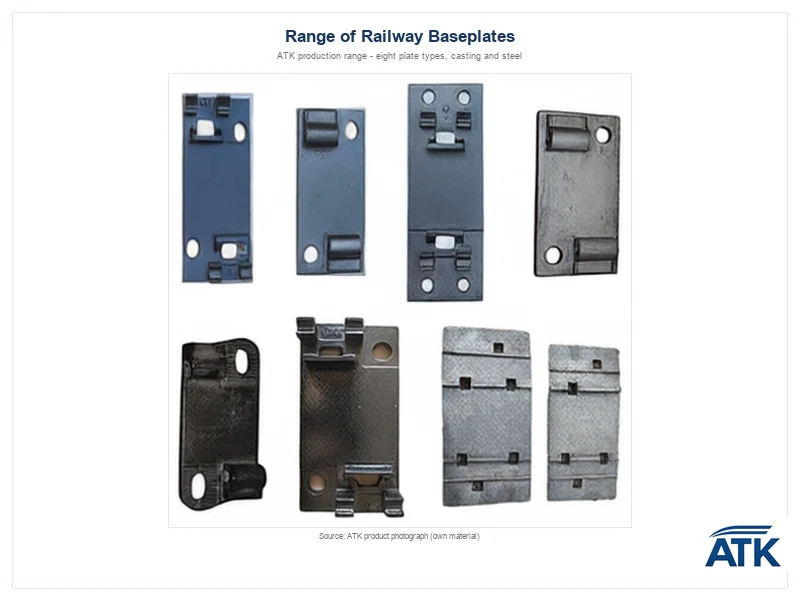
Railway baseplates and tie plates to the approved plate drawing
Hot-worked steel, ductile iron, cast carbon steel and grey iron grades
Cast, rolled and punched, or fabricated routes matched to the plate outline
Anchor hole pattern, rail seat cant and shoulder geometry to the drawing
TB/T 2346-1993 and TB/T 3307.8-2014 product standards referenced
Material grades to GB/T 1348-2019, GB/T 11352-2009, EN 1563:2018, ASTM A536
Dimensional, chemical, mechanical and coating checks with batch records
Assembly-level type testing to EN 13146 / EN 13481 / TB/T 3396 where specified
Enquiries reviewed from a drawing, a sample or photographs of the installed assembly
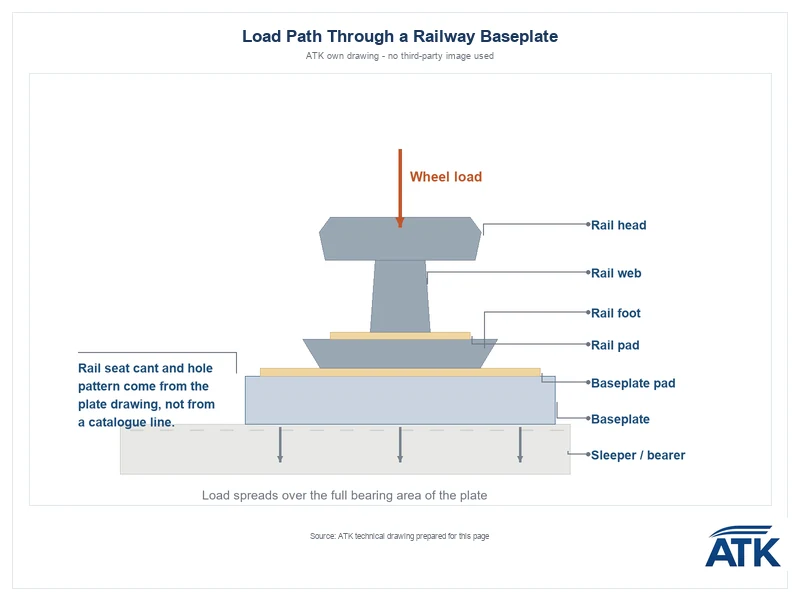
A railway baseplate sits between the rail foot and the sleeper, bearer or slab. The rail does not rest directly on timber or concrete: the plate spreads the wheel load over a larger bearing area, gives the rail a defined seat with the specified cant, and holds gauge while the fastening does the clamping. A British government design manual puts it plainly — the baseplate forms a bearing for the foot of the rail and serves to spread that load over a much larger area of the sleeper.
That is the whole job, and it is why the plate is always drawn as part of a system. Above it sit the rail, the rail pad, the clip or bolt and the insulator; below it sit the sleeper, the baseplate pad and the anchors. Change one and the load path changes. A plate that fits the rail but clashes with the clip seat is scrap, and a plate that fits the clip but sits on an uneven bearer will bend no matter how good the casting is.
Two neighbours turn up in the same enquiry often enough to be worth naming. A slide plate or switch plate sits in the switch panel of a turnout, where the point blade runs across a machined table; integral cast slide baseplates carry their own drawing, their own wear surface and their own inspection points, and the complete turnout fastening system around them is described separately. A sole plate under a crane rail belongs to the crane runway fixing family. Both are steel plates with holes, and neither is a rail fastening baseplate.
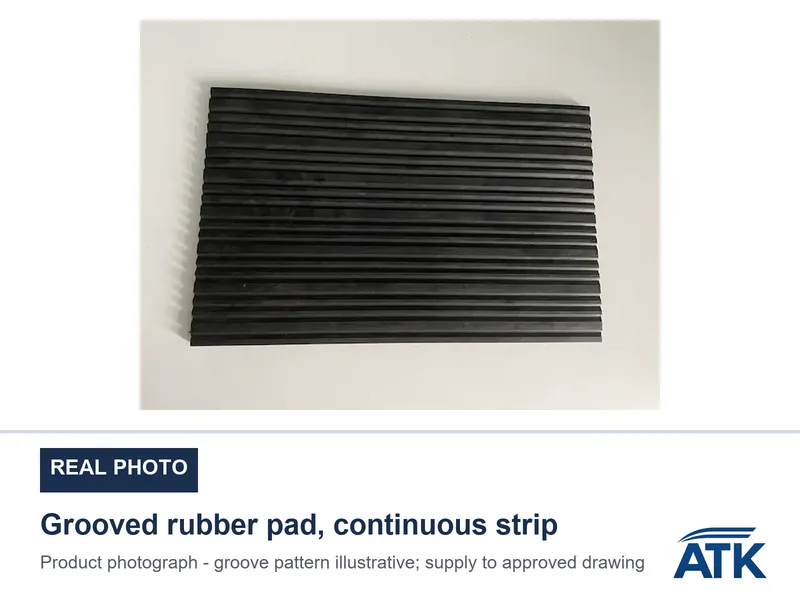
There is one more trap in the wording. Some suppliers use "rail baseplates" for a resilient rubber or polyurethane mat used for vibration isolation under slab track. If a tender asks for a baseplate and the attachment shows a black elastomer sheet, that is a different product entirely.
Baseplate and base plate are the common terms in Europe and in international tenders. Tie plate is the North American word, and AREMA uses it for the hot-worked steel plate under a tee rail. Sole plate appears in British and crane-track practice. Turnout baseplate and elastic iron plate are not free synonyms of these: the Chinese standard TB/T 3307.8 uses *elastic iron plates* for the resilient plates in high-speed turnouts, and a turnout plate is drawn for one position in the layout rather than for a length of plain line.
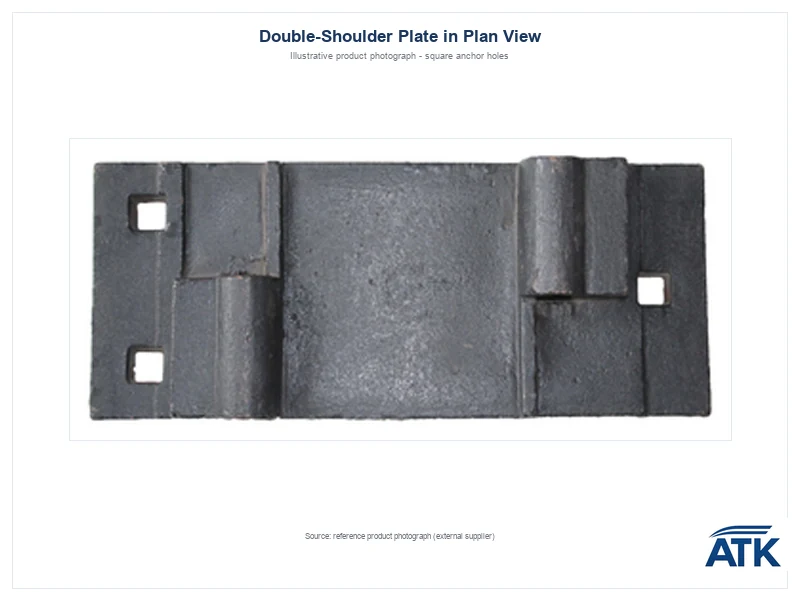
A purchase specification should name one term and then give the drawing number. "Tie plate for 60 kg/m rail" is not enough to start a quotation, because the rail section alone does not fix the hole pattern, the shoulder geometry, the rail seat cant or the clip that seats on it. When an enquiry arrives with a photograph and a single word, the first reply is usually a request for those four items.
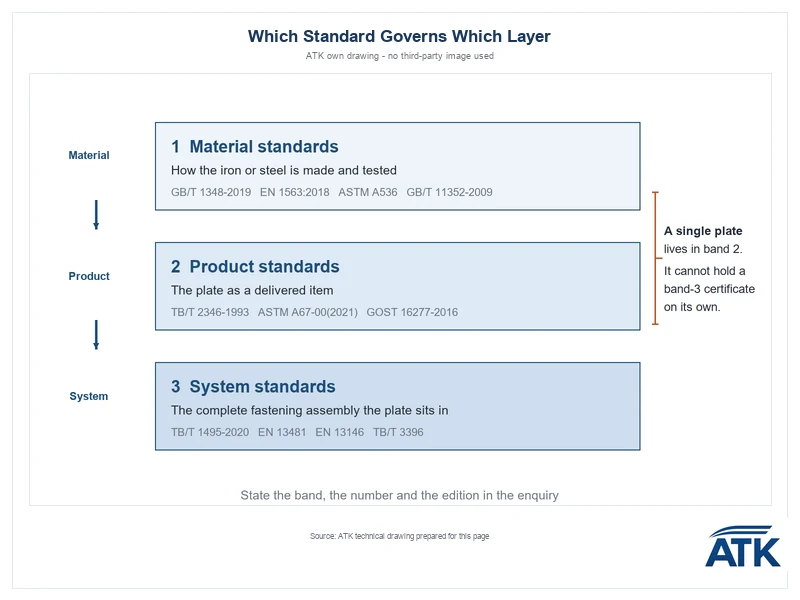
The first thing to settle is what kind of document the project is citing. Material standards tell you how the iron or steel is made. Product standards cover the plate as a delivered item. System standards cover the whole fastening assembly, and the plate is only one component of it. Mixing the layers is how a supplier ends up claiming a system certification for a single casting.
Standard | Where it applies | What it governs | What it does not govern |
TB/T 2346-1993 | China | Supply requirements for baseplates used with 43 to 75 kg/m rail | Turnout-specific plates, system performance |
TB/T 3307.8-2014 | China, high-speed turnouts | Manufacturing conditions for elastic iron plates | Plain steel or grey iron baseplates |
TB/T 1495-2020 / TB/T 3065-2020 | China | Type I and Type II elastic clip fastening systems | A single plate in isolation |
TB/T 3395.1–.5-2015 | China, high-speed lines | WJ-7, WJ-8 and related fastening systems | Standalone component approval |
TB/T 412-2020 | China, standard-gauge turnouts | The complete turnout, including its plates | Export drawings that name another edition |
ASTM A67-00(2021) | North America | Low-carbon and high-carbon hot-worked steel tie plates | Cast iron, ductile iron, cast steel plates |
AREMA MRE, Chapter 5, Part 1 | North America | Steel tie plate definitions, dimensions, flatness, hole and rail-seat-cant practice | It is recommended practice, not a regulation |
AREMA Portfolio of Trackwork Plans | North America | Switch plates, gauge plates and turnout plate details | Plain mainline tie plates |
EN 13146 series | Europe | Test methods for complete fastening assemblies | Certification of a single baseplate |
EN 13481 series | Europe | Performance requirements and acceptance criteria by sleeper type | Component-level approval |
EN 1563:2018 | Europe | Spheroidal graphite cast iron grades, measured on machined test bars | Technical delivery conditions for castings |
EN 13232-5:2023 / -7:2023 | Europe | Switches and crossings with moveable parts | A plate sold outside a turnout assembly |
ГОСТ 16277-2016 | Russia and CIS | Plates for separate fastenings (КБ / КД / СК types) | Confirm the current edition with the purchaser |
The differences matter most when the tender is being written.
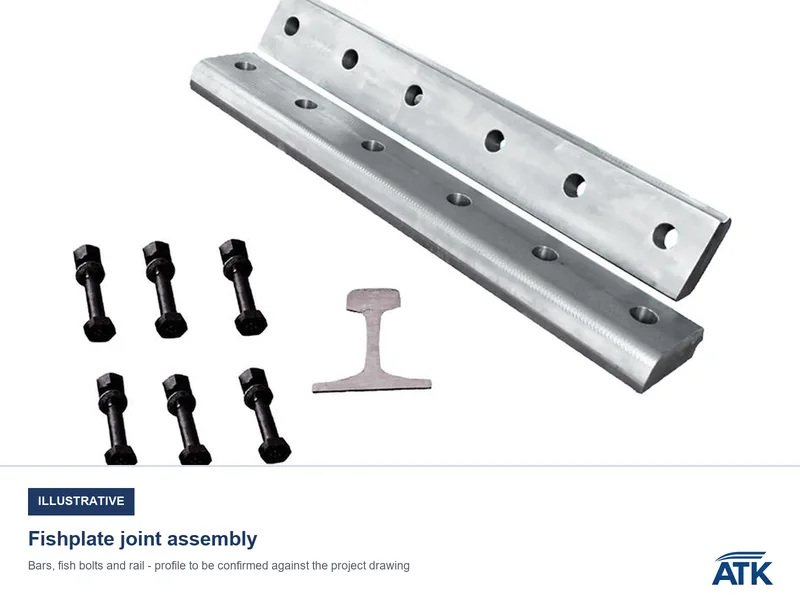
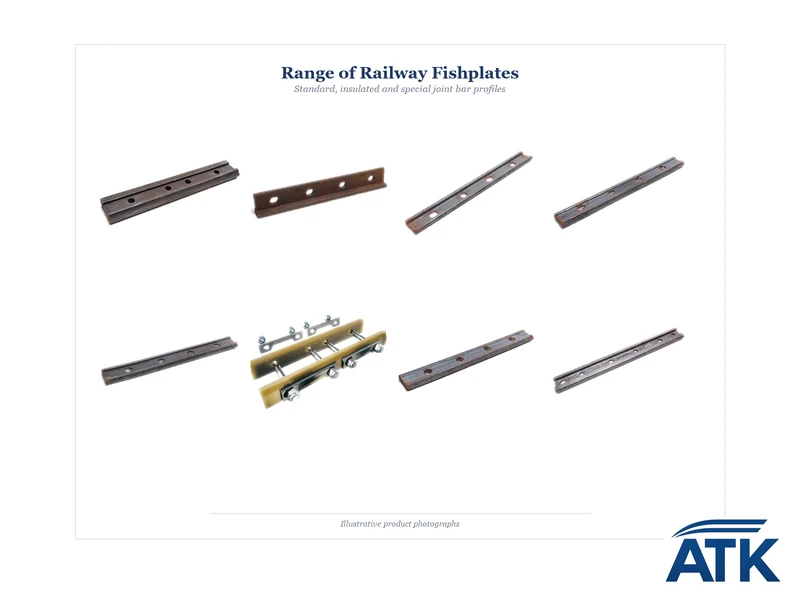
China has a real product standard for the plate itself: TB/T 2346-1993 covers baseplates for 43 to 75 kg/m rail and is still listed in the current industry standards catalogue. Alongside it, TB/T 3307.8-2014 covers elastic iron plates for high-speed turnouts. The better-known TB/T 1495, TB/T 3065 and TB/T 3395 series are fastening-system standards; TB/T 412-2020 governs the complete standard-gauge turnout. TB/T 2345-2008, despite the similar number, is the specification for joint bars — fishplates — not baseplates.
In North America, ASTM A67-00(2021) is the only ASTM specification written specifically for steel tie plates, and its scope is hot-worked low-carbon or high-carbon steel plate, sheared, punched or slotted hot or cold. It does not cover a ductile iron casting. AREMA's Manual for Railway Engineering is recommended practice rather than law; its Chapter 5 covers track, including steel tie plates, and turnout plate details live in the separate Portfolio of Trackwork Plans. A tender that says "to AREMA" should still name the chapter, the plan number and the edition.
In Europe, EN 13481 sets the performance requirements for complete fastening systems by sleeper type, and EN 13146 provides the test methods used to demonstrate them. Both explicitly work at assembly level. A baseplate has no standalone EN 13146 or EN 13481 certificate; what can be reported is the material grade to EN 1563 and the dimensional checks against the approved drawing. EN 13146-3, incidentally, is the determination of impact load attenuation — not a gauge retention test, which is a common miscopy in supplier literature.
Elsewhere the picture is thinner. The UK Ministry of Defence permanent way manual gives the clearest official description of what a baseplate does, but there is no current BS standard written specifically for baseplates. The Japanese JIS standards for flat-bottom rails cover the rail, not the plate. Australia's former AS 1085.9 and AS 1085.16 sleeper plate parts are recorded as withdrawn by the national track owner; the current AS 1085 series has no standalone baseplate part. Russia has ГОСТ 16277-2016 for plates of separate fastenings — the closest foreign equivalent to a Chinese tie plate — but the edition should be confirmed with the buyer before it is written into a contract.
Four material families turn up in baseplate drawings, and the choice is rarely about strength alone.
Hot-rolled carbon steel is the traditional tie plate material. It is sheared, punched and slotted, takes a predictable flat surface, and is straightforward to galvanise or paint. ASTM A67-00(2021) divides steel tie plates into low-carbon and high-carbon hot-worked grades. Structural steel designations such as Q235B, S235JR or ASTM A36 appear in drawings for welded or fabricated plates; they are not interchangeable by name, and the final grade belongs in the technical agreement.
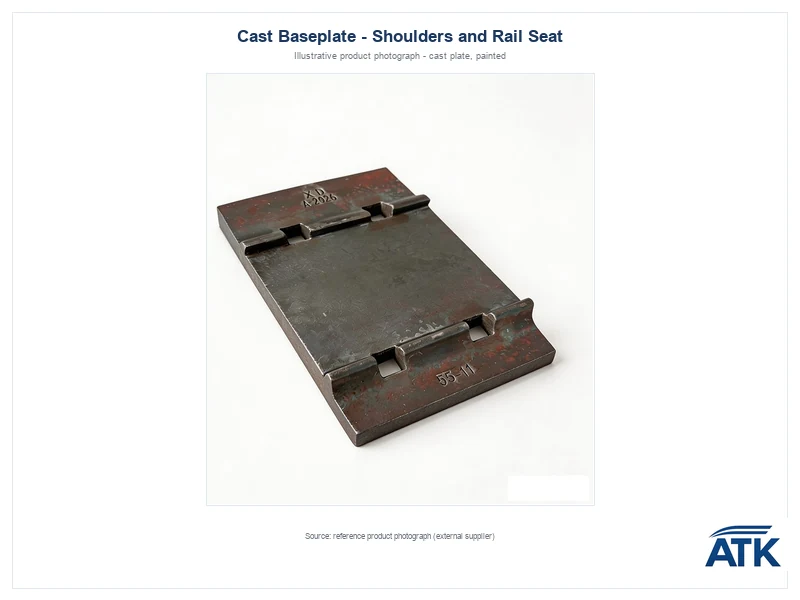
Ductile iron is the usual choice when the plate carries shoulders, clip seats or a recessed rail seat in one casting. The Chinese material standard is GB/T 1348-2019, the European one EN 1563:2018, and the North American one ASTM A536. It machines cleanly and holds a complex outline better than a built-up weldment. Cast carbon steel to GB/T 11352-2009 or ASTM A27/A27M covers heavier sections and impact-loaded turnout positions. Grey iron to GB/T 9439-2023 still appears on legacy drawings, but its brittleness makes it a poor fit for high-cycle or impact duty.
A caution on cross-references. QT450-10, EN-GJS-450-10 and ASTM A536 65-45-12 are often written as if they were the same material. They are approximately corresponding grades, not equivalents: EN 1563 classifies by machined test bars, GB/T 1348 is a modified adoption of ISO 1083, and ASTM A536 states outright that properties in different parts of a casting cannot be precisely related to a separately cast test bar. Write the grade on the drawing and get the buyer's approval before substituting one.
Surface treatment follows the site rather than the catalogue. Plain or oiled finish is normal for indoor workshops; shot-blasted and painted, or hot-dip galvanised, is worth specifying for coastal, tunnel, mining or wash-down environments where corrosion pits become crack starters. Coating thickness, salt spray hours and acceptance grades are project values, not figures to copy from a supplier page.
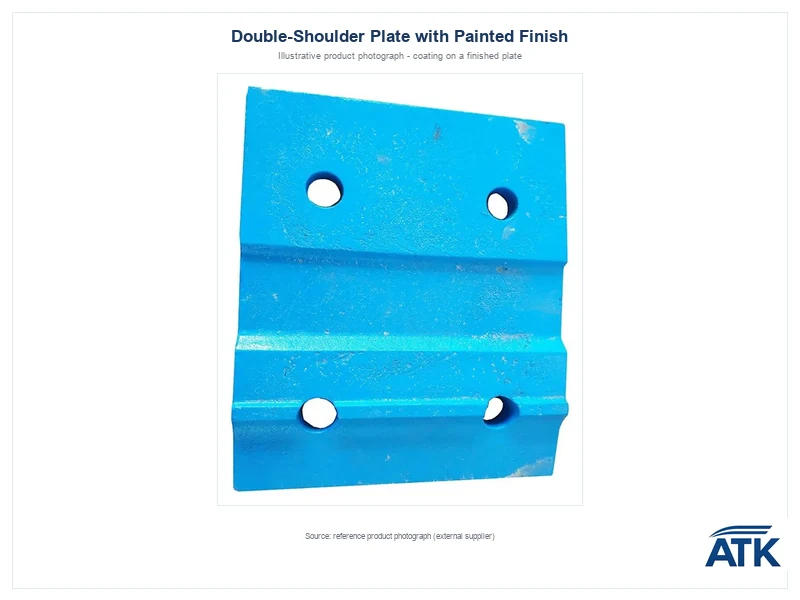
The route follows the material and the outline. A hot-worked steel tie plate starts as rolled plate: ASTM A67 describes shearing, punching or slotting hot or cold, with a bend test on each heat. Flatness and rail seat cant are then checked against the drawing, and the holes are deburred before surface treatment. It is a short route, which is why plain tie plates are the first thing a rolling mill quotes.
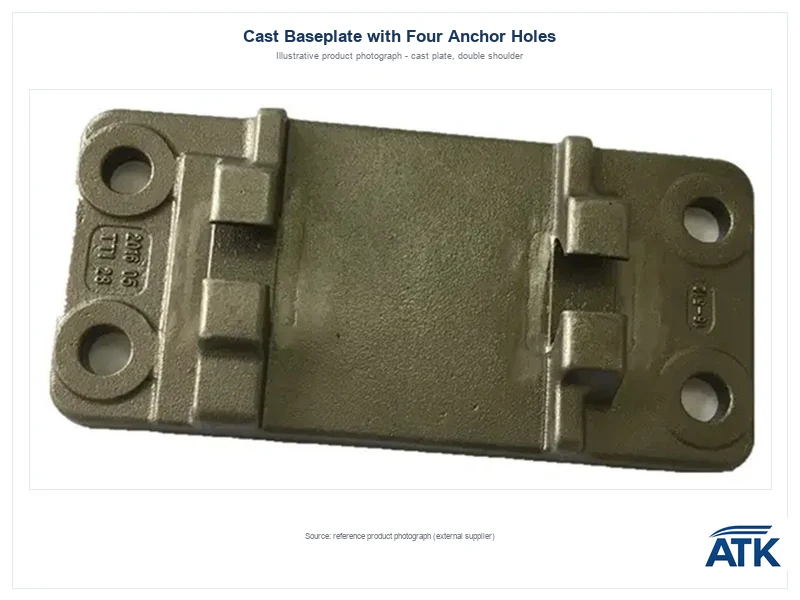
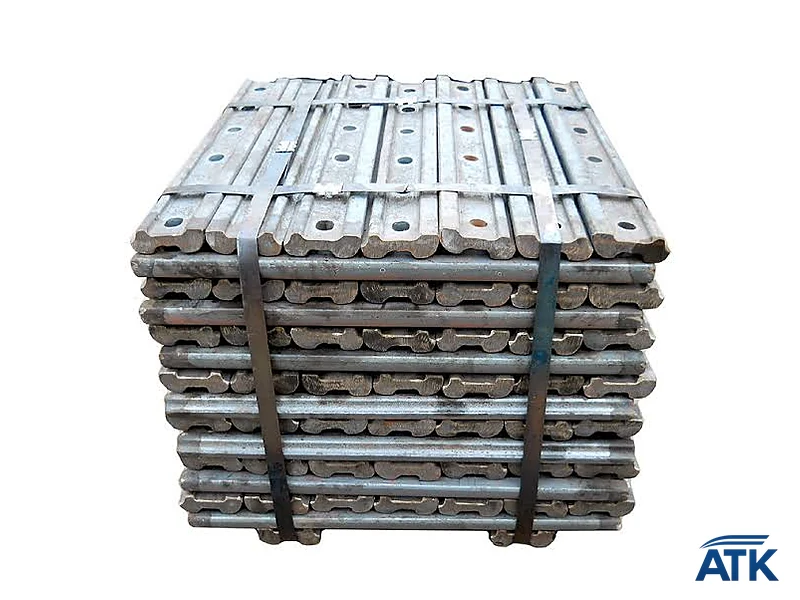
Cast plates take a longer path. The shoulder, the clip seat and the recessed rail seat are formed in the mould, then the rail seat and the anchor holes are machined to tolerance. Foundry practice decides more than the grade on the certificate: poor gating leaves shrinkage porosity, and a casting that looks sound on a pallet can still have a soft spot under the rail seat. A dye penetrant or ultrasonic check on the seat area is worth asking for on heavy-duty turnout plates.
Fabricated or welded plates suit one-off repairs and non-standard gauge work, where a pattern would cost more than the batch. The trade-off is the weld toe: it is a stress raiser, and on a plate that sees repeated wheel loading the fatigue crack usually starts there. Machining after welding restores flatness but does not remove the heat-affected zone.
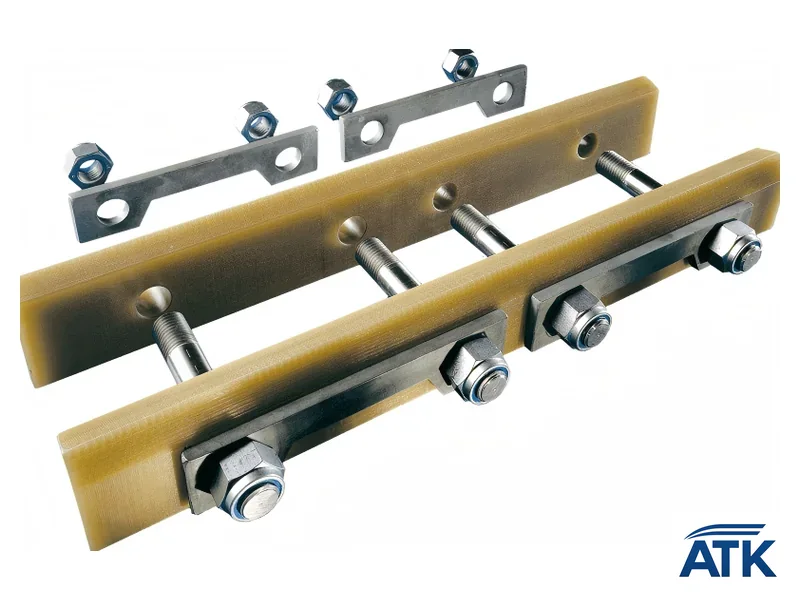
Insulated baseplates are a variation on the same three routes: the insulating layer, insert or coating is added to a plate that is otherwise made the same way, and the electrical resistance requirement sits with the fastening assembly specification rather than alone on the plate drawing. The rail fastenings category groups the plates with the clips, pads and anchors they work with; the plate itself is still made to a drawing, not to a catalogue line.
Start with the fastening system, not the plate. An E-clip system, an SKL system and a bolted Type I assembly all put different loads into the shoulder, and a plate machined for one will not accept the clip of another. If the enquiry names only the rail section, the drawing is still missing.
What a supplier needs before a plate can be matched to a track:
· Rail section and governing standard edition (UIC54 / UIC60, 50 / 60 / 75 kg/m, R65 / P50, 115RE / 136RE or the section named on the drawing)
· Fastening system type and the drawing number for the plate
· Sleeper or bearer type: timber, concrete, steel sleeper or slab track
· Rail seat cant and the gauge reference used on the project
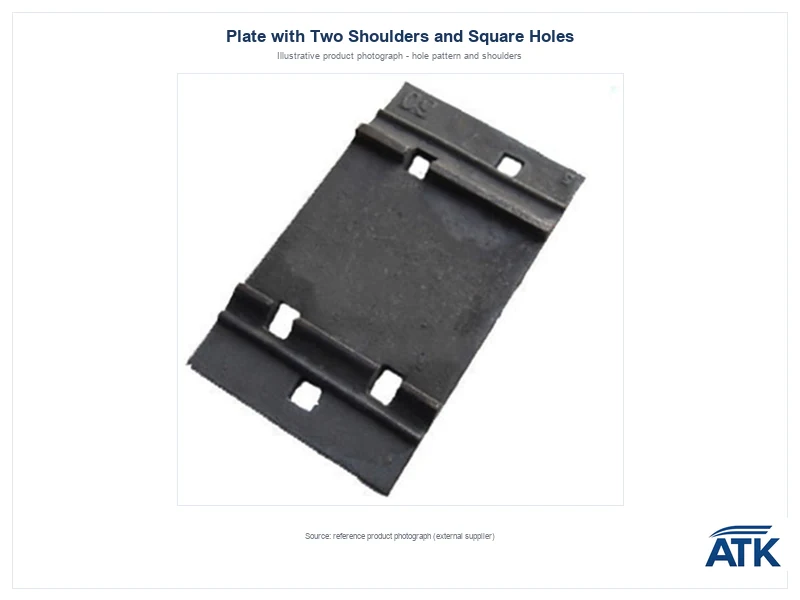
· Anchor hole quantity, diameter, position and whether any hole is slotted
· Material grade, plus any hardness or heat-treatment requirement
· Surface finish and the corrosion environment
· Inspection documents, quantity, packing and destination
A drawing or a sound sample is usually enough to confirm feasibility. Where a line is being re-railed, the old plate is the best record of what the original designer meant — keep it, lay a rule across the holes and photograph the seat before it goes to scrap. A plate that has carried traffic for years shows a witness mark where the rail foot sat, and that mark settles arguments about contact geometry faster than a catalogue table.
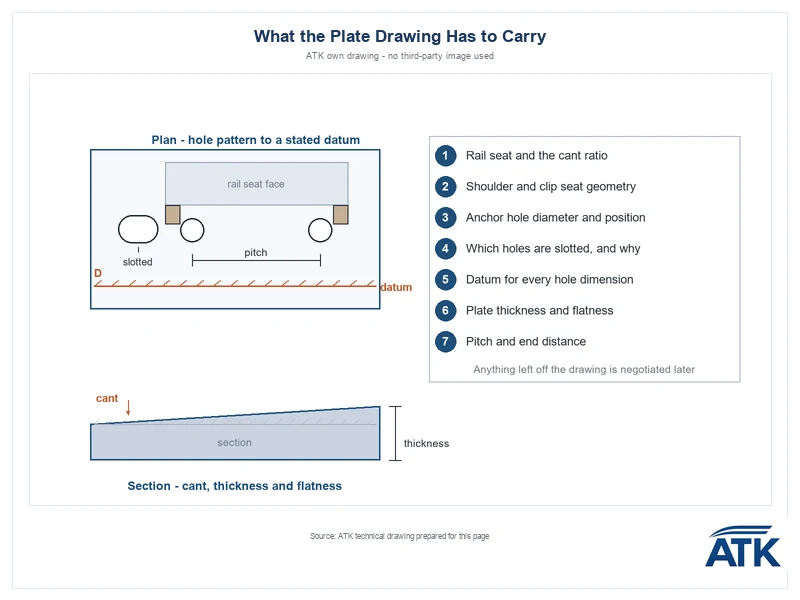
A dimensioned drawing is the only document that resolves a conflict between a catalogue and a specification. These are the lines that most often get left off, and the ones that cause the most rework.
Outline, thickness and flatness of the rail seat and of the plate underside. AREMA Chapter 5 defines rail seat and rail seat cant for steel tie plates, and its dimensional tables cover flatness and hole tolerance; the values belong to the edition cited in the project, not to a general description. Where the drawing calls for a cant, state the ratio and the reference face it is measured from.
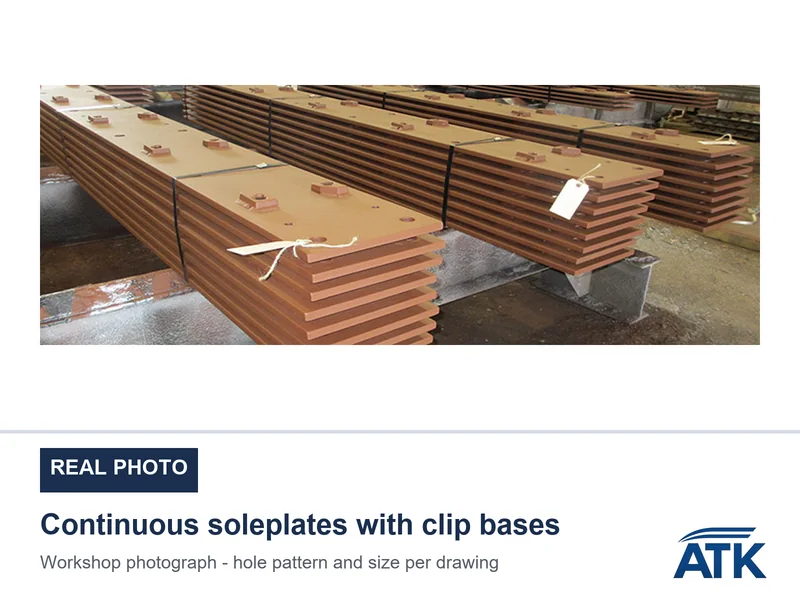
Anchor hole diameter, position, pitch and end distance, plus which holes are round and which are slotted. Hole position is measured from a stated datum, not from a plate edge that may have been flame-cut. A slotted hole is there for a reason defined by the design — installation adjustment, a defined movement, or a particular bolt arrangement — and the reason should be on the drawing rather than inferred from the shape.
Shoulder and clip seat geometry, including the contact face finish. The shoulder takes lateral load; a rounded shoulder or a seat that does not sit flat shows up later as lost clamping force rather than as an obvious defect on delivery. Where an insulating component is required, the interface and the electrical resistance requirement belong in the assembly specification.
Material, hardness where specified, and the test method for each. Chemical composition, tensile properties and hardness are reported against the material standard named on the drawing — GB/T 1348, GB/T 11352, EN 1563, ASTM A536 or ASTM A27 — using the test method standard that goes with it. Coating type and the required salt spray or galvanising check follow the environment, not the price list.
Marking and traceability. Cast or stamped identification lets a receiving store sort plates by drawing number and position without opening every bundle, and it is what makes a later batch certificate useful. Bolts, nuts and washers are a separate line item; state whether they are in scope so the two are not quoted against different assumptions.
The same plate design behaves differently on a heavy-haul freight line and on a metro viaduct. What changes is the number and size of the load cycles, the environment they arrive in, and how stiff the support underneath happens to be.
Condition | Why it changes the plate | What to state in the enquiry |
Axle load and wheel load | Sets the bending and bearing demand on the rail seat and shoulder | Design axle load, and the EN 13481 category if the project uses one |
Cumulative traffic (MGT / total gross mass) | Drives fatigue at the anchor holes and clip seats | Traffic tonnage or line category |
Curve radius | Lateral force rises on tight curves and works the shoulder harder | Minimum radius, cant and speed |
Sleeper / slab support | Uneven bearers concentrate load in the middle of a plate | Sleeper type, bearer spacing, support condition |
Corrosive environment | Pits in the seat and threads become crack starters | Coastal, tunnel, mining, wash-down, de-icing salt exposure |
Temperature range | Thermal movement changes joint and anchor behaviour | Installation and seasonal range |
Electrical / signalling | Insulated interfaces may be required at boundaries | Track circuit type and insulated-joint positions |
Maintenance access | Plates under end stops or in pits rarely get re-checked on schedule | Access constraints and the inspection regime |
Turnouts concentrate all of these at once: impact, lateral thrust and a bearing surface that is rarely even, which is why a turnout plate is drawn as its own item with its own drawing number rather than taken from a mainline pattern.
Two different things get called "testing" on a baseplate order, and they should be listed separately in the purchase specification.
The first is material and dimensional verification of the plate as a delivered item. Chemical composition by spectrometer, tensile and impact properties on test pieces, hardness on the rail seat where the drawing calls for it, and dimensional checks of outline, thickness, flatness, hole diameter, hole position and rail seat cant. These are reported against the material standard and the approved drawing. A casting certificate that gives a grade but no seat measurement tells you very little about whether the plate will sit flat.
The second is system-level type testing. EN 13146 is a series of test methods for complete fastening assemblies: longitudinal rail restraint, torsional resistance, impact load attenuation, repeated loading, electrical resistance, severe environmental conditions, clamping force, in-service testing and stiffness. EN 13481 sets the corresponding performance requirements by sleeper type. China has a parallel structure in TB/T 3396.1–.7-2015 for the high-speed fastening system test methods, with TB/T 2491-1994 covering assembly fatigue testing. None of these tests certifies a single plate on its own; they qualify the assembly the plate belongs to.
That distinction is worth keeping in a tender reply. A supplier who offers an EN 13146 certificate for a single plate has either misread the scope or is describing an assembly test in which a similar plate happened to be used. What can legitimately be offered is a plate supplied to the named material standard, dimensional inspection to the approved drawing, and — where the project requires it — participation in the assembly type test with test records issued for that assembly.
Ask which documents travel with the goods: material certificates for the casting or plate batch, dimensional inspection records, coating reports where a finish is specified, and the assembly type test report if it is in scope. Third-party inspection is a project option rather than a default. Where a buyer needs a fatigue result for a new plate outline, that is a qualification programme agreed before production, not a line added after the order.
There is no general design life for a railway baseplate, and no universal replacement interval. Published supplier pages quote anything from five to forty years for "tie plates" and often contradict themselves on the same site, which is a fair indication that the number is marketing rather than a standard. Standards and infrastructure owners do not work that way: a plate is replaced when condition assessment says it is due.
Replacement criteria are defect and wear limits — worn shoulders, elongated or worn anchor holes, rail seat wear, cracks, bending, and corrosion beyond the owner's limit — read together with the condition of the whole fastening assembly. A plate that has kept its shape but sits under a clip that has lost clamping force is not a serviceable joint. A UK government specification for reused tie plates lists much the same defects for rejection, and the same logic appears in maintenance practice for turnout elastic plates: published research on high-speed turnout elastic iron plates discusses replacement on a multi-year horizon, but explicitly requires assessment of the actual condition before anything enters a renewal plan.
For context, one official UK government carbon-accounting appendix for the HS2 slab track project assumes baseplates and fastenings are replaced at 25-year intervals as an input to a whole-life carbon model, alongside 60 years for concrete and 12.5 years for rails. That is a modelling assumption for one project, not a product life, a warranty or a general renewal rule. It is quoted here because buyers ask the question, and because the honest answer is more useful than a made-up figure.
What actually governs how long a plate lasts is the duty it sees: axle and wheel load, cumulative traffic in million gross tonnes, curve radius, humidity and corrosive exposure, ballast and support condition, clamping-force decay, and ageing of the elastic and insulating components around it. State those in the enquiry and the material, coating and inspection regime can be chosen to suit. State only a target number of years and there is nothing to design against.
A baseplate is a drawing-driven part. The fastest quotations come from an enquiry that names the rail section and standard edition, the fastening system and plate drawing number, the sleeper or slab type, the material and finish, the inspection documents required, the quantity and the destination. A photograph of the installed assembly and a measured hole pitch help when the drawing is no longer available.
State the supply boundary as well. The plate, the rail pad, the clips, the anchors and the bolt set may be quoted together or separately, and a price for "baseplates" is not a price for a fastening assembly. On timber-sleeper track, [screw spikes for timber sleepers] are the anchoring item fitted alongside the plate; confirm the sleeper type before adding them to the list. Where an insulating interface is needed, it belongs on the same list so the interfaces are checked as one set.
Send the drawing and the duty information through the contact us page. ATK reviews feasibility against the drawing first and confirms the specification before quoting; trial production is available for non-standard outlines, and the final dimensions, material grade, finish and inspection scope are recorded in the technical agreement rather than assumed from a catalogue.
Item | Basis |
Product | Railway baseplate / tie plate / base plate, including insulated and turnout plates |
Rail sections | Matched to the rail section named on the approved drawing |
Fastening systems | Matched to the fastening system and clip seat on the approved drawing |
Material | Ductile iron, grey iron, cast carbon steel or hot-worked / structural steel, to the grade named on the drawing |
Manufacturing route | Hot-worked and punched, cast and machined, or fabricated; agreed per drawing |
Hole pattern | Diameter, pitch, end distance and slot detail to the approved drawing |
Rail seat cant | To the project drawing and the stated reference face |
Surface finish | Plain, oiled, shot-blasted and painted, or hot-dip galvanised; to the order |
Inspection | Material, dimensional, hardness and coating checks to the applicable standards and the drawing |
System testing | Assembly-level type tests where the project specification calls for them |
Documentation | Material certificates, dimensional records and agreed inspection reports |
Supply scope | Plates alone, or plates with pads, clips, anchors and fasteners as listed |
Service life | Condition-based assessment within the owner's maintenance plan; no fixed interval is quoted |
Yes in principle. Baseplate and base plate are common in Europe and international tenders, while tie plate is the North American term for a hot-worked steel plate under a tee rail. The drawing and the fastening system decide which one is meant, not the word.
No. Slide plates and switch plates sit in the switch panel of a turnout and carry the moving point blade across a machined table. They are a separate product family with their own drawings and wear surfaces.
That depends on the market. China has TB/T 2346-1993 for baseplates used with 43 to 75 kg/m rail and TB/T 3307.8-2014 for elastic iron plates in high-speed turnouts. North America has ASTM A67-00(2021) for hot-worked steel tie plates plus AREMA Chapter 5 practice. European projects usually cite material standards for the plate and EN 13481 / EN 13146 for the complete fastening assembly.
No. Both are written for complete fastening assemblies. A plate can be supplied to a named material standard and dimensionally inspected to the drawing, and it can take part in an assembly type test, but the certificate is issued for the assembly.
It follows the outline and the duty. Punched steel plate suits simple flat tie plates; ductile iron or cast steel suits plates with shoulders, clip seats and machined recesses. Corrosion exposure and impact loading then decide the finish and whether extra seat inspection is justified. Approximate cross-references between Chinese, European and ASTM grades need the buyer's approval.
Plates are made to the drawing and technical agreement supplied with the order. Where a project names AREMA Chapter 5, a Portfolio of Trackwork Plan, ГОСТ 16277-2016 or a European fastening system, the applicable part and edition should be confirmed before production.
The rail section is the starting point, not the whole specification. Two systems on the same rail can use different shoulders, hole patterns and rail seat cants, so the plate drawing is needed alongside the section.
By the project drawing, which states the ratio and the reference face it is measured from. It is then checked on the finished plate as part of dimensional inspection.
There is no general figure. Replacement is condition-based: worn shoulders and holes, rail seat wear, cracking, bending and corrosion are assessed within the owner's maintenance plan, together with the condition of the clips, pads and anchors. Axle load, cumulative traffic, curve radius and environment are the inputs that matter.
The rail section and standard edition, fastening system and plate drawing number, sleeper or slab type, hole pattern, material and finish, required inspection documents, quantity and destination. Photographs and a measured pitch help where the drawing is no longer available.
Dimensions, material grades, hole patterns, rail seat cant, coating thickness, test methods and inspection criteria are project-specific. They are confirmed against the approved drawing and the technical agreement. No universal catalogue dimensions, performance ratings or service intervals are implied on this page.
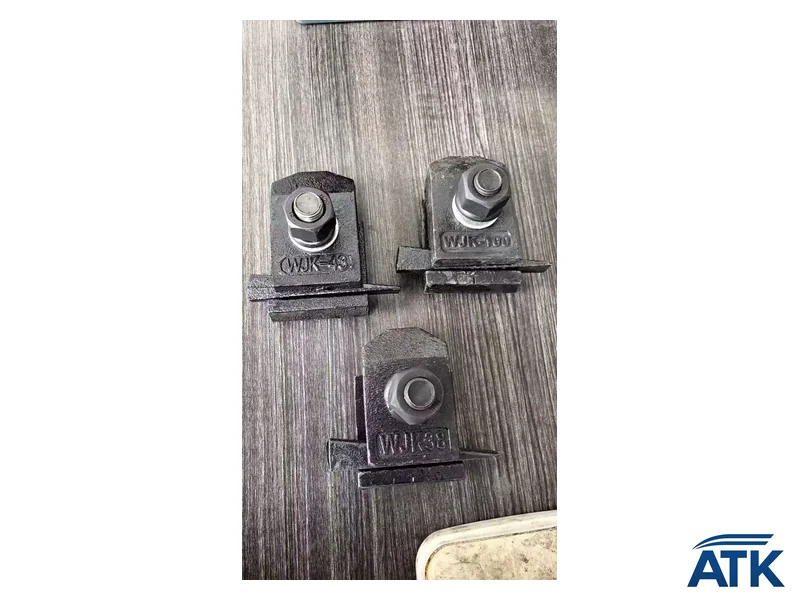
This page was put together by the rail fastening and trackwork engineering team at ATK, working from product drawings, workshop records and the reference photographs used to illustrate the plate types. Standard numbers, editions and scopes were checked against the current National Railway Administration industry standards catalogue, the SAMR standards platform, ASTM International, AREMA publications, CEN / DIN listings, UIC notices, the UK Ministry of Defence permanent way manual and a UK government HS2 carbon-accounting appendix. Where a source is a supplier catalogue or a research paper rather than a standard, the text says so rather than presenting it as a requirement.
We have recommended some of our Related products to you. I hope you will be interested.
 English
 Русский