
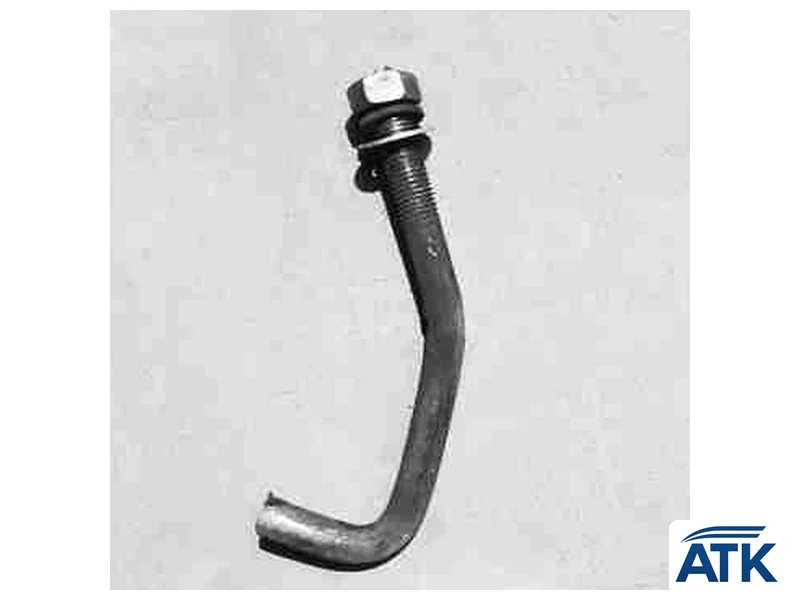
Hook bolts clamp the rail foot to the girder flange with no weld and no drilled hole
Joint bolts pull the fishplate against the rail web at every bolted joint
The hook is sized on flange thickness and reach, not on the rail designation alone
A square or oval neck locks the bolt so it can be torqued from above
Property classes 4.8 / 8.8 / 10.9 to ISO 898-1 and GB/T 3098.1
Joint bolts to TB/T 2347-1993 and ASTM A183/A183M-14(2020), oval neck to ASME B18.10
Torque is confirmed in the technical agreement, never copied from another assembly
Enquiry: part type, rail section, beam flange, thread, length definition, class, coating, documents
A crane runway gives trouble in two places before anywhere else. One is under the rail foot, where the rail is held down to the girder. The other is at the joint, where one rail length meets the next. Both are bolted, and the bolts look alike in the box: same wrench, similar length, often the same coating. In service they do unrelated jobs.
Crane rail hook bolts clamp the rail foot down onto the steel girder. Joint bolts, called fish bolts in most catalogues, pull a fishplate against the rail web and keep two rail ends in line. Fit the wrong one and nothing dramatic happens at first. The rail creeps a few millimetres a month, or a joint starts to pump, and by the time someone puts a straightedge on it the fishplate holes have gone oval.
What follows covers how each bolt is sized, what the standards actually fix, why no published torque table transfers between assemblies, and what to put on an enquiry so the quotation comes back for the part you meant.
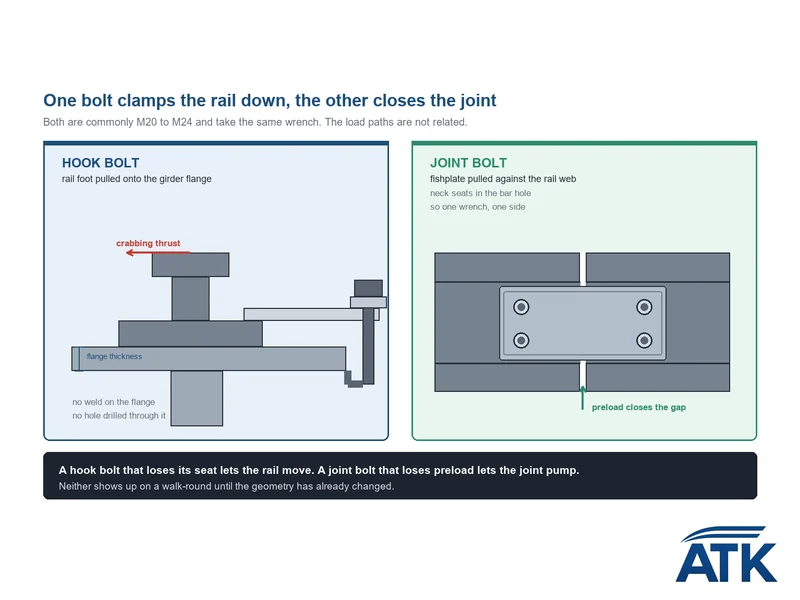
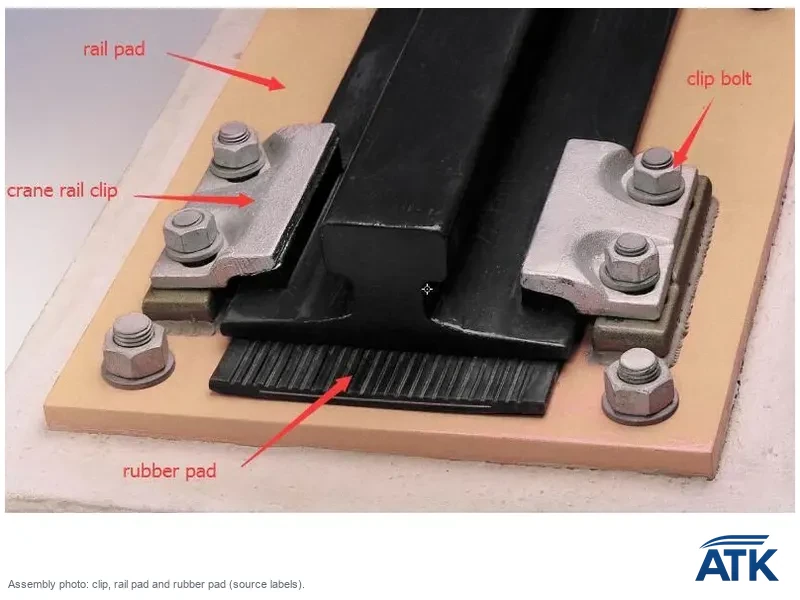
A hook bolt is a clamp. One end is forged into a hook that reaches under the edge of the girder flange. The other end is threaded, passes through a clamp plate that sits on the rail foot, and takes a nut on top. Running the nut down pulls the hook up against the underside of the flange and the plate down onto the rail foot. Nothing is welded, and no hole is drilled into the girder.
The loads it carries are not mainly vertical. A bridge crane crabs sideways as it travels, and that thrust arrives at the rail foot as a lateral force pushing the rail off the girder centreline; braking adds a longitudinal component. The assembly resists both through friction and through the mechanical stop of the hook against the flange edge. That is why the seating of the hook matters more than the torque number on the drawing.
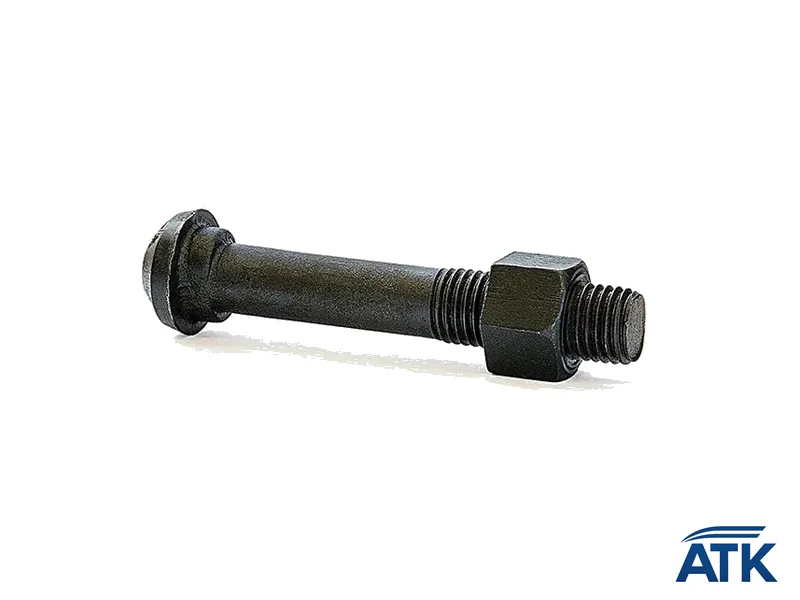
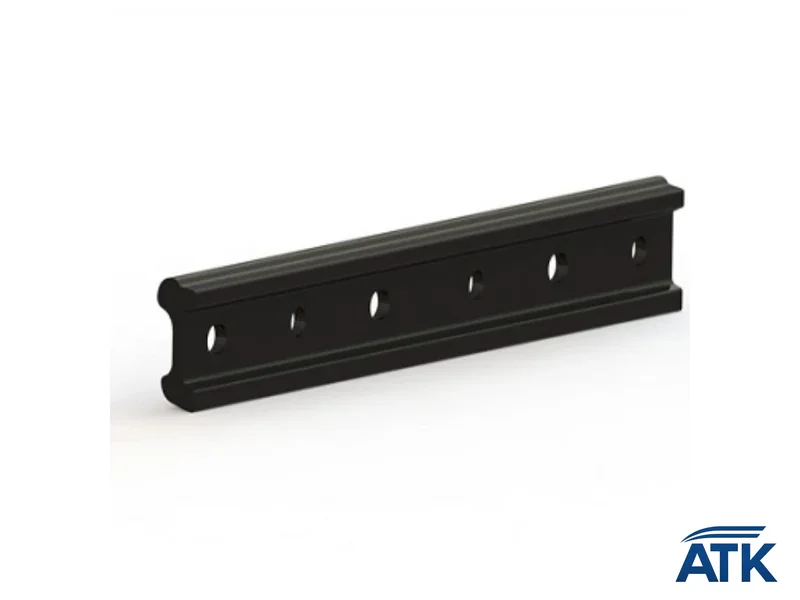
A joint bolt works on a different principle. It passes through the fishplate, the rail web and the second fishplate, and is tightened until the plates grip the web hard enough that the joint behaves close to a continuous rail. The shaped neck, oval, diamond or square, seats in the matching elongated hole in the bar and stops the bolt turning, so a joint can be tightened from one side of the track with one wrench. A plain hex bolt in the same hole spins, and no amount of torque will hold it.
Both parts get confused because both usually fall in the M16 to M24 range and both arrive on a purchase order described as a rail bolt. The railway track bolts range sets the whole family out in one place when you need to compare head and neck profiles side by side.
The bar a joint bolt clamps is drawn to the rail section rather than to a generic pattern. The crane rail fishplates used on QU and DIN A sections follow that section's web profile and hole spacing, which is why a bar and a bolt ordered from two different drawings can arrive incompatible.
The hook version earns its place where the girder cannot be touched. A galvanised beam, a thin flange, a structure already carrying load, a plant that will not issue a hot-work permit: each of these pushes the detail towards clamping instead of welding or drilling. The same reasoning applies to relocatable track and to gantry and portal beams built from H-sections, channels and S-beams.
The trade-off is lateral capacity. A clamped assembly depends on friction between plate and rail foot, and on the hook bearing properly on the flange edge. Where wheel loads are high and the crane travels far with heavy crabbing, a welded clip plate resists more side thrust. Chinese practice for solid-web steel crane girders therefore starts from the standard drawing 23G525, whose fixing details are the clip-plate and weld-on families. On those runways the crane rail clips and their T-bolts are ordered as one assembly with the welded base, and the bolt is not a loose item picked from a bin.
Beam type limits the hook as well. A concrete girder has no flange to hook under, so the detail moves to a cast-in anchor or an embedded plate with a welded clip. A beam with a steeply tapered flange can leave the hook bearing on a corner rather than a face, and a corner contact will yield long before the bolt does.
Joint bolts carry no such choice. They go wherever a bolted joint exists: expansion joints, insulated joints, runway splices, temporary closures during construction, and the connection between a runway and its end stop. If the joint is bolted, it has four or six of them, and the bar's hole pattern decides which.
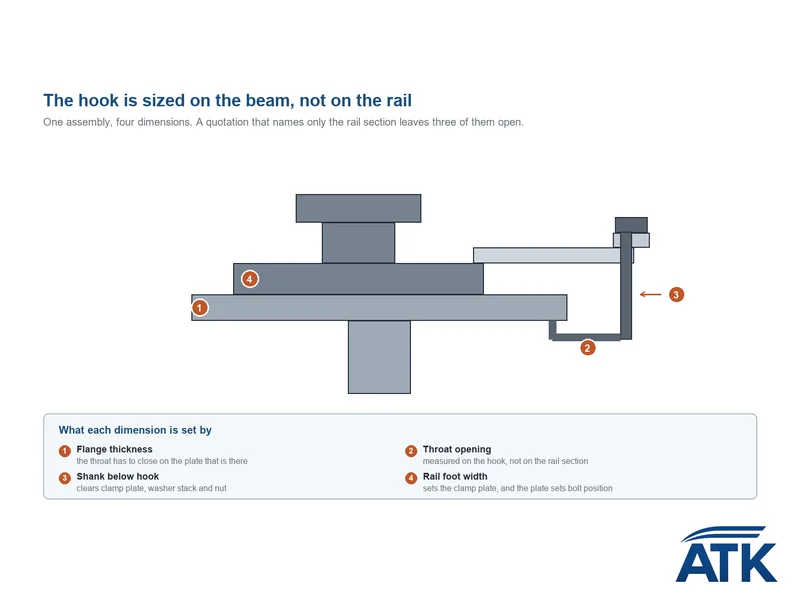
Most ordering errors start with the rail and stop there. Four dimensions decide whether a crane rail fastening bolt fits the hardware it is meant to hold.
Flange thickness comes first. The throat has to close on the plate that is actually there. Too wide and the hook hangs on the flange toe with the shank leaning over; too narrow and it will not seat at all, and the fitter will file the flange or force the nut, which are both ways of starting a failure.
Flange width and reach come next. The hook has to pass the edge and still leave the shank clear of the flange face, otherwise the clamp plate sits at an angle and the rail foot is pinched on one side only.
Shank length below the hook has to clear the clamp plate, the wedge or adjusting plate, the flat washer, the spring washer and the nut, with a couple of threads showing. Run out of thread and the assembly never reaches its preload.
Rail foot width sets the clamp plate, and the plate sets where the bolt sits relative to the rail centreline. A plate that is too wide will foul the web at the rail end; one that is too narrow will not cover the foot.
Two runways carrying the same QU100 rail can need two different hook bolts, because one girder is an H-section with a 20 mm flange and the other a channel with a 12 mm flange. That single fact is the argument for putting the beam on the enquiry form rather than in a later email.
One detail is worth checking on any hook bolt drawing: the neck. A square or oval neck below the hook, or at the clamp interface, locks the bolt into the plate so it will not rotate when the nut is run down from above. Top-side installation is the whole point of the design. A maintenance crew should never have to reach under a girder to hold a bolt head.
A line such as M24 x 150, class 8.8, hot-dip galvanised carries four separate pieces of information, and one of them is ambiguous. Diameter and pitch come from the thread standard. Class fixes the steel and the minimum mechanical properties. Finish fixes corrosion life and, less obviously, the friction coefficient that any torque figure was calculated from. Length is the ambiguous one: some catalogues measure under the head, some the full shank including the hook, some the threaded length only.
For a joint bolt, length is not a preference. It is the sum of bar thickness, rail web, washer stack and nut, and the joint drawing sets it. A short bolt leaves threads buried in the hole and never reaches full engagement. A long one bottoms on the far fishplate, or leaves so much thread that the nut runs onto an unplated section and starts to rust from the inside.
For a hook bolt the same arithmetic applies with one extra term, the hook itself. An order reading only M20 x 200 tells a supplier nothing about the throat opening, and a hook forged to the wrong throat is scrap whether or not the thread is perfect.
Class deserves its own note. 8.8 is the usual choice for joint bolts and clamp bolts, 10.9 where more clamping force is needed on a joint that carries impact, and 4.8 only in light positions. Class 12.9 appears in enquiries more often than the application justifies: the extra strength arrives with a hardness that makes electroplated coatings a hydrogen-embrittlement risk, and a bolt that snaps in service is worse than one that stretches.
Part | Document | What it fixes |
Joint bolt, China | TB/T 2347-1993 | High-strength joint bolts and nuts for 43 to 75 kg/m rail joints, M22 and M24, usually written 8.8S and 10.9S. Still listed as current in the national railway administration's 2024 catalogue of valid standards. |
Joint bar, China | TB/T 2345-2008 | The bar these bolts clamp, for 43 to 75 kg/m rail. |
Property classes | ISO 898-1 / GB/T 3098.1 | The 4.6 to 12.9 class system, tensile and yield minima, hardness, elongation. |
Joint bolt, North America | ASTM A183/A183M-14(2020) | Carbon steel track bolts and nuts used with joint bars to connect rails. The earlier edition split bolts into a low-carbon Grade 1 for industrial and mine track and a heat-treated Grade 2 for general track; the current edition describes a heat-treated bolt for general use. Oval-neck geometry comes from ASME B18.10, and AREMA practice adds the button-head profile, rolled threads and heavy nuts. |
Joint bolt, CIS | GOST 11530-76 / GOST 11532 | Metric joint bolts and nuts for P-series rails. The 1976 edition is the one supplier catalogues still quote. |
Crane runway fixing, China | 23G525 | Rail-to-girder fixings, rail splices, expansion joints and end stops for solid-web steel crane girders. In force from 1 June 2024, replacing 05G525. |
Hook bolt | no dedicated product standard | No product standard names the hook bolt itself. Sized from the beam and the rail, bought to a property class, a coating specification and a drawing. |
Rail fixing assemblies, China | JB/T 13125-2017 / JB/T 10543-2018 | Both current. They specify families of rail fixing and connection devices (LHFC, LHTZ, LHSTK, WJK, SWJK, SGL and others); JB/T 10543 explicitly covers QU70 to QU120. They govern the assembly family, not an individual hook bolt. |
TB/T 2347 is titled high-strength rail joint bolts and nuts, which is how railway joint bolts usually appear on Chinese project schedules. The Chinese fixing-assembly standards make the same distinction from the other side: JB/T 13125-2017 and JB/T 10543-2018 specify families of rail fixing and connection devices, including the WJK and SGL families used on QU sections, but neither names a hook bolt as a product. A hook-bolt order therefore leans on the drawing and the property class rather than on a product designation. Which document governs the rail section itself is a separate question, set out in the crane rail standards comparison. The pattern holds throughout: the standard fixes the bolt, not the joint. Bar drilling, hole size, slot length, rail-end gap and clamp-plate geometry belong to the drawing or the technical agreement, and that is where a quotation has to be checked line by line.
One boundary is worth stating because datasheets blur it. European fastening test methods such as EN 13146 are written for the complete assembly, clip and pad and base and anchors together. A single bolt or a single plate has no independent conformity to them, whatever a marketing page claims.
There is no transferable torque table for these bolts, and the pages that publish one cause real damage. The torque that produces a given preload depends on diameter and pitch, property class, the friction coefficient of thread and bearing face, and the stiffness of what is being clamped. Change the finish from oiled to hot-dip galvanised and the same torque produces a different preload with a wider scatter. Replace a nut with a tapped plate and the friction changes again.
So the figure belongs in one of three places: the project specification, the technical agreement for the order, or the installation instruction supplied with the assembly. Where a project names none of them, ask for the value in writing before the first nut is run down, and record what was applied. A site that cannot produce that record has no way to tell a bad batch from a bad installation.
Two habits matter more than the number. The first is staged tightening: bring a joint up in two passes, working from the centre of the bar outwards and alternating which side the nut sits on. The second is a re-check after the runway has taken traffic. Bar faces bed in, coatings creep, and a joint that was correct at handover is often loose a fortnight later.
Locking is where the cheap savings get expensive. The spring washer is doing real work and is also the first part to fail: once flattened, it has lost its load and gets replaced rather than reused. Where vibration is severe, a nylon-insert nut or a thread-locking compound is a more dependable answer than a second washer. Mixing bolts and nuts from different batches on one joint causes quiet trouble as well, because class and coating are matched properties rather than interchangeable ones.
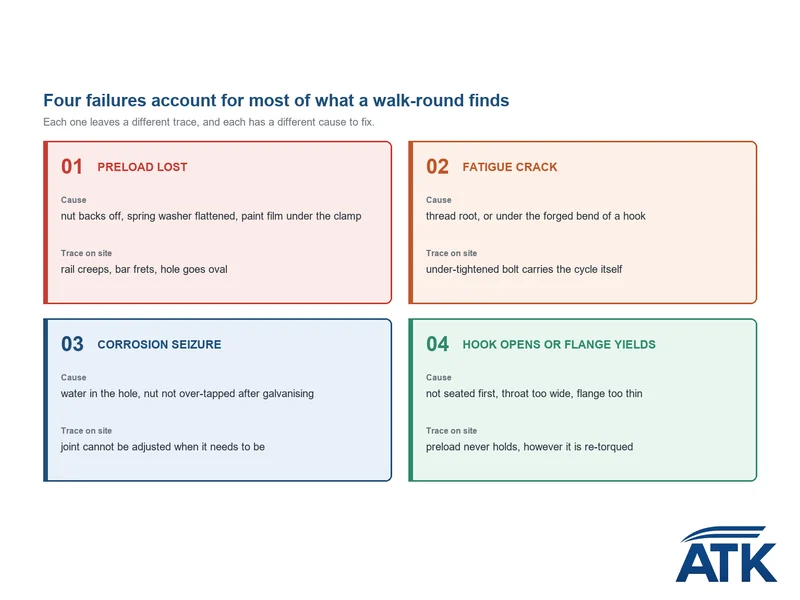
Four failures account for most of what a walking inspection finds.
Loosening comes first. The nut backs off a little at a time, the clamp plate loses its grip, and the rail starts to move. At a joint the symptom is a bar fretting against the web and a hole slowly going oval. Missing washers, reused washers and paint film trapped under a clamp all shorten the time to failure.
Fatigue fracture comes second, and usually follows under-tightening. A bolt that never reached its preload carries the cyclic load itself instead of clamping it away, so the crack starts at the thread root or under the forged bend of a hook, where the section changes. A forging with a tight radius or a fold at the bend does the same thing with no help from the torque wrench.
Corrosion seizure is third. Water sits in the hole, the thread rusts, and the nut will not move when the joint finally needs adjusting. Coating choice drives this: hot-dip galvanising for outdoor, coastal and ballast work; zinc or zinc-flake for general industrial use; plain finish only where the assembly is protected. The detail that gets missed is the nut, which has to be over-tapped to fit a galvanised bolt. A nut forced onto one has had its coating scraped off in the process.
The fourth failure is specific to hook bolts: the hook opens, or the flange edge yields. Both come back to a hook that was not seated on the flange face before tightening, or a throat too wide for the plate. On a thin flange the edge rolls, the hook angle changes, and the assembly never holds preload however carefully it is re-torqued afterwards.
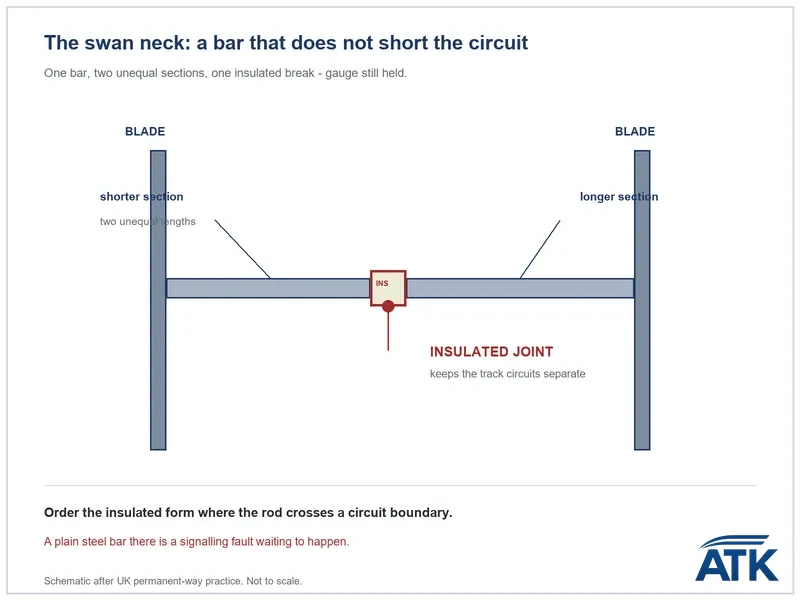
At an insulated joint there is a fifth symptom that arrives before any of these, a track circuit fault from a missing insulating bush or a washer in the wrong position. Nothing mechanical looks wrong yet, which is precisely why the electrical check comes before the torque check on that joint.
Crane rail fastening bolts arrive as a set, and the set is what has to match the drawing. Check it before anything goes up the ladder: bolt type, neck, throat, length, class, coating, nut and washer. A wrong length found at this stage costs a phone call.
Prepare the interfaces. The flange top should be clean and its paint complete before clamps go on, and the rail foot and clamp plate free of grit. Paint build-up under a clamp is a soft layer that creeps, and grit under a plate is a point load.
Seat the hook fully on the flange edge, square to the beam, clear of weld beads and flange taper. Partial seating is the most common installation error on this detail, and it is invisible once the nut is tight.
Fit the clamp plate or wedge with its grooved face to the rail foot, and line the spherical seat up with the bolt before tightening rather than forcing it into line afterwards.
Lubricate the thread only as far as the instruction allows. Oiled and dry threads need different torque for the same preload, so a habit borrowed from another assembly quietly changes the result.
Tighten in stages, from the middle of a joint outwards, alternating the nut side along the bar. On a hook-bolt pair, bring both sides up together, otherwise the rail shifts towards the side tightened first and stays there.
Record the value applied, the wrench used and the date, then mark the nut. A paint mark is the cheapest audit trail available on a runway.
Re-check after the first traffic, then at the maintenance interval: nut torque, gap between bar and rail web, rust bleeding from a hole, and hooks still seated on the flange. Skipping the seating check produces the failures described above, and skipping the re-check turns a small preload loss into a repair.
An enquiry that answers these twelve points usually gets quoted without a second round of questions.
Part type, whether hook bolt or joint bolt, and which assembly it belongs to. Rail section, and for a hook bolt the beam type with flange thickness and width. Thread size and pitch, length and how that length is measured. Property class and the standard with its edition. Hook throat and reach, or neck profile, whichever applies. Nut and washer specification, and whether they come as a set. Coating and coating thickness, including whether the nut is over-tapped. Whether the joint is insulated, and which insulating parts are in scope. Quantity, with a spares allowance for site losses. Documentation required: mill certificate, mechanical test, coating thickness, first-article report. Marking and packing, if the site stores bolts outdoors. Delivery window, which is confirmed against the order rather than promised from a catalogue.
Comparing one fish bolt supplier with another, the questions that separate them are less about price than about four answers. Does the quotation name the standard edition rather than the standard number alone. Is the nut matched to the bolt and over-tapped after coating. Can they hold a length tolerance across a forged hook, not just a turned shank. And will they supply bar, bolts and washers as a matched set drilled to one pattern. A supplier who cannot answer the first question rarely answers the other three.
No. A clip bolt, or T-bolt, has a flat T head that slides into a slot in a baseplate or clip assembly. A hook bolt is forged with a hook that reaches under the girder flange. Both hold a rail down, but they fit different hardware and are not interchangeable.
On a steel girder runway, no, and that is the reason they exist. The hook grips the flange edge and the clamp plate presses on the rail foot, so the girder stays intact. A J-bolt used on a concrete base is a different detail: it is cast in or grouted into a hole. Where a steel flange is too thin, too narrow or inaccessible, a welded clip plate is the better answer.
Not directly. There is no flange to hook under. The fixing moves to a cast-in anchor, a resin-bonded anchor or an embedded plate with a welded clip, and the bolt then works by tension rather than by clamping.
Suppliers commonly offer M16 to M24, or 5/8 in to 1 in in imperial sizes, with the size set by the clamp plate and the lateral load rather than by the rail alone. On a heavy runway with high crabbing forces, a larger bolt buys little if the flange is thin.
The value comes from the technical agreement, the project specification or the installation instruction, because it depends on the bolt, the coating and what is being clamped. A figure copied from another assembly transfers neither the preload nor the safety margin.
Usually because the preload was never right. Look at the spring washer first, then at paint film or grit under the bar, then at the hole size in the fishplate. A bolt cannot compensate for a joint whose faces do not bed.
Yes. Track bolt is the broader North American term; fish bolt and fishplate bolt name the same part by its job at the joint bar. Both appear on purchase orders, so both are worth recognising on a drawing.
No. The S classes belong to TB/T 2347, a rail-specific standard with its own mechanical requirements. An 8.8S bolt is not an ISO 898-1 class 8.8 bolt under another name, and the two should be quoted separately.
8.8 covers most joints and clamp plates; 10.9 where the joint carries impact and needs more clamping force; 4.8 only in light positions. Where a project specifies a class, that class governs regardless of what a catalogue lists as standard.
The sum of fishplate thickness, rail web, washer stack and nut, taken from the joint drawing. A bolt that engages only part of the nut will fail at the thread rather than at the shank, which is the harder failure to inspect for.
Where the specification allows it, provided the threads and coating are sound and the washers are replaced. In practice, bolts that have sat in a wet hole for years come out with damaged threads, and reusing one is a false economy.
The standard and its edition, the property class, the neck profile and how length is measured, the coating and whether the nut is over-tapped, and the documents that will accompany the shipment. Those five answers decide whether the bolts fit the joint you already have.
We have recommended some of our Related products to you. I hope you will be interested.
 English
 Русский