
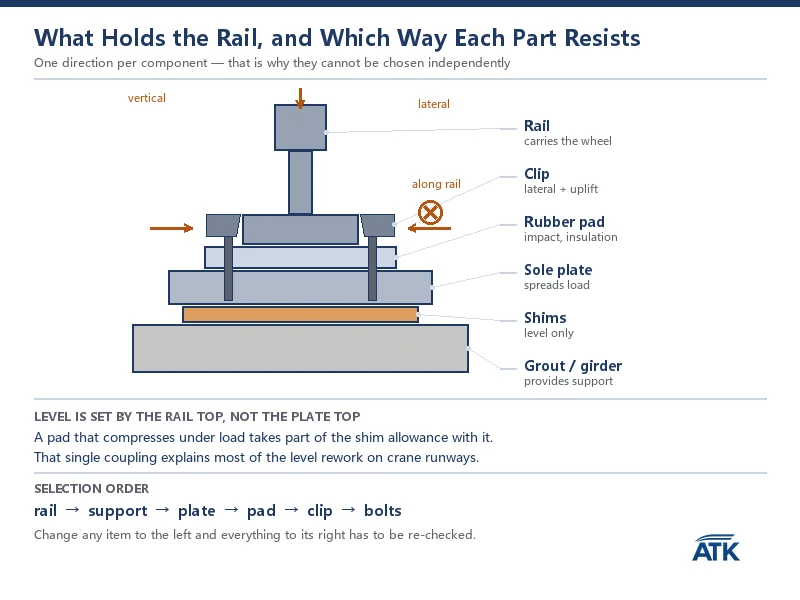
A runway rarely fails at the rail. It fails where the rail meets what holds it. This guide covers the six components, how they constrain each other, and what to send with an enquiry.
A crane runway rarely fails at the rail. It fails where the rail meets what holds it. Several components share that job, and each one takes a different direction of load. Buy them one at a time and the mismatch only appears after installation, when a clip will not seat, a pad has eaten the level, or a joint has opened under the wheel.
Most enquiries arrive as a parts list. A better one starts from the runway: which rail, what wheel load, what the support is, what the electrical environment is. Those four answers usually decide the rest.
The system has four jobs, and none of them can be passed to another part.
It has to hold the rail down against lift and roll, and keep it at gauge against side load. It also has to allow a little movement along the rail without letting it walk, and take the impact of every wheel pass. On electrified or track-circuited runways there is a fifth job: keep the rail electrically separate from the structure.
A crane rail fastening system is judged on those jobs, not on the individual parts. A clip that is strong enough on its own can still fail if the sole plate under it is too narrow, or if the pad compresses more than the shim stack allowed for.
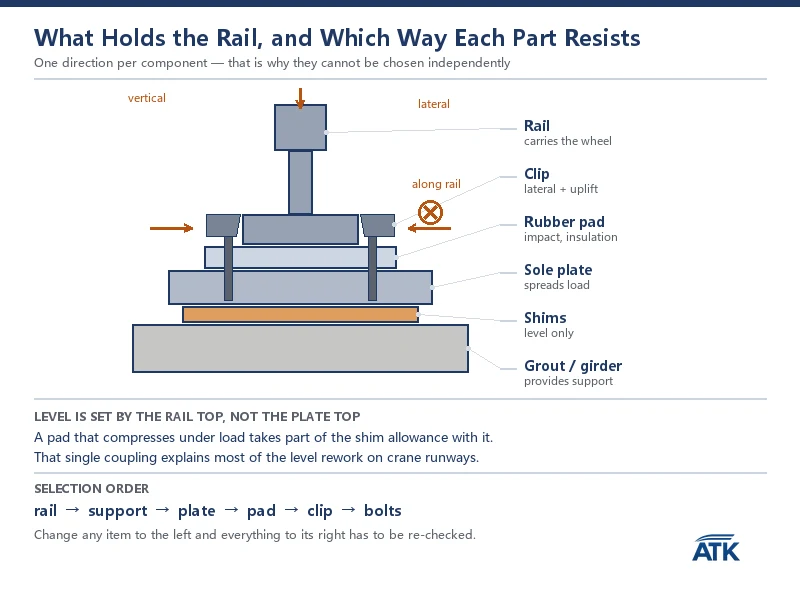
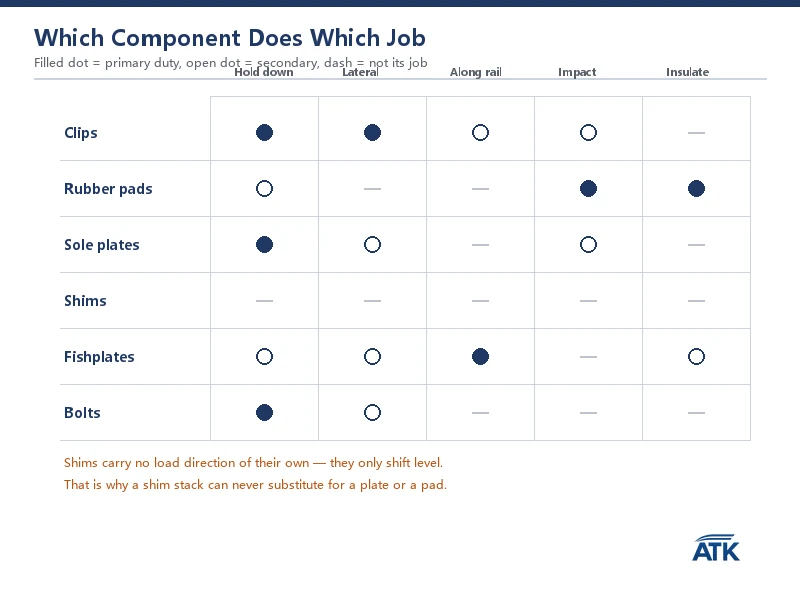
Six crane rail fastening components, each with one job. What limits each one matters as much as what it does.
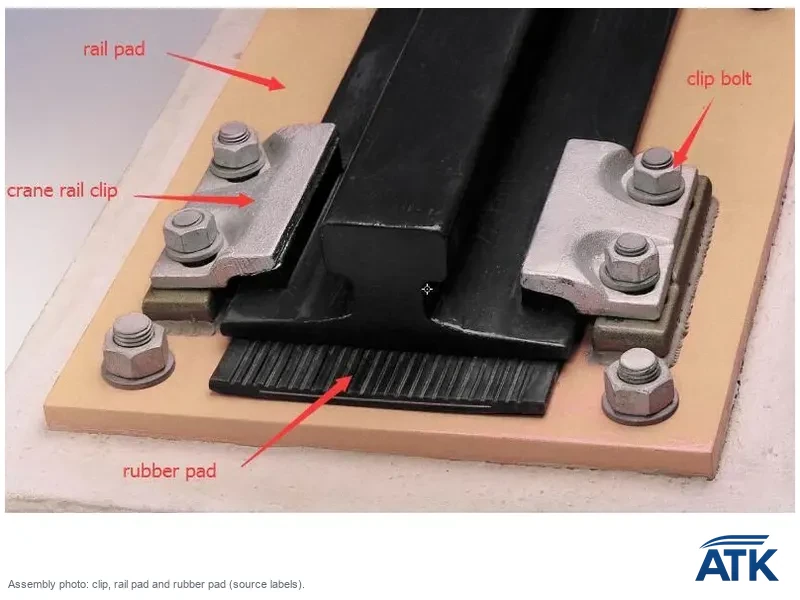
The clip holds the rail foot against the support and stops the rail lifting, rolling or walking sideways. It carries transverse load from skew and from flanging, and it carries vibration.
Limited by: the plate it bolts to, the rail foot width, and the pad thickness under the rail. A clip specified for one foot width sits wrong on another.
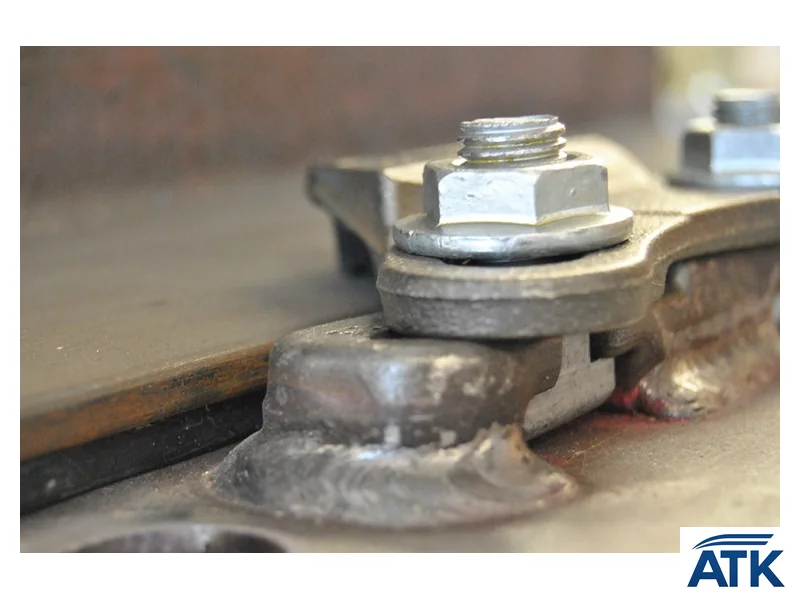
The pad sits between rail foot and plate. It spreads contact pressure, takes the edge off wheel impact and, on electrified or track-circuited runways, provides electrical separation.
Limited by: everything above and below it. A pad compresses under load, so the rail does not stay at the delivered thickness. That compression has to be allowed for in the level, and it changes when the pad is replaced.
The sole plate takes the rail load and spreads it over enough area that the sleeper, girder or concrete below is not overstressed. It also fixes where the clip and the pad land.
Limited by: the bearing area available, the clip type, and the fixing method, welded or bolted.
Shims correct level. They do not add strength, and they do not fix a support that is still moving.
Limited by: the pad. Part of any shim allowance is consumed by pad compression, so the two have to be chosen together.
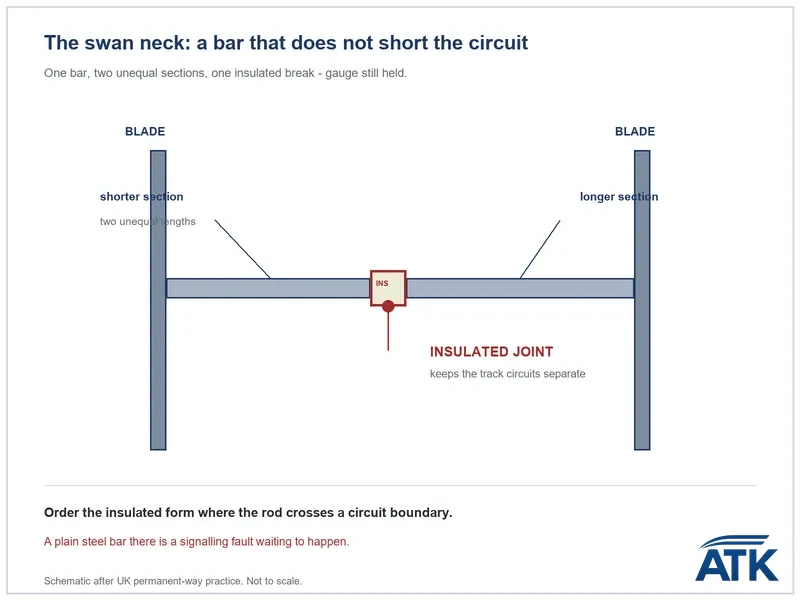
The fishplate carries bending moment and shear across a rail joint and keeps the two rail ends aligned. On a runway, a joint is a stiffness discontinuity, and the wheel feels it.
Limited by: the joint bolts and the support under the joint. A joint on weak support opens however well the bar is made.
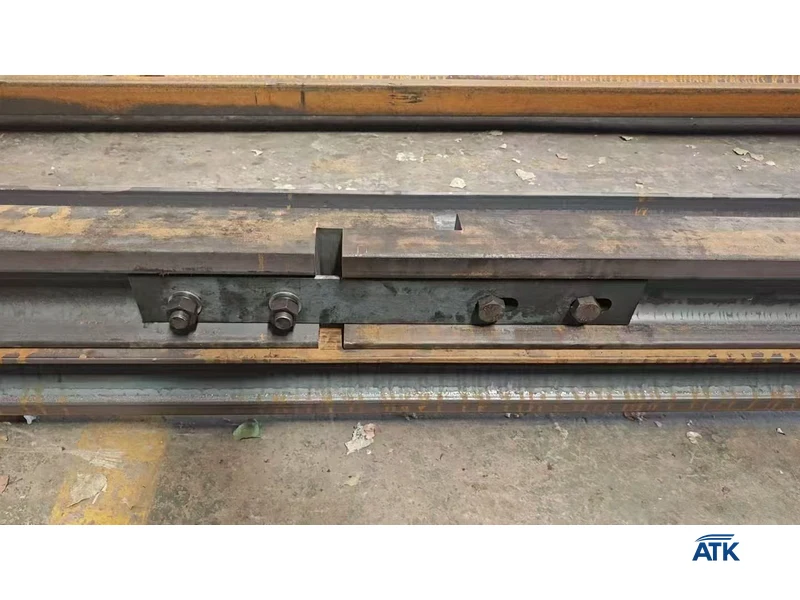
Bolts deliver the preload that makes every other component work. A clip without preload is a loose piece of steel. Hook bolts and anchor bolts fix the assembly to the structure; joint bolts close the fishplate.
Limited by: the hole geometry in the plate below, the torque the assembly can take, and the vibration environment.
Most of the rework on site comes down to four couplings between parts.
Shims and pads. Level is set by the rail top, not the plate top. A pad that compresses under load needs more shim than the drawing suggests. Change the pad grade and the level moves again.
Clips and sole plates. The clip toe has to bear on the rail foot over its full contact area. Where the plate is too narrow, or the shim stack sits under the clip seat, the toe lands partly on the shim edge.
Fishplates and support. A joint concentrates load. Where the support under a joint is softer than under plain rail, the joint opens and the bar works loose. The correction is support, not a heavier fishplate.
Plates and structure. A sole plate spreads load only if the surface below is flat and in contact. Grout or a machined seat does that work. A plate on an uneven surface stops spreading the load and concentrates it at a point.
Scope depends on which of three situations you are in.
A single part can be chosen alone when nothing around it changes. Replacing a worn clip with the same type, or a pad with the same grade, is a part decision. Check the mating dimensions and stop there.
The whole assembly has to be chosen together when the rail or the support changes. A different rail section changes foot width, clip, plate, pad contact area and bolt length at once. So does a move from timber to concrete, or from bolted to welded fixing.
The fastening layer is the wrong place to start when the support is moving. Shims buy time; they do not stop settlement, and treating them as a repair is how a runway gets adjusted twice.
Two more triggers widen the scope. Track circuits and electrification bring insulation into every component, joints included. Coastal and dusty sites change the corrosion allowance and the drainage detail, which changes plate and shim material.
An enquiry that gets a useful answer first time carries eight items. A crane runway fixing system cannot be quoted from a rail section alone.
Item | Why it is needed | Often missing |
Rail section and standard | Sets foot width, height and clip family | Given as a trade size without the standard |
Wheel load, static and maximum | Sizes plate and clip | Only the crane capacity is quoted |
Gauge and runway length | Sets quantity and joint positions | Length given, gauge not |
Support type | Sleeper, steel girder, concrete beam | Assumed to be concrete |
Fixing method | Welded or bolted changes the whole plate | Left open |
Electrical requirement | Insulated or not | Raised after the joint is designed |
Environment | Corrosion class, temperature range, drainage | Not mentioned |
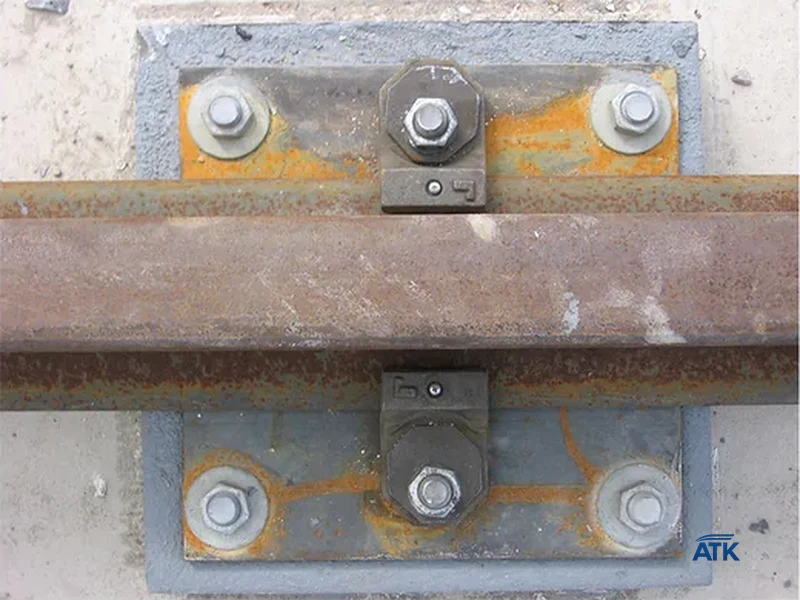
Existing assembly | What is on the runway now | No photograph |
A photograph of the assembly in place answers several of these at once. So does the drawing number of the runway beam.
If the rail section and the fixing method are already settled, buying is straightforward: pick the sizes you need and order them.
The decisions that cause trouble happen earlier, when nobody has worked out which components the runway actually needs or which ones move together. Most wrong parts are decided at that stage, not at the ordering stage.
The same five patterns turn up again and again on different runways.
- A clip from one system on a plate from another. The toe lands short or long and preload is lost.
- Shims stacked under the clip seat instead of under the plate. The stack creeps and the clip loosens.
- A stiffer pad chosen to cut vibration with no re-check of level. The rail sits high and the clip fights the toe.
- Joint bolts reused after a joint has been opened. Preload is gone even if the bolt looks sound.
- Plates sized to the rail rather than to the bearing area. The plate is right and the structure below is overstressed.
Each component has its own detail elsewhere. Crane rail clips follow the rail section. Crane rail rubber pads are chosen by build and thickness. Crane rail sole plates and height adjustment shims carry the dimensional rules. Crane rail fishplates are listed by rail section, and crane rail hook bolts and joint bolts cover hook and joint duty.
Start from the component the project has already fixed, usually the rail, and work outward. That order keeps the couplings in view.
Clips, pads, sole plates, height adjustment shims, fishplates and the bolts that preload them. Insulated versions of each where the runway carries track circuits.
Yes, when nothing around it changes. Check foot width, plate seat and pad thickness before ordering, because those are what a replacement has to match.
Sometimes, but check the toe contact and the plate seat. Mixed systems usually fail at the toe, not at the bolt.
No. A thicker or stiffer pad changes the working height of the rail, so the level and the clip adjustment have to be re-checked.
Only where the runway is track-circuited or where stray current matters. Insulation then extends to the joint, not just the plate.
The limit comes from the plate fixing and the standard you are working to. It is not a figure to improvise on site.
They correct level, not support. If the runway is still moving, shims buy time and the foundation needs attention.
Quoting a rail trade size without the standard, and leaving the fixing method open. Both change the plate.
It has to suit the rail section and the joint bolt, and it has to sit on sound support. A runway joint carries more impact than a plain track joint.
If the rail section, the support type or the fixing method is changing, review the whole assembly. If only wear parts are being replaced, check the mating dimensions and order.
We have recommended some of our Related products to you. I hope you will be interested.

 English
 Русский