
An enquiry lands with "crane rail clips" in the subject line and "rail clamps" in the attached drawing. The buyer wants one price. Before anybody quotes, somebody has to decide whether those are two parts or one.
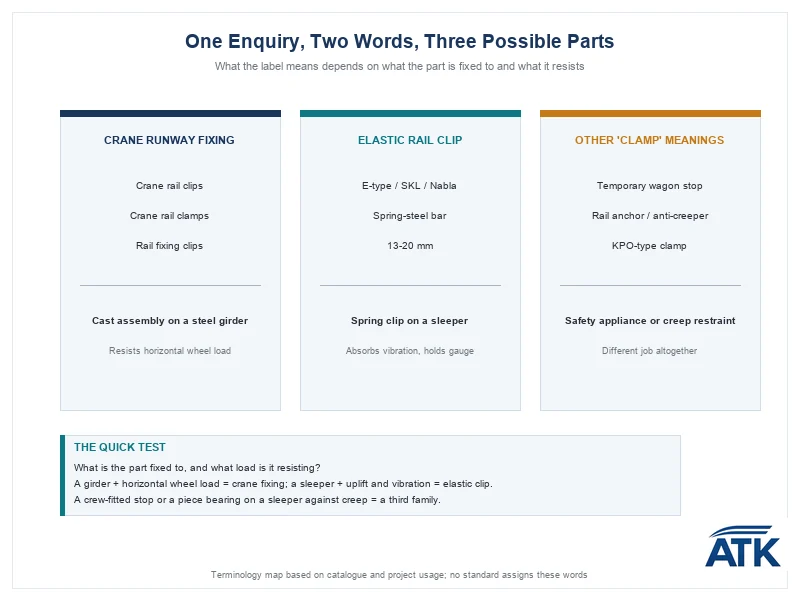
That question is worth more than it looks. Search for the difference and you get three incompatible answers. One supplier says a clip is elastic and a clamp is rigid. Another says the clip belongs on a crane runway and the clamp on a railway line - the exact reverse of the first. A third uses "rail clamp" for a temporary device that stops a wagon on a stub track. All three are in circulation, all three appear in real purchasing documents, and none of them is wrong in its own context.
This guide is about reading the context. It explains where the two words mean the same assembly, where they point at genuinely different products, and what to put on the enquiry so the quotation comes back for the right part.
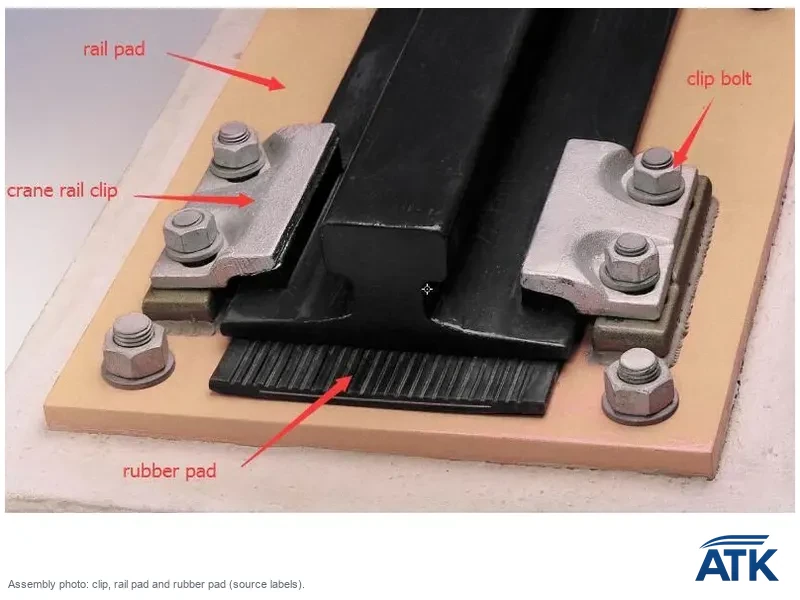
On a crane runway, "clip" and "clamp" are the same cast fixing assembly. It sits on the top flange of a steel girder, holds the rail foot down, carries the sideways push from the crane wheels into the supporting steel, and still lets the rail grow and shrink lengthways as the temperature changes.
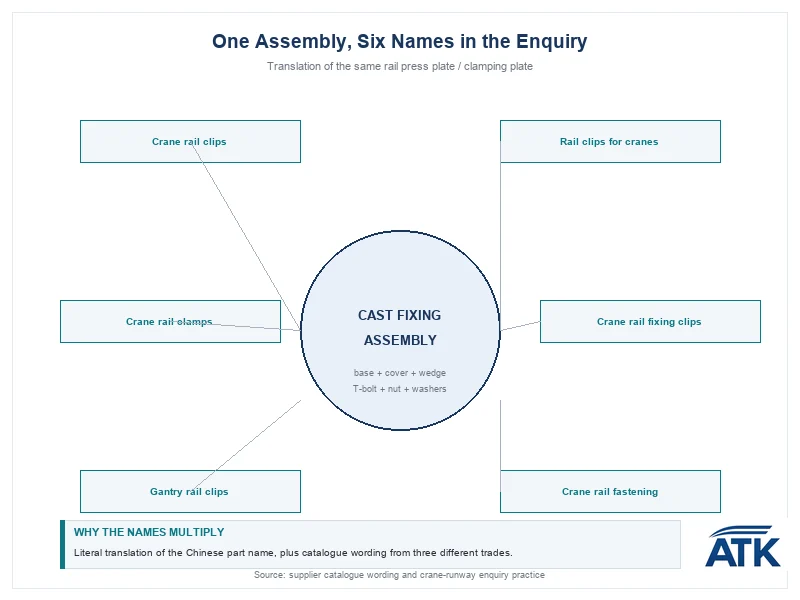
The vocabulary is a translation problem more than an engineering one. The Chinese name for this part is literally a rail press plate or pressure plate. Depending on who translated the catalogue, it comes out as clip, clamp, clamping plate, rail fixing clip, press plate or fastening clip. Add "crane" or put it in a gantry-runway context and the meaning narrows to the crane fixing; leave that word out and a supplier may quote a completely different family.
That is why the same purchase order can carry six names for one assembly. Crane rail clips, rail clips for cranes, crane rail clamps, crane rail fixing clips, gantry rail clips, crane rail fastening - in most crane-runway enquiries they all point at the same cast component.
The engineering is unchanged by the label. A welded WJK-type assembly has a base plate welded to the girder flange, a top cover profiled to the rail foot, an adjustable wedge plate, a T-bolt with a spherical lower seat, a nut and two washers. Tightening the nut pulls the cover onto the rail foot. The spherical seat lets the bolt lean a few degrees when a horizontal impact arrives instead of taking the load in bending. That detail is why the design survives heavy-duty crane service.
For the dimensions, model families and the 23G525 schedule that sit behind those assemblies, see the WJK welded clip family product page.
Three other products hide behind these words. Confusing them with a crane runway fixing is the expensive mistake.
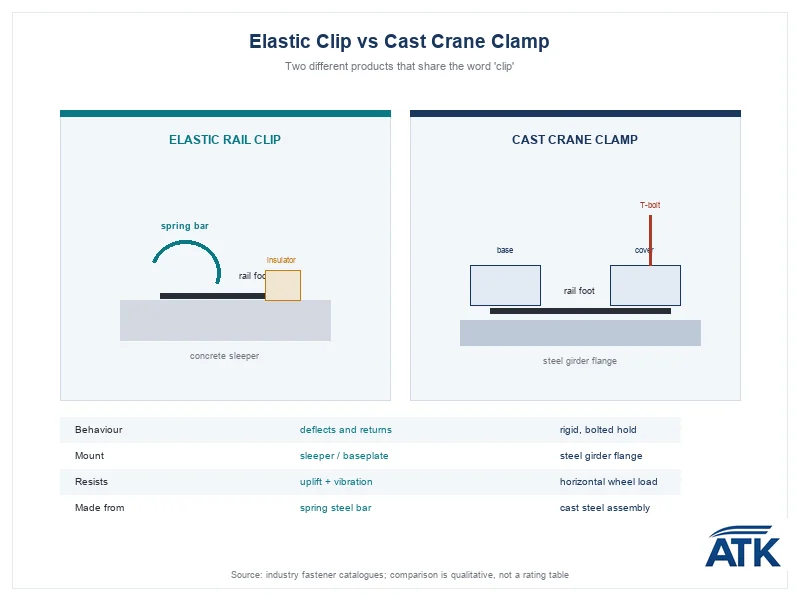
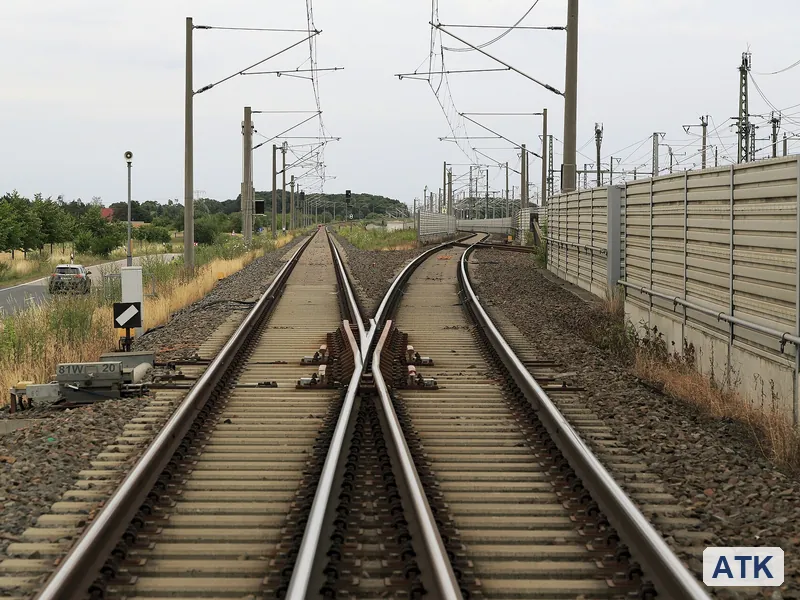
Elastic rail clips. On a mainline, metro or high-speed track, "rail clip" normally means a spring-steel component - E-type, SKL tension clips, Nabla, Deenik and their relatives. It is a bent bar, typically 13-20 mm in spring steel such as 60Si2MnA or 38Si7. It deflects under the wheel load and returns to shape, holding a stable toe load over millions of cycles. That elasticity absorbs impact, protects the concrete sleeper seat, keeps gauge, and allows a little longitudinal rail movement to release thermal stress. It is a different product from a cast crane fixing, made to a different standard, sold by weight rather than by assembly. The same fastening families show up in switch and crossing work, where a railway turnout assembly (https://www.tkrailwaymaterials.com/Products/VehicleElectricalandSignaling/railway-turnout/) puts its own geometry around them.
Temporary rail clamps. In railway operating practice, a rail clamp can be a portable device clamped to the rail to stop a wagon passing a given point - used at platforms, on stub tracks, or to protect a work site. It is a safety appliance, not a permanent fastening. It is bolted on, self-locking and removable. If a drawing says "rail clamp" and the context is a possession or a siding protection plan, this may be what is meant.
Rail anchors. Also called anti-creepers, these are spring-steel clips fixed to the underside of the rail foot and bearing against the sleeper. Their job is to resist longitudinal rail creep from temperature change, braking and traffic - not to hold the rail down. North American practice puts them under AREMA Chapter 5, Part 7. They are a third family again.
A quick test settles most cases: what is the part fixed to, and what is it resisting? A crane fixing is fixed to a steel girder and resists a horizontal wheel load. An elastic clip is fixed to a sleeper or baseplate and resists uplift and vibration. An anchor bears against a sleeper and resists longitudinal movement. A temporary clamp is fitted and removed by the crew.
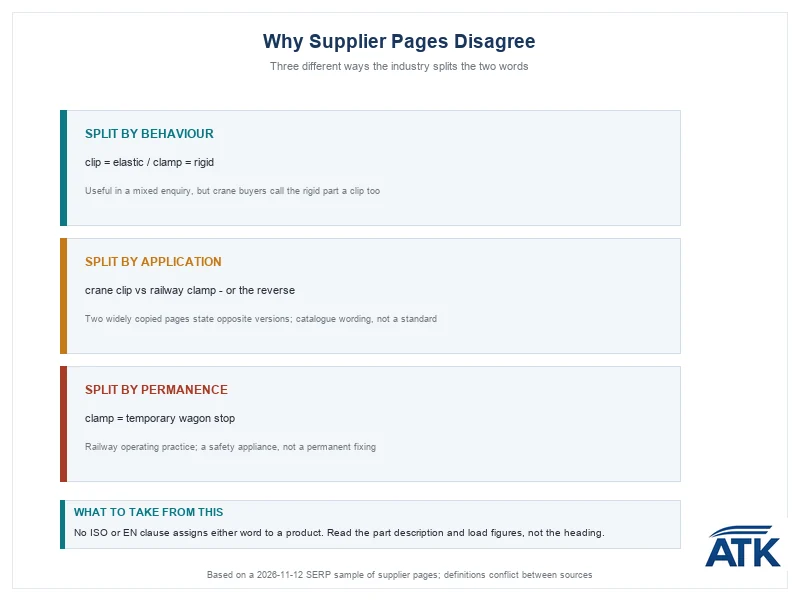
The contradictions are real, and they come from three different habits.
Some suppliers split by behaviour: elastic equals clip, rigid equals clamp. On that reading a clip is the spring-steel railway fastener and a clamp is the bolted or welded crane assembly. It is a clean distinction, and it is the one most useful in a mixed enquiry - but it is not how crane-runway buyers actually speak, because they call the rigid assembly a clip too.
Others split by application, and here the wheels come off. One widely copied page states that a crane rail clip is for crane rails and a rail clamp is for railway track; another states the reverse. Neither is a standard definition. Both are catalogue wording written to separate two product lines on the same website.
A third group uses clamp for the temporary appliance, as described above, and uses clip for everything permanent.
What exists instead are project specifications, manufacturer catalogues and drawing titles. No issuing body assigns either word to a specific product. That is why the word on its own cannot decide a quotation - and why asking a supplier "do you have rail clips?" without a rail section and a duty class often returns the wrong datasheet.
The honest answer to "are they the same?" is therefore: in a crane runway enquiry, usually yes; in a mixed railway and crane enquiry, not necessarily; on a drawing, only the drawing can tell you.
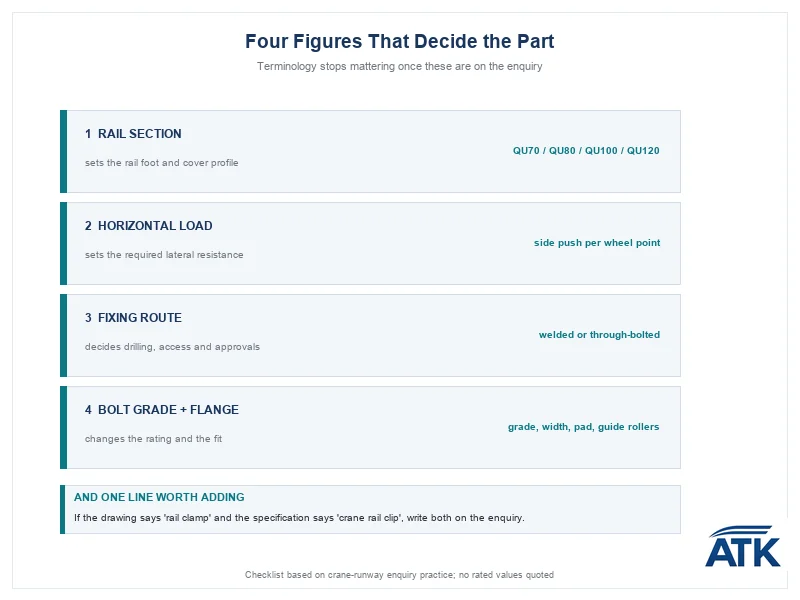
Four figures settle more than any amount of terminology.
The rail section comes first - QU70, QU80, QU100, QU120, or a TG, DIN, ASCE or railway profile. The fixing is matched to the rail foot width and the girder flange available for it. Then the horizontal wheel load, because that sets the required lateral resistance. Then the bolt grade and the fixing route, welded or through-bolted. Finally the site conditions: whether a resilient pad sits under the rail, whether the crane has horizontal guide rollers that need a low-profile cover, and whether welding on the beam is permitted at all.
A specification that names a product family but omits those four is not yet a specification. Series numbers are worth a separate warning: a "Series 3" or "Series 4" clip is one supplier's product-family designation, not a standard size, not a rail section and not a load rating. What "3" and "4" actually denote, and why a drawing carrying one of them still needs a datasheet, is covered in our note on Series 3 and Series 4 clip numbers .
The same logic applies to the rail itself. If the enquiry also covers the runway rail, the profile, standard and dimensional data belong on one sheet; our crane rail profiles page covers the sections and the current standard editions.
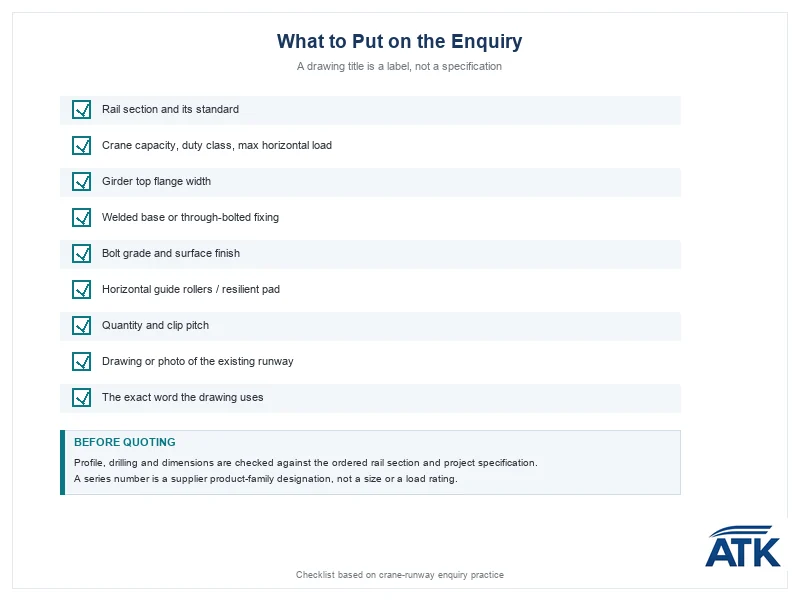
A drawing title is a label, not a specification. Open the detail and look for what is physically there.
A welded base shown with a weld symbol on the girder flange, a T-bolt in a spherical seat and a wedge plate for gauge adjustment is a WJK-type crane fixing, whatever the title calls it. A spring-steel bar clipped into a shoulder on a concrete sleeper, with an insulator and a rail pad, is an elastic fastening. A portable jaw bolted to the rail head at a work site is a temporary stop. A small spring-steel piece bearing against a sleeper under the rail foot is an anchor.
Where the drawing is a bolted low-profile assembly with a rubber nose and a lateral adjustment figure, check the fixing route and the support width before comparing offers. A bolted clip is not a drop-in substitute for a welded WJK clip: different drilling, different approvals, different girder flange requirements.
Two items are worth checking even when the label is right. The bolt grade changes the rated lateral capacity of the same clip body, so the grade belongs in the schedule. And the washers are not optional - a spring washer holds preload through crane braking and starting, while a hardened flat washer spreads the nut load so the cover is not brinelled. If a bill of materials omits them, the assembly is incomplete.
The bolts themselves have their own standards and head profiles; the railway track bolts page sets out the grades, neck profiles and matched nut and washer sets used with these assemblies.
State the rail section and its standard. Give the crane capacity, duty class and the maximum horizontal load per wheel point. Say whether the base is welded or through-bolted, and give the girder top flange width available for the fixing. Name the bolt grade and the surface finish. Say whether the crane has horizontal guide rollers and whether a resilient pad sits under the rail. Add the quantity, the clip pitch if it is already set, and the drawing or a photograph of the existing runway.
Then add one line that most enquiries leave out: the word the drawing uses. If the drawing says "rail clamp" and the specification says "crane rail clip", write both. A supplier reading that line knows to check the detail rather than pick a catalogue family from the title.
A girder drawing or a site photo resolves more than a paragraph of description, particularly on refurbishment jobs where the flange width is the limiting dimension. We check the profile, the drilling and the dimensions before quoting, and confirm feasibility against the ordered rail section and the project specification.
A wrong-family quotation is not a small administrative error. An elastic clip specified for a crane runway has no way to carry the concentrated horizontal load; the runway will move, the gauge will drift and the rail will start to gnaw. A rigid crane fixing specified for a concrete sleeper track transfers impact straight into the sleeper seat and cracks it. A temporary stop ordered in place of a permanent fixing leaves the runway with no restraint at all.
The failure usually shows up months later, at the first shutdown inspection: loosened nuts, ovalised holes, a cover that has walked off the rail foot, or a pad that has worked its way out. By then the label on the original purchase order is long forgotten, and what matters is the drawing and the load figure behind it.
This is also why "fixing crane rail" and "crane rail fastening" are worth reading as scope words, not part names. In an enquiry they often mean the whole package - clip, pad, rail, bolts and the installation method - rather than a single cast component. Ask which is meant before pricing either.
In most crane-runway enquiries, yes. Both names refer to the cast fixing assembly that holds the rail foot to a steel girder and resists the sideways wheel load. The wording is a translation of the same Chinese part name. Check the drawing detail before ordering, because "rail clamp" can also mean a temporary wagon stop.
It depends on the trade. On mainline track, a rail clip is usually a spring-steel elastic fastener that holds the rail to a sleeper and absorbs vibration; a clamp is a rigid, bolted or welded assembly used for heavy lateral loads. On a crane runway, buyers use both words for the same rigid assembly. Neither usage comes from a standard - both come from catalogue and drawing habits.
It can be. In railway operating practice, a portable self-locking clamp fitted to the rail to prevent a wagon passing a point on a stub track or into a work site is called a rail clamp. It is a safety appliance, removed after use, and has nothing to do with a permanent crane rail fixing. If the context is a possession plan or siding protection, confirm which one is meant.
No. An elastic clip is designed for repeated wheel loads on sleepers, with controlled deflection and vibration damping. A crane runway puts a concentrated horizontal load into the fixing and needs a rigid bolted or welded assembly with a defined lateral capacity. The two are not interchangeable.
Not as a like-for-like swap. A welded base transfers load into the girder flange without drilling it; a bolted clip needs holes, access below the beam and a different support width. They carry different approvals and different drawings. Replacing one with the other is a design change, not a substitution.
Because supplier catalogues use the words to separate their own product lines, not because a standard defines them. Some split by elastic versus rigid behaviour, some by crane versus railway application, and some by permanent versus temporary. Read the part description and the load figures, not the heading.
The rail section and its standard, the crane duty class and maximum horizontal load, the girder flange width, the fixing route (welded or bolted), bolt grade, whether guide rollers or a resilient pad are present, the quantity, and the drawing. If the drawing uses a different word from the specification, include both.
No. Those are one supplier's product-family numbers for a range of through-bolted, rubber-nosed clips, not standard designations, rail sections or load ratings. Ask for the datasheet for the individual clip name and the rail section before comparing two offers.
Terminology only gets you to the right catalogue. The dimensions, lateral capacities, bolt grades and the 23G525 model schedule are on the clip product page linked above; the crane rail page covers the profiles and standard editions; the track bolt page covers the matched fasteners. Read those alongside the drawing, and the label stops mattering.
For a mixed order, state the rail section, the horizontal load, the girder flange width and the fixing route in the first message, and we will confirm the specification before quoting.
We have recommended some of our Related products to you. I hope you will be interested.
 English
 Русский