
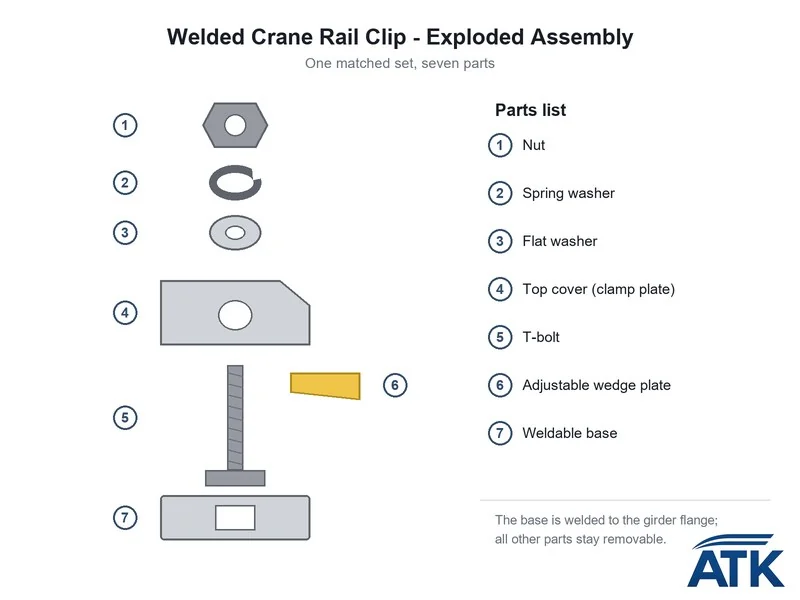
Enquiries for crane runway fixings arrive with half a dozen different names for the same assembly. "rail clips for cranes" and "crane rail clips" are the two most common. Then come "crane rail clamps", "crane rail fixing clips", "gantry rail clips" and "crane rail fastening". They all point at one assembly. It holds a crane rail down onto a steel girder and carries the sideways push from the wheels.
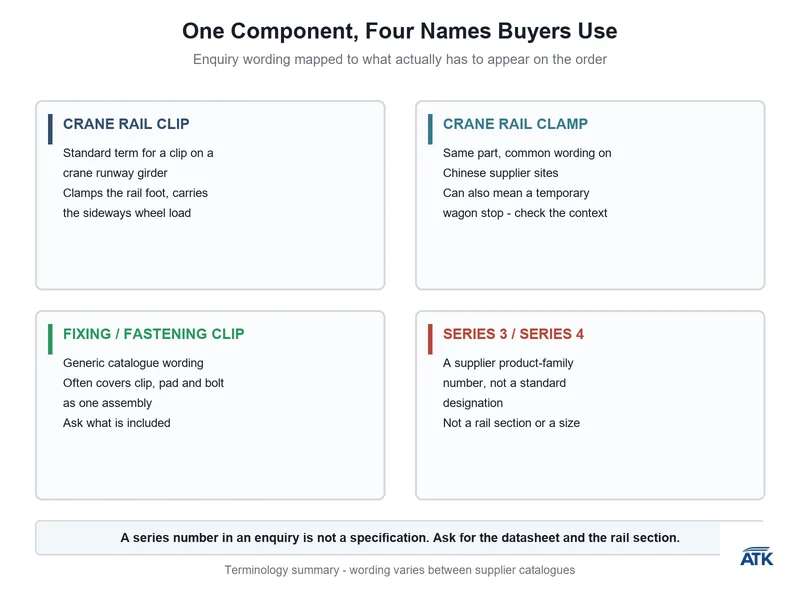
The confusion is not harmless. A "rail clip" on its own usually means an elastic spring clip for railway sleepers - E-clip, SKL, Nabla - which is a different product entirely. A "rail clamp" can also mean a temporary device that stops a wagon on a stub track. "Rail anchor" is a creep restraint. Add the word "crane" and the meaning narrows; leave it out and a supplier may quote the wrong family.
A clip does three jobs at once. It clamps the rail foot to the support. It transfers lateral force into the girder. It also lets the rail grow and shrink lengthways as temperature changes. That last requirement is why a crane runway fixing is bolted or welded steel rather than a spring. Concentrated wheel loads would walk an elastic clip out of position in weeks.
A series number is not a rail section. It is worth stating plainly, because "crane rail clip series 4" and "crane rail clip series 3" turn up in enquiries as if they were international size codes. They are not. That distinction matters. They are one supplier's product-family numbers for a range of hexagon-head, through-bolted, rubber-nosed clips used on light to medium duty crane runways.
That range has been on the market since the 1960s and uses a double-wedge design that tightens itself under load. A newer generation, labelled the 4 series, was launched in 2020 to replace the older 3 series. The changes were practical rather than dimensional: a drain hole so water cannot stand in the clip, a rotating washer that locks all components during installation, updated bolt engagement to reduce maintenance, and a low-height locking flange nut for runways with horizontal guide rollers. One published example is a "4124/15" clip replacing an earlier "3124/15" at the same 15 mm lateral adjustment.
So when a drawing says "Series 4 clip", it is naming a catalogue family, not a standard. It does not tell you the rail section. It does not give the side load either. The flange width and bolt grade are still missing. Those four come from the project. "Crane rail accessories" and "fixing crane rail" are looser still - they usually mean the whole clip, pad and bolt package. Ask for the datasheet before comparing any two offers.
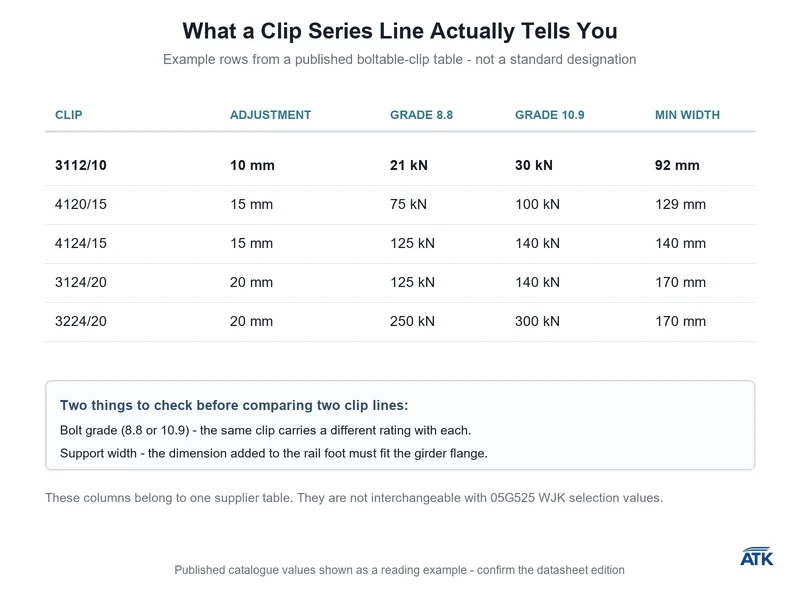
A published boltable-clip table gives five columns that matter: the clip name, its lateral adjustment, the horizontal force capacity with Grade 8.8 bolts, the same capacity with Grade 10.9 bolts, and the dimension that must be added to the rail foot to get the minimum support width. A "3112/10" line reads 10 mm adjustment, 21 kN with 8.8 bolts, 30 kN with 10.9 bolts, and 92 mm added to the rail foot. A "3224/20" line reads 20 mm, 250 kN, 300 kN and 170 mm.
Two details change how these numbers are used. The same clip has two ratings. Grade 8.8 is the normal, economical choice; 10.9 is used when a larger clip will not fit but more capacity is needed. The width added to the rail foot is a minimum support width. A narrower girder flange will not accept the clip. Rating alone does not fix that.
These columns belong to one supplier's table. They are not interchangeable with the 23G525 selection values used for welded WJK clips, and a "4124/15" is not a substitute for a "WJK-QU100". Different fixing routes, different approvals, different drawings.
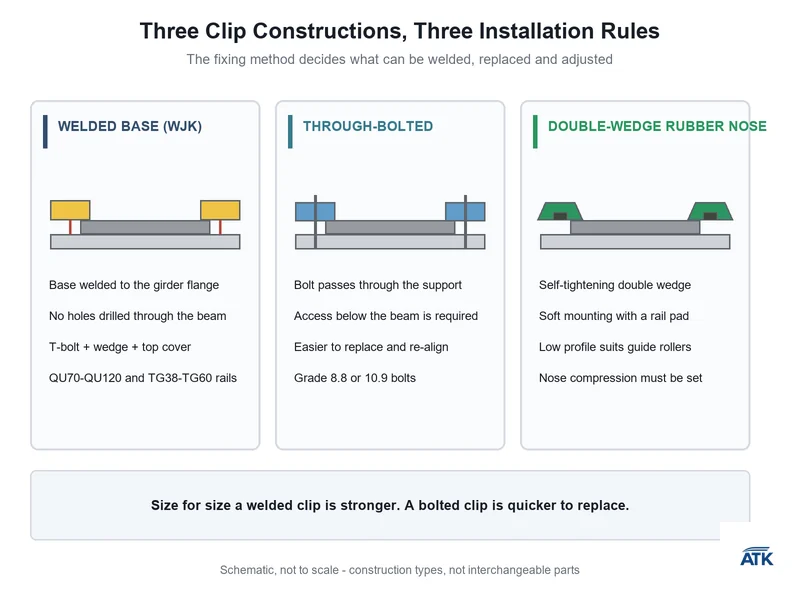
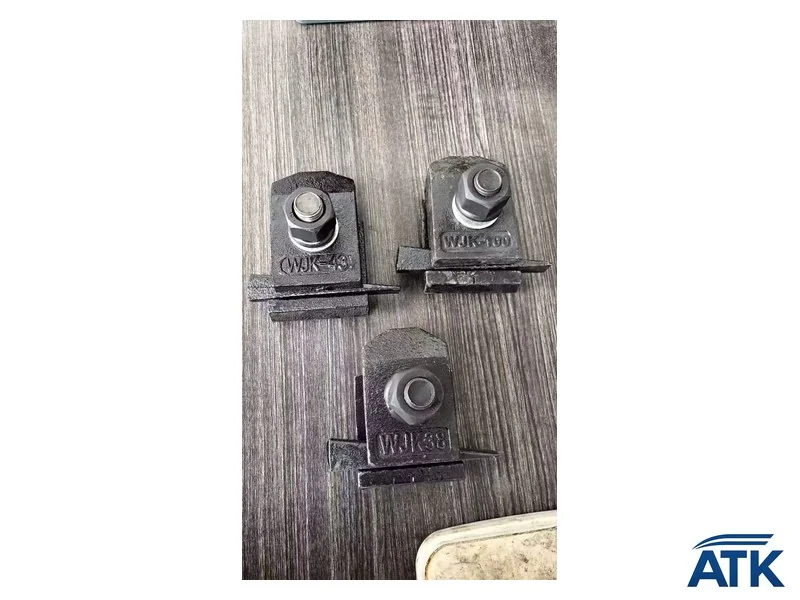
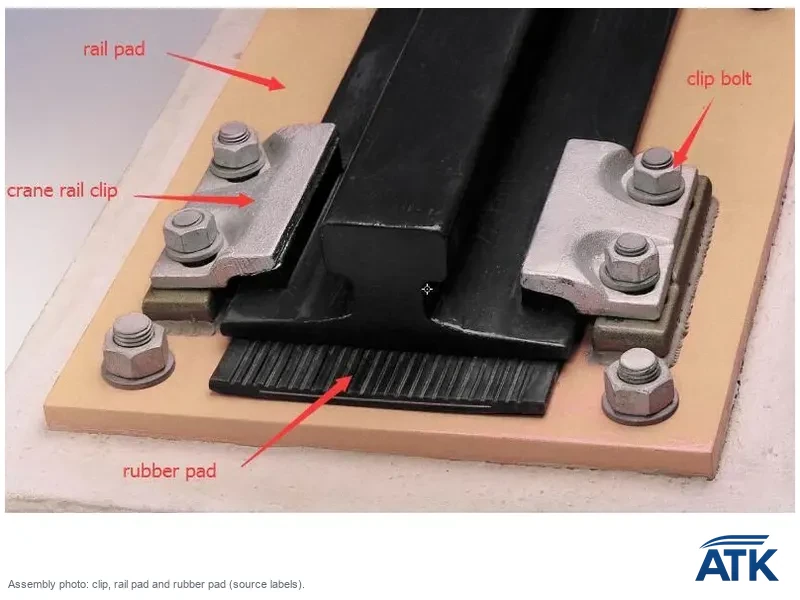
Three clip constructions cover most crane runway work. The welded base type is the standard Chinese WJK family: a cast base is welded to the top flange of the girder, so no holes are drilled through the beam and the girder section is not weakened. The bolted type passes a bolt through the rail support, which means access below the beam is required but replacement and re-alignment are much quicker. The third route is the double-wedge clip with a vulcanised rubber nose, used with a rail pad as part of a soft mounting system.
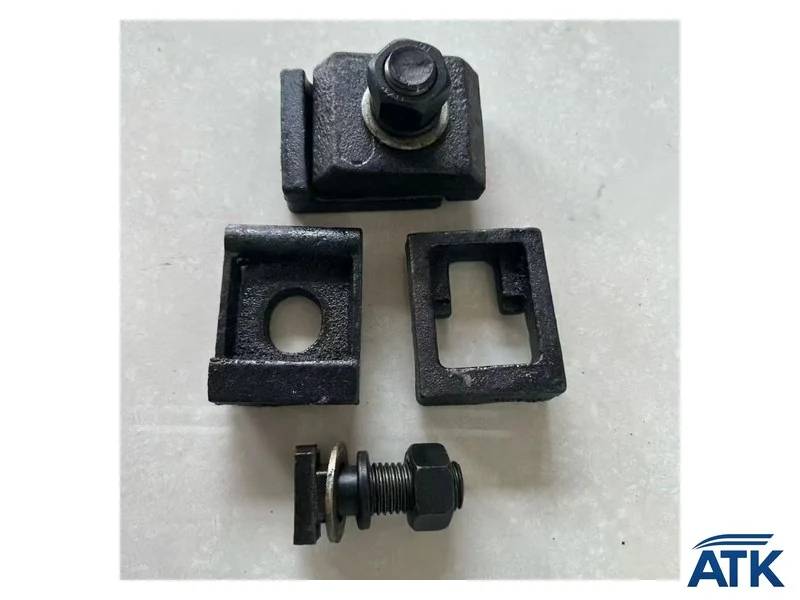
The welded version uses a base, a top cover profiled to the rail foot, an adjustable wedge plate, a T-bolt with a spherical lower seat, a nut and two washers. The spherical seat lets the bolt lean a few degrees when a horizontal impact arrives instead of taking the load in bending. That single detail is why the design survives heavy-duty crane service. Spring and flat washers are not optional hardware: one holds preload during braking, the other spreads the nut load so the cover is not brinelled.
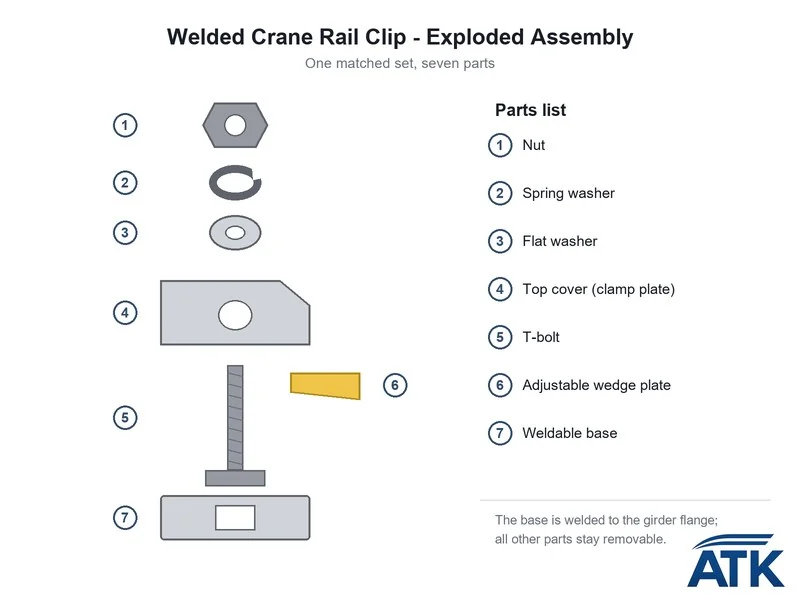
Size for size, a welded clip gives a stronger installation. That is the trade, not a quality ranking. Welding needs a clean girder flange, the right low-hydrogen electrodes and a qualified welder; where welding on the beam is restricted, or where a shutdown window is short, a bolted clip wins on access even if its rating is lower.
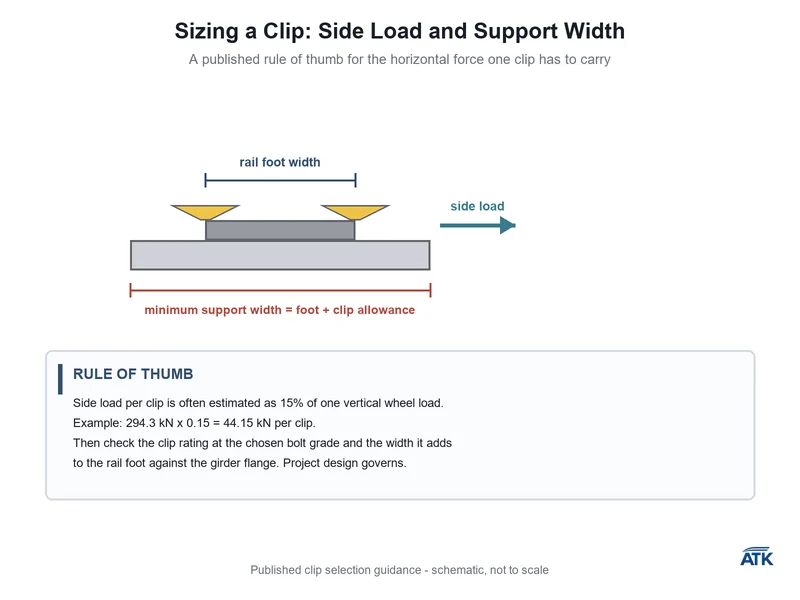
Side load is the number that decides the clip. It is often the number missing from the first enquiry. One published selection guide estimates the horizontal force on one clip as about 15 percent of one vertical wheel load - 294.3 kN times 0.15 gives 44.15 kN. That is a rule of thumb, not a structural calculation. It is still enough to catch an undersized clip before the quote goes out.
What to check | Why it matters | Where the value comes from |
Vertical wheel load and side load | Sets the required clip rating | Crane duty class and project design |
Bolt grade (8.8 or 10.9) | The same clip has two published ratings | Clip datasheet |
Rail section and foot width | Fixes the clip size and hole pattern | EN 13674-1 / GB/T 2585 / supplier drawing |
Dimension added to rail foot | Minimum girder flange width | Clip datasheet |
Whether welding is allowed | Decides welded or bolted route | Site and girder specification |
Guide roller clearance | Low-profile clip may be required | Crane manufacturer |
A clip that passes the load check can still fail the width check. Read the two together. On runways with horizontal guide rollers, installed height becomes a third constraint: a standard cover will foul the roller, so a low-height version is needed.
Model numbers in the WJK family follow the rail section, not a series code. A "WJK-QU100" clip is built for a QU100 rail; "WJK-TG60" for a 60 kg/m rail. The Chinese national standard drawing 23G525 fixes the selection dimensions across eight sections from 38 kg/m to QU120. In that table, "a" is the distance from the T-bolt centre to the rail centre, "b" is the centre-to-centre distance between the two T-bolts - so b = 2a across the whole family - "e" is 62 mm, "s" is 10 (5) mm, and "B = b + 2e + 2s" is the minimum required width of the girder top flange. The bracketed figures apply where the base is welded on two sides only.
Rail section | Clip model | a (mm) | b (mm) | B (mm) |
38 kg/m | WJK-TG38 | 97 | 194 | 338 (328) |
50 kg/m | WJK-TG50 | 106 | 212 | 356 (346) |
60 kg/m | WJK-TG60 | 115 | 230 | 374 (364) |
QU70 | WJK-QU70 | 100 | 200 | 344 (334) |
QU80 | WJK-QU80 | 105 | 210 | 354 (344) |
QU100 | WJK-QU100 | 115 | 230 | 374 (364) |
QU120 | WJK-QU120 | 125 | 250 | 394 (384) |
The same drawing specifies Q235 or Q345 cast steel for the base, cover and wedge, Grade 8.8 T-bolts, E4315 electrodes for Q235 and E5015 for Q345, two-side or three-side welding, and clip pitch of 600 mm up to 275 t crane capacity and 500 mm above it. Supplier catalogues quote 45 to 55 kN maximum lateral load per wheel load point and tightening torque of 150 N·m for medium duty and 220 N·m for heavy duty. These are published selection and catalogue values, not batch measurements; which inspection documents apply to a lot is confirmed when the order is placed.
A clip is a matched kit, not a single plate. Casting dimensional tolerance is normally specified to GB/T 6414 CT6, and contact faces are shot-blasted before coating. Three variations appear in enquiries: SWJK is compact, with a lower installed height for guide-roller cranes; HWJK is reinforced and used with an elastic composite pad under the rail; single-bolt and double-bolt plates cover imported-style low-height runways. The purchase list should also include railway track bolts, nuts and washers - a joint specified down to the last bush is still let down by the wrong bolt grade.
A resilient pad under the rail changes the whole assembly. The clip then has to apply a controlled vertical force: enough to compress the pad edge seals and keep dirt and water out, but not so much that vertical rail movement is transferred straight into the bolt. Over-compression shortens fatigue life; under-compression lets the pad work its way out. Rubber-nosed clips are designed around that balance, which is why nose compression is an installation setting rather than a detail to leave to the fitter.
Hard mounting - rail directly on a bare steel girder - removes the pad and its failure modes, at the cost of more impact and noise. Low-profile clips with a locking flange nut are used where clearance is tight. If the crane has horizontal guide rollers, say so in the first message; it changes the model before any load calculation is done.
Port terminals and intermodal yards are the biggest group. Ship-to-shore cranes and rubber-tyred gantry cranes put high, repeated lateral loads into their runways, and the clip is what keeps gauge stable while the crane travels. "Gantry rail clips" is the wording often used for this application. Steel mills come next: ladle cranes, slab handlers and coil cranes run almost continuously in heat and dust.
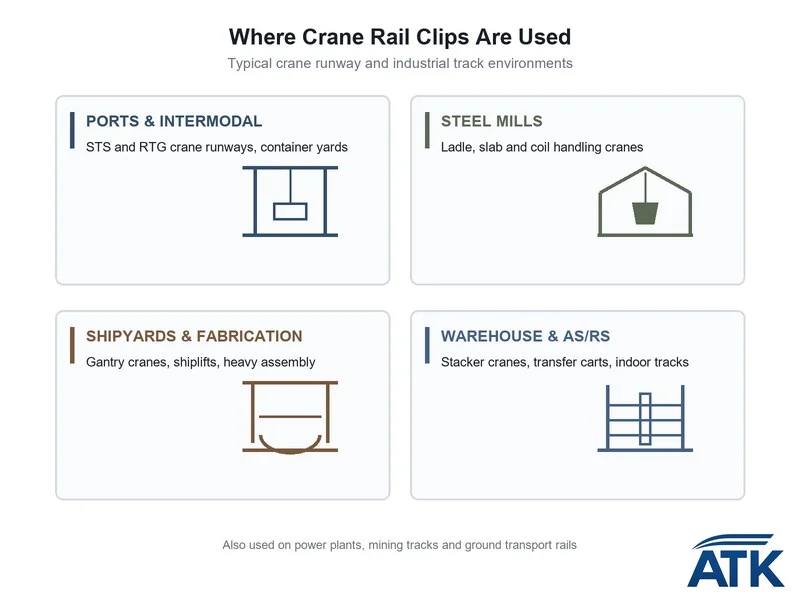
Shipyards and heavy fabrication shops use long gantry runways with tight alignment tolerances. Warehouses and automated storage and retrieval systems use smaller rail sections but very high cycle counts, which makes the washer and pad arrangement more important than the raw side-load figure. Mining, bulk handling and water treatment plants appear in the boltable-clip catalogues for a different reason: sealed designs resist spilled material and uplift.
Two special cases are worth flagging early. Cranes with guide rollers need a low-profile clip. Runways with a resilient pad need controlled nose compression. Both belong in the enquiry, not in a later drawing revision.
Check the girder flange first. Flatness, cleanliness and available support width all matter. For a welded base, confirm the electrode matches the base grade. Two-side and three-side welding give different "B" values. For a bolted clip, check access below the beam before the shutdown starts. Tighten to the torque on the drawing and record it; a nut that never reaches torque usually means the fit is wrong, not that the bolt is stiff.
At a scheduled shutdown, look for a clip that has backed off the rail, a crushed or displaced washer, a pad that has crept, and rust streaks around the weld or bolt hole. A single loose clip is a local repair. A row of them on one side of the runway usually points to side load, alignment or support width rather than a bad batch. Keep the torque record, the clip model and the rail section together so a repeat failure is recognisable.For the full sequence behind those shutdown checks — weld preparation, wedge seating, torque records and what to do when a row of clips loosens — see the crane rail clip installation and inspection checklist.
The enquiry needs the rail section and its standard, the crane capacity and duty class, the vertical wheel load or the side load, the girder flange width, and whether welding on the beam is allowed. Add the clip route - welded, through-bolted or double-wedge - the bolt grade, the pad arrangement, and whether guide rollers are fitted. If the drawing names a series number, attach the datasheet. A photograph of the existing assembly settles more than a paragraph of description on replacement jobs.
Where steel rails and clip assemblies are ordered together, state the drilling standard so both sides work from the same drawing. For the joint components that sit in the same fastening family, see the composite insulated fishplate and the glued insulated rail joint; for the turnout side of the layout, see the integral cast slide baseplate for turnouts. All three belong to the same track system, but each has its own drawing and approval basis.
No. They are not standard designations. They are one supplier's product-family numbers for through-bolted, rubber-nosed clips. They do not define a rail section, a side load or a bolt grade. Ask for the datasheet and the rail section before comparing offers.
The 4 series was launched in 2020 to replace the 3 series. Published changes include a drain hole, a rotating washer that locks components during installation, updated bolt engagement and a low-height locking flange nut for guide rollers. Load ratings are read from the datasheet for each individual clip name, not from the series number.
In most crane-runway enquiries, yes - both refer to the cast fixing assembly. "Rail clamp" can also mean a temporary wagon stop on a stub track, so the context matters. "Rail clip" without "crane" usually means an elastic fastening for sleepers.
Not directly. A welded base needs no holes in the girder and gives higher lateral resistance size for size; a bolted clip needs access below the beam and a different support detail. The rail section, side load and flange width have to be re-checked against the new datasheet.
One published guide takes about 15 percent of a single vertical wheel load - 294.3 kN times 0.15 gives 44.15 kN. Use it for sizing, then confirm against the project's structural design and the clip rating at the chosen bolt grade.
Yes. Published boltable-clip tables give separate horizontal force capacities for Grade 8.8 and Grade 10.9 bolts. Grade 8.8 is the normal economical choice; 10.9 is used where a larger clip will not fit but more capacity is needed.
"a" is the distance from a T-bolt centre to the rail centre, and "b" is the centre-to-centre spacing of the two T-bolts. With one bolt on each side of the rail, b equals twice a. "B = b + 2e + 2s" then gives the minimum girder flange width.
A resilient pad under the rail forms a soft mounting system. It reduces impact and noise but needs a clip that applies controlled vertical force - commonly a rubber-nosed double-wedge design. Hard mounting puts the rail directly on the girder and uses no pad.
Rail section and drilling standard, crane duty class, wheel or side load, girder flange width, whether welding is permitted, bolt grade, pad arrangement, guide roller clearance and the quantity. If a series number appears on the drawing, attach its datasheet.
A series number tells you which catalogue a buyer was reading. It does not tell you what to ship. The rest comes from the drawing. The rail section, the side load, the flange width and the fixing route do that, and they are the four items worth settling before a price is discussed. The WJK welded clip family is documented with its full 23G525 selection table on the product page; the other routes are quoted against a drawing. If a project specification names a series number and you are not sure which family it belongs to, contact us with the datasheet and the rail section and the enquiry can start from the right drawing.
We have recommended some of our Related products to you. I hope you will be interested.
 English
 Русский