
A settled runway is a measurement problem before it is a parts problem. This article covers causes, survey method, where sole plates and shims stop working, and four published port cases.
A crane runway that has settled does not announce itself. The crane still works, the spreader still lands on the stack, and the first sign is usually a driver complaint that the trolley pulls to one side, or a fitter finding worn clip toes along one rail only. By the time anyone puts a level on the rail, the question is no longer whether the runway moved. It is which part moved, how fast it is still moving, and what will hold it.
That decision is the subject here. It covers why port runways settle, how the deviation should be measured before anything is ordered, where steel sole plates and height adjustment shims stop being the answer, and what published port cases show about the rest.
Two mechanisms get confused in the same conversation, and they need different fixes.
The first is residual settlement of a new foundation. A quay built on reclaimed ground, a rail beam sitting on a rubble mound, backfill placed late in the programme — all of it keeps compressing after the crane is commissioned. A published case from Bayuquan port makes the scale visible. Three and a half years after commissioning, the sea-side rail had settled about 90 mm on average and the land-side rail about 230 mm. The gap between the two had reached roughly 140 mm. The land-side rail moved further because its beam sat on the shoulder of an un-compacted rubble mound, with backfill and yard stacking load feeding into the same subgrade.
The second is loss of support under a runway that was already stable. At expansion joints, every wheel passage pumps water and fines out from under the footing. Voids form, the rail and its foundation settle a little more with each pass, and the movement becomes dynamic rather than gradual. Keller documented exactly this at an inland intermodal terminal in Kansas, where the settlement exceeded the crane manufacturer's tolerance.
Longitudinal movement belongs in the same survey even though it is not settlement. On continuous welded runway rail, thermal movement has to be restrained without locking the rail solid, which is why adjustable track fixings and end stops appear together in Chinese container terminal practice.
One habit worth adopting early: check whether the settlement has stopped. At Guang'ao, the rear rail was re-levelled twice — about 125 mm of settlement by 1998, about 78 mm more by 2001. The second correction was smaller than the first, which is the signature of a foundation that is closing out. Adjusting a runway that is still moving at that rate means doing the work twice.
A level difference between the two rails tilts the whole portal. Load shifts to the low side, wheel loads become uneven, and the crane starts to steer. What the operator notices is flanging and rail-side wear on one rail, more frequent skew correction, and a trolley that will not hold a line.
How much difference is acceptable is not a number to be picked from a table. It is agreed between the operator and the crane manufacturer for that machine. In the Bayuquan phase two work, the figure adopted for the land-side to sea-side rail difference was 30 mm, set through discussion with the crane supplier, the designer and the contractor. Your machine may allow more or less; the point is that the limit belongs to the crane, not to the rail.
Local steps matter more than a gentle overall slope. A 5 mm step at a joint produces an impact every wheel pass, and impact is what cracks clip toes and loosens bolts. A runway that is uniformly 20 mm low over 200 m will often run quietly for years.
When the deviation passes the manufacturer's tolerance, the problem has changed category. In the Kansas case the facility was facing shutdown rather than a maintenance adjustment. No amount of shimming fixes a foundation that is pumping voids.
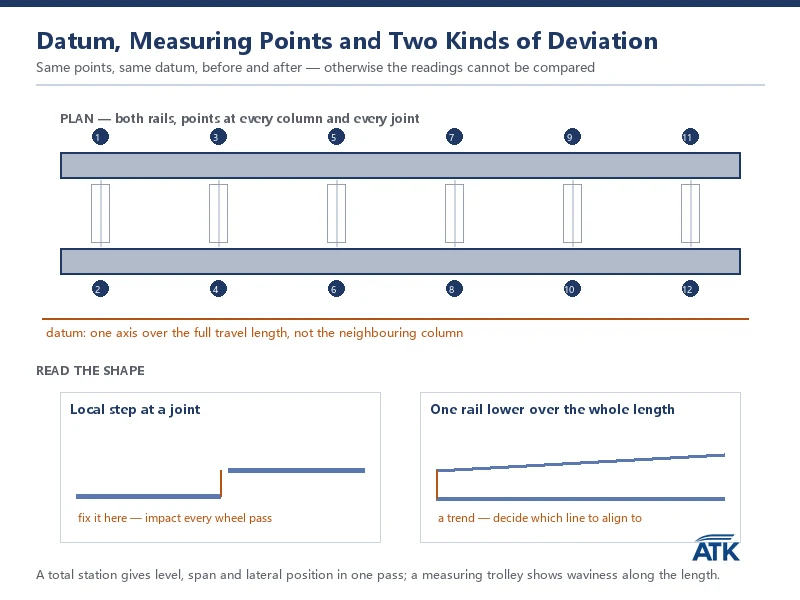
Crane runway rail level adjustment starts before any plate is ordered. Two things have to be settled first: the datum, and the measuring points. Skip either and the before-and-after numbers cannot be compared.
The datum is one line running the full travel length — an axis, not the neighbouring column. Measuring points go at every column or bracket and at every rail joint, on both rails opposite each other. Mark and number them, because the re-survey has to land on the same spots.
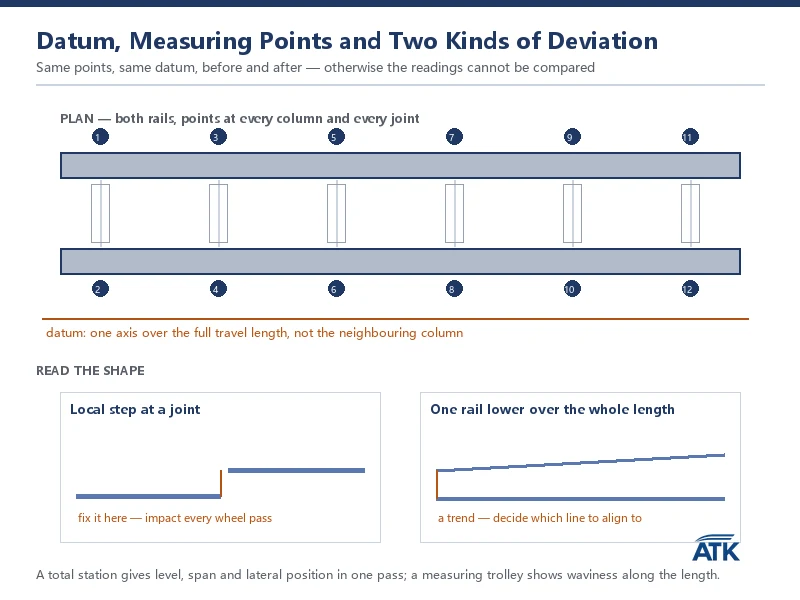
Method follows purpose. A total station records level, lateral position and span in one pass and is the usual choice for a full survey. A rotating laser with a level is steady for rail level alone over long distances. A measuring trolley running on the rail gives continuous span, level and lateral position, which is how waviness shows up. Tape, straightedge and feeler gauge remain useful for joint steps — as a supplement, never as the survey.
Then read the shape of the result, not just the maximum. A single point out at one joint or one bracket is a local fault: fix it there. One rail sitting lower than the other over the whole length is a trend: it forces a decision about which reference line the runway is aligned to, and that decision belongs to the operator with their competent person.
The survey report should carry the instrument, the date, the method, the datum system, every point with target and actual value, a plot along the travel length, and the proposed measures. Without that document, the next adjustment starts from zero.
Shims correct geometry. They do not correct load path, and crane rail sole plate adjustment is the same argument one layer down.When the plate itself has lost its flat face, shimming cannot restore it, and sole plate deformation sets out the measurement and the repair boundary.
What they genuinely fix: a rail sitting below design level by a few millimetres, a local dip at a bracket, or the level error left behind after a new pad. A bearing area that was never quite true falls in the same group. What they cannot fix: a foundation still consolidating, a void under a footing, a deflected girder, a pulled anchor. Those are structural matters, and the correction is a structural one.
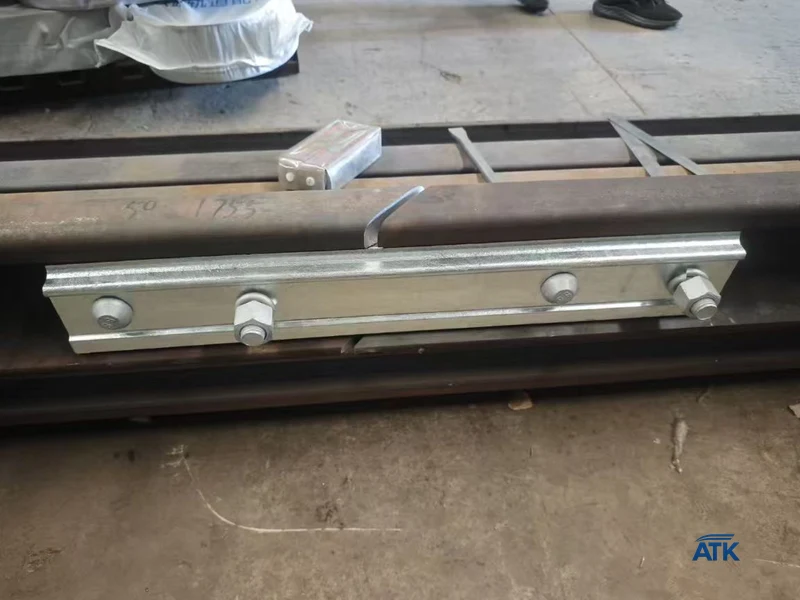
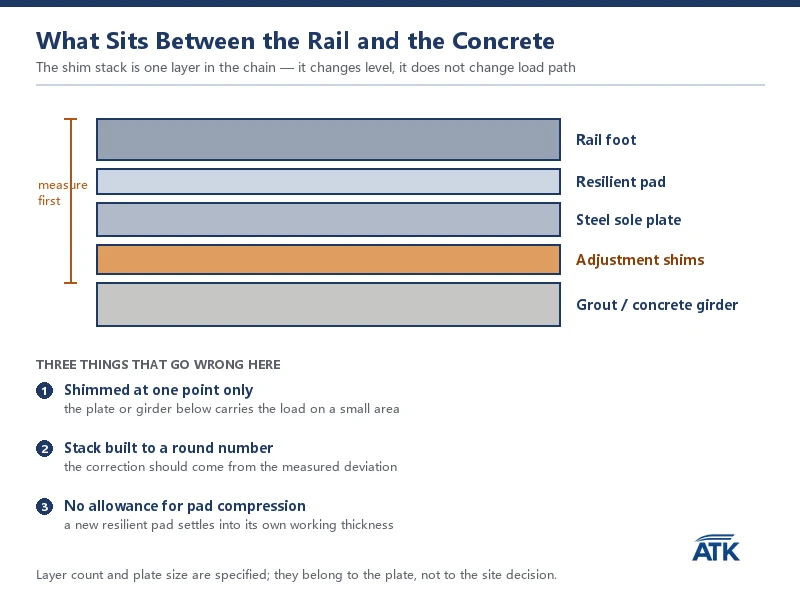
The single most common mistake on site is shimming at one point. A shim placed under part of the rail seat lifts the rail and leaves the base plate or girder carrying the load on a small area. Adjustment has to be spread over the full bearing area so the support below is not locally overloaded. The same logic applies whether the shim goes under the rail or under the base plate.
Layer count, plate size and the projection past the pad edge are specified rather than improvised, and a stock range of crane rail sole plates and height adjustment shims covers the usual deviations. What matters here is the sequence: measure first, choose the stack from the measured deviation, and never build the stack to hit a round number.
Acceptance is a separate question from adjustment. Installation tolerances for crane runway rail exist in GB 50278-2010, and they describe the finished installation, not the plate. Where the crane manufacturer publishes a tighter figure, the tighter one governs.
Crane rail leveling shims are chosen from what was measured, never from what is in the store. The work follows a fixed order, and skipping a step is how a runway ends up adjusted twice.
Measure the point and decide the correction. Loosen the clips along the section, not just at the point, so the rail can move without fighting its neighbours. Lift with jacks or wedges enough to break contact. Clean the mating faces — grit under a shim stack is a future high spot. Place the stack over the full bearing area. Lower, check contact by feeler gauge at the edges. Re-tighten the clips to the manufacturer's torque, then re-torque after the section has been trafficked, because a fresh stack beds down.
Two details that get missed. The lift has to allow for the compression that will come back out of the rubber pad underneath; if the pad is new, it will settle into its own thickness under load. And the shim stack needs a drainage path. Water sitting against a stack of plates is how a five-year correction becomes a corrosion problem.
Work windows drive the method more than the engineering does. Night possession, between-vessel gaps, weekend shutdowns — the adjustment has to fit inside one. Published port corrections have been done in six night shifts for a 258 m² slab, and in a 72-hour window for a micropile and jacking operation. Plan the sequence around the window, not the other way round.
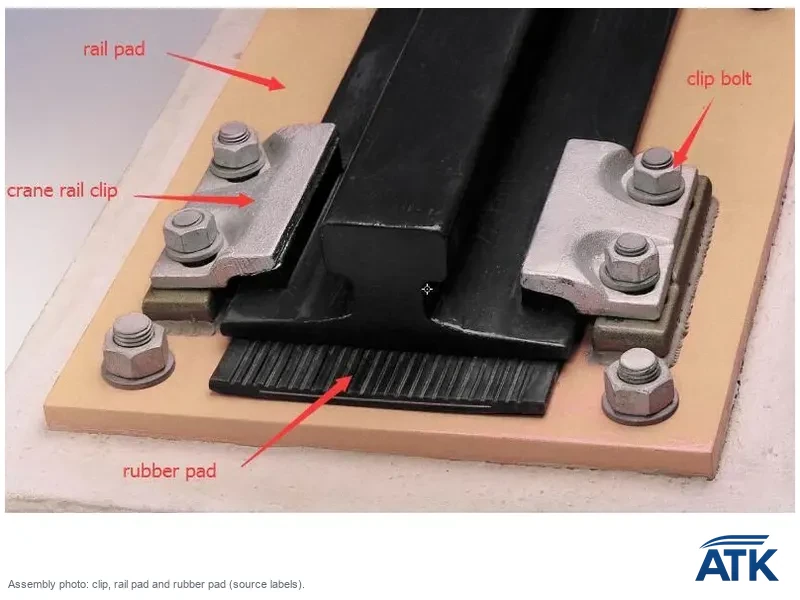
Three components, three jobs, and they interfere with each other if the order is wrong.
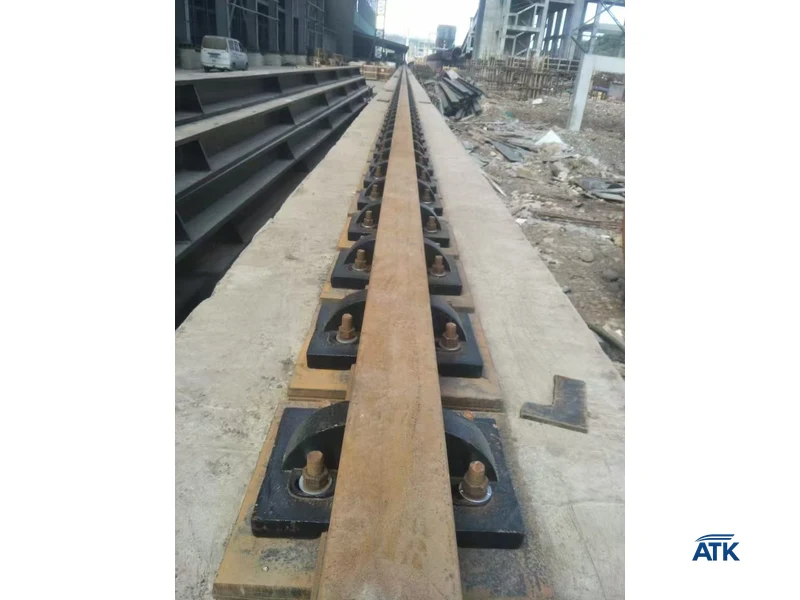
The crane rail clips hold the rail laterally and stop it lifting. They carry transverse load and vibration, not height. Change the level under a clip and the clip has to be checked again: the toe must still bear on the rail foot, and it must not be bearing on the shim stack instead.
Crane rail rubber pads sit between rail and support to attenuate impact and, where required, to insulate. They are elastic, so they compress. A pad of a given thickness does not hold the rail at that thickness under load, which means the level correction has to be calculated with the pad's working thickness, not its delivered thickness. Replace the pads and the level changes — sometimes enough to need a re-shim.
The practical rule: shims set the geometry, pads handle the dynamics, clips hold the rail in place. Adjust them in that order, and re-check the clip after the level work, not before.
A correction is not finished when the bolts are tight. It is finished when the same points, measured by the same method, come back inside tolerance.
Re-survey at the marked points. Compare against the original report point by point, not against an average. Then judge against both limits — the installation tolerance and the crane manufacturer's figure — and take the stricter one.
A short trial run tells you what the survey cannot. Watch for flanging on the rail side, the frequency of skew correction, any new noise at joints, and whether the trolley tracks straight without correction. A runway back inside tolerance but still steering has something else wrong, usually alignment rather than level.
File the after-report with the before-report. The next team will need both, and a runway adjusted without a baseline is a runway that gets surveyed from scratch next time.
Crane runway settlement repair splits into two families, and the split is what matters. Four public cases, four different answers — but they sort into those two groups.
Case | What was wrong | What was done | Result |
Bayuquan bulk terminal, phase 1 and 2 | Land-side rail settled about 230 mm against 90 mm on the sea side, a 140 mm differential | Phase 2 raised the land-side beam by 70 mm at construction as a settlement allowance, and adopted a 30 mm differential as the operating limit | The problem was designed out rather than repaired |
Guang'ao multi-purpose berth | Rear rail settled 125 mm by 1998, a further 78 mm by 2001 | Rail level adjusted twice, at three-year intervals | Settlement rate fell; the second correction was smaller |
Akita port, RTG runway slab | Slab settled, creating a step at the adjacent vehicle path and longitudinal unevenness | Resin injection under the slab, lifting it while monitoring in millimetres; 57 mm maximum correction over 258 m² in six night shifts | Operations not suspended |
Kansas intermodal terminal | Settlement and dynamic movement at rail expansion joints, exceeding crane tolerance | Cased rock-socketed micropiles plus a reinforced pile cap, then the rail foundation jacked back to original elevation | Back in service within 72 hours |
Read them as two groups. Bayuquan and Guang'ao stayed inside the rail-and-fastening layer: allowance, then shimming, then re-checking. Akita and Kansas had left that layer — the support itself had to be restored before any level work made sense. Putting a shim stack into either of the last two would have bought months, not years.
That is the honest boundary of what shims do. They are the right tool for level error and the wrong tool for a foundation that is still losing support.
Only temporarily. Shims correct the level at the day of adjustment; if the foundation is still consolidating, the error returns and you adjust again. Measure the rate over two surveys before deciding. If the rate is falling and the differential is inside the crane tolerance, shimming buys useful time. If it is not falling, the foundation needs treating.
It is set by the crane manufacturer for that machine, agreed with the operator. In one published port case the adopted figure was 30 mm. Do not assume that number applies to your crane.
For rail-level work, yes — a possession is needed because clips are released and the rail is lifted. The correction itself is short; the window is the constraint. Larger support repairs have been done between vessel calls, but that is a different scope.
No. Lifting one point puts the load on a small area of the plate or girder underneath. Spread the adjustment over the full bearing area so the support is not locally overloaded.
Limits exist in the installation standard and in our own specification; they are on the sole plate page rather than repeated here. The practical rule is to build the stack from the measured deviation, not from what is in the store.
Yes. A pad compresses under load, and a new pad compresses differently from a worn one. Calculate the correction using the working thickness, and re-check level after any pad replacement.
By measuring both. If the rail top is out but the girder top under it is true, it is a rail and fastening issue. If the girder or bracket has moved, the correction is structural and needs an engineer, not a shim.
A total station for a full survey covering level, span and lateral position; a measuring trolley where waviness along the length matters; laser and level for level alone. Whatever the method, points must be numbered and re-used.
After the section has been trafficked and the stack has bedded in — typically once the crane has worked the area, plus a second check at the next scheduled inspection. The after-report is what closes the job.
Rail section, fixing type, the measured deviation at each point, the available bearing area, and the quantity of points.
We have recommended some of our Related products to you. I hope you will be interested.
 English
 Русский