
A loose clip is often the last thing to fail. This guide covers sole plate deformation: the three shapes, how to measure them on site, and when a shim cannot help.
A clip that keeps coming loose gets replaced. A pad that has flattened gets swapped. The rail still moves, and the next crew finds the same loose clip three months later. The part nobody pulled out and put on a bench was the steel plate underneath, and that plate is often where the trouble started.
Sole plate deformation is easy to miss because it is small, slow and hidden. The plate is buried between the rail pad and the grout, covered in rust and grease, and nobody measures it until something above it has already failed. This guide is about catching crane rail sole plate deformation earlier. It covers what the condition looks like, how to measure it with tools a maintenance team already has, and how to tell a plate that was never flat from one that was flattened in service.
If the symptom you are chasing is a loose clip, a cracked weld or a pad working out from under the foot, those have their own failure paths. They are covered in the crane rail clip failure guide. This one stays one layer down.
A sole plate has two jobs that have nothing to do with carrying the crane. It gives the rail a flat seat, and it gives the clip a solid surface to react against. Both of those are geometry, not strength. A plate made from the right steel, at the right thickness, can still do its job badly if its top face is not flat.
When the top face is bowed or twisted, the rail does not sit on the plate. It sits on the high points, and the rest of the foot is in the air. Every wheel pass then rocks the rail across those high points. The clip is a spring with a fixed working range; it cannot follow that rocking without changing the force it delivers. Toe load rises and falls with each pass instead of holding steady, and the clip starts to fatigue at a load it was never specified for.
That is the sequence worth remembering. Deformation does not break anything directly. It removes the flat seat, the rail starts to move, and the movement is spent on the parts above the plate.
There is a second effect that shows up later. A plate that is not flat cannot sit evenly on its grout. The gap under the low side stays open, water gets in, and the grout either erodes or never bonded in the first place. What looks like a settlement problem six months after handover is sometimes a flatness problem that was there on day one.
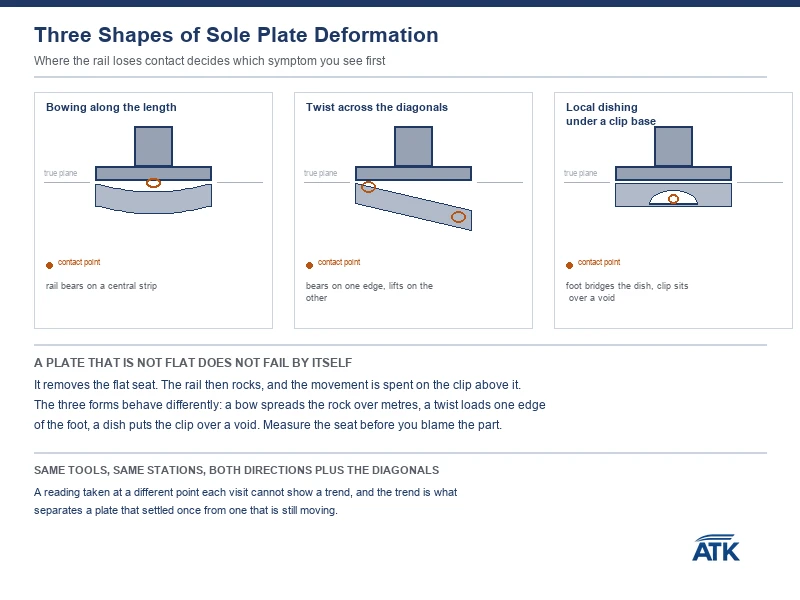
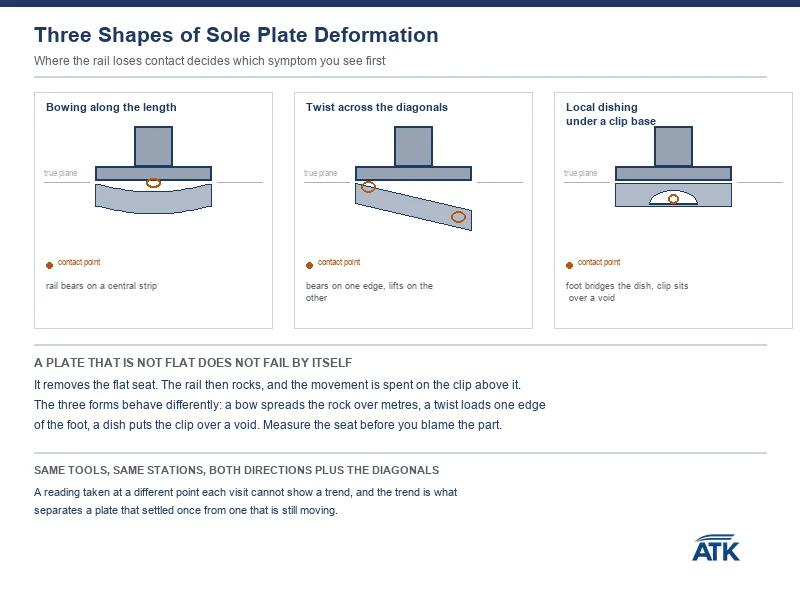
Deformation is not one condition. The shape decides where the rail loses contact, and that decides which symptom you see first. Three forms cover most of what turns up on a runway.
Bowing along the length. The plate curves up or down along its long axis, so the middle of the rail seat stands proud and both ends fall away. The rail then bears on a short central strip. On a continuous plate this produces a rocker effect spread over several metres, and the clips at the two ends of the bow carry almost nothing.
Twist across the diagonals. One corner is high, the opposite corner is low, and the plate rests on two diagonal corners. This is the hardest form to see by eye because the plate still looks straight from any single side. A rail on a twisted plate bears on one edge of the foot and lifts on the other, which puts the clip toe on an angled contact and loads one side of the baseplate weld.
Local dishing or a dished seat. A patch of the top face, usually under a clip base or beside a weld, has sunk or been pressed down. The rail foot bridges the dish, and the clip sits over a void. This form is often created during fabrication rather than in service, particularly where a clip base was welded on and the plate was not restrained against the heat.
A folded or lipped edge is a fourth pattern, but it usually comes from handling and transport rather than from load. It matters because a lipped edge holds the plate off the grout the same way a burr does, and it will not flatten under the clip.
You do not need a coordinate measuring machine. A straightedge and a set of feeler gauges will find deformation of the size that matters, provided the plate is clean and the measurement is taken in the right places.
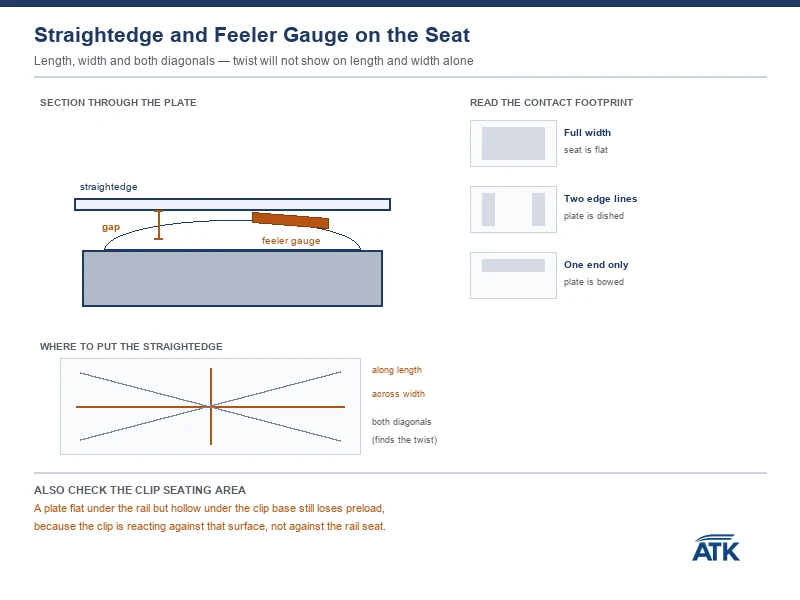
Straightedge and feeler gauge. Lay a straightedge across the rail seat, in both directions: along the length, and across the width at three or four points. Try to push a feeler gauge under the straightedge at its worst point. Record the thickness that passes and where it passes. Do the same along both diagonals, because twist will not show up on the length and width checks.
Contact pattern on the seat. Where the plate has been in service, the rail foot leaves a polished or fretted footprint on the seat. A footprint that covers the full width means the seat is flat. A footprint in two lines along the edges, with a clean strip down the middle, means the plate is dished. A footprint at one end only means it is bowed.
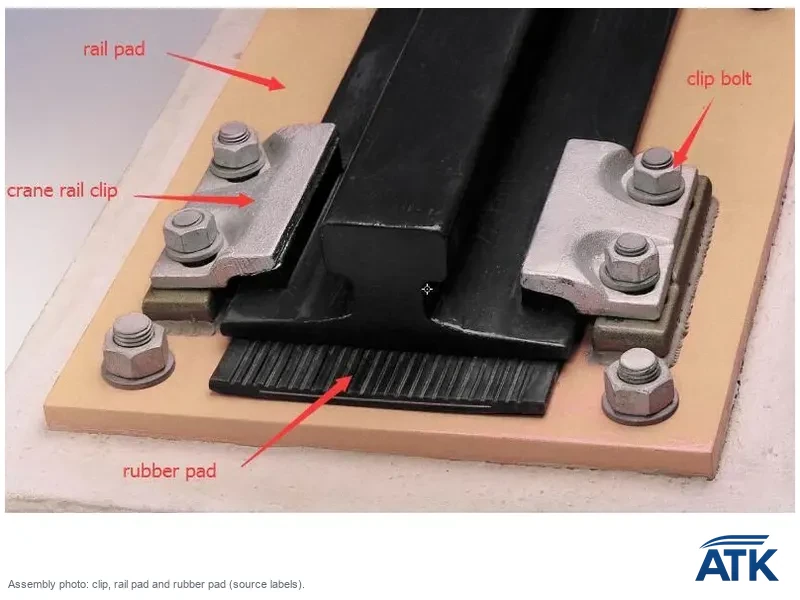
Check under the clip base, not just under the rail. The clip needs a flat reaction surface for the same reason the rail does. Put the straightedge across the clip seating area as well, especially where a base has been welded. A plate that is flat under the rail but hollow under the clip base will still lose preload. The difference between the two families is set out in the crane rail clips range.
Read the grout gap while you are there. With the plate still in place, look at the edge where it meets the grout. An open gap along one side, wide enough to take a feeler gauge, tells you the plate is not bearing evenly. That gap is a flatness or a bedding problem, and the two have to be separated before anything is ordered.
Take the readings at the same stations each time, and write down the position with the number. A flatness reading with no location attached cannot be compared with the next inspection, and comparison is the whole point.
This is where a lot of guides become unhelpful, because there is no single universal number. The acceptance limit for sole plate flatness is set by the project, and it is normally written on the drawing or in the fastening specification rather than in a national standard. What the trade calls crane rail base plate deformation is the same condition measured from a different drawing convention, and the same rule applies: the drawing governs.
The Chinese installation code that governs crane runway work, GB 50278-2010, deals with the plate mainly through the parts around it. Clause 3.0.11 requires the rail to sit tight against the elastic pad before the bolts are tightened. Where a gap remains, packing plates go under the elastic pad. Those packing plates must be longer and wider than the pad by 10 mm to 20 mm on each dimension. Clause 3.0.12 requires the rail base to sit tight on a steel crane girder, and where packing is needed, limits the group to no more than three layers. Neither clause gives a flatness figure for the plate itself, which is exactly why the drawing has to be the first place you look.
Where the drawing is silent, project specifications commonly call for the rail seat to be flat within a few tenths of a millimetre across a 300 mm straightedge, measured in both directions. Treat that as a typical industry figure rather than a standard value, and confirm the actual requirement with whoever issued the fastening drawing before you reject a plate against it.
A practical field rule sits underneath the numbers. If you can pass a feeler gauge under the straightedge at a point where the rail foot should be in contact, the seat is not doing its job. That holds whether or not the reading exceeds a written limit. The consequence, not the number, is what the rail reacts to.
Sorting the cause matters because it decides whether a replacement plate will stay flat. A plate that was never flat and a plate that was flattened in service look the same on the bench, but only one of them is fixed by ordering a new plate.
It was never flat. Plate that was cut from stock with residual stress, or plate that was welded without restraint, can arrive with a bow or a twist built in. Welding a clip base onto a plate concentrates heat in one area and pulls the seat down if the plate is not held. Transport and storage add their own distortion, particularly where plates are stacked on an uneven surface or lifted from one corner.
The seat under it was never flat. A plate cannot be flatter than the surface it is bedded onto. A high spot on the grout, a piece of debris left under the plate, or a girder flange that is itself out of flat will telegraph straight through. This is the most common cause of a plate that reads flat on the bench and rocks once it is installed. The same bedding faults show up under the elastic layer, and the crane rail rubber pads have to be matched to whatever seat they land on.
It was overloaded or under-supported. Where the bearing area is too small for the wheel load, or where grout has eroded and left the plate spanning a void, the plate is asked to carry load in bending rather than in bearing. It deflects, and some of that deflection stays. Plates that fail this way usually show the deformation concentrated over the void, not spread across the seat.
It was disturbed during a repair. Cutting a weld off with a flame, forcing a plate with a pry bar, or re-tightening a clip against a shim stack that has crept can all bend a plate that was previously serviceable. Repairs are where a flat plate most often stops being flat.
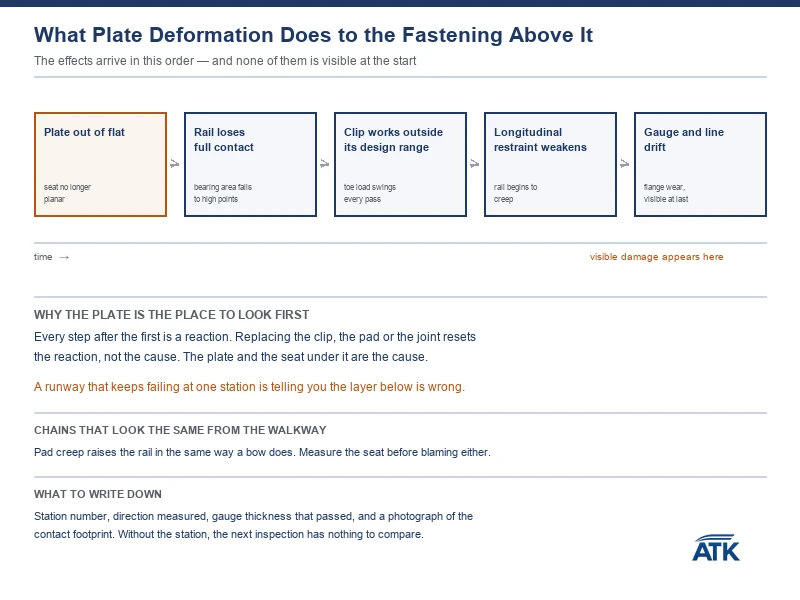
The reason to chase plate flatness is not the plate. It is what the plate does to everything sitting on it, and the effects are cumulative in a specific order.
The rail loses full contact first. Not visibly, and not all at once, but the bearing area shrinks to the high points. Contact pressure at those points rises well above the design value, and the pad underneath starts to take a permanent set in those locations rather than uniformly.
The clip then works outside its design range. A clip delivers its rated toe load at a specific deflection. When the rail foot moves up and down across a bow, that deflection changes every pass, and the toe load swings with it. The clip is now cycling, and fatigue damage accumulates at the bend whether or not the clip ever looks loose.
Longitudinal restraint weakens at the same time. A clip that is not holding its toe load cannot resist rail creep, so the rail starts to walk. On a runway with a joint, that walk closes or opens the gap and loads the joint bolts differently from the design case.
Gauge and line follow last. Once the rail is moving on its seat, alignment drifts. The drift shows up as flange wear on one side, a rail that no longer follows the setting-out line, or a clip sitting at a visible angle to the foot.
By the time any of this is visible, the plate has been out of flat for a long time. That is the argument for measuring the plate before replacing the third clip on the same station.
There are three responses to a deformed plate, and choosing the wrong one is how a runway gets repaired twice.
Shimming is for level, not for flatness. A shim changes where the plate sits. It does nothing about the shape of the top face. Putting shims under a bowed plate lifts the whole plate, bow included, and the rail still bears on the high point. Where a shim is used, the code limits the stack to three layers, and anything above the pad is wrong because it moves the clip's reaction surface. Reach for shims when the seat is flat and the level is low, not when the seat itself is out. The level side of the same question is worked through in the crane rail settlement and level adjustment guide.
Replacement is the answer when the plate is the problem. If the straightedge shows a bow, a twist or a dish that the drawing does not allow, and the seat under it is sound, a new plate is the cheap option. Replacing a plate is a fraction of the cost of breaking out grout and rebuilding a girder, and it removes the cause rather than the symptom. Match the new plate to the rail section, the clip base positions and the bolt pattern on the drawing, because a plate that is flat but drilled wrong will not go on. The dimensional fields to state for a replacement are the same ones listed on the crane rail sole plates page.
Rebuilding the seat is the answer when the support is the problem. If the plate is flat but the grout under it is hollow, a new plate will simply rock in the same place. The repair is to lift the plate, remove the failed grout, restore the bearing surface, re-bed the plate and re-survey the level. This is structural work, and it belongs with an engineer and an approved method rather than with a maintenance fitter improvising on the girder.
One boundary is worth stating plainly. Cold-bending a deformed plate back into shape on site is not a repair. The plate has already yielded once, and a second cold set adds its own residual stress without restoring the flat face. Where the deformation is real, the plate is replaced.
Plate deformation is found by looking in the right place at the right time, not by inspecting everything every month.
At handover, before the grout has fully hidden the evidence, measure flatness and record it by station. This baseline is what makes every later reading meaningful, and it is the cheapest measurement you will ever take on that runway. Handover checks for the whole fastening, not just the plate, are set out in the crane rail clip installation and inspection checklist.
During routine clip inspection, add one check that costs almost nothing. Where a clip has come loose and is being re-torqued, put a straightedge across the seat before the new clip goes on. If the seat is out, re-torquing is a delay rather than a repair, and you have found the cause at the moment the symptom appears.
Where a pad has been replaced because it flattened, look at the plate at the same time. Pads flatten for their own reasons, but a plate that is dished under the pad will flatten the next pad in the same place. The two checks belong together.
Where a runway keeps coming back to the same station, stop replacing parts and measure the plate. Repeat failures at one location are the clearest signal that the problem is in the layer below the parts being replaced, and that layer is the plate and the seat under it.
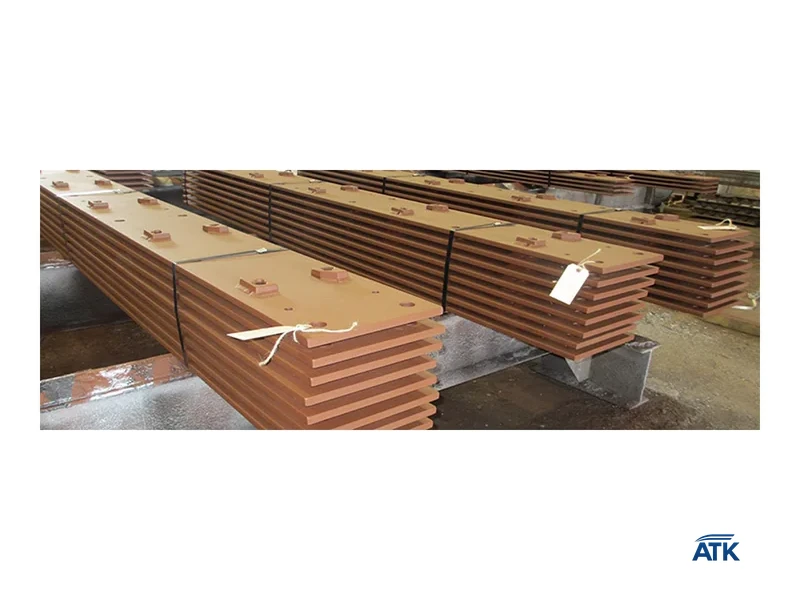
Any repair that involves welding, flame cutting or prying near a plate should end with a flatness check. It is the step most often skipped, and it is the step that decides whether the repair lasts.
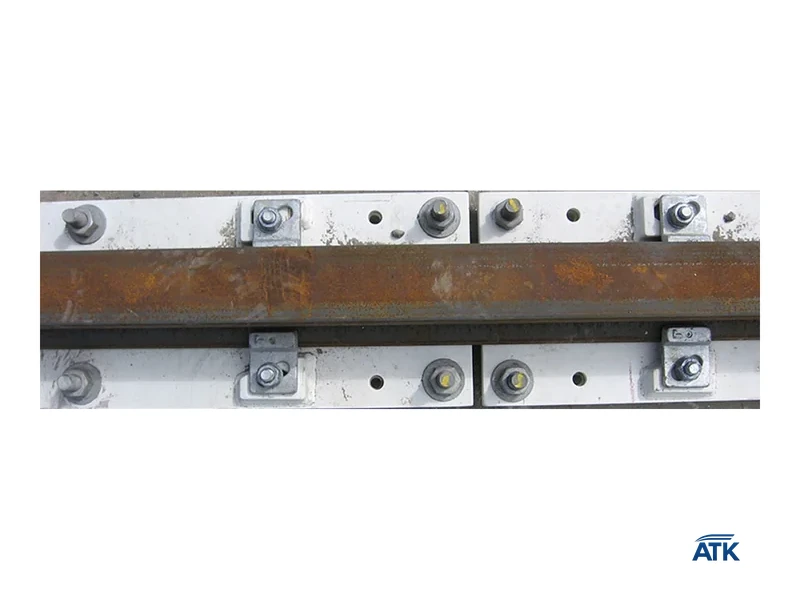
Re-torque the clip and measure the gap between the rail foot and the plate with a feeler gauge. If the gap stays after torque, the seat is out, not the clip.
No. Cold-bending a yielded plate adds residual stress without restoring a flat face. Replacement is the reliable repair.
The drawing governs. Where it is silent, a few tenths of a millimetre across a 300 mm straightedge, in both directions, is a common industry figure. Confirm it with the drawing issuer.
It does not give a plate flatness figure. It governs the contact around the plate, including packing under the elastic pad and the three-layer limit on a packing group.
Shims change level, not shape. They lift the plate, bow included, so the rail still bears on the high point.
Usually because the seat below it is not flat. The clip is being asked to hold a rail that is rocking, and it loses preload every cycle.
Not immediately. The risk is what it does above it: reduced contact, clip fatigue, rail creep and gauge drift, which accumulate before anything looks wrong.
GB 50278-2010 clause 3.0.12 limits a packing group to no more than three layers, and the assembly is then welded to the girder.
No. A flat plate on a hollow bed will rock in the same place. The bed has to be rebuilt before the plate is re-set.
At handover as a baseline, whenever a clip is re-torqued, and whenever a pad is replaced. A runway that keeps failing at one station should be measured immediately.
We have recommended some of our Related products to you. I hope you will be interested.
 English
 Русский