
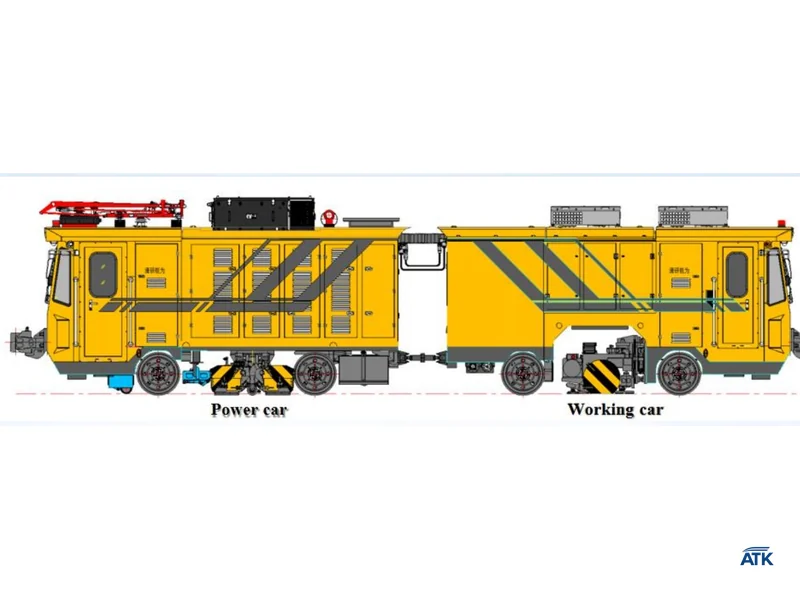
FGM500 two-car disc milling train with finish grinding in a single pass at 300 - 1000 m/h
Spark-free cold cutting, 99 percent iron chip collection and Ra 5 um surface finish
CMC-12 twelve-head grinding train at 3 - 16 km/h, 60 km/h self-propelled, with turnout and switch grinding
GMC-12 11-tonne lightweight grinding car for short lines, sidings and 1067 / 1435 / 1520 / 1600 mm gauges
On-board profile and corrugation measurement to EN 13231-3, plus or minus 0.1 mm profile accuracy
Selectable wireless remote control, RFID tag control and automatic turnout and expansion-joint milling
Fire protection, dust collection, water spray, obstacle-recognition camera and dual-power configurations
Non-standard customisation from the first enquiry - gauge, axle load, power supply, turnout function, remote control and RFID selected to the line, with configuration and schedule confirmed per order
Trial production to your gauge, curve radius, cant, possession window and acceptance standard
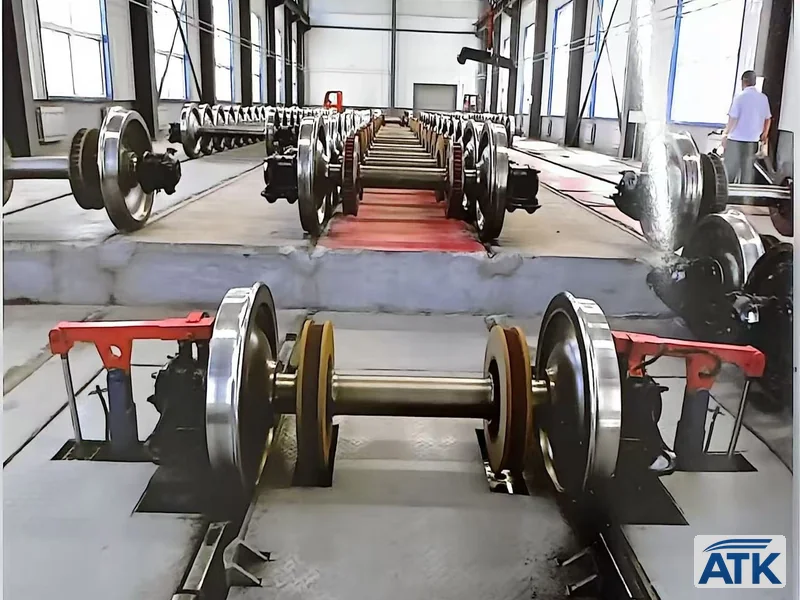
A rail milling and grinding train restores the rail head on track that is already in service. It removes corrugation, rolling contact fatigue cracks, spalling and weld high spots, then leaves a measured profile behind. Corrugation makes noise. The matching wheel-side component is covered by railway axlebox bearings and wheelset bearing units.Head checking grows into deeper cracks. Both shorten rail life and raise wheel-rail forces long before the rail is worn out. Reprofiling is the maintenance job that stops that chain.
The machine is not a grinder in the workshop sense. Milling cuts metal away with a rotating disc fitted with carbide inserts; grinding abrades it with a rotating wheel. One removes a fatigue layer in a single pass. The other takes a thin, controlled cut and repeats until the target profile is reached. Both are carried on self-propelled rail vehicles with on-board measurement, and both finish against an acceptance standard rather than against the operator's eye.
Duty separates the three machines. The FGM500 is a two-car milling train for deep corrective work. The CMC-12 runs twelve heads for network-wide preventive cycles. The GMC-12 is a lightweight grinding car for short lines, industrial sidings and grinding service contractors. They are not versions of one another. Each exists because the possession window, the defect depth and the track geometry are different.
Enquiry wording varies more than the hardware. "Rail milling train" and "rail grinding train" are the two standard terms. "Rail grinding machine", "rail grinding car" and "rail profile grinding train" appear in metro tender documents. "Rail reprofiling machine", "rail head profiler" and "track grinding vehicle" are common in European and translated specifications. "Rail maintenance train" is the broad category, not a product.
Three phrases cause trouble. "Train track sharpener" is not a product class at all - a rail is ground, not sharpened. "Rail saw" or "rail cutter" cuts rail to length, which is a different job. A "ballast tamper" works on the bed under the sleepers. Those words will not get you a milling or grinding quotation.
The model names are worth putting on the enquiry rather than a generic description: FGM500A, FGM500B, FGM500C, FGM01, FGM500, CMC-12, CMC-12-III, GMC-12 and the narrow-gauge GMC12 variant. Each has its own gauge, axle load and working speed. A description like "12-head grinding train" narrows the family but not the configuration.
Three series cover the programme, and the split is by duty, not by size alone. The FGM500 uses disc milling plus a finishing grind to repair severe surface damage in one pass. It is the machine for deep fatigue layers, tunnels and fire-risk sections where sparks are not acceptable. The CMC-12 runs 12 grinding heads at 3 to 16 km/h for conventional and turnout grinding across a network. The GMC-12 is an 11-tonne car for lines under 200 km, factory-owned sidings and contractors who need an economical machine rather than a fleet.
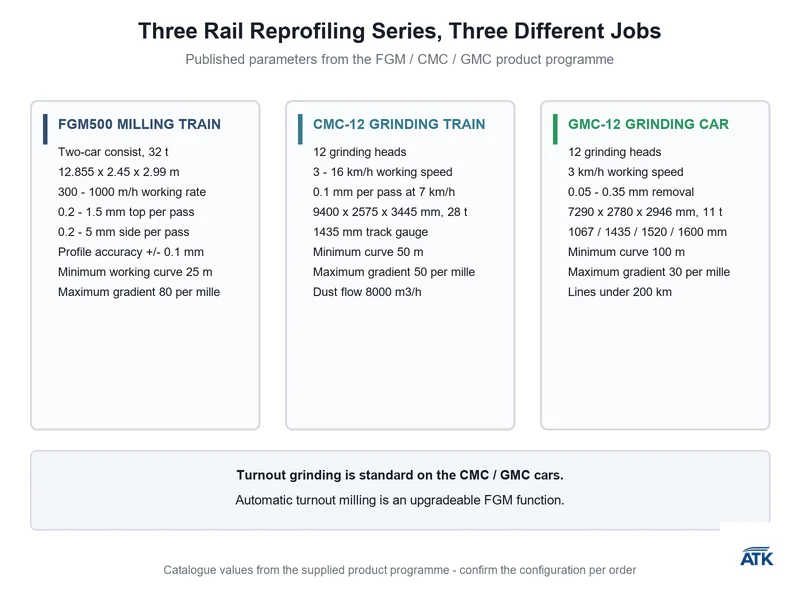
Series | Process | Working rate | Vehicle | Typical use |
FGM500 | Disc milling + finish grinding | 300 - 1000 m/h | 2-car consist, 32 t | Deep corrective repair, tunnels |
CMC-12 | 12-head grinding | 3 - 16 km/h | 1 car, 28 t | Network preventive cycles |
GMC-12 | 12-head grinding | 3 km/h | 1 car, 11 t | Short lines, sidings, service work |
Turnout grinding is a standard function on the CMC-12 and GMC-12. On the FGM milling train, automatic milling of turnouts and expansion rail joints is an upgradeable option. That difference matters when the specification includes switch panels, because the geometry at a crossing nose cannot be treated like plain line.
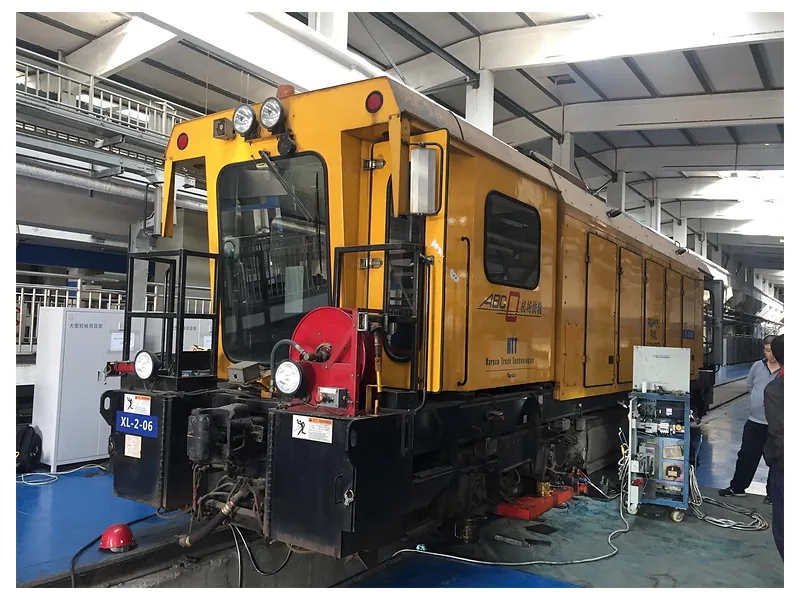
The FGM500 is built as two cars. A power car carries a driver's cab, the rail measurement system, the grinding system, main and auxiliary diesel generators, fire protection, dust collection and a bogie. A working car carries a second cab, the electrical control room, the milling system, chip collection, CCTV, communications, lighting and its own bogie. Splitting the functions is what keeps the milling unit and its chip handling separate from the power and finishing equipment.
The milling device uses a disc cutter on each rail. It is electrically driven, with no hydraulic system, so there is no oil leakage path into the track and fewer failure modes in the drive. A high-response servo spindle and a profiling detection and positioning system hold the cutter against the measured rail profile. Cutting depth is controllable; the top surface takes 0.2 to 1.5 mm per pass and the side surface 0.2 to 5 mm. The system collects 99 percent of the iron chips it produces.
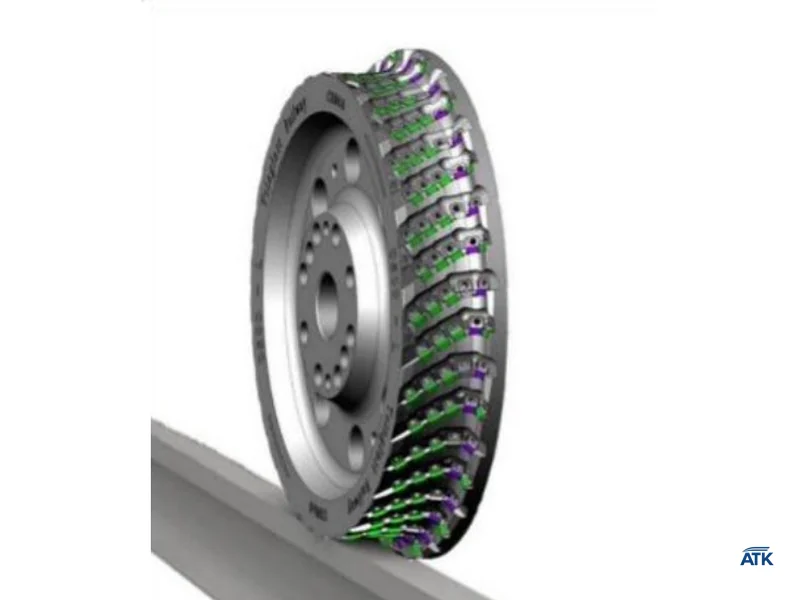
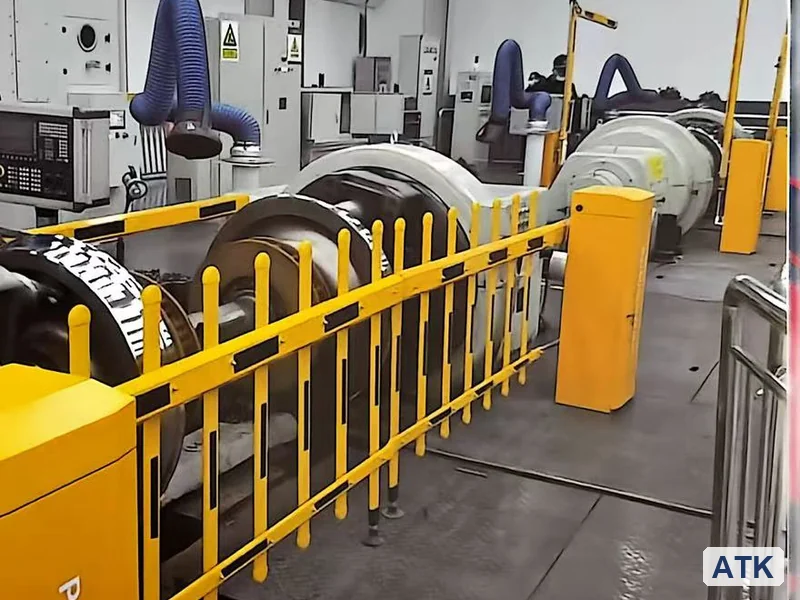
A set of grinding devices on each rail finishes the surface after milling, removing residual ripples across the full rail top without burn marks. Grinding debris collection is above 95 percent. On-board measurement then checks what was actually achieved: profile accuracy is plus or minus 0.1 mm, corrugation measurement accuracy is plus or minus 0.0001 mm, and the system follows EN 13231-3. An image-recognition camera at the front watches for obstacles along the rails and alerts the operator before the milling unit reaches them.
Wireless remote control, RFID tag control and automatic turnout and expansion-joint milling are selectable functions. Consumable cost is stated as 30 percent lower than the conventional route. The design basis listed in the programme references BS EN, UIC, ISO and DIN requirements; which documents apply to a given order is confirmed when the specification is agreed.
The CMC-12 is a 12-head grinding train built for most network grinding scenarios. It runs at 3 to 16 km/h with a speed control error of plus or minus 0.1 km/h and reaches 60 km/h self-propelled. At 7 km/h a pass removes up to 0.1 mm. Grinding range is minus 70 to plus 15 degrees, so the heads can be angled across the rail head without repositioning the vehicle.
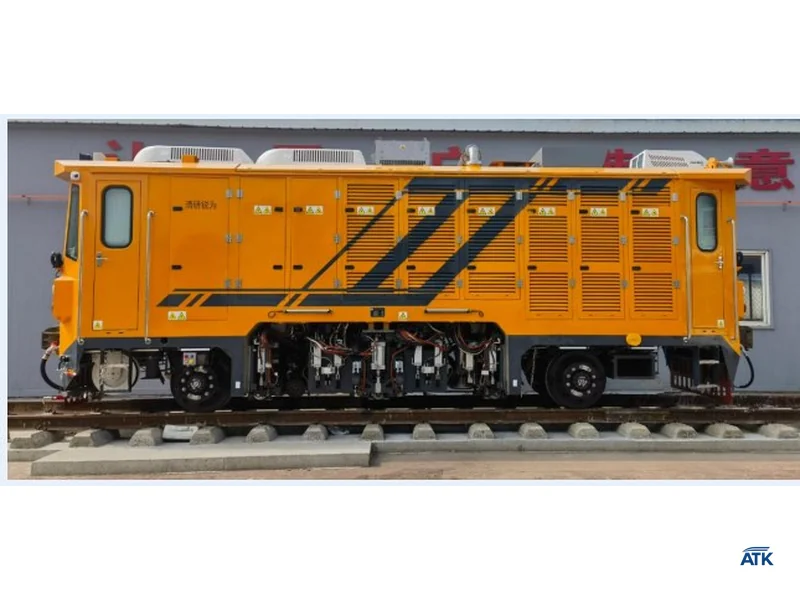
The vehicle is 9400 x 2575 x 3445 mm, weighs 28 t and carries an axle load of no more than 14 t. It works on 1435 mm gauge, down to a 50 m curve radius, on gradients up to 50 per mille and with cant up to 175 mm. Driver's cab noise is no more than 75 dB. Exhaust is Euro Stage IV, the fuel tank holds 500 L, grinding motors run at 3000 to 4000 r/min and continuous operating time is at least 8 hours. Grinding wheels are 260 mm or 150 mm. Dust collection moves 8000 m3/h and a water spray system handles the rest.
On-board inspection compares corrugation and profile before and after each pass, and longitudinal smoothness is checked to EN 13231. Cabs, the online measurement system, grinding units, diesel generator, fire protection, dust collection, bogies, CCTV, braking, communications, lighting and the spray system are all carried on the one vehicle. Multi-unit linkage is supported where a possession window demands more heads on the same track.
The GMC-12 is the lightweight option for above-ground lines and routes under 200 km. It weighs 11 t with an axle load of no more than 6 t, measures 7290 x 2780 x 2946 mm and runs at 3 km/h while grinding. Twelve grinding heads cover minus 70 to plus 22 degrees, with removal of 0.05 to 0.35 mm. Self-propelled speed is 30 km/h. The car works on curves down to 100 m radius, gradients up to 30 per mille and cant of 50 to 100 mm.
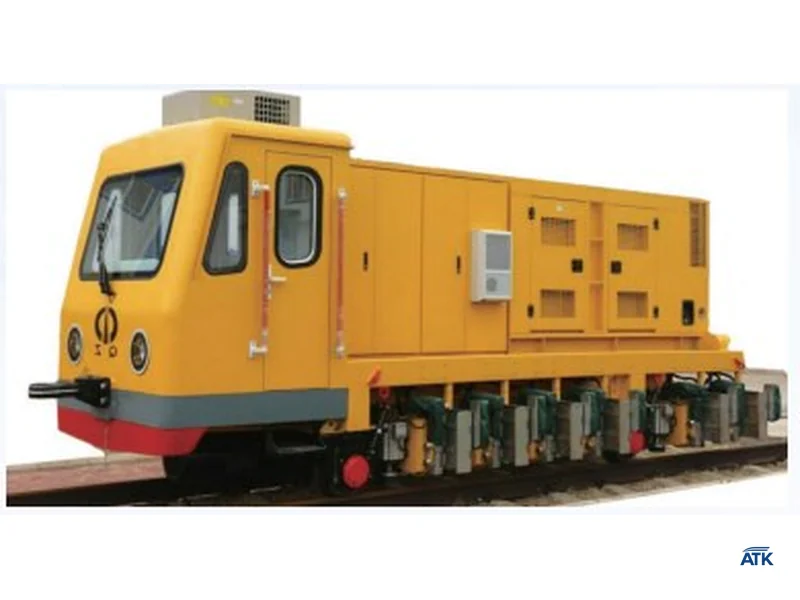
Four track gauges are covered in one platform: 1067, 1435, 1520 and 1600 mm. That is the detail that usually decides the order. A narrow-gauge GMC12 variant has completed design, and production plus commissioning of an order can be finished within three months. The coupler is specified to the customer's requirement, and transmission is AC-DC-AC electric.
Noise is no more than 75 dB in the cab, exhaust is Euro Stage IV, the fuel tank holds 220 L, grinding motor speed is at least 2800 r/min, and continuous operating time is at least 4 hours. Wheels are 740 mm new and 670 mm fully worn. The car is aimed at factory-owned railway lines, short-mileage segments and grinding service companies; polishing turnout panels, small-radius curves and straight track at low cost is what it does best. Multi-unit linkage is supported.
The figures below are the published design and catalogue values from the product programme. Which inspection documents apply to a given lot is confirmed when the order is placed.
FGM500 parameter | Published value |
Consist / dimensions / weight | 2 cars / 12855 x 2450 x 2990 mm / 32 t |
Maximum axle load | 8 t |
Wheelset inner distance / wheel diameter | 1353 +/- 1 mm / 640 mm |
Transmission / max self-propelled speed | Internal combustion-electric / 60 km/h |
Braking deceleration | 1.0 m/s2 normal, 1.2 m/s2 emergency |
Minimum operating curve / max gradient / max cant | 25 m / 80 per mille / 175 mm |
Working rate / cross-section accuracy | 300 - 1000 m/h / +/- 0.1 mm |
Surface roughness / longitudinal smoothness | Ra 5 um or better; +/- 0.01, 0.015, 0.075 mm by wavelength band |
Milling capacity | Top 0.2 - 1.5 mm/pass, side 0.2 - 5 mm/pass |
Milling cutter head / coverage | 500 mm x 2 / -87 to +30 degrees |
Grinding wheel / coverage | 400 mm x 4 / -45 to +20 degrees |
Chip and debris collection | 99 percent milling chips, above 95 percent grinding debris |
Parameter | CMC-12 | GMC-12 |
Grinding heads | 12 | 12 |
Working speed | 3 - 16 km/h | 3 km/h |
Removal per pass | 0.1 mm at 7 km/h | 0.05 - 0.35 mm |
Track gauge | 1435 mm | 1067 / 1435 / 1520 / 1600 mm |
Size / weight / axle load | 9400 x 2575 x 3445 mm / 28 t / <= 14 t | 7290 x 2780 x 2946 mm / 11 t / <= 6 t |
Min curve / max gradient / max cant | 50 m / 50 per mille / 175 mm | 100 m / 30 per mille / 50 - 100 mm |
Max self-propelled speed | 60 km/h | 30 km/h |
Fuel tank / continuous operation | 500 L / >= 8 h | 220 L / >= 4 h |
Dust collection | 8000 m3/h + water spray | Integrated dust collection |
Emission / cab noise | Euro Stage IV / <= 75 dB | Euro Stage IV / <= 75 dB |
Milling cuts. Grinding abrades. That single difference decides everything else: how much metal comes off in a pass, whether sparks are produced, what has to be collected, and how long the possession needs to be.The same comparison, set against rail welding and wheel reprofiling as the rest of the maintenance cycle, is in track maintenance equipment.
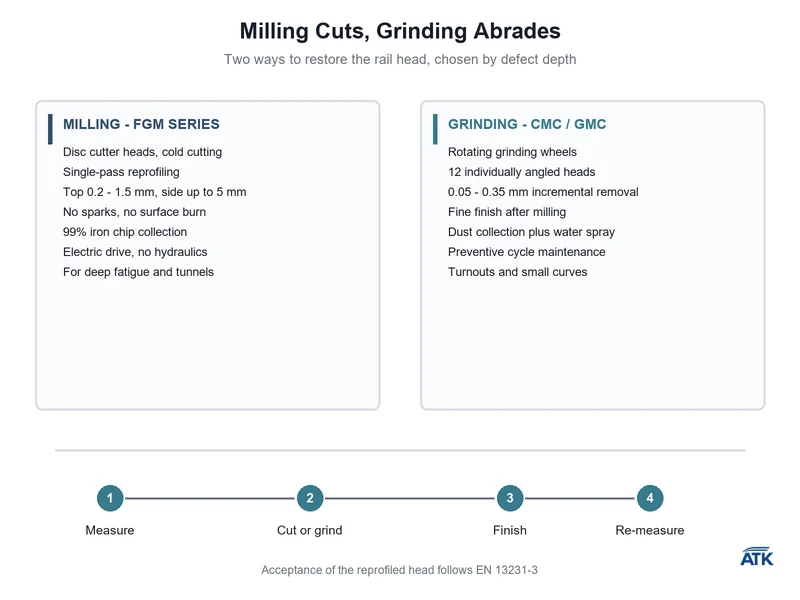
Milling (FGM) | Grinding (CMC / GMC) | |
Material removal | Cutting, single-pass reprofiling | Abrasive, incremental |
Depth in the programme | Top up to 1.5 mm, side up to 5 mm per pass | 0.05 - 0.35 mm or 0.1 mm per pass |
Sparks | None by design | Present; managed by spray and collection |
Waste | Iron chips, 99 percent collected | Grinding dust, collected and sprayed |
Best for | Deep fatigue, spalling, tunnels, fire-risk sections | Preventive cycles, fine finish, turnouts |
Typical sequence | Measure, mill, finish grind, re-measure | Measure, grind in passes, re-measure |
The two are complementary, not competing. A conventional grinding programme may need eight to ten passes to take 0.2 mm off the rail top. A milling train removes the fatigue layer in one pass and a finishing grind cleans the surface. Where a tunnel, a fire-risk section or a short possession rules out repeated passes, that difference is the whole argument
For the decision between the two processes before you specify a machine, see rail milling vs grinding — it starts from the defect rather than the model.
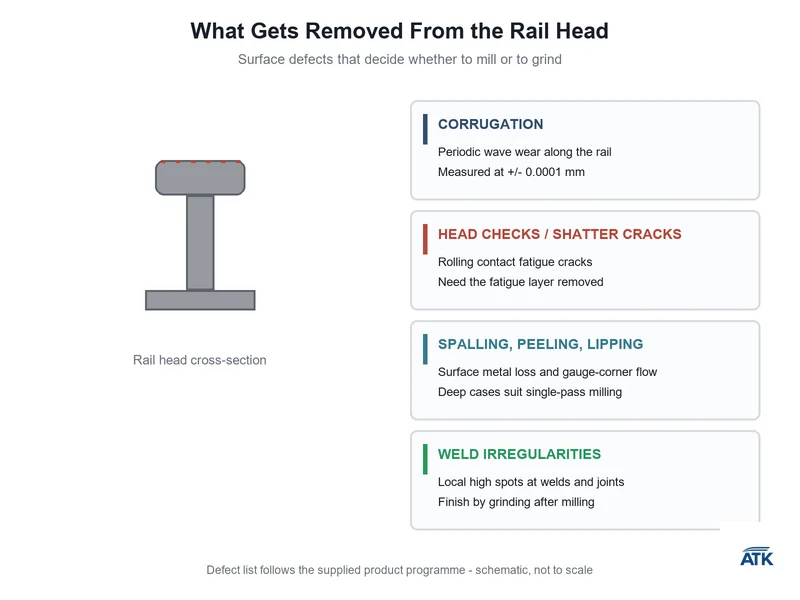
Corrugation is periodic wave wear along the running surface. Head checks and shatter cracks are rolling contact fatigue cracks that start at the surface and grow inward. Spalling and peeling lose metal from the gauge corner; lipping pushes it outward. Weld irregularities leave local high spots. Each one changes the wheel-rail contact patch, and each one is measured before a machine is chosen.
Acceptance is not a visual judgement. The programme's on-board measurement covers rail profile and corrugation, with profile accuracy of plus or minus 0.1 mm and corrugation accuracy of plus or minus 0.0001 mm. Cross-section profile accuracy is plus or minus 0.1 mm, surface roughness is Ra 5 um or better, and longitudinal smoothness is held to plus or minus 0.01 mm for 10 to 100 mm wavelengths, 0.015 mm for 100 to 300 mm and 0.075 mm for 300 to 1000 mm. EN 13231-3 covers acceptance of grinding, milling and planing work in track; the edition named in the project specification governs.
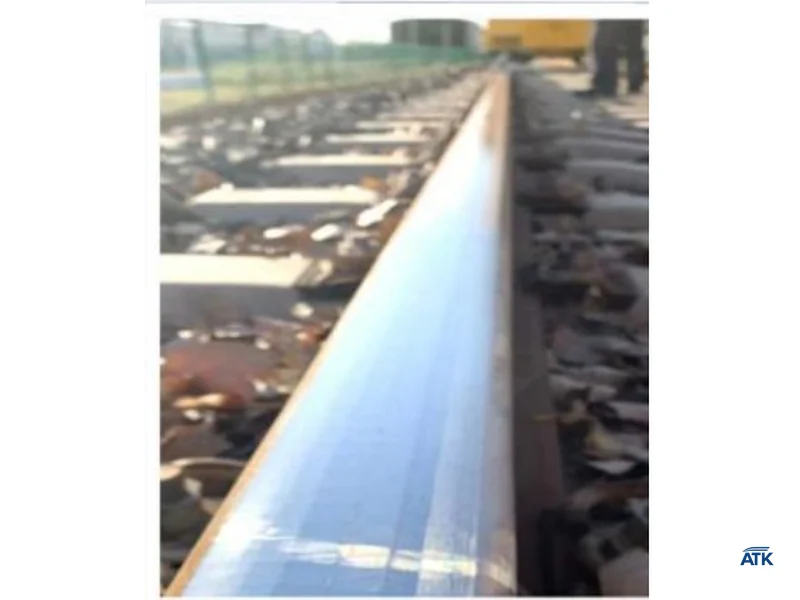
A rail surface after milling is bright and even, with a fine machined texture rather than a polished one. The finishing grind removes that texture where the running surface requires it. Neither process should leave burn marks, and a burned surface is a reason to stop and check wheel condition and feed rate before continuing.
Switch and crossing panels are the hardest part of any reprofiling programme. The rail geometry changes through the switch zone, the crossing nose has a flangeway, and a standard plain-line head arrangement cannot simply be carried through. CMC-12 and GMC-12 support fine turnout grinding; automatic turnout and expansion-joint milling is an upgradeable FGM function. Obstacle recognition at the front of the milling train matters here, because point machines, rods and detection equipment sit close to the running rails.
The parts in those panels are a different purchase. Where a turnout panel needs its slide chairs replaced while the rail is being reprofiled, the integral cast slide baseplate for turnouts is specified on its own drawing. At insulated boundaries, the composite insulated fishplate and the glued insulated rail joint have their own approval basis and must not be treated as ordinary joint bars. Reprofiling work near those components is planned around them, not through them.
Curve radius, gradient and cant bound what each machine can do: 25 m and 80 per mille for the FGM500, 50 m and 50 per mille for the CMC-12, 100 m and 30 per mille for the GMC-12. Tunnel work favours the milling train because it produces no sparks and low emissions, with no overheating of the working environment. A possession window on a metro line usually decides the machine before the defect depth does.
For the rail sections themselves, see steel rails; for the fastening and joint hardware in the same track system, see crane rail clips and railway track bolts. All of these are specified separately from the reprofiling programme.
A grinding or milling train is configured to the line, not picked off a shelf. Non-standard customisation starts at the pre-sales stage. The first message should carry track gauge, axle load, minimum curve radius, maximum gradient and cant, the possession window, the power source, the emission class and the defects to be treated. From those, the gauge variant, dual power option, coupler type, turnout and obstacle functions, remote control and RFID tagging are set.
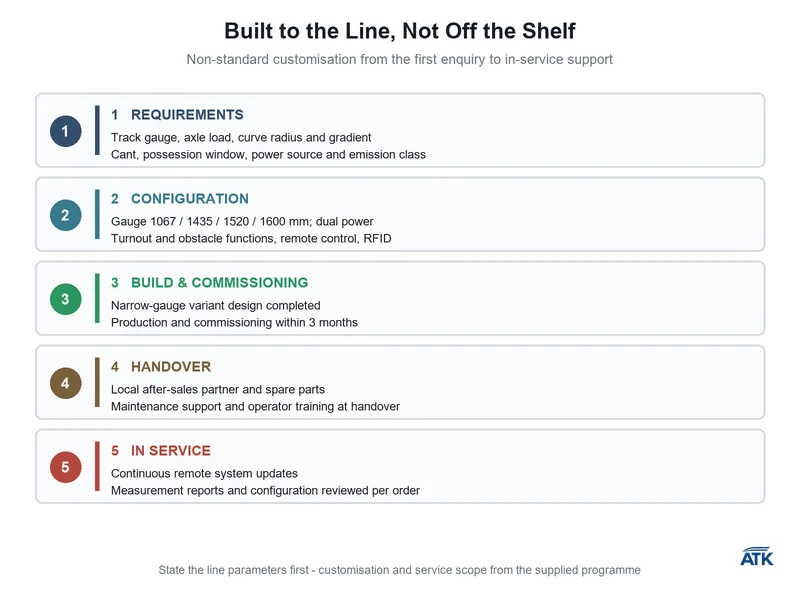
Production follows the agreed configuration. The narrow-gauge GMC12 design is complete and an order can be produced and commissioned within three months. During delivery, a local after-sales partner is selected to support normal operation, maintenance and spare parts, so a fault does not wait on an international service trip. On-board systems can be updated remotely after handover. The programme also supports local assembly and other cooperation models where a fleet operator wants long-term in-country support.
Customisation is not limited to the vehicle. Measurement reports, acceptance documentation, operator training and the inspection basis for the contract are agreed with the configuration. Where the project specification names a particular EN edition or a particular acceptance class, that is stated before the build starts rather than discovered at commissioning.
A milling train cuts metal with rotating disc cutters and can restore a profile in one pass. A grinding train uses rotating abrasive wheels and removes a thin layer per pass. In this programme the FGM500 mills, while the CMC-12 and GMC-12 grind.
That depends on defect depth. For deep fatigue or a tunnel section with no spark allowance, the FGM500 milling train does the work in one pass. For preventive cycles and turnout grinding, the CMC-12 covers most scenarios at 3 to 16 km/h.
Yes. CMC-12 and GMC-12 support conventional and fine turnout grinding. Automatic milling of turnouts and expansion rail joints is an upgradeable function on the FGM milling train.
The GMC-12 covers 1067, 1435, 1520 and 1600 mm. The CMC-12 is listed for 1435 mm. A narrow gauge GMC12 variant has completed design. Other gauges are handled as a customised configuration.
Acceptance of rail grinding, milling and planing work in track, including transverse and longitudinal profile tolerances and the measurement methods used to verify them. The edition named in the project specification applies.
In this programme, cross-section profile accuracy is plus or minus 0.1 mm, surface roughness is Ra 5 um or better, and longitudinal smoothness is held in three wavelength bands from plus or minus 0.01 to 0.075 mm.
The milling process cuts cold and produces no sparks by design. It collects 99 percent of the iron chips. The grinding process produces sparks and dust, which is why the grinding trains carry dust collection and a water spray system.
25 m for the FGM500, 50 m for the CMC-12 and 100 m for the GMC-12, at their respective maximum gradients of 80, 50 and 30 per mille.
Yes. Gauge, power source, coupler, turnout and obstacle functions, remote control, RFID tagging and the inspection basis are configured to the order. Non-standard customisation is offered at the pre-sales stage.
The narrow-gauge GMC12 design is complete; production and commissioning of an order can be finished within three months. The final schedule is confirmed with the configuration and the shipping plan.
Send the track gauge, rail section, line length, minimum curve radius, gradient and cant, the defects to be treated, the possession window and the acceptance standard named in the project. Add the power source, emission class, coupler type and whether turnout or tunnel work is included. We can configure and build rail milling and grinding trains to those parameters, including non-standard gauge and function packages, and will confirm the specification before the price is fixed. A datasheet, a configuration proposal or a project quotation are available - contact us with the line parameters in the first message.
We have recommended some of our Related products to you. I hope you will be interested.
 English
 Русский